


Quick Summary: Automotive leaders read this guide to understand where automation starts losing control, how AI restores decision timing, and what readiness really looks like inside live plants. The blog connects operational pressure, real scenarios, and implementation steps, helping decision makers move from uncertainty to confident evaluation without disruption across manufacturing operations.
You do not question automation value inside automotive manufacturing. But the pressure builds when automated lines keep running while changeover decisions, quality drift, and maintenance timing still rely on operator judgment instead of early warning signals. Conversations around AI in industrial automation begin at that point, when throughput metrics appear stable yet confidence in execution weakens across programs and facilities under your responsibility.
Mixed-model production, supplier variability across regions, and compressed launch schedules push automation logic designed for stable environments beyond intended limits.
Dense option mixes expose those limits earlier, which explains why European automotive manufacturers acted sooner and secured a 30.04% global industrial automation market share during 2024.
Global industrial automation spending followed similar operational pressure, growing from USD 205.86 billion during 2022 toward USD 395.09 billion by 2029 at a 9.8% CAGR as production complexity increased worldwide.
You already recognize where existing automation loses effectiveness. Continue reading to understand how leading automotive plants restore execution control before losses surface during operational reviews.
If AI app development feels important but the starting point feels unclear, read our AI App Development Guide to understand the right first steps, decision points, and implementation path.
Why Traditional Industrial Automation Stops Helping at Scale
Traditional automation performs well when operations stay predictable. Pressure builds once volume rises, product mix expands, and timing decisions rely more on experience than clear signals. AI in industrial automation becomes relevant at that stage, when automation keeps running but confidence in outcomes starts eroding across quality, maintenance, and throughput.

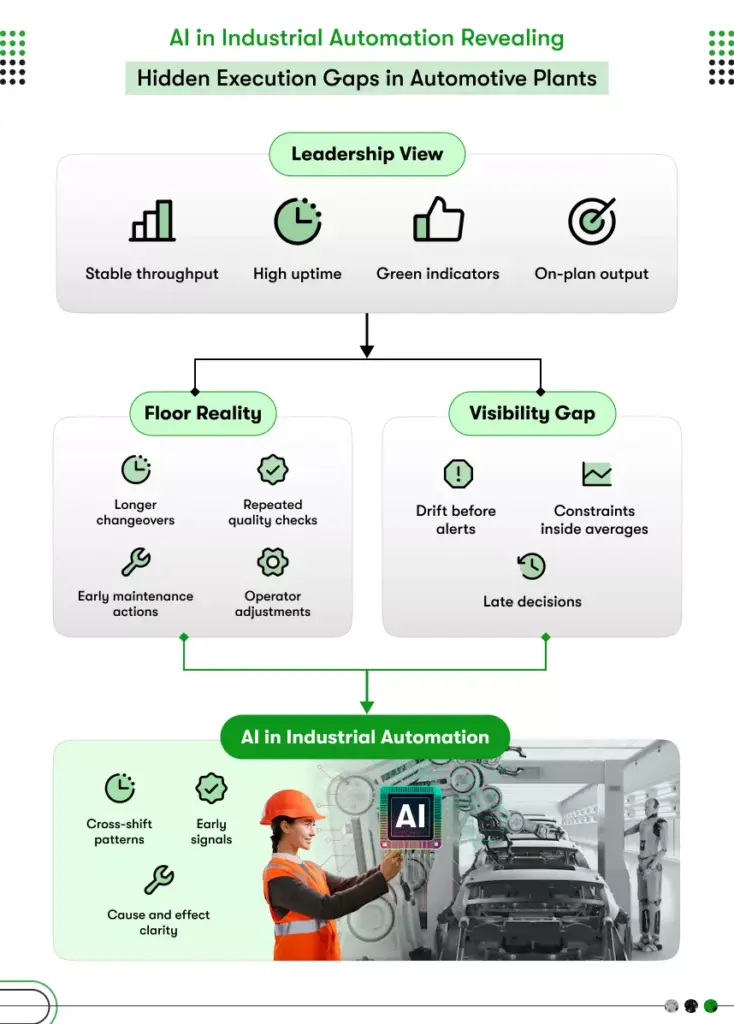
Rule-based logic cannot keep pace with production variability
Traditional automation depends on predefined thresholds and fixed sequences. Once complexity increases, AI-driven industrial automation becomes relevant because static logic cannot keep up with daily variation across stations, shifts, and product variants.
- Rule libraries work reliably during repeatable runs but struggle once product mix starts changing every day.
- Threshold alerts react after deviation appears instead of showing drift early enough to act within the same shift.
- Engineering time gets pulled into parameter tuning instead of improving how quickly decisions happen.
As production variability increases, predefined rules reach a practical ceiling. AI in industrial automation helps make sense of live patterns across variants before decision accuracy starts breaking down.
Visibility gaps grow as decision latency increases
Automation executes commands consistently, but decision speed slows as data volume grows. Artificial intelligence in industrial automation shortens the gap between signal and response across production, quality, and maintenance decisions.
- Control systems report status clearly but leave teams guessing about the cause across connected stations.
- Dashboards summarize results while local constraints keep building underneath.
- Corrective action often comes late, bringing scrap, overtime, and schedule pressure along with it.
As data grows without interpretation, action gets delayed even when problems feel obvious. Many leaders turn to practical resources such as an AI in Manufacturing guide, alongside industrial automation with AI, to gain clarity early enough to prevent small issues from turning into measurable losses.
Traditional automation reaches a ceiling once production complexity outgrows decision visibility, while AI in industrial automation for manufacturing restores timing and clarity during live operations where early signals matter.
The Hidden Costs Leadership Reviews Rarely Capture
Daily operations inside automotive plants rarely look chaotic during reviews, because production keeps moving and output reports stay close to plan while teams spend most of the day correcting small issues before escalation reaches leadership. AI in industrial automation enters discussion once margin pressure keeps increasing even while reports suggest operations remain stable.
Small execution losses compound across shifts
Most losses start small and feel manageable at first, such as delayed changeovers, on-the-fly quality adjustments, or maintenance pulled forward to keep flow intact. Over time, recovery turns into routine work that absorbs attention and capacity. AI-driven industrial automation connects repeated recovery efforts into visible patterns instead of leaving each incident isolated.
- Recovery work consumes labor hours without appearing as downtime or stoppage in formal reporting.
- Repeated micro delays reduce usable capacity while daily output targets still appear achievable.
- Teams adjust habits to protect targets, which hides structural strain from leadership view.
As repetition continues across shifts, cost accumulates without a single moment that forces intervention. AI in industrial automation for manufacturing brings visibility to compounding loss before margins tighten further.


Static automation hides loss inside averages
Traditional automation reports performance through summaries that smooth over local pressure, which causes station-level strain to blend into line averages. Review discussions stay focused on outcomes rather than formation of loss. Artificial intelligence in industrial automation reconnects signals across stations, shifts, and time windows to restore context.
- Line averages conceal constraints forming inside specific stations during live production.
- End-of-shift summaries arrive after corrective options narrow.
- Leadership conversations focus on results while causes remain distributed across operations.
Aggregated reporting delays recognition of problems that operations teams already feel during execution. Industrial automation with AI restores clarity early enough to support decisions while recovery remains possible.
Execution pressure grows through repetition, adjustment, and normalized recovery across shifts. Cost absorbs quietly across quality, maintenance, delivery, and upstream coordination that increasingly overlaps with AI for supply chain decisions. AI-powered industrial automation changes when clarity arrives, allowing leadership action before operational strain turns into financial impact.
How AI in Industrial Automation Works in Real Operations
AI in Industrial Automation does not arrive as a single installation or a software switch. The work happens through coordinated ownership across operations, engineering, IT, and leadership. Existing automation continues running production while artificial intelligence in industrial automation operates above control systems to support decisions without disrupting execution.

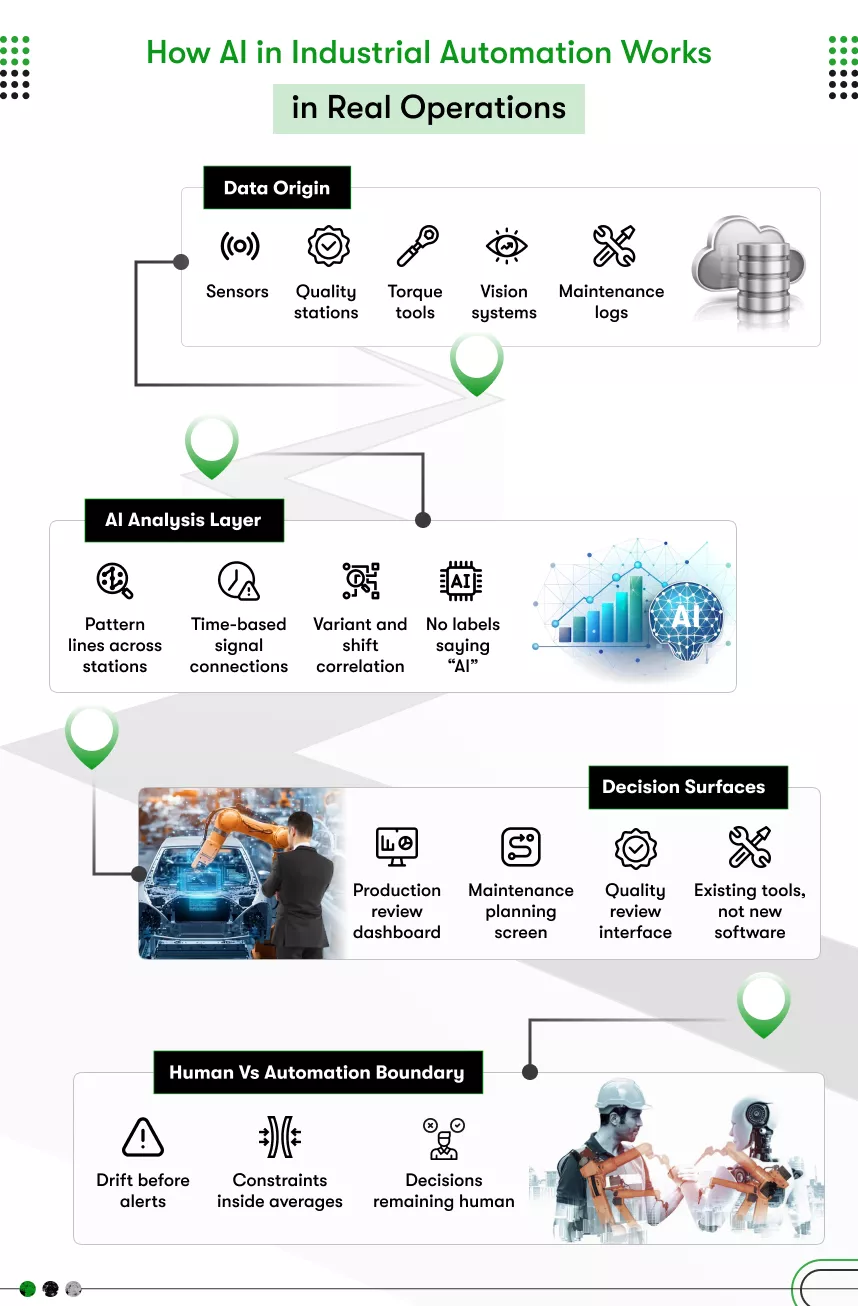
Data collection and preparation happens inside the plant
Plant engineering and operations teams enable data access from existing sensors, quality stations, torque tools, vision systems, and maintenance logs. Industrial automation with AI relies on production signals already generated every day. System integrators and internal IT teams align data timing, identifiers, and variant context so learning reflects real production behavior.
- Engineering teams validate signal accuracy and resolve inconsistencies across equipment vendors.
- Operations teams confirm process context so data reflects actual work, not theoretical flow.
- IT teams ensure secure, continuous data movement without affecting control performance.
AI-based industrial automation systems begin learning only after data reflects trusted operational reality.
Learning models are configured with operational ownership
AI-driven industrial automation models are configured by specialists who understand manufacturing processes, not by developers alone. Domain experts define normal behavior across shifts, variants, and conditions. Leadership sets priorities around quality, throughput, and maintenance impact so learning aligns with business outcomes.
- Process experts guide model focus toward recurring operational pain.
- Quality teams link measurement behavior to upstream process conditions.
- Maintenance teams align learning with failure patterns seen on the floor.
Artificial intelligence in industrial automation improves relevance through close alignment with plant knowledge.
Insights surface through existing decision workflows
AI-powered industrial automation does not introduce separate tools that teams ignore. Insights appear inside systems already used for planning, maintenance coordination, quality review, and daily production meetings. Ownership remains with the same leaders who already make decisions.
- Operations leaders see early constraint signals during daily reviews.
- Maintenance planners receive intervention windows aligned with production impact.
- Quality teams detect drift before containment becomes necessary.
AI in industrial automation for manufacturing strengthens decisions already happening across the plant.
Action remains human while execution stays automated
Production equipment continues executing programmed logic managed by automation engineers. AI supports human judgment through clearer timing and context rather than direct machine control. Leadership remains accountable for decisions while automation remains responsible for execution.
- Schedule changes reflect live behavior rather than static assumptions.
- Maintenance actions align with operating conditions rather than fixed intervals.
- Capacity planning reflects constraint behavior rather than historical averages.
Industrial automation with AI improves outcomes by improving decisions, not by replacing teams.
AI in Industrial Automation works through shared ownership across plant teams and leadership. Each layer adds clarity without disrupting execution. The result comes from earlier understanding, coordinated action, and sustained control under production complexity.
A Hypothetical Example of AI in Industrial Automation Inside an Automotive Plant
Context of the plant
- A mid-sized automotive manufacturing plant in Ohio supplies multiple OEM programs across the United States.
- The assembly line runs three vehicle variants with frequent changeovers and tight delivery commitments.
- Daily production reports stay close to plan, yet recovery effort grows across shifts.
What happens without AI in industrial automation
- Changeovers take slightly longer than planned and recovery relies on operator judgment.
- Quality checks repeat more often without crossing alert thresholds.
- Maintenance actions move forward to avoid escalation later in the shift.
- End-of-shift reports show acceptable output while added effort hides inside overtime and extra inspections.
What changes with AI in industrial automation for manufacturing
- Production signals stay connected across timing, variant sequence, quality checks, and maintenance activity.
- Artificial intelligence in industrial automation identifies recurring patterns during live production rather than after completion.
- Operations teams receive early insight while corrective action still fits inside planned capacity.
- Quality and maintenance teams act with clearer context instead of reacting after impact appears.
How leadership reviews improve
- AI-driven industrial automation highlights where execution pressure forms instead of relying on averages alone.
- Industrial automation with AI supports decisions based on live production behavior rather than historical assumptions.
- Cost, quality, and delivery discussions shift toward prevention instead of explanation.
The hypothetical scenario shows how AI in industrial automation improves decision timing during normal production days, often supported by focused AI development services that align insight with real operational needs. Earlier clarity protects margins and delivery without adding complexity to shop floor execution.
What Technologies Power AI in Industrial Automation Across Automotive Manufacturing
AI in Industrial Automation inside automotive manufacturing runs on a coordinated technology stack. Each layer supports earlier decision clarity across production, quality, and maintenance, while existing automation continues executing work without disruption.

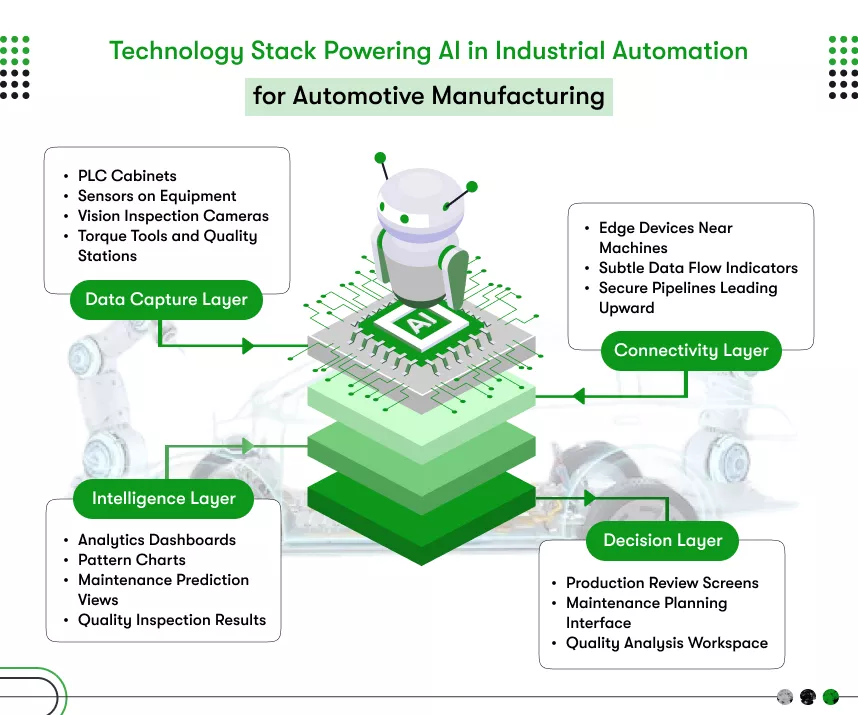
Industrial data capture and connectivity
AI in industrial automation for manufacturing depends on continuous access to production signals generated across the plant.
- Industrial connectivity technologies stream data from PLCs, robots, vision systems, torque tools, and quality stations.
- Edge systems preserve timing, sequence, and variant context close to equipment.
- Secure data pipelines move signals into analytics layers without affecting shop floor control.
Machine learning and behavior modeling
AI-driven industrial automation relies on learning systems focused on production behavior rather than fixed thresholds.
- Machine learning models identify relationships between process conditions and downstream outcomes.
- Pattern recognition highlights deviation forming across shifts and variants.
- Time-based models track how small changes evolve into measurable loss.
Artificial intelligence in industrial automation supports earlier recognition of drift rather than reaction after impact.
Computer vision and inspection intelligence
AI-powered industrial automation strengthens quality control through vision-based learning.
- Vision systems evaluate surface finish, assembly accuracy, and component placement during production.
- Image analysis links visual variation to upstream process conditions.
- Continuous learning adapts inspection accuracy as model mix changes.
Predictive analytics for maintenance decisions
Industrial automation with AI supports maintenance planning based on operating behavior instead of fixed schedules.
- Predictive analytics evaluate vibration, temperature, load, and cycle behavior.
- Maintenance actions align with production impact rather than calendar intervals.
- Early intervention windows reduce recovery effort and schedule pressure.
Decision orchestration and system integration
AI-based industrial automation systems deliver value only when insight reaches decision workflows already in use.
- Integration layers surface insights inside planning tools, maintenance systems, and daily production reviews.
- Decision orchestration aligns recommendations with operational ownership.
- Feedback mechanisms allow learning from actions taken on the floor.
Technology behind AI in industrial automation, including approaches such as Generative AI in Manufacturing, works as a connected system rather than isolated tools. Each layer improves understanding of live production behavior. Automotive manufacturers gain control through better timing and clearer decisions.
How to Know If AI in Industrial Automation Makes Sense for Your Automotive Plant
Interest in AI in Industrial Automation usually appears after recurring operational pressure, not curiosity. The decision becomes relevant once existing automation continues running while confidence around quality, maintenance timing, and throughput starts eroding. The questions below help determine whether industrial automation with AI fits current operational reality.
Operational signals worth paying attention to
Automotive plants ready for AI-driven industrial automation often share common patterns across daily execution.
- Recovery work absorbs increasing time across shifts even when output targets remain achievable.
- Engineering teams spend more effort tuning parameters than improving decision timing.
- Quality teams react to variation instead of understanding formation during production.
- Maintenance actions move forward frequently to avoid escalation later in the shift.
Artificial intelligence in industrial automation becomes useful once these patterns repeat consistently.
Decision timing reveals readiness more than data volume
Large volumes of production data do not indicate readiness on their own. Readiness appears when decisions rely on judgment because signals arrive too late to act comfortably.
- Production reviews depend on averages rather than live behavior across stations.
- Corrective action options narrow before leadership discussions begin.
- Capacity planning relies on historical assumptions instead of current constraint behavior.
AI in industrial automation for manufacturing improves outcomes once decision timing becomes the limiting factor.
Organizational ownership matters as much as technology
AI-powered industrial automation succeeds when ownership around action stays clear.
- Operations leaders remain responsible for production decisions.
- Quality teams maintain authority over intervention timing.
- Maintenance teams act based on operating behavior rather than fixed schedules.
AI-based industrial automation systems support clarity, not delegation of responsibility.
A practical way to assess alignment
Plants aligned for industrial automation with AI share a willingness to examine execution honestly.
- Leadership seeks earlier visibility rather than confirmation after cost absorbs impact.
- Teams accept pattern-based insight alongside experience.
- Improvement discussions focus on prevention instead of recovery.
AI-driven industrial automation fits environments ready to act on insight during production rather than explain outcomes later, often before leaders decide to hire AI developers or formalize external support.
Readiness for AI in industrial automation depends less on ambition and more on timing, ownership, and operational pressure. Automotive plants benefit most once early insight protects quality, cost, and delivery during normal production days. The next section explores what leaders should evaluate first when moving toward assessment and planning.
How to Implement AI in Automotive Manufacturing Operations
Implementation of AI in industrial automation works best as a staged operational shift rather than a technology rollout. Successful automotive plants treat AI-driven industrial automation as an extension of existing decision processes, not a replacement for current systems or teams.
Start with decision pressure, not technology selection
Implementation begins once leadership aligns on where decision timing limits performance.
- Operations leaders identify recurring situations where recovery replaces prevention.
- Quality teams highlight areas where variation appears too late to correct comfortably.
- Maintenance teams point to equipment behavior that forces early or reactive intervention.
Artificial intelligence in industrial automation delivers value only when aligned with real operational pressure.
Build on existing automation and data foundations
Automotive plants do not replace automation to introduce AI. Industrial automation with AI operates above current systems and uses data already generated on the shop floor.
- Existing sensors, inspection systems, and maintenance logs form the initial data foundation.
- Engineering teams validate signal consistency and operational relevance.
- IT teams support secure and continuous data flow without affecting control performance.
AI in industrial automation for manufacturing grows stronger once production data reflects real behavior accurately.
Define ownership before insights appear
Clear ownership prevents AI-powered industrial automation from becoming another reporting layer.
- Operations leadership retains authority over production decisions.
- Quality teams own intervention timing and escalation paths.
- Maintenance teams control execution of recommended actions.
AI-based industrial automation systems support accountability rather than shifting responsibility.
Introduce learning in focused operational areas
Effective implementation begins with narrow scope and clear outcomes.
- Initial focus areas often include changeover timing, quality drift, or maintenance intervention windows.
- AI-driven industrial automation learns patterns inside controlled boundaries before expansion.
- Early success builds trust across teams and leadership.
Gradual expansion preserves confidence and adoption.
Integrate insight into daily workflows
Implementation succeeds once insight appears where decisions already happen.
- Production reviews include early indicators alongside output metrics.
- Maintenance planning reflects operating behavior instead of static schedules.
- Quality discussions connect inspection results to upstream process conditions.
Industrial automation with AI becomes part of daily execution rather than an external tool.

Conclusion
Automation maturity does not guarantee control inside automotive manufacturing operations facing rising variability and tighter delivery expectations. Pressure builds around timing, confidence, and decision accuracy rather than machine performance alone. AI in Industrial Automation becomes relevant when leadership seeks earlier visibility across production, quality, and maintenance before recovery work absorbs margin and focus.
Plants moving forward take a practical approach. Progress begins with identifying moments where judgment fills gaps left by delayed signals. Industrial automation with AI supports earlier awareness by connecting production behavior already present across the plant into actionable insight during execution.
Kody Technolab supports automotive manufacturers through focused assessment and implementation planning aligned with live operations, with capabilities that reflect the depth expected from a generative AI development company operating in complex manufacturing environments. The process starts with understanding execution pressure, then moves into ownership alignment, data readiness, and decision flow design. Implementation builds on existing automation and production systems without interrupting running lines.
A structured engagement clarifies where industrial automation with AI fits operational reality, what scope delivers measurable value, and how teams act on insight during production. For leaders considering next steps, a conversation with Kody Technolab provides clarity on readiness, sequencing, and execution fit before complexity grows further.