


Quick Summary: This guide explains how AI in Manufacturing strengthens timing accuracy, quality, equipment reliability, and plant-wide stability. Leaders will learn practical use cases, architecture, cost factors, and proven steps that help manufacturing teams move from reactive decisions to steady, intelligence-supported operations designed for measurable impact.
Every production head who walks into the plant at 7:00 AM carries the same worry. Machines run, workers move, and dashboards glow, yet one question waits beneath the routine.
How can the entire operation gain steadier predictability with AI in Manufacturing supporting each decision across the floor?
Pressure rises when leadership asks for higher output, fewer breakdowns, stronger accuracy, and tighter cost control at once. Global leaders already sense this urgency.
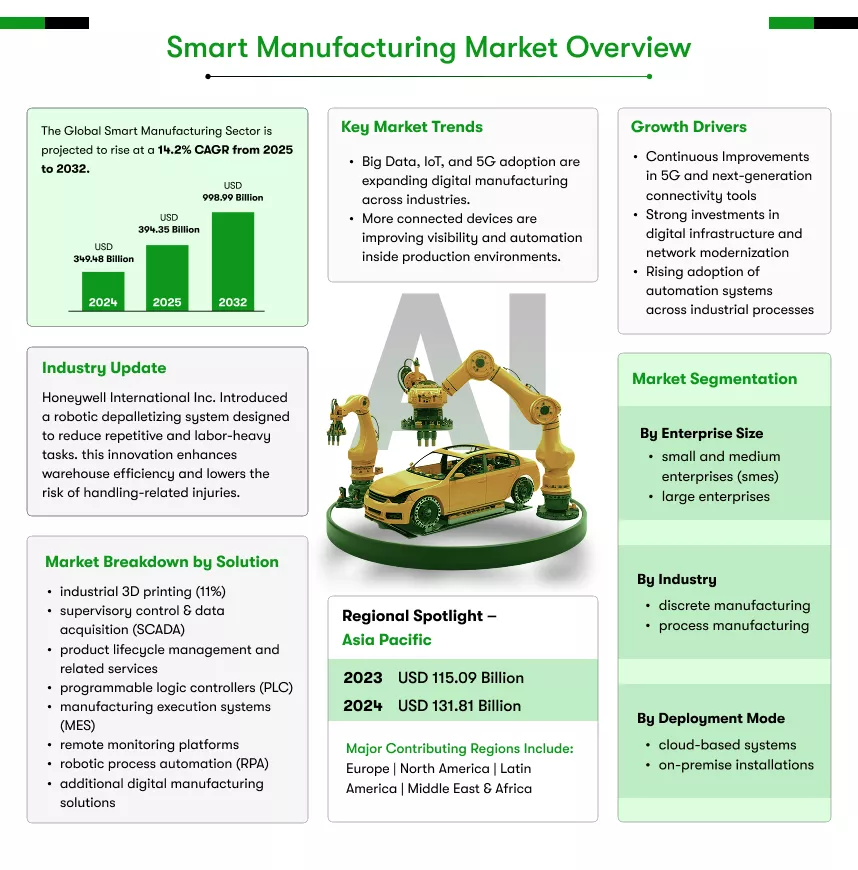
The smart manufacturing market reached USD 349.48 billion in 2024 and is projected to pass USD 394.35 billion in 2025 on its climb toward USD 998.99 billion by 2032.
(Source: Fortune Business insights)
This growth highlights a clear reality. Plants built on traditional planning struggle to keep pace, while plants supported through adaptive intelligence achieve steadier results. Leaders see this gap grow each quarter and look for practical ways to strengthen daily production. Many teams also turn to AI for supply chain stability because stronger flow reduces pressure on every line.
The insights ahead will help you understand where this intelligence fits, how it strengthens plant-level decisions, and what steps create measurable progress from the first week onward.

The Hidden Pressure Points Holding Manufacturing Teams Back
AI in Manufacturing enters every conversation when teams try to deliver stable output while managing rising complexity across shifts. Operations leaders rely on dedication from supervisors, maintenance engineers, and quality teams, yet each group handles daily pressure caused through unpredictable conditions and limited cross-line visibility. This creates the need for clear intelligence that supports decisions across the plant.
Unstable Timing That Disrupts Shift Planning
Supervisors begin each shift with planned cycle targets, yet timing changes without early signals and force mid-shift corrections. Small inconsistencies push schedules off track, delay downstream work, and increase delivery risk.
Leaders see this across the AI in the manufacturing industry, especially when several dependent lines must stay aligned through every cycle. Plants that follow AI in smart manufacturing practices experience fewer timing surprises because intelligence highlights deviations before they spread across the workflow.
Maintenance Teams Fighting Sudden Faults
Maintenance engineers respond to failures without reliable indications of early wear. A single machine issue interrupts activity on the entire line and adds pressure to meet hourly output goals. Artificial intelligence in manufacturing provides earlier notice and helps engineers understand fault patterns before they interrupt planned production windows.
Quality Variation That Appears Late in the Process
Quality leads work with checkpoints that detect issues after a large volume is already produced. Even small parameter drift causes scrap, rework, and delivery concerns. Leaders who explore using AI in manufacturing notice how detailed inspection signals help catch variations earlier and reduce the stress of late-stage corrections.
Scattered Data Across Systems That Slows Action
Machine logs, production counts, and operator notes often sit in separate systems. Signals reach supervisors late or reach them without enough context, which slows action during busy hours. Leaders in AI integration in manufacturing highlight this as one of the strongest friction points during daily execution.
Dependence on Individual Experience
Experienced workers understand the behavior of each line, while new staff struggle to keep the same rhythm. When performance depends on individual instinct, consistency drops and training time increases. AI in smart manufacturing helps teams maintain stable behavior even when staffing changes across shifts.
Cost Pressure Without Clear Root-Cause Insight
Material movement, downtime, and quality variation influence cost each hour. Leaders need clarity to protect margins, yet insights arrive slowly or arrive through disconnected views. This challenge appears in most AI in manufacturing companies, and it pushes decision makers to search for intelligence that supports confident planning.
Daily Expectations That Outpace Available Insight
Pressure rises whenever output targets, quality standards, and cost goals move faster than the information teams receive. When multiple roles operate with incomplete visibility, progress slows and stress rises across the plant. This creates a strong need for dependable support that guides actions before issues spread.
These pressure points explain why many leaders revisit how AI in Manufacturing should support supervisors, planners, and engineers inside the plant. The next section can now focus on why traditional planning methods struggle under this load and how intelligent support changes the outcome for every stakeholder on the floor.
If you plan to build an AI app and feel unsure about the starting point, explore our AI app development guide for a clear direction.
Why Traditional Planning Struggles To Deliver Predictable Outcomes
Daily operations become difficult to control when traditional planning tools fall behind the speed of real shop-floor changes. AI in manufacturing helps leaders replace guesswork with clearer insight when cycle timing, material flow, and machine behavior shift throughout the day.
Static plans cannot match real-time conditions
Cycle timing, material movement, and operator rhythm shift hour by hour. Planning built through fixed assumptions cannot follow these changes. When plans stop reflecting actual conditions, delays spread across dependent steps and disrupt output.
Delayed signals weaken decision making
Machine indicators move through separate systems and reach supervisors with minimal context. This slows action during high-pressure moments and forces teams into reactive decisions. Leaders working with insight tools in the AI in manufacturing industry confirm how unified signals support steadier responses.
Interconnected lines suffer chain reactions
A slowdown in one area affects every linked process. Traditional tools cannot show how timing changes travel across the plant. The lack of visibility increases recovery time and adds pressure to every shift.
Judgment-based adjustments create uneven performance
Supervisors respond quickly under pressure, yet each decision varies from one shift to another. This variation creates unpredictable output, especially when multiple lines run at full load. Consistent improvement becomes harder when decisions rely only on experience.
Root causes stay hidden behind surface-level data
Traditional systems highlight visible symptoms but offer limited pattern clarity. Root causes appear late, often after scrap or rework already increases. This affects cost, accuracy, and delivery speed.
Traditional planning tools cannot keep pace with the volume and speed of daily production activity. Intelligence supported through AI in manufacturing and AI in automation helps teams act earlier, adjust schedules with greater confidence, and maintain steadier performance across connected lines.
How AI Strengthens Each Stage of Manufacturing Operations
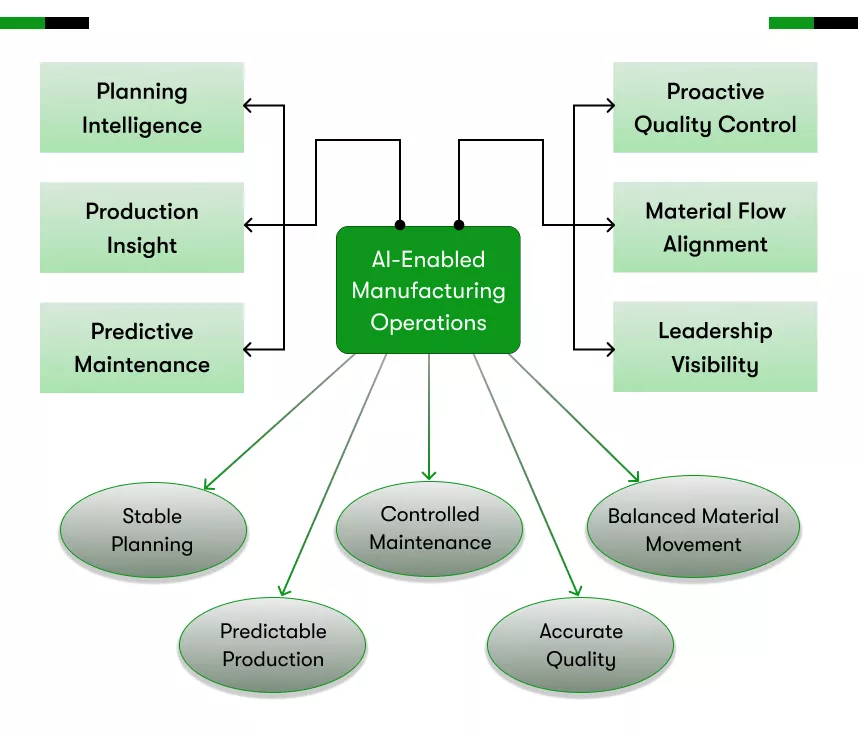
Leaders rely on steady performance across planning, production, maintenance, quality, and material flow. Using AI in manufacturing creates that stability through earlier signals, clearer context, and guidance that reduces uncertainty during fast operational changes. AI in Manufacturing supports every decision with insights that align equipment behaviour, workforce actions, and production goals.

Stronger planning direction with live operational context
Real-time updates on cycle timing, resource levels, and workload distribution help leaders push accurate schedules to every line. This reduces conflict between planned output and actual floor behavior.
Production teams gain clarity during hour-to-hour changes
Supervisors see deviations as they develop, not after they disrupt output. Early recognition helps guide operators toward the next stable action, especially during high-load periods. Many leadership teams working in artificial intelligence in manufacturing space call this shift one of the strongest contributors to predictability.
Maintenance work shifts toward controlled preparation
Engineers track abnormal vibration, temperature drift, and timing irregularities before they affect performance. Advance notice supports scheduled interventions instead of rapid-response work that pressures teams during peak output windows.
Quality becomes proactive instead of late-stage catch-up
Parameter movements are visible at the start of the run, allowing teams to correct issues long before scrap or rework grows. Leaders appreciate this change because it protects delivery commitments without slowing throughput.
Material movement stays aligned with production pace
Shortage risk, buffer buildup, and route delays appear early enough for teams to adjust quickly. This alignment helps prevent idle time across workstations and keeps production rhythm stable across shifts.
AI in manufacturing supports steady leadership decisions by delivering clearer signals across planning, production, maintenance, quality, and logistics. This clarity forms the base for measurable gains in output stability, cost control, and operational confidence.
What Measurable Gains Leaders See After AI Adoption
Senior manufacturing leaders want fewer surprises and clear proof that each plant moves in the right direction. When data about output, cost, and stability is tied together through AI in manufacturing, improvement becomes visible, repeatable, and easier to defend in every review.
Output stays closer to plan
Cycle timing deviations surface early enough for supervisors to protect flow across linked lines. Plants reach planned volumes with less last-hour firefighting and more consistent weekly performance.
Cost becomes easier to control
Scrap, rework, idle-time pockets, and loss points appear with clear context instead of after-the-fact reports. Leadership teams working with solutions in the AI in manufacturing industry often talk about tighter cost discipline once waste sources stop hiding inside delayed summaries.
Schedules reflect real conditions
Planners rely on live floor behavior instead of yesterday’s numbers. That alignment reduces stress at shift handover, keeps promises to customers realistic, and limits the need for emergency overtime.
Interruptions recover faster
When a line slows or stops, supervisors see why it happened and what to stabilize first. Recovery time shrinks, and performance between shifts becomes more consistent.
Machine readiness improves
Maintenance windows are prepared before minor faults build into stoppages. Plants see fewer surprise halts, which protects throughput during high-demand periods.
Quality holds steady over long runs
Parameter drift is flagged at the start of a problem, not at the end of a batch. Teams correct earlier, ship with more confidence, and reduce the volume of product that needs rework.
Taken together, these gains shift AI in Manufacturing from a side project into a practical lever for output, cost, and stability decisions at leadership level.
End-to-End Operational Map of AI Inside Manufacturing
Leadership teams need more than dashboards to guide large manufacturing environments. AI in Manufacturing brings clarity to daily operations through early signals, accurate context, and guidance shaped around real production behavior. This structure improves predictability across planning, production, quality, maintenance, and plant-wide flow.
1. Demand Understanding and Capacity Alignment
A stable cycle begins with clarity. Leaders evaluate how much demand the plant must absorb and how much capacity the lines can realistically support. Intelligence reviews past orders, seasonal swings, and customer behavior to prevent overloading lines during high-pressure weeks.
Key operational factors:
- Leaders study demand peaks and dips so each high-load period receives a realistic capacity plan instead of reactive line stretching.
- Capacity discussions across planning and production teams become factual because both sides work with the same demand view.
- High-priority customers receive protected capacity instead of competing blindly with standard orders.
- The plant enters each week with clear expectations for load, rather than discovering the real stress level mid-shift.
2. Scheduling Reflecting Real Floor Conditions
Schedules grounded in real machine status, workforce allocation, and material availability remove friction during the first hours of the shift. Leaders work with plans that adjust dynamically as floor conditions evolve through the day.
- Schedules adapt when key machines move from ready to constrained, which prevents lines from stalling in the first active hour.
- Workforce allocation balances skills and workloads across lines so no single team absorbs unfair pressure for the entire day.
- Material readiness is confirmed before schedules freeze, which reduces the need for urgent supply calls once production starts.
- Shift handovers become smoother because every team works from plans that match current floor reality, not yesterday’s assumptions.
3. Balanced Workloads Across Stations
Bottlenecks rarely appear in planning tools first; they show up on the floor through delays and operator stress. Intelligence monitors cycle timing and station behaviour to reveal where work piles up. Leaders rebalance tasks and staffing before those delays spread across dependent stages.
- Workstations that show rising cycle variance receive attention early, so leaders move support there before output drops.
- Teams see where buffer levels shrink or grow, which helps adjust upstream and downstream pacing in a controlled manner.
- Operators feel fewer spikes in workload intensity, which maintains focus and reduces avoidable errors during long runs.
- Line performance stays more consistent across shifts because workload balance is monitored and corrected instead of left to habit.
4. Equipment Health Visibility Before Breakdowns
Machines tend to “speak” through small changes long before they fail. Intelligence tracks vibration, temperature, current draw, and timing shifts so early stress becomes visible. Engineers and leaders see where risk builds and can schedule controlled maintenance instead of dealing with sudden stoppages.
- Maintenance teams receive prioritized lists of machines that show rising risk, which helps plan service windows without guesswork.
- Critical lines experience fewer emergency halts because minor issues receive attention during planned downtime.
- Spare parts planning improves since recurring stress patterns point to components that will demand replacement.
- Overall plant stability strengthens during peak demand because equipment behaviour is tracked, understood, and acted on early.
5. Root-Cause Identification Without Long Delays
When output drops, leaders need to know where and why before they can fix anything. Intelligence links signals across machines, stations, and time so deviations are traced to their starting point. That clarity keeps teams out of endless discussions and moves them into focused correction faster.
- Supervisors see which specific step introduced delay or variation, instead of exploring every part of the line without direction.
- Recurring issues are analysed with pattern history, which reduces the chances of applying short-term fixes that do not hold.
- Cross-functional discussions gain structure because everyone can see the same root evidence on screen.
- Weekly review meetings shift from blame and speculation to targeted actions grounded in clear operational data.
6. Quality Awareness During Active Production
Quality problems become expensive when they appear late. Intelligence tracks process parameters and inspection data during the run so quality drift appears early. Teams adjust conditions while the line is still running, rather than discovering a large volume of off-spec output at the end.
- Operators receive precise signals about which parameter moved, so corrections are controlled and do not disrupt the whole workflow.
- Scrap and rework volumes shrink because deviations are contained quickly instead of spreading across an entire batch.
- Quality teams spend more time on prevention and less time on sorting and investigation at the end of production.
- Customer-facing complaints decrease as consistency improves across long, high-speed runs.
7. Material Flow That Matches Line Speed
Even with perfect machines and operators, poor material flow can slow everything. Intelligence watches inventory levels, routing paths, and staging areas to reveal where shortages or congestion will appear. Leaders keep material moving at the same rhythm as production instead of chasing gaps all day.
- Workstations receive material before reaching critical low points, which avoids last-minute requests and idle labour.
- Routing conflicts between forklifts, conveyors, or AGVs show up as patterns, allowing teams to redesign movement paths thoughtfully.
- Overstock signals reveal where material sits too long, which helps free space and cash tied in unnecessary holding.
- Coordination between warehouse and production improves because both sides share one view of demand from producing lines.
8. Operator Guidance During Shifts
Floor teams deal with real-time decisions that cannot wait for long meetings. Intelligence translates complex signals into clear, simple next steps for operators. Leaders know that confident operators protect output better than anxious ones who try to guess the best move.
- Operators receive instructions that connect directly to what they see on the station, rather than abstract numbers with no context.
- Supervisors spend less time firefighting and more time coaching because guidance tools handle routine adjustments.
- New staff gain confidence faster when assistance appears at the moment of confusion, instead of after mistakes accumulate.
- Shift-to-shift performance variation reduces because decisions depend less on who happens to be on duty.
9. Inspection Results Connected to Upstream Stages
Inspection alone does not fix problems; connection does. Intelligence links end-of-line findings to upstream stages so leaders know which process step triggered the defect. That link turns inspection from a late-stage alarm into a feedback mechanism that strengthens earlier operations.
- A defect category points directly to the machine, station, or parameter that most likely created the fault.
- Teams avoid broad rework instructions and instead concentrate on the part of the process that truly needs correction.
- Trend views show whether a fix holds over time, which prevents the same issue from returning quietly in later batches.
- Quality and production teams align around shared evidence, reducing friction and finger-pointing during busy periods.
10. Dispatch Accuracy Based on Real Progress
Customer promises depend on what really happens inside the plant, not only on what was planned. Intelligence translates live progress into realistic completion times, so dispatch teams and sales leaders commit to dates they can defend with confidence.
- Dispatch schedules adjust when production moves faster or slower than planned, keeping customers updated with believable timelines.
- Logistics partners receive clearer loading windows, which reduces idle truck time and congestion at gates.
- Internal teams avoid the constant cycle of rushing orders at the last minute to protect relationships.
- Leaders support commercial negotiations with clear proof of how artificial intelligence in manufacturing improves delivery reliability across key product lines.
This operational map explains how intelligence flows through demand planning, scheduling, production balance, maintenance, quality, material movement, operator support, inspection, and dispatch. With AI in Manufacturing shaping this flow, leaders gain a plant they can understand, explain, and improve with far greater confidence.

High-Impact Use Cases Leaders Can Deploy Inside Real Manufacturing Environments
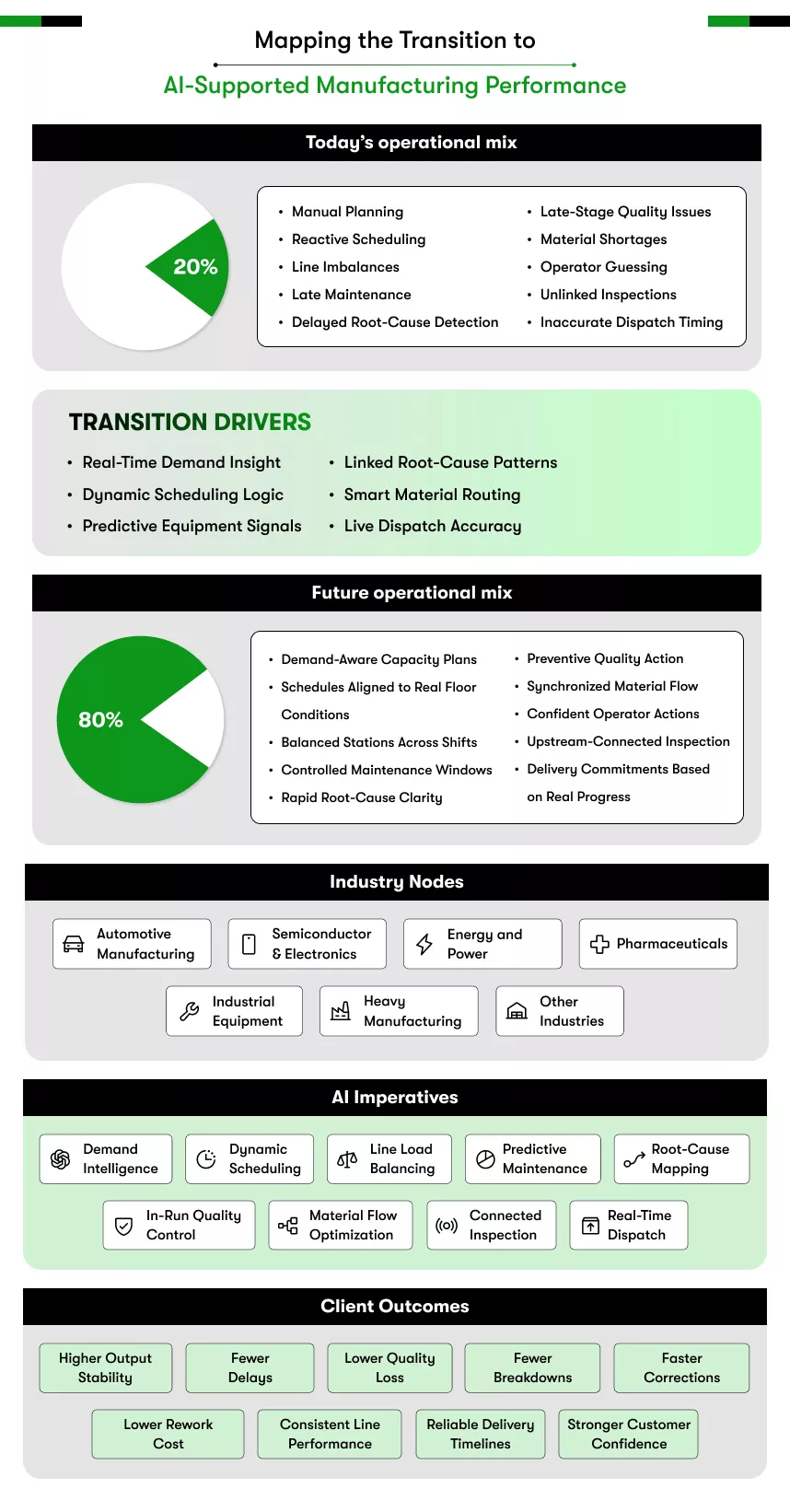
Factories gain the strongest results when intelligence is applied to daily decisions that shape throughput, reliability, quality, and delivery. AI in Manufacturing converts plant signals into practical guidance for operators, supervisors, planners, and engineers across the full production lifecycle. Many leaders study proven AI use cases in manufacturing to understand where intelligence delivers the fastest and most stable improvement.
1. Predictive Production Planning for High-Mix, Low-Volume Plants
Plants running multiple product variants struggle with fluctuating demand and unpredictable loading. Intelligence analyzes historical orders, machine readiness, and material movement to forecast realistic production runs. Leaders use these projections to avoid overcommitment and protect delivery promises.
- Planning teams work with forecasts that reflect actual load instead of rough estimates.
- Line assignment becomes smoother because high-priority products receive clear run windows.
- Short-notice changes are handled with less disruption as intelligence predicts feasible alternatives.
- Weekly stability improves because production plans match plant capability.
2. Intelligent Line Allocation for Multi-Product Factories
When several products run across shared lines, capacity conflict becomes common. Intelligence reviews cycle timing, setup history, and station capability to recommend which line should run each product. This reduces stress and prevents the wrong product from occupying the fastest line.
- Leaders assign products to the most compatible line based on data instead of habit.
- Setup mistakes decline because each product follows a proven line-specific sequence.
- High-priority orders avoid delays created through poor line selection.
- Throughput improves when plant routing decisions reflect real line behavior.
3. Real-Time Cycle Optimization for Throughput Expansion
Cycle drift can slow entire lines quietly. Intelligence tracks every station’s timing to reveal where small delays originate. Supervisors take corrective action at the exact moment timing begins to slip, which protects line speed and keeps output targets achievable.
- Bottlenecks receive attention before they disrupt connected downstream steps.
- Operators maintain consistent rhythm across long production runs.
- High-volume lines stay stable even during demanding product mixes.
- Daily throughput becomes more predictable across all shifts.
4. Adaptive Quality Control for Parameter-Driven Processes
Processes sensitive to temperature, pressure, speed, or alignment face unpredictability when conditions shift. Intelligence monitors parameter changes in real time and shows which adjustment prevents quality drift. Teams act early instead of reacting after inspection rejects an entire batch.
- Quality problems decline because variation receives attention while production continues.
- Operators correct conditions precisely instead of applying broad adjustments.
- Scrap rates fall as early corrections prevent large volumes of rework.
- Customer-facing accuracy improves through steadier quality.
5. Automated Root-Cause Identification for Faster Recovery
When output drops or quality shifts, investigations become slow and error-prone. Intelligence connects signals from machines, stations, and inspection to reveal the exact source of deviation. Leaders resolve issues faster and avoid repeated disruptions.
- Recovery time decreases because teams act on clear evidence.
- Repeated faults disappear once root causes are addressed directly.
- Shift supervisors focus on correction rather than lengthy diagnosis.
- Plant stability improves across weekly cycles.
6. Predictive Maintenance for Asset-Intensive Plants
Critical equipment demands early attention. Intelligence examines vibration patterns, cycle irregularities, and heat signatures to predict component stress. Engineers act during planned downtime instead of reacting when breakdowns interrupt production, which aligns with the core strength of AI predictive maintenance in modern plants.
- Maintenance windows become strategic instead of reactive.
- Spare parts planning improves when failure patterns are visible early.
- Unplanned halts reduce across equipment with complex mechanisms.
- Asset reliability strengthens during high-demand periods.
7. AI-Guided Workforce Allocation During Demand Spikes
Demand surges overload specific lines while others remain underutilized. Intelligence evaluates operator skills, line needs, and timing sensitivity to guide workforce distribution. Supervisors assign operators to the most impactful zones instead of relying on intuition.
- Lines with the highest demand receive appropriate skilled support.
- Supervisors maintain control even during rapid changes in loading.
- New staff integrate quickly with clear allocation guidance.
- Productivity improves because labour strength matches line requirements accurately.
8. Intelligent Material Replenishment and Route Optimization
Material shortages and routing congestion freeze lines at the worst moments. Intelligence detects low-stock signals early and analyzes movement paths across forklifts, AGVs, and conveyors. Teams adjust routes before congestion affects production.
- Workstations remain supplied during all running hours.
- Routing conflicts reduce as movement paths become data-driven.
- Inventory buildup receives prompt correction to free space.
- Warehouse and production teams coordinate around shared visibility.
9. AI-Driven Changeover Optimization for Faster Transitions
Changeovers consume valuable production hours. Intelligence stores the best past setups, adjustment sequences, and machine settings for each product. Operators follow precise, proven instructions, which reduces mistakes and speeds up the transition.
- Changeover duration declines as teams follow consistent, optimized steps.
- Senior operators spend less time fixing errors created through manual judgment.
- High-mix plants gain more available production time per shift.
- Output increases because downtime between products drops steadily.
10. Production–Inventory Synchronization for Reliable Dispatch Commitments
Inventory mismatches create delays and lose credibility with customers. Intelligence connects real-time production progress with finished goods availability. Dispatch teams work with realistic timelines rather than estimates.
- Commitments to customers remain reliable because timelines reflect actual readiness.
- Logistics teams prepare shipments with fewer last-minute adjustments.
- Finished goods inventory stays aligned with production flow.
- Leaders use clear evidence to support commercial decisions grounded in real performance.
Every use case in this section reflects a practical improvement that strengthens planning, stabilizes production, reduces rework, and supports dependable delivery. Leaders gain a clearer plant, faster decisions, and a structure that improves weekly performance without placing extra pressure on teams.

What Are the Business Benefits of AI in Manufacturing That Leaders Should Focus On?
Operational strength begins with predictable performance, stable output, and clear decision-making. AI in Manufacturing supports these priorities by improving consistency across production, maintenance, quality, inventory flow, and dispatch. Leaders gain a plant that behaves reliably and performs steadily across all shifts, which aligns with the core AI benefits in manufacturing valued across the sector.
1. Predictable Output Every Week
Stability improves when cycle timing, workload distribution, and line flow stay consistent. Intelligence reduces variability and helps leaders forecast output with confidence.
- Customers receive delivery timelines that reflect real production behaviour instead of estimates.
- Sales and operations coordinate smoothly because both teams work with one accurate view.
- Weekly commitments become easier to achieve since leaders avoid mid-week recovery pressure.
2. Stronger Margins Through Controlled Waste
Margins strengthen when scrap, rework, and overtime reduce. Intelligence detects early drift and helps teams correct issues before costs build.
- Plants minimize material loss because deviations receive attention before becoming large errors.
- Overtime expenses decline as teams avoid last-minute recovery shifts.
- Cost per unit becomes steady since production relies on consistent, controlled processes.
3. Fewer Emergency Stoppages
Unexpected breakdowns create plantwide disruption. Intelligence shows early equipment stress, helping teams plan intervention before failures occur.
- Maintenance teams schedule corrective work during controlled windows rather than reacting under pressure.
- Supervisors avoid chaotic rescheduling because equipment failures become less frequent.
- Production remains stable across lines, protecting output during peak cycles.
4. Smoother Supplier Coordination
Material planning stays accurate when consumption aligns with real production pace. Intelligence keeps suppliers informed and reduces last-minute shortages.
- Shortage risks reduce because material demand reflects actual line progress.
- Inventory becomes balanced since excess stock receives early correction.
- Procurement teams avoid urgent purchase requests and plan more confidently.
5. Faster Audits and Reliable Traceability
Strong documentation and organized production data simplify compliance requirements. Intelligence creates clear traceability for every step.
- Audit preparation becomes easier since evidence is stored with accurate timestamps.
- Traceability strengthens customer trust because leaders provide clear justification for decisions.
- Investigations take less time as corrective actions are supported by documented plant behaviour.
6. Consistent Delivery Performance
Delivery reliability improves when production progress aligns with dispatch readiness. Intelligence provides timelines that reflect real floor activity.
- Dispatch teams work with precise completion windows that reduce rescheduling.
- Logistics partners coordinate smoothly because loading plans match plant readiness.
- Customer relationships strengthen through consistent fulfilment performance.
7. Sharper Decision-Making Under Pressure
Leaders act confidently when they see how each decision affects the plant. Intelligence provides context that supports quick, informed action.
- Teams align rapidly on next steps because decisions rely on shared evidence.
- Disruption recovery becomes faster since leaders understand which areas need attention first.
- Meetings remain focused on execution instead of debating unclear data.
8. Balanced Workforce Utilization
Staffing becomes effective when operator skills match the needs of each station. Intelligence guides placement decisions that support productivity and reduce stress.
- Supervisors assign operators where their skill makes the strongest impact.
- Teams maintain balanced workloads, improving performance throughout long production runs.
- New operators integrate smoothly because guidance reduces uncertainty on the floor.
9. Financial Predictability Across Quarters
Stable operations lead to predictable financial outcomes. Intelligence reduces variability across production cycles and supports consistent planning.
- Cost per unit becomes more stable as waste and downtime decrease.
- Finance teams forecast more accurately because operational behavior stays consistent.
- Quarterly targets become easier to meet due to fewer unexpected losses.
10. Confidence Across Leadership, Teams, and Customers
Predictable operations strengthen trust across every level of the organization. Intelligence removes uncertainty and supports steady, reliable performance.
- Teams rely on consistent processes that reduce daily stress.
- Customers receive evidence-backed delivery commitments that build long-term trust.
- Leadership gains clarity and stability that support growth decisions.
These impacts reflect how intelligence strengthens planning, execution, cost control, and delivery. Leaders operate with clearer visibility, steadier performance, and greater confidence across the entire manufacturing cycle.


How AI Fits Into Real Manufacturing Architecture and the Systems Leaders Rely On
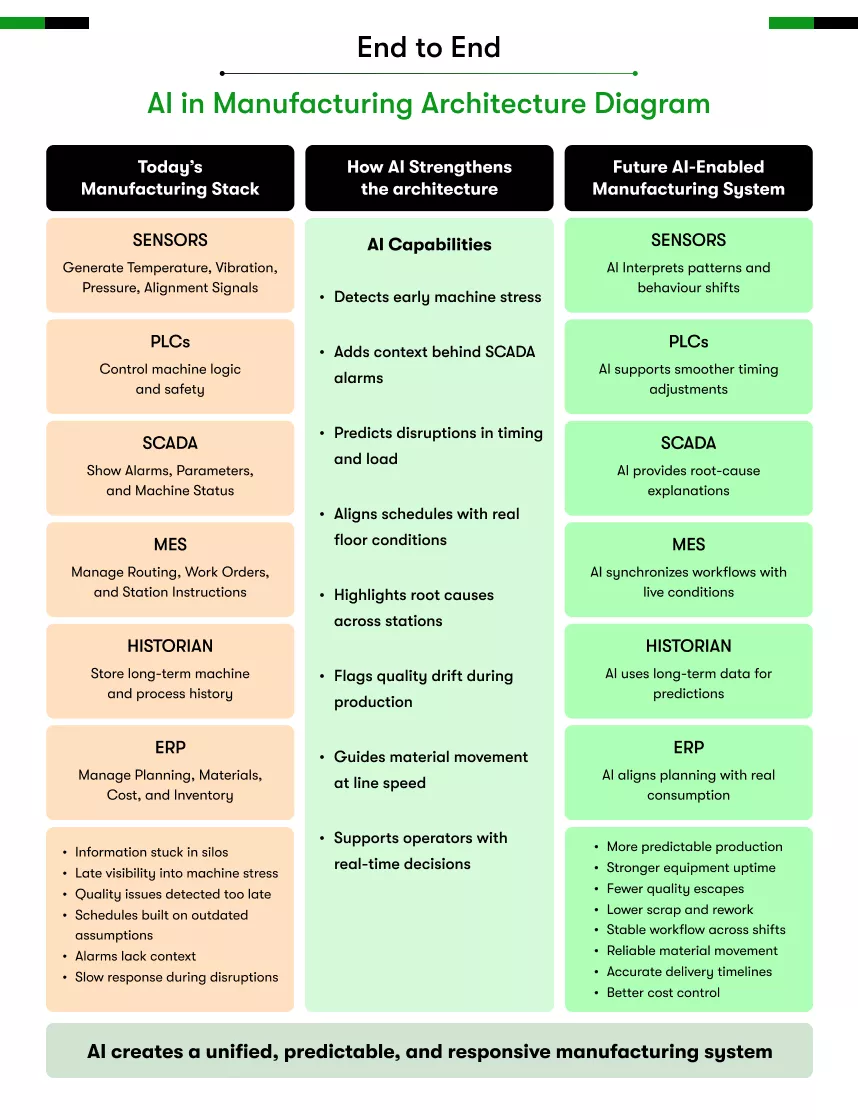
Manufacturing facilities already use structured layers of control systems, sensors, workflows, and planning tools. AI in Manufacturing strengthens this architecture by interpreting machine signals, predicting behaviour, and guiding production teams without disturbing the systems leaders trust.
This approach supports consistent results across the manufacturing floor and elevates how decisions flow through the plant.

Core Architecture Inside an AI-Enabled Plant
Intelligence connects with the existing stack used across the manufacturing industry. Each component keeps its primary function, while Artificial intelligence in manufacturing enhances responsiveness, stability, and timing. This structure creates a reliable path that supports leaders aiming for predictable performance improvements.
Sensors: Real-Time Machine and Process Signals
Sensors generate temperature, vibration, pressure, and alignment data. Intelligence uses these signals to recognise behaviour that influences product quality and equipment health.
- Sensors reveal early shifts that indicate upcoming wear in machinery.
- Teams maintain steadiness in sensitive processes through continuous monitoring.
- Detection of quality variation becomes possible long before visible defects appear.
- Long-term sensor patterns support maintenance planning across full equipment cycles.
PLCs: Machine-Level Logic and Control
PLCs retain full control over machine operations while intelligence provides context for more accurate adjustments based on real plant conditions.
- PLCs receive improved insights that help maintain machine timing.
- Machine safety stays intact because core logic remains inside PLC programs.
- Adjustments become smoother when PLCs receive intelligence early.
- Engineers understand which behaviour changes triggered every update.
SCADA: Supervisory Control With Added Insight
SCADA platforms show alarms, parameters, and machine status. Intelligence explains the behaviour behind those signals so supervisors act faster with confidence.
- Alerts include meaningful context that highlights the root of each shift.
- Supervisors respond quickly because they understand the cause instead of only seeing the alarm.
- Review sessions gain clarity through a direct link between shifts and plant behaviour.
- Noise reduces as intelligence highlights high-priority alerts.
MES: Production Execution and Workflow Coordination
MES controls production routing, work orders, and station instructions. Intelligence aligns MES workflows with true line conditions.
- Schedules adjust to equipment readiness instead of fixed rules.
- Delays reduce because intelligence highlights the next best action.
- Operators receive instructions informed by MES logic and live context.
- Leaders gain smoother flow across production stages.
Historian Systems: Long-Term Behaviour Foundation
Historian databases store years of machine, quality, and performance data that support learning for stronger predictive models.
- Predictive maintenance gains accuracy through long-term equipment history.
- Quality deviations become clearer when patterns appear in long-term data.
- Cycle timing trends support early detection of bottlenecks.
- Investigation becomes easier because historical data connects past signals to present conditions.
ERP: Planning, Inventory, and Cost Alignment
ERP systems coordinate procurement, planning, and inventory. Intelligence brings real plant behaviour into ERP actions for stronger alignment.
- Material forecasts reflect actual consumption instead of estimates.
- Procurement teams gain steadier demand visibility.
- Cost stability improves as variability reduces across production stages.
- Planning becomes more reliable through accurate production signals.
Edge Devices: Local Intelligence for Fast Response
Edge devices process selected data close to machines and support quick responses for operations that require immediate reactions.
- Adjustments happen instantly without network delays.
- Sensitive processes maintain stability because decisions occur at the machine level.
- Facilities with limited connectivity receive consistent decision support.
- Machine data stays inside the facility which improves continuity.
Cloud Logic: Deep Learning and Multi-Line Optimization
Cloud systems perform high-capacity learning across multiple machines, lines, and plants, supporting broader improvements.
- Cloud models interpret long-term trends across product families.
- Insights roll down to the edge for real-time use.
- Multi-line analysis reveals opportunities not visible locally.
- Leadership receives plant-wide intelligence grounded in data-driven understanding.
How the Architecture Works as a Unified System
- Sensors collect real machine behaviour.
- PLCs convert those signals into safe control actions.
- SCADA provides supervisory oversight.
- MES coordinates production execution.
- Historian systems store long-term patterns.
- ERP supports material and planning alignment.
- Edge devices deliver immediate decisions.
- Cloud logic powers deep learning and broad optimisation.
The entire architecture supports AI integration in manufacturing across all layers without replacing existing systems. This structure strengthens reliability, enhances clarity, and stabilises plant-wide performance for leaders aiming to modernise confidently. Many organisations rely on trusted AI development services to build this architecture correctly and ensure every layer works in alignment with plant operations.

Path to Implementing AI Without Disrupting Current Operations
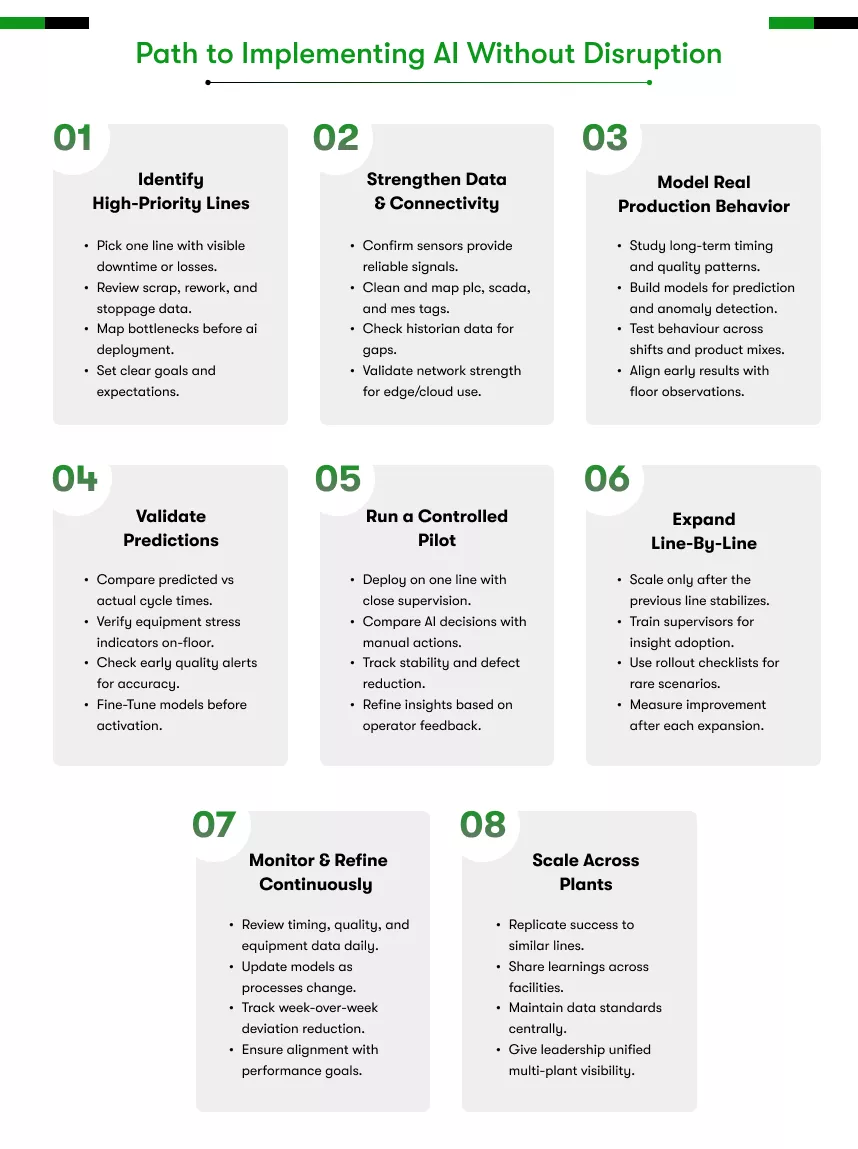
Manufacturing leaders succeed with AI in Manufacturing when execution happens in small, controlled phases. A structured approach protects stability, ensures predictable progress, and aligns improvement with real priorities across the manufacturing floor and the broader manufacturing industry.

Identify High-Priority Lines With Measurable Gain
The starting point matters. Leaders select a line or product family where downtime, timing variation, or quality issues clearly affect results. A focused scope gives teams a manageable environment for using AI in manufacturing without overwhelming operators or supervisors.
- Leadership teams review losses linked to scrap, rework, and stoppages to choose the first line.
- One product family or line becomes the initial environment for controlled deployment.
- Bottlenecks, constraints, and stabilizing factors are documented before any integration begins.
- Supervisors receive clear expectations, timelines, and measurable targets for the first phase.
Assess Data Clarity and Strengthen Connectivity Foundations
Reliable intelligence depends on reliable signals. Plants confirm that sensors, PLCs, SCADA, MES, and historian systems capture clean, consistent data that can support generative AI in manufacturing and other model types later in the journey.
- Engineers validate that critical sensors provide continuous readings across the chosen line.
- PLC tags, SCADA parameters, and MES events are mapped with clear naming and units.
- Historian data is checked for gaps, inconsistent timestamps, or missing channels.
- Network reliability is evaluated to define the balance between local edge processing and cloud analysis.
Model Real Production Behaviour for Accurate Intelligence
Models earn trust when they reflect how the plant behaves under real load, not ideal conditions. Data teams study patterns, machine responses, and workflow interactions so intelligence mirrors actual behaviour inside the facility.
- Data teams examine long-term trends for cycle timing, quality deviations, and equipment stress.
- Separate models are defined for prediction, anomaly detection, and workflow guidance.
- Performance is validated across shifts and product mixes to avoid narrow tuning.
- Leadership reviews early outputs to confirm alignment with floor observations.
Validate Predictions and Conduct Controlled Trials
A validation stage ensures predictions behave reliably before active use. Production, quality, and maintenance teams assess how accurately intelligence reflects real plant conditions. This step confirms whether AI integration in manufacturing will support stability instead of creating noise.
- Predicted timing is compared with actual cycle data for accuracy.
- Maintenance teams verify equipment stress indicators with on-floor conditions.
- Quality signals are reviewed to confirm early-deviation accuracy.
- Adjustments are applied before full rollout begins.
Run a Pilot Cycle With Close Supervision
The pilot introduces intelligence in a controlled space. Supervisors and leaders observe responses, confirm accuracy, and refine guidance for daily use.
- Supervisors compare insights against manual decisions to verify reliability.
- Production outcomes are tracked for timing stability and defect reduction.
- Operators share feedback on instruction clarity and insight usability.
- Final refinements prepare the system for wider expansion.
Roll Out Intelligence Gradually Across Lines
Deployment moves line by line to maintain safety and build team confidence. Each expansion wave follows a proven pattern grounded in earlier success.
- Each new line adopts intelligence after the previous line demonstrates stable performance.
- Supervisors receive training to integrate insights with existing dashboards and workflows.
- Teams prepare checklists to manage uncommon conditions during rollout.
- Leadership tracks progress through measurable improvements.
Monitor Behaviour and Refine Intelligence Continuously
Continuous observation ensures stability and long-term accuracy. Teams review insights regularly to confirm alignment with changing plant conditions.
- Daily reviews track timing stability, quality indicators, and equipment patterns.
- Model updates occur when processes or equipment configurations change.
- Supervisors evaluate week-over-week deviation reduction.
- Leadership reviews confirm alignment with operational goals.
Expand Intelligence Across Products and Facilities
Successful pilots scale across similar lines, product families, and locations. Patterns that drive improvement are standardized and deployed across the organization.
- Proven strategies are replicated across similar machines or processes.
- Plants share learning to build unified intelligence across locations.
- A central governance team manages data standards and updates.
- Leadership gains visibility into multi-plant improvement supported through consistent intelligence.
This roadmap shows a practical way of using AI in manufacturing without risking production reliability. Leaders move from focused pilots to broader deployment in a controlled manner, guided by AI manufacturing trends that highlight where the strongest gains appear. This helps generative AI in manufacturing and other intelligent systems deliver measurable outcomes instead of experimental results.
Decision Framework for Choosing the Right AI Partner in Manufacturing
Leaders select AI partners carefully because real manufacturing deployment depends on strong domain clarity, dependable execution, and practical understanding of plant behaviour. A structured evaluation process helps manufacturers choose a partner who can deliver reliable AI in Manufacturing outcomes instead of unproven experiments.
Assess Manufacturing Domain Understanding
A strong partner understands line flow, equipment behaviour, timing patterns, and quality dependencies. This clarity shapes better intelligence because models reflect the organisation’s true operating conditions inside the manufacturing industry.
- The partner must demonstrate experience across similar production environments or equipment groups.
- Process knowledge must cover cycle timing, variation patterns, material movement, and operator workflows.
- The partner must interpret sensor behaviour, machine responses, and workflow shifts with accuracy.
- Case discussions must prove understanding of AI in manufacturing industry problems, not generic AI theory.
Examine Real Deployment History and Measurable Success
Experience distinguishes capable partners from theoretical vendors. Leaders prioritise firms who deliver predictable performance in running factories, not only in prototypes or labs.
- Evidence of pilot-to-scale deployment across real plant floors.
- Measurable improvements in stability, downtime reduction, or quality outcomes.
- Demonstrated success with ai in smart manufacturing rollouts.
- Detailed breakdowns of how each deployment handled timing, data, and integration constraints.
Evaluate Integration Capability With Existing Systems
Plants rely on SCADA, MES, PLCs, historian databases, and ERP systems. The right partner integrates intelligence smoothly into these layers without creating friction.
- Understanding of SCADA, MES, PLCs, historian and ERP architectures.
- Ability to interpret tags, parameters, time-series data, and workflow logic.
- Proven capability to manage ai integration in manufacturing with minimal disruption.
- A clear strategy for edge processing, cloud logic, and hybrid data flow.
Validate Model Reliability and Plant-Specific Behaviour
Reliable intelligence performs consistently across shifts, environmental conditions, and product mixes. Leaders evaluate how partners design and test models for long-term stability.
- Reliable predictions tested across multiple shifts and load conditions.
- Separate models for timing, quality drift, equipment stress, and workflow guidance.
- Demonstrated methods for validating performance against real plant outcomes.
- Clear proof that models work under daily variation, not ideal lab conditions.
Ensure Interpretability and Trust in Recommendations
Supervisors and operators rely on clear explanations. Intelligence must show why an insight appears, not only present a value.
- Insights must connect to real signals such as alignment shifts, timing deviations, or parameter drift.
- Supervisors must understand how recommendations relate to plant behaviour.
- Operators must receive actionable explanations tied to machine states or process stages.
- Intelligence must support transparency so teams trust each recommendation.
Check Support Structure and Post-Deployment Stability
AI requires ongoing refinement. A strong partner offers operational support, model updates, and continuous monitoring after deployment.
- A clear post-deployment support plan for monitoring timing, quality behaviour, and stress indicators.
- Regular model reviews aligned with process changes and equipment upgrades.
- Local or remote support for handling exceptions, configuration needs, and threshold adjustments.
- A dependable escalation structure for technical or operational concerns.
Expect Rollout Discipline and Controlled Expansion
Predictable rollout practices ensure stable plant performance. Leaders select partners who follow structured plans that avoid operational risk.
- A phased rollout structure that moves from pilot to progressive expansion.
- Training programs for supervisors and operators.
- Checklists for uncommon conditions and special-case scenarios.
- Consistent reporting linked to measurable business outcomes.
A strong evaluation framework helps leaders choose partners who can execute reliable AI in Manufacturing deployments. The framework ensures intelligence strengthens production, improves timing accuracy, and supports stable performance without disrupting operations. Many organisations also look to hire AI developers who understand real plant environments and can build systems that function reliably on the floor.
Cost Factors and Development Cost of AI in Manufacturing
Clear cost visibility helps leaders evaluate the full development journey for AI in Manufacturing. Budget planning becomes predictable when every cost category is explained in detail, supported with realistic ranges and practical manufacturing context.
1. Data Infrastructure Cost
Strong data foundations define the accuracy of Artificial intelligence in manufacturing. Plants invest in infrastructure to ensure stable sensor signals, clean data, reliable connectivity, and long-term historian access. These elements support learning, modelling, and production-level intelligence.
| Cost Factor | Description | Estimated Cost Range |
| Sensor Additions / Upgrades | Adding or upgrading sensors to capture vibration, temperature, pressure, and alignment signals | $8,000 – $90,000 |
| Data Cleaning & Structuring | Preparing historian, SCADA, MES, and PLC data for model training | $12,000 – $60,000 |
| Connectivity & Gateways | Edge gateways and network improvements for stable communication | $10,000 – $80,000 |
| Historian Integration | Mapping long-term data for consistent learning | $15,000 – $70,000 |
Data infrastructure investment ensures accurate signals and consistent data flow. Reliable data supports using AI in manufacturing effectively across timing, quality, and equipment behaviour. Plants gain stronger modelling accuracy when foundations remain stable and well-structured.
2. Intelligence (AI Model) Development Cost
Model development forms the core of Generative AI in manufacturing and predictive intelligence. Plants require multiple models that understand timing behaviour, quality patterns, workflow interactions, and equipment states. Deeper logic increases accuracy and strengthens decision-making across operations.
| Cost Factor | Description | Estimated Cost Range |
| Predictive Models | Timing, quality deviation, equipment stress, and workflow prediction | $30,000 – $150,000 |
| Generative Simulation Logic | Scenario testing and root-cause analysis | $40,000 – $180,000 |
| Workflow & Optimization Models | Sequencing, routing, and balancing guidance | $35,000 – $140,000 |
| Validation Cycles | Multi-shift testing to ensure reliability | $15,000 – $90,000 |
Intelligence development costs depend on the number of models and the depth of learning required. Accurate models help leaders stabilize timing, reduce variation, and improve reliability across lines. The right model mix elevates outcomes for ai in manufacturing companies.
3. Integration & System Alignment Cost
Integration connects intelligence with existing plant systems such as SCADA, MES, PLCs, and ERP. Smooth alignment creates a unified flow of insights across machines, workflows, planning, and costing structures. Strong integration keeps operations steady during AI adoption.
| Cost Factor | Description | Estimated Cost Range |
| SCADA Integration | Mapping parameters and overlaying insights | $20,000 – $110,000 |
| MES Alignment | Synchronising intelligence with routing and work-order logic | $25,000 – $120,000 |
| PLC Interfacing | Tag mapping and timing exchange | $15,000 – $95,000 |
| ERP Synchronization | Connecting intelligence to planning, costing, and inventory | $20,000 – $130,000 |
Integration costs vary based on system diversity and workflow structure. Plants benefit when intelligence interacts correctly with existing architecture and supports ai integration in manufacturing across all workflows. This alignment ensures reliable plant-wide adoption.
4. Deployment & Rollout Cost
Deployment defines how intelligence enters active production. Plants start with controlled pilots and expand across lines once stability improves. Rollout costs depend on line count, hardware readiness, and training depth for supervisors and operators.
| Cost Factor | Description | Estimated Cost Range |
| Single-Line Pilot | Controlled deployment for one line or product family | $50,000 – $180,000 |
| Multi-Line Expansion | Rollout across additional lines | $120,000 – $600,000 |
| Edge Devices | Gateways and industrial compute units | $5,000 – $25,000 per unit |
| Workforce Training | Sessions for operators and supervisors | $5,000 – $35,000 |
Rollout investment supports safe and progressive expansion. Plants gain steady improvements when deployment happens line by line with close supervision. This structure ensures predictable performance across every new environment.
5. Post-Deployment Monitoring & Governance Cost
Ongoing monitoring maintains model accuracy across equipment, products, and shift variations. Plants invest in support, updates, and governance to sustain long-term value and protect performance outcomes across complex environments.
| Cost Factor | Description | Estimated Yearly Cost |
| Model Monitoring | Daily observation of timing, quality, and equipment patterns | $12,000 – $60,000 per year |
| Model Updates | Adjustments for new workflows or equipment changes | $10,000 – $80,000 per year |
| Technical Support | Issue resolution and configuration updates | $15,000 – $70,000 per year |
| Multi-Plant Governance | Standardisation across multiple plants | $20,000 – $120,000 per year |
Monitoring ensures long-term consistency across facilities. Plants maintain accuracy by updating models frequently and reviewing performance trends. Governance strengthens outcomes for organisations using AI in manufacturing across multiple locations.
Clear cost visibility helps leaders plan AI in manufacturing initiatives with confidence instead of uncertainty. Each category shows where budgets grow, where savings appear, and where intelligence creates measurable value. Plants that prepare structured budgets move faster, complete deployments smoothly, and capture stronger returns across production.
Conclusion
Manufacturing leaders eventually hit a ceiling where more dashboards and manual adjustments fail to deliver dependable stability. Production becomes smoother when intelligence supports timing, quality, and equipment behaviour with consistent accuracy. Plants record stronger margins when workflows move with fewer interruptions, and supervisors gain confidence from signals that guide the next move with clarity.
The next move now becomes a choice for leaders who want visible progress instead of repetitive conversations. Focused pilots create impact within weeks when supported through the right data foundation, correct models, and a structured rollout. Operations improve steadily when intelligence enters the line with a clear purpose.
Kody Technolab helps manufacturers achieve this shift by building AI systems that operate inside real production floors with precision and accountability. A short inquiry starts the process. Our team will understand your goals, map your environment, and guide you toward a controlled, value-driven adoption path tailored for your facility.

FAQs
1. How do I know if my plant is ready for AI in Manufacturing?
Readiness improves when stable data, clear workflows, and reliable equipment signals exist. Plants with connected sensors, basic historian access, and standardised processes can begin immediately. Facilities with inconsistent signals can still start through a structured pilot that stabilises data step by step.
2. What results can manufacturing teams expect in the first 90 days?
Early pilots show timing improvements, fewer workflow interruptions, and clearer maintenance planning. Supervisors gain cleaner signals, planners get steadier forecasts, and leadership sees reduced uncertainty around output. These early gains create confidence for broader rollout.
3. Do I need to change existing SCADA, MES, or PLC systems to adopt AI?
No. AI systems align with current architecture. Intelligence reads signals, interprets patterns, and guides decisions without replacing existing tools. This keeps operator routines intact while improving accuracy across all layers.
4. How does a manufacturing plant protect output when intelligence enters a production line?
Output stays protected when intelligence runs in observation mode before any guidance reaches operators. Supervisors review timing, workload movement, and equipment behaviour across the exact product family on that line. Activation begins only after the model proves consistent across multiple cycles, which keeps performance steady.
5. How can I reduce risk during the first phase of adoption?
Risk drops when the project begins with a focused pilot, clear success metrics, accurate data mapping, and dedicated support. Plants gain predictable outcomes when intelligence enters a single environment first and expands only after proven stability.