


Quick Summary: Most Computer Vision Development Cost estimates fail because teams skip upfront data preparation and integration complexity. This guide breaks down actual project expenses from planning through deployment, explains what drives pricing to be higher or lower, and shows where hidden costs emerge after contracts are signed. You learn to budget accurately, rather than discovering halfway through development that your approved amount covers only half of what production deployment actually requires.
Computer Vision Development Cost projections miss reality because initial estimates cover algorithm development while ignoring data labeling, system integration, and infrastructure expenses that often exceed model training budgets. Teams approve projects based on vendor quotes that show software development hours, without accounting for the months spent collecting labeled datasets or building middleware to connect vision outputs to manufacturing execution systems.
Budget overruns occur when organizations discover during development that existing camera quality cannot support the required detection accuracy, or that legacy enterprise systems require custom APIs that accept real-time vision inputs. Many teams underestimate the data preparation effort requiring subject matter experts to spend weeks labeling thousands of images before any model training begins. Integration complexity arises late, when pilot systems demonstrating impressive accuracy cannot trigger actions in production databases without extensive middleware development that nobody initially budgeted for.
Cost clarity matters before seeking executive approvals and committing resources to pilots because realistic budgets prevent projects from stalling midway when actual expenses exceed initial estimates. Understanding the Computer Vision Development guide requirements helps organizations plan a complete project scope rather than optimistic timelines covering only visible development work.
What Determines the Cost of Computer Vision Software?
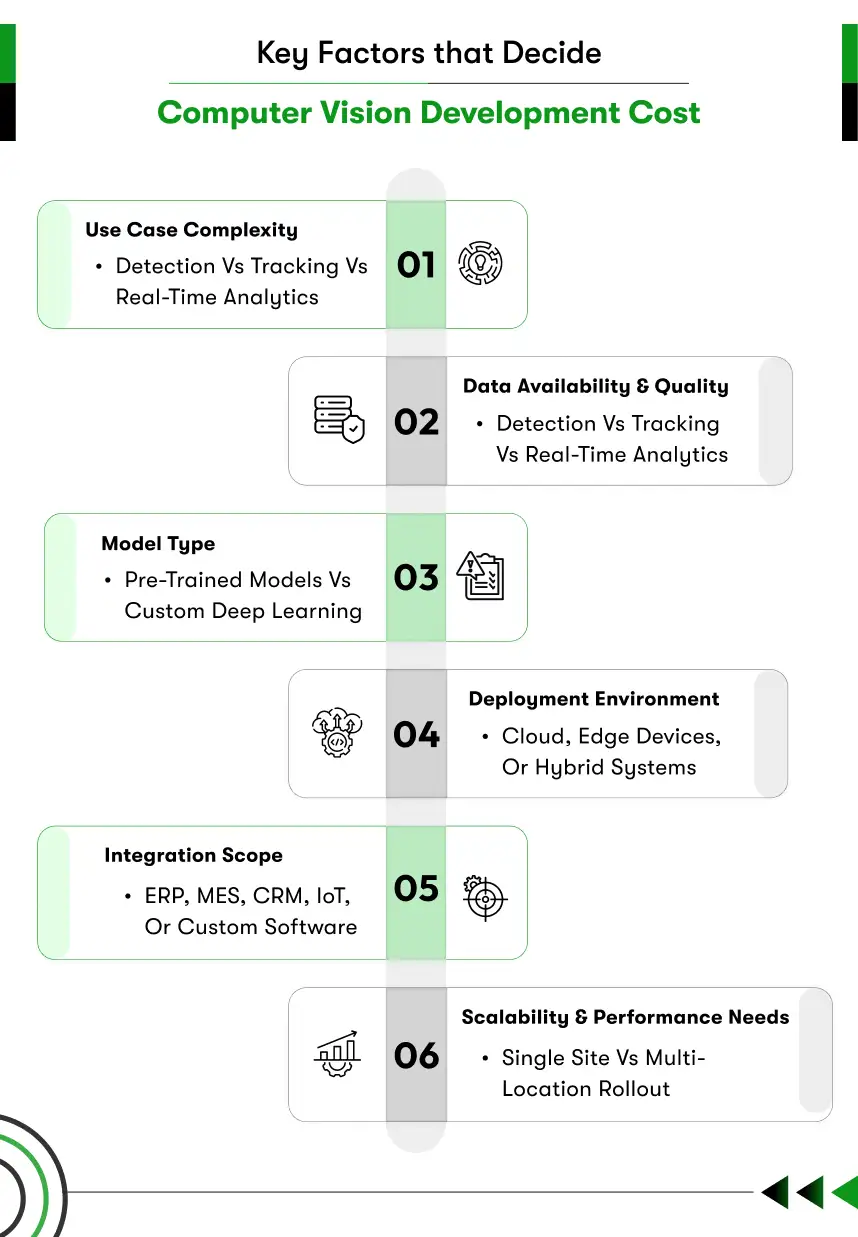
Your Computer Vision Implementation Cost depends on what you’re solving and your existing setup. Pre-trained models for standard tasks cost far less than custom solutions requiring proprietary data and real-time processing.
Complexity shapes investment. Single defect detection? Manageable. Multi-class detection across changing conditions demands extensive training, especially for safety-critical applications where accuracy is non-negotiable.
Your data determines the timeline. Thousands of labeled images available? You’re ahead. Starting from scratch means months of collection before development begins. Poor camera quality may require hardware upgrades first.
Architecture affects infrastructure. Real-time detection needs powerful edge devices. Cloud deployment trades hardware costs for ongoing fees; network reliability determines your path.
Integration drives costs. Connecting vision outputs to manufacturing systems, warehouse platforms, or quality databases requires real engineering. When evaluating a Computer Vision Software Development Company, ensure they understand your complete integration needs, not just model building.
Cost Breakdown of a Computer Vision Project
A Custom Computer Vision Project spans multiple phases, from initial planning through ongoing maintenance, and requires budgets that cover each development stage.
3.1 Use Case Definition and Planning
Business analysis shows that computer vision addresses real operational constraints that warrant automation investment, rather than simpler alternatives that deliver comparable value. Requirements workshops with operations teams define success through specific accuracy targets, throughput requirements, and integration points with existing workflows. A feasibility assessment evaluates whether the available data quality, infrastructure readiness, and technical complexity align with budget and timeline expectations.
ROI modeling quantifies expected improvements in scrap reduction, inspection throughput, or error prevention against total project investment, including ongoing operational costs. Planning identifies the pilot scope, proves value before enterprise commitment, and defines a scaling roadmap to extend successful deployments to additional locations. Proper scoping prevents mid-project surprises when teams discover that requirements exceed initial estimates because the planning skipped critical workflow details.
Cost range for comprehensive planning: $15,000 – $35,000, depending on use case complexity and organizational alignment effort required to establish clear success criteria.
3.2 Data Collection and Preparation
Camera setup involves selecting industrial-grade equipment that meets resolution, frame rate, and environmental durability specifications to support the required detection accuracy. Lighting design eliminates shadows and glare that affect image quality, because algorithms cannot overcome poor illumination, regardless of sophistication. Mounting hardware positions cameras at angles to capture necessary visual details without interfering with production or raising worker safety concerns.
Data capture collects thousands of images representing normal operations, defect variations, and edge cases that models must recognize during production deployment. Image labeling requires domain experts to identify defects, draw bounding boxes, and classify examples using consistent criteria. Algorithms use learning detection patterns. Quality checks validate labeling consistency across team members, preventing training data errors from degrading model performance.
Data preparation typically accounts for 25-35% of the total project cost because creating clean, labeled datasets requires significant expert time before any model development begins. Organizations with labeled historical data reduce this expense, while those starting fresh invest heavily up front.
Cost range for data work: $30,000–$150,000, depending on dataset size requirements, labeling complexity, and whether existing data meet quality standards.
3.3 Model Development and Training
Algorithm selection involves choosing architectures that balance accuracy, inference speed, and computational requirements, while matching deployment constraints and business priorities. Transfer learning leverages pre-trained models to accelerate development when similar detection tasks exist, while custom architectures address unique requirements that lack comparable starting points. Hyperparameter tuning optimizes model performance through systematic experimentation, finding configurations delivering the best accuracy-speed tradeoffs.
Training cycles iterate through variations in the dataset, architecture adjustments, and validation testing until models meet defined accuracy thresholds under representative conditions. Testing evaluates performance on held-out datasets that simulate production variability, ensuring models generalize beyond the training data. Optimization techniques like pruning and quantization reduce model size, enabling deployment on resource-constrained edge devices without sacrificing accuracy.
Development effort varies dramatically depending on problem complexity and whether existing architectures adapt easily or require novel approaches. Standard object detection using proven frameworks is less expensive than specialized applications that require custom loss functions or unique architectural modifications.
Cost range for model development: $40,000–$200,000, depending on architectural complexity, required accuracy levels, and the number of iterations needed to achieve production-ready performance.
3.4 Infrastructure and Deployment
Cloud deployment provisions computing resources, storage, and network bandwidth supporting inference workloads at required throughput levels. Edge deployment purchases industrial computers, installs them at camera locations, and configures local processing to eliminate cloud latency. Hybrid architectures balance real-time edge inference with cloud-based monitoring and model management, requiring coordinated infrastructure across environments.
Performance planning ensures that the infrastructure handles peak loads without degrading performance when production volumes spike during high-demand periods. Scalability design enables adding capacity through additional devices or cloud resources as operations expand across locations. Redundancy planning prevents single points of failure from halting operations when individual components experience issues.
Infrastructure costs vary widely depending on deployment scale, processing requirements, and whether organizations use existing resources or purchase dedicated hardware.
Cost range for infrastructure: $25,000–$300,000+, depending on deployment architecture, scale, and whether edge hardware or cloud services dominate costs.
3.5 Integration and Testing
Enterprise system integration builds middleware connecting vision outputs to manufacturing execution systems, warehouse management platforms, or quality tracking databases. API development creates interfaces that legacy systems use to consume vision results and trigger downstream actions based on detection outcomes. Protocol translation handles format conversions when vision systems and enterprise platforms use incompatible data structures.
System validation tests complete workflows end-to-end under realistic conditions, proving vision outputs correctly trigger intended actions without data loss. Acceptance testing verifies that accuracy, throughput, and reliability meet defined requirements before production cutover. Performance benchmarking measures actual response times, processing capacity, and resource consumption against specifications.
Integration complexity drives costs more than teams anticipate because connecting modern vision systems to legacy enterprise platforms often demands significant custom development.
Cost range for integration: $30,000–$150,000, depending on the number of integration points, the complexity of the legacy system, and real-time processing requirements.
3.6 Maintenance and Continuous Improvement
Model monitoring tracks prediction-confidence distributions, detects accuracy drift, and indicates when retraining is needed when operational conditions change. Performance dashboards alert teams when inference latency increases or error rates exceed thresholds requiring investigation. Retraining workflows incorporate new labeled examples covering edge cases discovered during production operations, improving model coverage.
Support contracts provide vendor assistance for troubleshooting issues, applying security patches, and upgrading dependencies as ecosystems evolve. Performance tuning optimizes resource utilization, reducing infrastructure costs or improving throughput as usage patterns become clear. Feature enhancements add capabilities addressing evolving business needs beyond the initial deployment scope.
Ongoing costs often surprise organizations that expect one-time development expenses, failing to account for continuous model refinement and infrastructure management.
Annual maintenance range: 15-25% of initial development cost, covering monitoring, retraining, support, and incremental improvements to maintain production performance.
Typical Cost Ranges by Project Type
How much does computer vision costs varies dramatically based on project scope, complexity, and deployment scale across different implementation stages.
| Project Type | Estimated Cost Range (USA 2026) | Timeline | Key Drivers |
| Proof of Concept | $50,000 – $100,000 | 1–2 months | Basic model development, limited data prep, single use case validation |
| Pilot Deployment | $80,000 – $200,000 | 3–6 months | Production-quality models, integration testing, infrastructure setup, operational validation |
| Full-Scale System | $250,000 – $1,000,000+ | 6–12+ months | Custom AI architectures, enterprise integration, multi-location deployment, and comprehensive training |
Proof-of-concept projects validate technical feasibility using simplified datasets and standalone processing, without the complexity of enterprise integration. These efforts answer whether computer vision can detect target objects with acceptable accuracy, thereby justifying further investment. A limited scope helps keep costs contained while demonstrating core capability before committing to production development.
Pilot deployments prove production viability by integrating vision systems with actual operational workflows at single locations or production lines. Infrastructure setup, system integration, and operational validation increase investment beyond proof of concept. Pilots generate realistic performance data under actual conditions, informing enterprise rollout decisions and budget projections.
Full-scale implementations span multiple facilities, requiring deployment automation, centralized management, and comprehensive operator training programs. Custom model architectures address specialized requirements lacking off-the-shelf solutions, while enterprise integration connects vision outputs across multiple backend systems. Ongoing support infrastructure ensures operational reliability across distributed installations.

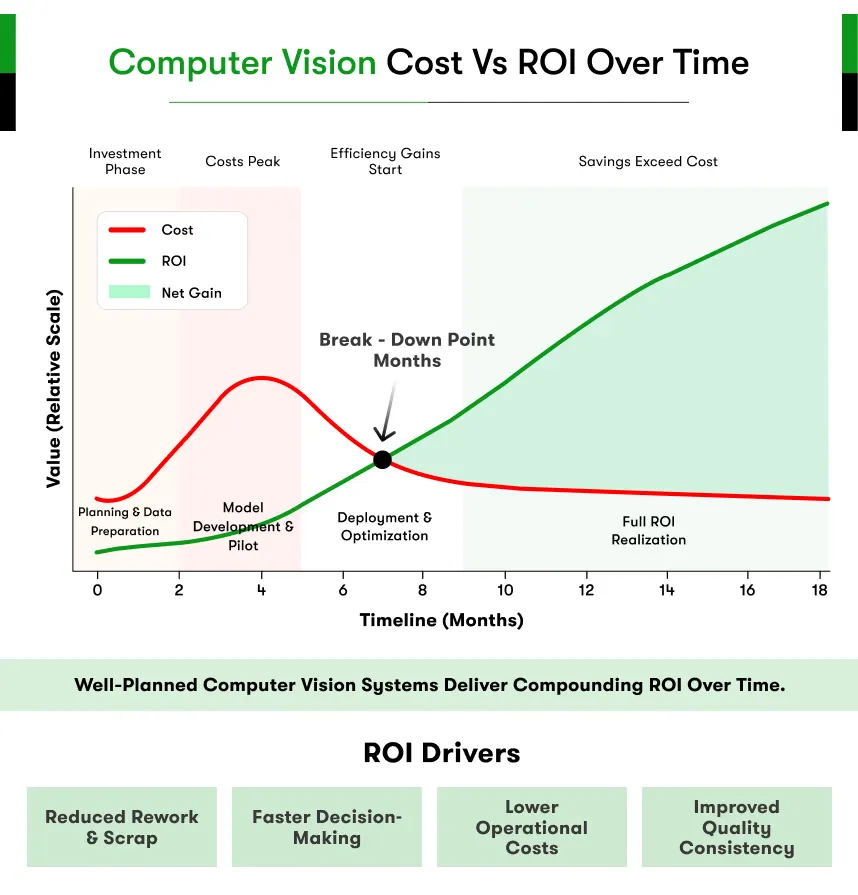
How Much Does a Computer Vision Project Cost ultimately depends on whether organizations need experimental validation, operational pilots, or enterprise-scale deployments supporting business-critical workflows. Organizations exploring how retailers use people analytics or queue and dwell-time analytics in retail face similar cost structures, where proof of concept validation costs significantly less than full store network deployments.
Factors That Increase or Reduce Development Cost
Computer Vision Price Guide planning requires understanding which project characteristics drive expenses higher versus opportunities for reducing total investment without sacrificing operational value.

Cost Increases When
Data requires heavy labeling – Projects lacking pre-existing labeled datasets demand weeks of expert time reviewing thousands of images and applying consistent annotation algorithms used during training. Complex labeling tasks, such as polygon segmentation or multi-class classification, require more effort than simple bounding boxes. Quality control processes that ensure labeling consistency across team members add overhead but are necessary, preventing training data errors that degrade model accuracy.
Real-time performance is critical – Applications demanding millisecond-level response times require optimized models, powerful edge hardware, and careful performance tuning, increasing both development and infrastructure costs. Real-time constraints limit architecture choices to faster models, potentially sacrificing some accuracy for speed. Edge deployment hardware supporting real-time processing costs more than cloud infrastructure handling batch workloads without strict latency requirements.
Multiple system integrations exist – Connecting vision outputs to several enterprise platforms like manufacturing execution systems, quality databases, and reporting tools multiplies the integration effort. Each system may use different protocols, data formats, and authentication mechanisms, requiring custom middleware development. Testing integration points thoroughly under production loads ensures reliability but extends validation timelines and costs.
Cost Decreases When
Data quality already exists: organizations with thousands of labeled images from historical operations or similar projects eliminate expensive data preparation phases. Existing camera infrastructure meeting quality specifications avoids hardware upgrade costs before development begins. Clean structured data reduces preprocessing effort, allowing teams to focus resources on model development and deployment.
Scope stays focused: single-use case projects with clearly defined success criteria avoid scope creep, by not expanding requirements during development. Limited object classes requiring detection simplify model architecture and reduce training complexity. Focused deployments at individual facilities cost less than enterprise rollouts while proving value before broader investment.
A phased rollout is used: incremental deployment spreads investment across quarters, reducing upfront capital requirements while validating each phase before proceeding. Learning from initial locations improves subsequent deployments, reducing per-site costs through standardized processes. Phased approaches enable course corrections when early phases reveal requirements differing from initial assumptions.
AI Computer Vision Pricing advantages emerge when organizations leverage transfer learning from pre-trained models, reuse data-collection infrastructure across multiple projects, and standardize deployment architectures, thereby reducing per-application customization. Understanding retail heatmap analytics and Retail Computer Vision Intelligence applications helps retailers recognize where standardized approaches reduce costs and where unique requirements demand custom development.
Cloud vs Edge Deployment Cost Considerations
AI vision development pricing varies significantly based on whether systems process images in cloud data centers or on local edge devices near camera installations.
Hardware and device costs: Edge deployment requires purchasing industrial computers for each camera location, with specifications that support the required inference speed and environmental durability. Upfront hardware investment scales linearly with deployment size as each location needs dedicated processing capacity. Cloud deployment eliminates local hardware costs but introduces ongoing API usage fees charged per image processed or per unit of compute time consumed.
Latency and processing requirements: Real-time applications that demand immediate responses to visual detections typically require edge processing because cloud round-trip delays exceed acceptable latency budgets. Manufacturing inspection, which stops production lines within milliseconds, cannot tolerate the network delays inherent in cloud architectures. Batch processing applications analyzing footage overnight tolerate cloud latency while benefiting from centralized computing resources.
Long-term operational expenses: Cloud costs accumulate monthly, potentially exceeding edge hardware investments over multi-year periods for high-throughput applications. Edge devices require upfront capital but incur minimal ongoing costs beyond electricity and occasional hardware replacement. Hybrid architectures balance edge inference for time-sensitive decisions with cloud analytics for historical pattern analysis and model management.
Network dependency affects total cost of ownership when unreliable connectivity forces edge deployment, even for applications where cloud economics would otherwise be favorable. Bandwidth costs for transporting high-resolution images to cloud platforms add expenses for installations that process large volumes. Vision intelligence cost calculations should model both upfront capital and ongoing operational expenses across the expected system lifespan, accounting for processing volume growth.
Is it cheaper to build or buy computer vision software?
Buying commercial software reduces initial Computer Vision Development Cost but limits customization for specialized requirements and creates ongoing licensing expenses. Building custom solutions costs more upfront but offers complete control, intellectual property ownership, and long-term ROI for businesses with complex or evolving operational needs.
Commercial platforms provide faster deployment through pre-built models, managed infrastructure, and vendor support, reducing time to initial value. Licensing fees cover ongoing updates, security patches, and technical assistance without requiring dedicated internal teams. Standard capabilities are sufficient for common use cases such as generic object detection, face recognition, and optical character recognition, where customization needs remain limited.
Custom development enables optimization for proprietary processes, unique defect types, or specialized detection criteria that competitors cannot replicate using commercial tools. Organizations own resulting intellectual property and avoid vendor lock-in, restricting future flexibility. Development costs are concentrated up front but eliminate perpetual licensing fees, benefiting high-volume applications over multi-year periods.
Hybrid approaches start with commercial platforms for standard capabilities and build custom components to address specialized requirements beyond vendor offerings. Modular architectures enable replacing commercial modules with custom alternatives as needs evolve without a complete system redesign. Vendor relationships provide stability for commodity functions while custom development differentiates critical workflows.
Computer Vision Implementation Cost trade-offs depend on whether operational requirements align with commercial capabilities or whether competitive advantage requires proprietary implementations. Organizations exploring retail space utilization analytics might find commercial retail analytics platforms sufficient, while manufacturers with unique defect patterns require custom models trained on proprietary data.


Hidden Costs Leaders Often Miss
Custom Computer Vision Project Cost budgets often overlook expenses that arise during implementation or operation beyond the obvious development and infrastructure investments.
Data annotation at scale: Initial budgets cover labeling sample datasets but underestimate ongoing annotation effort as operations expand or requirements evolve. New product variants, packaging changes, or defect types require additional labeled examples to maintain model accuracy. Annotation quality control, which ensures consistent labeling across growing teams, often adds management overhead not included in initial estimates.
Model retraining cycles: Production environments drift from training conditions due to equipment changes, process modifications, or seasonal variations, requiring periodic model updates. Retraining effort includes collecting new examples, validating updated models, and deploying replacements without disrupting operations. Frequency depends on operational stability, but organizations should budget quarterly or semi-annual retraining cycles to maintain accuracy.
Compliance and security requirements: Regulated industries face data governance costs, securing visual information, implementing access controls, and maintaining audit trails to prove compliance. Healthcare applications require HIPAA-compliant infrastructure, while financial services require SOC 2 certification, adding security overhead. Privacy regulations governing facial recognition or employee monitoring vary by jurisdiction, creating legal consultation expenses.
Internal change management: Operators require training to understand system outputs, handle exceptions, and validate edge cases before trusting automated decisions. Resistance to automation perceived as threatening jobs demands careful communication and gradual transition planning. Process documentation updates reflecting new workflows and the development of standard operating procedures consume time that is rarely budgeted initially.
Infrastructure scaling costs arise when initial deployments succeed,, prompting faster-than-anticipated expansion to additional locations. Network bandwidth upgrades support increased image traffic while storage expansion accommodates growing historical datasets. Support team hiring becomes necessary when single deployments grow into enterprise-scale systems demanding 24/7 operational monitoring.
How to Control Computer Vision Development Costs
How much does computer vision costs ultimately depends on strategic choices controlling expenses without sacrificing operational value or production reliability.
Start with a single high-impact use case – Focused initial deployments prove value and establish processes before expanding scope across multiple applications simultaneously. Single use cases generate learnings about data quality, integration complexity, and operational requirements, informing subsequent projects. Concentrated investment in the highest-value opportunities delivers faster ROI, justifying broader adoption rather than spreading resources across multiple experimental efforts.
Validate ROI early: pilot projects should demonstrate measurable improvements in quality, throughput, or cost reduction within months, proving the investment is justified. Clear success metrics established upfront enable objective evaluation of whether results warrant continued investment. Early validation prevents sunk costs when projects fail to meet expectations, allowing redirection toward more promising opportunities.
Choose modular architecture – Component-based designs enable replacing or upgrading individual pieces without complete system redevelopment as requirements evolve. Standardized interfaces between data collection, processing, and integration layers facilitate reuse across multiple projects. Modularity reduces vendor lock-in, allowing selective replacement of underperforming components without abandoning entire investments.
Work with experienced partners – Vendors with production deployment experience avoid common pitfalls, causing delays and cost overruns on initial projects. Partner expertise accelerates development through proven architectures, reusable components, and established integration patterns. Fixed-price contracts for defined scopes provide budget certainty compared with time-and-materials arrangements, which risk overruns from scope creep. Organizations ready to proceed should hire Computer Vision Developers with relevant industry experience matching their specific operational requirements and deployment constraints.
Phased funding aligns investment releases with milestone achievements, preventing full budget commitment until technical feasibility and operational fit are validated. An incremental approach enables course corrections when early phases reveal assumptions requiring adjustment before proceeding. Governance frameworks prevent scope expansion without corresponding budget adjustments, maintaining cost control throughout development.
Is Computer Vision Worth the Investment
Computer Vision Development Cost justification requires an honest evaluation of whether visual automation addresses constraints that are actually limiting business performance, rather than adopting technology to solve problems.

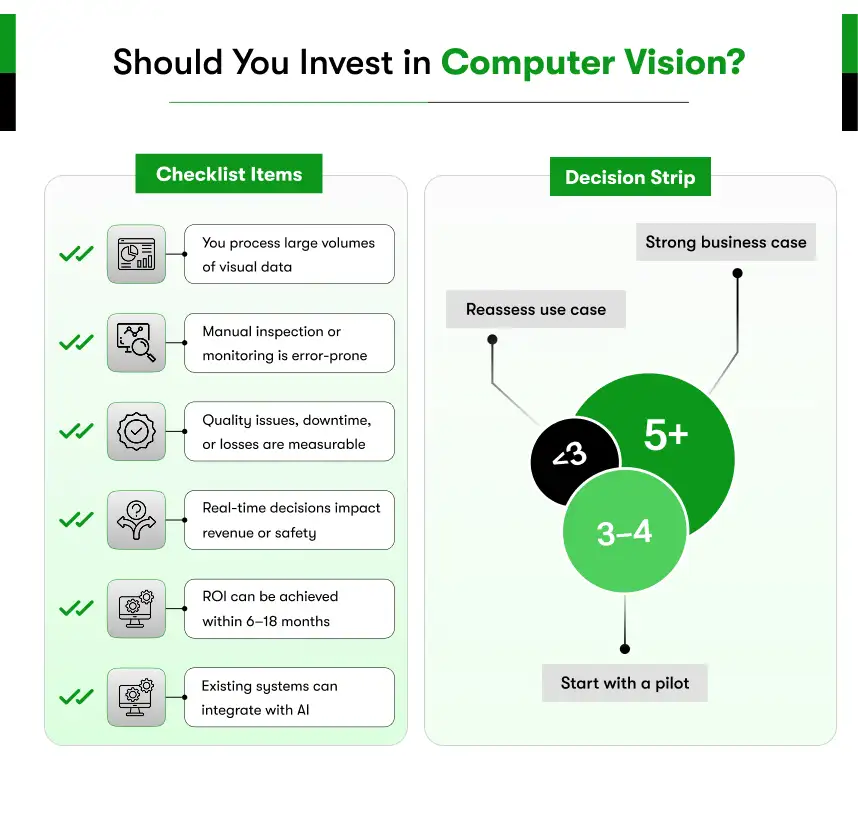
When computer vision delivers strong ROI – Quality inspection preventing recalls costing millions justifies a six-figure automation investment through risk reduction alone. Manufacturing scrap rates exceeding acceptable thresholds indicate that systems are not catching defects before expensive downstream processing. Safety monitoring,,injury prevention, and regulatory compliance are valuable when incident costs and liability exposure significantly exceed automation expenses.
High-volume, repetitive inspections that exceed human processing capacity demonstrate clear automation value when manual approaches cannot scale to meet throughput demands. Real-time monitoring requirements incompatible with scheduled human rounds justify continuous automated surveillance. Consistency demands eliminating subjective human judgment variations, supporting automation where regulatory compliance requires documented identical criteria application.
When alternative automation works better: Simple binary decisions based on non-visual data cost less with traditional automation, without the complexity of computer vision. Process problems solvable through mechanical controls, sensors, or procedural changes should be addressed with simpler options before investing in vision. Applications lacking clear accuracy targets or undefined success criteria indicate premature automation before understanding actual requirements.
Low-volume specialty operations may find human expertise more economical than training custom models for limited production runs. Highly variable products lacking pattern consistency challenge vision systems, potentially requiring continuous retraining exceeding automation value. Edge cases dominating operations where exceptions outnumber standard scenarios reduce automation ROI when human judgment handles variability better.
Cost justification calculations should compare total ownership across the expected system lifespan versus continued manual operations, accounting for labor inflation and scaling constraints. Break-even analysis identifies throughput thresholds or error rate improvements, making automation economically favorable. Organizations exploring computer vision consulting benefit from an objective assessment of whether their specific constraints justify investment before committing development resources.
Conclusion
Accurate Computer Vision Development Cost planning prevents projects from stalling midway when reality exceeds initial estimates because organizations understand the complete scope requirements upfront. Budget clarity covering data preparation, integration complexity, infrastructure needs, and ongoing maintenance enables realistic executive approvals based on total investment rather than optimistic development-only quotes. Strategic planning identifies cost drivers early, allowing informed trade-offs between capability requirements and budget constraints before signing contracts.
Computer Vision Implementation Cost transparency helps organizations prioritize the highest-value applications delivering measurable ROI fastest, rather than spreading resources across multiple experiments without clear success criteria. Detailed breakdowns reveal where expenses concentrate, enabling targeted cost reduction through data reuse, architecture standardization, or phased deployment, spreading investment across fiscal periods. Honest assessment of whether build versus buy trade-offs favor custom development or commercial platforms prevents expensive mid-project pivots when initial approaches prove unsuitable.
Long-term thinking, evaluating total ownership costs across the expected system lifespan, produces better decisions than minimizing upfront investment without accounting for ongoing operational expenses and maintenance requirements. Organizations succeeding with computer vision investments understand costs extend beyond initial deployment through continuous model refinement, infrastructure management, and capability expansion as operational needs evolve. Budget planning accounting for hidden expenses like annotation scaling, compliance requirements, and change management reflects deployment reality better than development quotes, ignoring operational complexities.
Strategic execution matching investment levels to business value potential improves ROI by avoiding both under-investment, compromising quality, and over-engineering beyond actual requirements. Modular approaches enable starting focused, then expanding systematically as proven value justifies additional investment versus betting entire budgets on unvalidated assumptions. Partner selection emphasizing production deployment experience over impressive demos reduces the risk of cost overruns from teams learning integration realities during customer projects.
Kody Technolab Limited provides transparent Computer Vision Price Guide assessments, helping organizations understand the complete project scope before committing resources to development. The team breaks down costs across planning, data preparation, model development, infrastructure, integration, and ongoing maintenance, enabling realistic budget planning. Organizations seeking confident investment decisions grounded in production deployment reality rather than optimistic vendor quotes can engage Kody Technolab Limited for detailed cost analysis supporting informed approvals.

Frequently Asked Questions
What is the average Computer Vision Development Cost for manufacturing quality inspection?
Manufacturing inspection projects typically range from $150,000 to $500,000, depending on defect complexity, production line count, and integration depth with existing manufacturing execution systems. Costs increase when real-time inline inspection requires millisecond response times versus offline batch analysis, tolerating processing delays. Multi-shift deployments across several production lines cost more than a single-line pilot,s proving the concept before broader rollout.
How does the Custom Computer Vision Project Cost compare between cloud and edge deployment?
Edge deployment requires $5,000 to $15,000 per location for industrial computing hardware, but minimizes ongoing operational costs beyond electricity and maintenance. Cloud deployment eliminates upfront hardware investment but incurs monthly API fees, potentially totaling $2,000 to $10,000 per location annually, depending on image processing volumes. Break-even analysis typically favors edge economics for high-volume applications over multi-year periods while cloud suits lower volumes or experimental phases.
What factors affect Computer Vision Implementation Cost most significantly?
Data preparation effort represents the largest cost variable when organizations lack existing labeled datasets, requiring weeks of expert annotation time. Integration complexity with legacy enterprise systems drives expenses higher through custom middleware development connecting vision outputs to manufacturing or warehouse platforms. Real-time performance requirements increase costs through optimized models and powerful edge hardware versus batch processing, tolerating standard infrastructure.
How Much Does a Computer Vision Project Cost for retail analytics applications?
Retail analytics deployments range from $100,000 to $400,000, depending on store count, camera coverage density, and analytical sophistication required. Basic traffic counting costs less than comprehensive customer journey mapping, tracking individual shopper paths throughout stores. Multi-location rollouts benefit from standardized deployment processes, reducing per-store costs after initial locations establish proven architectures and integration patterns.
What ongoing costs should organizations budget beyond the initial Computer Vision Development Cost?
Annual maintenance typically runs 15-25% of the initial development cost, covering model retraining, infrastructure management, security updates, and technical support. Additional annotation effort emerges when product changes or new defect types require expanding training datasets, while maintaining accuracy. Cloud infrastructure costs scale with processing volumes, while edge deployments incur minimal ongoing expenses beyond occasional hardware replacement.
Does Vision intelligence cost increase significantly for custom versus pre-trained models?
Custom model development costs $50,000 to $200,000 more than leveraging pre-trained architectures because training from scratch requires larger datasets, longer iteration cycles, and specialized expertise. Transfer learning using pre-trained models as starting points reduces costs while maintaining good accuracy for similar detection tasks. Completely novel applications lacking comparable pre-trained options justify custom development investment through superior accuracy, addressing specialized requirements.
How can businesses reduce Computer Vision Price Guide estimates without compromising quality?
Focus initial scope on single high-value use cases proving ROI before expanding across multiple applications, simultaneously reducing upfront investment. Leverage existing camera infrastructure when image quality meets specifications, avoiding hardware upgrade costs. Implement phased deployment, spreading investment across fiscal periods while validating each phase before proceeding to subsequent locations or capabilities.