


Quick Summary: This guide gives you clear direction on how computer vision initiatives succeed inside real operations. You learn how decisions get defined, data gets prepared, systems get deployed, and performance gets measured over time. The content focuses on cost control, KPIs, execution discipline, and partner selection so you can plan confidently and move toward production with clarity.
Your factory cameras already record every movement across operations. Computer vision development determines whether recorded footage creates margin before competitors act. You reach this stage when pilots stretch timelines, GPU costs climb, and leadership asks for measurable outcomes. You feel pressure to justify spending while scale plans remain paused.
CEOs and CTOs want production systems tied to revenue, efficiency, and risk control. Agency leaders face similar pressure while protecting client trust and delivery credibility. Confusion grows when internal teams lack vision expertise and vendor claims start sounding identical.
Fast movers scale inside a market already proving demand. Global computer vision spending reached 17.84 billion dollars during 2024. Enterprise investment accelerates toward 58.33 billion dollars by 2032 at nearly 16% compound growth. North America commands more than one third of market share, driven by organizations converting visual insight into operating advantage.
This guide explains how to reach production readiness, deploy reliable models, control cost, and monetize intelligence already present across business environments.
What Is Computer Vision Software Development?
Computer vision software development means building business software that reads images and video, understands visual patterns, and produces usable decisions. It converts camera data into reliable actions that support revenue, efficiency, safety, and operational control.
Computer vision software development starts with business intent, not algorithms. You define where visual judgment affects cost, speed, or risk. Cameras already capture images across operations, facilities, and customer touchpoints.
Software analyzes visual signals such as shape, motion, position, and change. Models learn patterns from real data instead of fixed rules. Learning allows systems to handle lighting shifts, angle changes, and environmental variation.
Outputs appear as clear decisions. Outputs include alerts, classifications, counts, measurements, or approvals. Your teams consume results through dashboards, workflows, or automated actions.
Computer Vision Development differs from simple image tools. Rule driven logic fails under scale and variation. Learning based systems adapt with feedback and monitoring.
Computer vision and software development must progress together. Vision models without software integration create no business value. Architecture, data flow, accuracy targets, latency limits, and ownership define long term success.
You build a decision system powered by visual understanding. That system supports growth, control, and confidence at scale.
In the next section, we break down how computer vision works so you can clearly understand what happens and why each step matters for real business outcomes.
How Computer Vision Software Development Works for Scalable Business Use
Computer vision software development works through a connected execution flow that moves visual data from cameras into business decisions. Computer vision development succeeds when problem definition, data, software, and operations progress together, allowing leadership teams to control outcomes, cost, and scale without delivery shocks.
Step 1: Start with the business decision that visual data must support
Every initiative begins with a business decision that depends on human visual judgment today. Computer vision development becomes relevant only after leadership defines which decision requires consistency, speed, or scale beyond manual review.
- The decision must influence revenue performance, cost control, safety enforcement, or risk exposure.
- Success thresholds must reflect real operational tolerance rather than ideal accuracy conditions.
- Stakeholders must agree on how each decision outcome affects daily workflows and responsibilities.
Once the decision reaches clarity, teams can assess whether existing environments can support reliable visual understanding and whether computer vision software development fits the business context.
Step 2: Validate real operating conditions before software work begins
Visual environments shape outcomes more than most teams expect. Cameras respond to light, motion, angles, and background variation present during daily operations.
- Camera placement must support the defined decision without blind spots.
- Lighting and motion patterns must reflect real operating hours.
- Environmental constraints must be acknowledged early.
After validating conditions, teams can prepare data that mirrors reality instead of controlled assumptions.
Step 3: Prepare visual data that reflects real business outcomes
Data preparation translates business intent into machine understanding. The quality of this step determines learning speed and long term reliability.
- Images and video samples must represent real operational scenarios.
- Labels must align with business outcomes using shared definitions across stakeholders.
- Review cycles must confirm consistent interpretation between business and technical teams.
Strong preparation ensures training reflects operational pressure and sets the foundation for dependable system behavior.
Step 4: Train and validate system behavior against operating reality
Training explains how visual patterns connect with defined business outcomes inside computer vision software development. Validation confirms whether learned behavior holds under real operating variation across environments, shifts, and workloads.
- Training must focus only on visual patterns linked to the defined business decision.
- Validation must include difficult and uncommon operating scenarios found during daily operations.
- Performance evaluation must measure missed detections and false alerts with equal business importance.
Validated behavior builds decision confidence and supports progression toward workflow integration without introducing hidden operational risk during computer vision application development.
Step 5: Integrate visual decisions into existing business workflows
Vision output delivers value only after reaching the point of action. Integration determines adoption speed and measurable impact.
- Outputs must connect with dashboards, alerts, or automation systems already in use.
- Response timing must align with staffing capacity and operational urgency.
- Ownership for each outcome must remain explicit across business functions.
Once decisions influence daily workflows, sustained reliability becomes the primary focus for your teams.
Step 6: Monitor performance and govern long-term ownership
Operating environments change continuously as layouts evolve and behavior shifts. Reliability depends on disciplined oversight and ownership control.
- Performance monitoring must track accuracy trends, latency, and failure patterns.
- Updated data must reflect current operating conditions rather than early training scenarios.
- Governance rules must define update cadence, access control, and budget accountability.
Ongoing governance preserves confidence, prevents silent decay, and supports predictable scaling.
The full journey should feel clearer and more grounded across computer vision for industries.
Each stage builds on the previous one, moving from business intent toward controlled execution.
Such clarity helps your teams spot risks early, ask sharper vendor questions, and judge partner understanding of production reality.
Planning shifts from hope-driven pilots toward disciplined execution that protects budgets, timelines, and long-term ownership.
What Technology Stack Is Used in Computer Vision Software Development?
Computer vision software development relies on a layered technology stack that connects cameras, data pipelines, learning models, and business systems. Computer Vision Development succeeds when each layer works together, allowing visual understanding to move reliably from image capture to real business decisions without breaking performance, cost, or ownership control.


Vision input and data capture layer
Every computer vision system starts with how visual data enters the software. Camera quality matters, but placement, stability, and consistency matter more for long term success.
- Cameras must capture visuals that directly support the defined business decision.
- Video streams or images must remain stable across lighting, motion, and operating hours.
- Input formats must align with downstream computer vision application development needs.
This layer determines whether later software stages work with usable visual signals or constant noise.
Data processing and preparation layer
Raw visual input cannot move directly into learning systems. Processing pipelines clean, structure, and prepare data for reliable use.
- Data pipelines handle frame selection, resizing, normalization, and filtering.
- Labeling tools connect visual patterns with business meaning.
- Storage systems manage large volumes of image and video data efficiently.
Strong preparation pipelines reduce learning time and support scalable computer vision development.
Model development and learning layer
This layer handles how software learns to interpret visual patterns. The focus stays on business accuracy, not experimental benchmarks.
- Learning frameworks train models on labeled visual data.
- Detection, classification, or tracking methods align with business outcomes.
- Validation tools measure performance against real operating scenarios.
This layer defines how computer vision and software development combine into dependable decision behavior.
Application and integration layer
Vision intelligence delivers value only after integration with business software. This layer connects insight with action.
- APIs expose visual decisions to dashboards, alerts, or automation systems.
- Integration connects vision output with ERP, CRM, or operational tools.
- Application logic manages response timing and ownership.
Effective integration turns computer vision software development into usable enterprise capability.
Infrastructure and deployment layer
Infrastructure defines how computer vision software performs once it enters real operations. Deployment choices shape response speed, cost predictability, and long term control. Computer vision software development succeeds only when infrastructure matches how the business actually operates.
- Edge systems support low latency processing where immediate decisions affect safety, quality, or customer interaction.
- Cloud platforms support scalability, centralized management, and cross location visibility for distributed operations.
- Hybrid setups combine local processing with centralized control to balance speed, cost efficiency, and data governance.
Infrastructure alignment ensures computer vision application development scales smoothly without performance drops or unexpected cost spikes as usage grows.
Monitoring, security, and governance layer
Once systems operate in production, oversight determines whether performance remains stable or slowly degrades. Monitoring, security, and governance protect the reliability of computer vision development over time.
- Monitoring systems track accuracy trends, latency behavior, and failure patterns across live environments.
- Security controls protect visual data, system access, and integration points from unauthorized use.
- Governance frameworks define update responsibility, cost ownership, and long term maintenance rules.
This layer keeps computer vision and software development predictable as environments evolve, requirements change, and operational scale increases.
The technology stack should now feel less abstract and more practical. Each layer supports the next, forming a complete system rather than isolated tools. This understanding helps your teams evaluate vendors, compare architectures, and choose computer vision software development partners who design for production reality, not short term demonstrations.
How Much Data Is Needed to Reach Production-Level Accuracy in Computer Vision Systems?
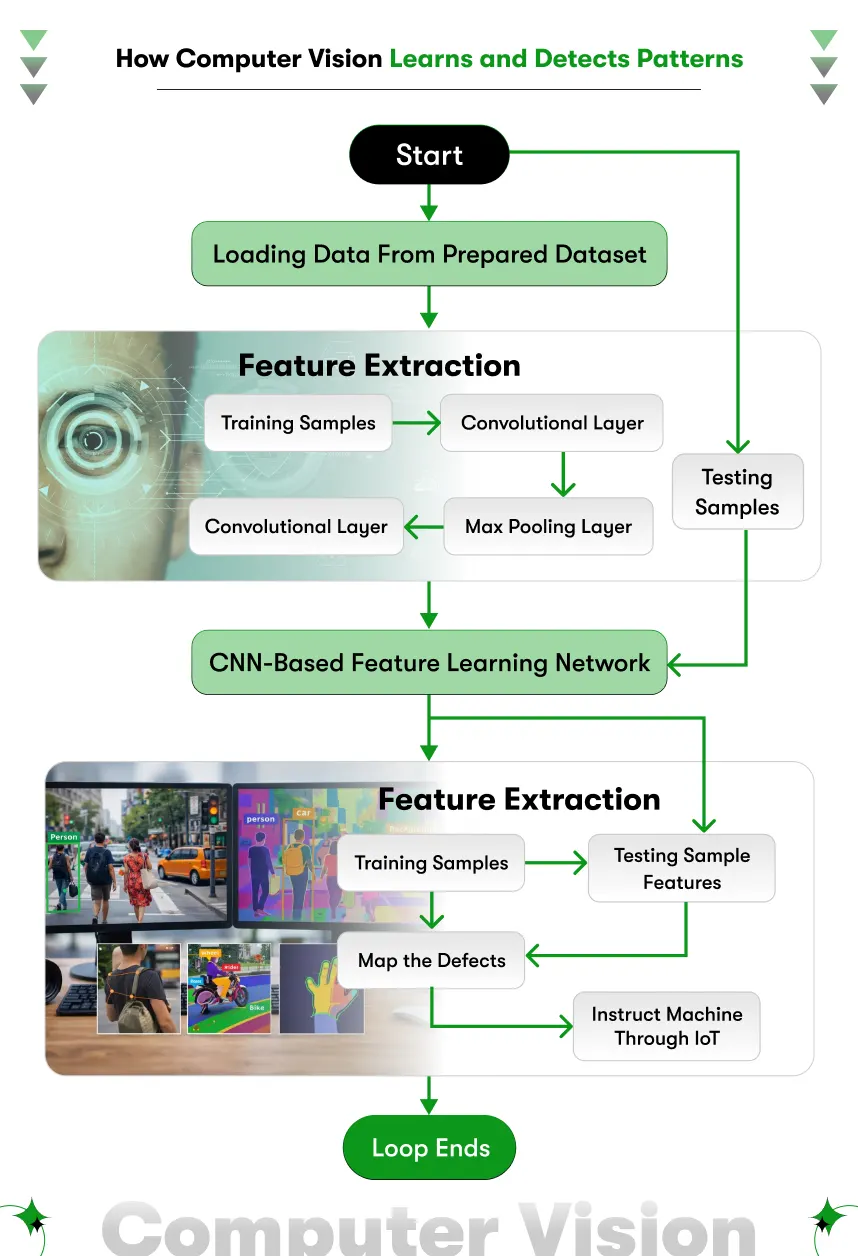
Production-level accuracy means accuracy that holds inside your real business operations, not inside test files. In computer vision software development, Computer Vision Development reaches production accuracy when data reflects real environments, real variation, and real error cost, allowing decisions to stay reliable after deployment, scale, and daily use.

Start with accuracy defined from a business point of view
Accuracy does not mean a single percentage number. Accuracy means whether the system makes the right decision often enough to protect revenue, cost, safety, or risk.
- Accuracy must reflect how costly a wrong decision becomes for the business.
- Different decisions demand different accuracy tolerance levels.
- Leadership teams must agree on what acceptable error looks like before data planning begins.
Once accuracy carries business meaning, data discussions stop sounding abstract and start becoming measurable.
Data volume follows decision complexity, not ambition
The amount of data needed depends on how complex the visual judgment is, not how advanced the system sounds.
- Simple visual checks require fewer examples when conditions remain consistent.
- Multi-condition or context-based decisions require broader and deeper data coverage.
- Higher business risk increases data needs because confidence margins shrink.
Clear decision scope prevents unnecessary data collection and wasted labeling effort.
Real-world variation matters more than raw image count
Ten thousand similar images teach very little. A few thousand varied examples teach far more.
- Data must reflect lighting changes across shifts, locations, and seasons.
- Camera angle differences must appear naturally within training data.
- Background noise, occlusion, and motion must receive proper representation.
Variation prepares computer vision development for real operations instead of controlled conditions.
Labeling quality shapes how fast and how well systems learn
Once data gets selected, labeling decides whether learning stays stable or collapses later. Labels do more than tag images. Labels teach the system what success means inside real business operations.
- Labels must represent actual business outcomes, not assumptions made during early planning.
- Shared definitions must guide every labeling decision to avoid conflicting interpretations.
- Review cycles must confirm alignment between business intent and labeled examples.
Strong labeling discipline reduces retraining effort and improves confidence during scale, which prepares the system for honest validation.
Validation confirms whether accuracy survives real operations
Validation answers one critical question. Can the system perform reliably where daily work happens, not where tests feel comfortable. Validation protects operations from silent failure after deployment.
- Validation datasets must remain separate from training data to prevent biased results.
- Performance checks must include edge cases and uncommon scenarios found in real usage.
- Missed detections and false alerts must receive equal business weighting.
Reliable validation creates confidence for production rollout and signals readiness for long term use.
Data requirements continue after deployment begins
Accuracy does not freeze at launch. Environments evolve, workflows change, and visual conditions shift over time. Data planning must reflect ongoing reality, not a one-time milestone.
- New data must capture layout changes, behavior shifts, and condition variation.
- Retraining schedules must stay planned, budgeted, and owned.
- Responsibility for data updates must remain clearly defined across teams.
Sustained accuracy depends on discipline and ownership, which separates production systems from short-lived pilots and mirrors proven computer vision examples used in live operations.
Accuracy should now feel defined, measurable, and grounded in business reality. Production-level accuracy belongs to your decision, your environment, and your tolerance for error, not to a model score on paper.
With this understanding, computer vision development moves from guesswork toward disciplined execution that supports long-term reliability, scale, and ownership.
Which Industries Benefit from Computer Vision Software Development?
Industries turn toward computer vision software development when visual judgment starts limiting growth, control, or consistency. Wherever people visually inspect, monitor, or verify something at scale, Computer Vision Development creates leverage. The benefit appears when software takes over repeatable visual decisions and applies them reliably across real operating environments.
Manufacturing and industrial operations
Manufacturing teams rely heavily on visual judgment for quality, safety, and process control. Computer vision application development reduces dependency on manual inspection and improves consistency at scale.
- Visual inspection systems detect defects, deviations, and anomalies earlier in production.
- Safety monitoring systems identify unsafe behavior or zone violations in real time.
- Process visibility improves through automated checks across shifts and facilities.
These capabilities help manufacturers reduce scrap, avoid downtime, and maintain consistent output without increasing labor pressure.
Retail, malls, and physical commerce
Retail environments generate constant visual data through stores, aisles, and customer movement. Computer vision development helps retail teams understand behavior and improve in-store performance.
- Footfall and movement analysis reveals how customers navigate physical spaces.
- Shelf monitoring systems identify stock gaps and placement issues.
- Loss prevention systems detect suspicious activity without disrupting shoppers.
Retail teams gain clearer insight into store performance and improve experience without relying on guesswork.
Logistics, warehousing, and supply chain operations
Logistics operations rely on visual confirmation at nearly every stage, from inbound receipt to outbound dispatch. Computer vision and software development help logistics teams replace slow manual checks with consistent, software-driven visibility across facilities.
- Package and pallet detection systems improve inventory visibility and reduce misplacement errors.
- Zone monitoring systems lower collision risk and improve safety compliance inside busy facilities.
- Process tracking systems highlight throughput gaps and recurring bottlenecks in material flow.
These capabilities allow logistics teams to move faster, reduce error-related costs, and maintain operational safety without increasing headcount.
Healthcare and life sciences
Healthcare environments demand high accuracy, traceability, and consistency in every visual decision. Computer vision software development supports teams where visual assessment directly affects patient outcomes and compliance standards.
- Imaging analysis systems assist clinical review and diagnostic workflows.
- Monitoring systems support patient safety and facility compliance without constant manual observation.
- Process verification systems improve accuracy in laboratories, pharmacies, and controlled environments.
Healthcare teams gain dependable decision support that improves reliability while reducing operational burden.
Smart buildings, infrastructure, and large facilities
Large facilities operate across complex layouts, high foot traffic, and continuous activity. Computer Vision Development provides real-time awareness that manual monitoring cannot maintain at scale.
- Occupancy analysis improves space utilization and supports informed energy planning.
- Access monitoring systems strengthen security controls and compliance enforcement.
- Maintenance detection systems identify visible wear or anomalies before failures disrupt operations.
Facility teams gain consistent operational control without relying on constant physical oversight.
Agencies and solution providers
Agencies adopt computer vision application development to deliver differentiated value to enterprise clients across industries. Strong execution builds long-term credibility and repeat business.
- Custom vision solutions expand agency service offerings beyond standard software delivery.
- Repeatable platforms support faster deployment across multiple client environments.
- Scalable systems improve client retention through measurable, long-term outcomes.
Agencies strengthen positioning by delivering reliable results tied to business impact rather than experimental technology.
Industries turn toward computer vision software development when visual judgment starts limiting growth, control, or consistency. Wherever people visually inspect, monitor, or verify something at scale, Computer Vision Development creates leverage. The benefit appears when software takes over repeatable visual decisions and applies them reliably across real operating environments.
Common Use Cases That Turn Computer Vision Software Development into Measurable Impact
Businesses turn to computer vision software development when visual work starts affecting speed, cost, or consistency across operations. Computer Vision Development fits where teams rely on repeated visual checks and outcomes vary across locations or shifts.
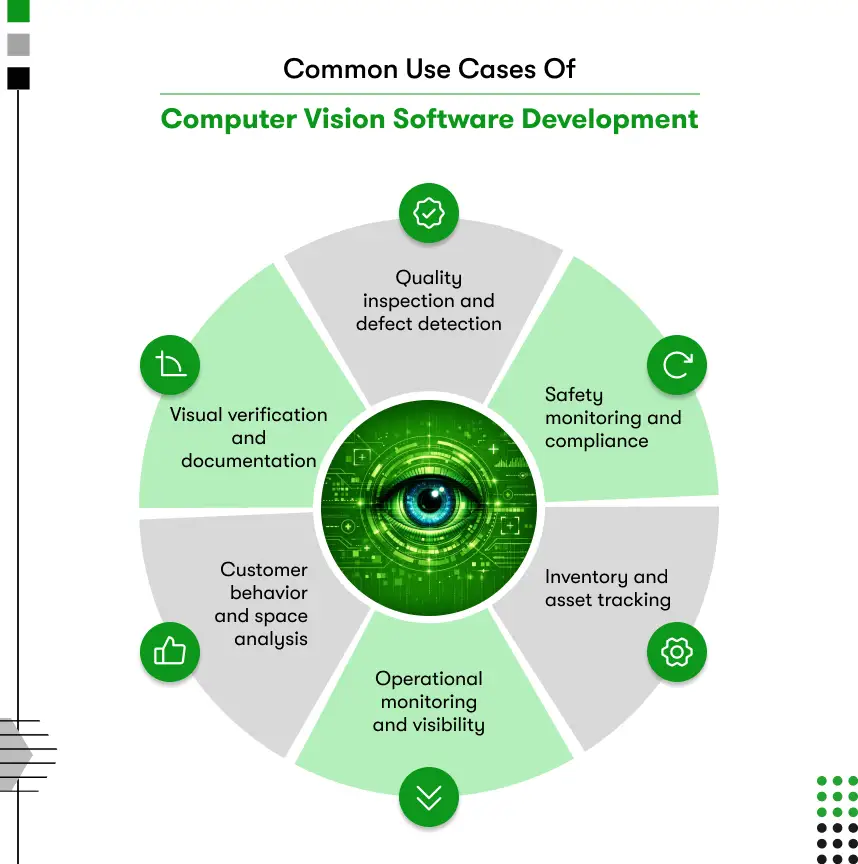
The use cases below show how computer vision application development delivers clear operational and financial value in real business environments.

Visual quality inspection and defect detection
Quality decisions often depend on human attention under time pressure. Variation across shifts, fatigue, and volume makes consistent inspection difficult at scale. Computer vision software development helps businesses standardize visual inspection without slowing throughput.
- Vision systems inspect surfaces, assemblies, or finished goods with the same criteria every time.
- Early defect detection prevents faulty output from moving deeper into operations.
- Consistent inspection standards reduce rework, scrap, and customer complaints.
Organizations use this approach when product quality directly affects margin, compliance, or brand trust.
Safety monitoring and compliance enforcement
Safety depends on continuous visual awareness across dynamic environments. Manual supervision cannot maintain the same level of coverage across large facilities or long operating hours. Computer Vision Development supports proactive safety control through constant observation.
- Vision systems detect unsafe behavior, restricted zone entry, or missing safety equipment.
- Real-time alerts support faster intervention before incidents escalate.
- Visual records strengthen audit readiness and accountability.
Operations with high safety exposure benefit from reduced incident rates and improved compliance confidence.
Inventory, asset, and material tracking
Inventory accuracy often suffers due to manual scans, missed confirmations, and reconciliation delays. Computer vision and software development improve tracking reliability across movement-heavy environments.
- Vision systems identify pallets, packages, and assets automatically during transfers.
- Location awareness reduces misplacement and reconciliation errors.
- Early discrepancy detection prevents downstream delays and inventory mismatches.
Warehousing and supply chain teams gain visibility without increasing operational friction.
Operational monitoring and process visibility
Many process inefficiencies remain hidden because visual confirmation happens intermittently. Computer vision application development provides continuous visibility into how work actually flows.
- Vision systems track movement patterns and process adherence across facilities.
- Bottlenecks appear through recurring visual behavior rather than manual reports.
- Exception detection allows teams to focus attention where intervention matters.
Operations teams use this capability to improve throughput and consistency without adding oversight layers.
Customer behavior and space usage analysis
Physical spaces generate constant visual signals about movement, engagement, and congestion. Manual observation rarely captures patterns accurately over time. Computer vision development turns observation into measurable insight.
- Movement analysis shows how people navigate aisles, zones, or entry points.
- Dwell time patterns reveal engagement areas and underutilized spaces.
- Layout decisions improve through observed behavior rather than assumptions.
Retailers, venues, and facility managers apply this use case to improve experience and utilization.
Visual verification and process documentation
Many processes require proof of correct execution for compliance or accountability. Manual documentation often introduces gaps and disputes. Computer vision software development automates verification with consistency.
- Vision systems confirm task completion through captured visual evidence.
- Documentation remains timestamped, standardized, and review-ready.
- Disputes reduce through objective records tied to actual activity.
Regulated operations benefit from improved traceability without additional reporting effort.
Common use cases now connect clearly with business outcomes rather than abstract capability, supported by real computer vision applications and examples seen in production environments. Each example shows where visual judgment limits scale and where software-driven decisions create practical leverage across operations.

Real-World Examples of Computer Vision Software Development
Large enterprises already run computer vision software development inside daily operations. Retailers use vision systems to audit shelves. Automotive firms use vision to inspect vehicles. Logistics operators use vision to track movement and verify handling. Computer vision development appears where manual visual work slows decisions or creates inconsistency at scale.
The examples below show how real companies apply computer vision application development in production environments, what problems those systems replaced, and what measurable outcomes followed.
Retail shelf monitoring and analytics with Trax
Trax Retail is a global company that uses computer vision technology to give consumer goods brands real-time insight into what is happening on store shelves across thousands of locations.
Trax systems capture shelf images, process them with vision models, and deliver data about product placement, stock levels, and planogram compliance.
Major brands such as Coca-Cola and Anheuser-Busch InBev use Trax’s solution to reduce out-of-stock losses, improve planogram compliance, and optimize promotional execution across markets.
- Trax’s vision systems identify products and measure shelf space across retail aisles.
- Analytics helps brands detect misplaced items and correct display inconsistencies.
- Automated reports reach category managers faster than traditional manual audits.
The result is improved on-shelf availability and execution precision that turns visual insights into better category performance.
Automated inventory scanning with Bossa Nova Robotics
Bossa Nova Robotics built autonomous robots deployed in retail stores that navigate aisles and capture shelf-level data for inventory accuracy. Retailers such as Walmart have tested these vision-enabled robots to reduce manual counting cycles and improve inventory visibility.
- Robots scan shelves using vision cameras while moving through store aisles.
- Inventory discrepancies appear in real time instead of weekly manual checks.
- Stock alerts and restock suggestions integrate with existing inventory systems.
This vision application accelerates inventory accuracy, reduces shrink, and frees staff from tedious visual tasks.
Automated vehicle inspection with UVeye
UVeye developed a computer vision platform that scans vehicles in seconds to detect damage, wear, or anomalies. The system is used by vehicle rental agencies, fleet operators, and automotive dealerships, including large clients such as Amazon, to inspect cars automatically.
- Vehicles drive through a vision inspection lane equipped with cameras and sensors.
- The software analyzes visual data to highlight dents, scratches, or undercarriage issues.
- Inspection reports generate in 20–30 seconds, replacing slow manual checks.
This real application delivers consistent inspection quality, faster turnaround times, and less human error.
Robotics and warehouse vision at Amazon
Amazon has invested heavily in warehouse automation that blends robotics with real-time visual awareness. Its proprietary systems use computer vision within robotics platforms to navigate facilities, pick items, and sort packages.
- Vision–enabled robots to perceive surroundings and avoid obstacles during tasks.
- Systems work alongside human teams to increase order fulfillment efficiency.
- Visual data feeds optimization engines that improve routing and storage decisions.
In practice, vision-driven automation supports faster delivery, lower fulfillment costs, and improved operational predictability.
Real deployments show how computer vision software development performs inside daily operations, not controlled environments. Computer vision software delivers value when visual work becomes a reliable decision system that improves speed, accuracy, and operational control.
For teams planning execution, the need to hire computer vision developers becomes clearer, making it easier to map opportunities inside existing processes and approach implementation with realistic expectations.
How Much Does Computer Vision Software Development Cost for a Real Business?
Computer vision software development cost depends on decision complexity, data readiness, deployment scale, and ownership expectations. Computer Vision Development projects for real businesses usually fall within predictable ranges when scope stays clear and production requirements guide design, validation, and long-term maintenance planning.
Typical cost ranges for computer vision software development projects
The table below reflects actual pricing observed in real commercial projects across the USA, UK, UAE, and similar enterprise markets. Pricing applies to custom computer vision application development, not packaged tools or research prototypes.
| Cost Area | What Businesses Pay For | Realistic Cost Range (USD) |
| Business discovery and solution design | Decision definition, feasibility assessment, architecture planning, and success criteria alignment. | $8,000 – $20,000 |
| Data preparation and labeling | Data audit, sampling, labeling rules, quality review, and dataset readiness. | $10,000 – $40,000 |
| Model training and validation | Custom model training, tuning, and validation under real operating conditions. | $25,000 – $80,000 |
| Application development and system integration | APIs, dashboards, workflow logic, and integration with existing software systems. | $20,000 – $70,000 |
| Deployment and infrastructure setup | Edge, cloud, or hybrid deployment configuration and performance tuning. | $8,000 – $25,000 |
| Monitoring and governance setup | Accuracy tracking, drift detection, access control, and update workflows. | $5,000 – $15,000 |
End-to-end project investment: $75,000 – $250,000
Factors that increase or reduce computer vision development cost
Cost changes based on business choices made early, not on technology branding.
- Multi-condition decisions cost more than simple visual pass or fail checks.
- Poor data quality increases labeling and retraining effort.
- Multi-location deployments raise integration and validation scope.
- Unclear ownership increases post-launch correction cost.
Clear scope definition keeps computer vision development cost controlled and predictable.
Ongoing costs businesses must plan after deployment
Production systems continue to incur cost after launch, and clear planning protects long-term accuracy and stability. A practical understanding of computer vision software development cost helps teams evaluate ownership beyond initial build and avoid surprises later.
- Compute and storage cost grows with image and video volume processed.
- Periodic retraining requires fresh data and validation effort.
- Monitoring and support effort ensures accuracy stays within defined tolerance.
Annual operating budgets usually range between 15 and 30 percent of initial development investment.
Why transparent pricing matters during partner selection
Extremely low quotes often ignore data work, validation, or ownership planning. Inflated quotes often bundle unnecessary complexity. Realistic pricing signals delivery experience and production accountability.
Kody Technolab Limited delivers custom AI automation and computer vision software development with honest scoping and production-first planning. Kody teams align cost with business impact, define ownership clearly, and build systems designed for long-term operation inside real business environments.
Which KPIs Improve After Deploying Computer Vision Software?
Deployment of computer vision software shifts performance measurement from effort to outcomes. Visual decisions handled by software start influencing efficiency, accuracy, cost control, and risk exposure across daily operations. Computer vision development proves value when operating KPIs move in visible, trackable ways that leadership teams already monitor and report.
Operational efficiency KPIs
Operational teams track efficiency improvements first because visual automation removes delays caused by manual checks.
- Process cycle time typically improves between 10 and 30 percent after deployment.
- Manual visual inspection effort often reduces by 40 to 70 percent.
- Throughput consistency improves across shifts and locations.
As efficiency stabilizes, attention naturally moves toward whether decisions remain correct under pressure, not only fast.
Accuracy and quality KPIs
Accuracy matters only when accuracy protects revenue or prevents loss. Production teams measure accuracy through outcome stability.
- Defect escape rates commonly reduce between 30 and 60 percent.
- Inspection consistency improves across facilities and operating hours.
- Rework and scrap costs often drop between 10 and 25 percent.
Once quality stabilizes, leadership starts asking how much effort and cost the system removes from daily operations.
Cost and resource utilization KPIs
Finance and operations leaders evaluate whether Computer Vision Development controls cost while scaling output.
- Cost per inspection or verification decreases after automation replaces manual effort.
- Labor hours spent on repetitive visual work reduce significantly.
- Overtime and reinspection costs decline as consistency improves.
Computer vision application development supports predictable cost structures at scale.
Safety and risk KPIs
Safety improvements appear when visual monitoring becomes continuous rather than intermittent.
- Safety violations surface earlier, often improving detection rates by 30 to 50 percent.
- Incident response time shortens due to faster alerts.
- Compliance reporting accuracy improves across facilities.
Computer vision development supports risk reduction through early visibility and faster intervention.
Decision speed and response time KPIs
Visual decisions lose value when response arrives late. Deployment reveals how quickly teams can act once detection becomes immediate.
- Time from event detection to action reduces from minutes to seconds.
- Escalation delays decrease as responsibility becomes clearer.
- Response consistency improves across locations handling similar events.
As response speed improves, stability over weeks and months becomes the real test.
Long-term stability and performance drift KPIs
Short-term gains mean little without durability. Mature teams track whether performance holds as conditions change.
- Accuracy drift stays within defined tolerance ranges over time.
- System availability aligns with operational uptime expectations.
- Processing cost per image or video minute remains predictable at scale.
Sustained stability confirms readiness for long-term ownership rather than short-lived success.
Deployment success becomes visible through measurable movement in daily metrics. Tracking the right KPIs turns computer vision development from a technical initiative into an operational asset. Strong KPI movement allows organizations to judge readiness, challenge vendors with clarity, and commit investment with confidence, often supported by early computer vision consulting that aligns metrics with real performance change.

Conclusion
Computer vision software development decisions carry long-term impact on cost, control, and competitive position. Successful outcomes come from clarity, discipline, and the right execution partner, not from rushing pilots or chasing surface-level accuracy. Throughout this guide, the focus stayed on business decisions, real operating conditions, measurable KPIs, and production ownership. Each section aimed to prepare leadership teams to ask sharper questions, spot hidden risks early, and plan deployments with confidence.
Computer Vision Development works best when strategy leads technology. Data relevance matters more than volume. Integration matters more than demos. Governance matters more than launch speed. Organizations that treat computer vision as a core business system gain consistency, visibility, and scale without adding operational burden.
Kody Technolab Limited supports enterprises and agencies worldwide as a trusted computer vision software development company, delivering custom AI automation software built for production reality. Kody teams guide planning, architecture, data strategy, deployment, and long-term ownership aligned with unique business needs. For leaders ready to move from evaluation to execution, Kody designs computer vision solutions that deliver measurable results inside real operations.
FAQs
1. How do we know computer vision fits our business problem?
Computer vision fits when teams rely on repeated visual checks that affect cost, speed, safety, or quality. If people visually inspect, verify, monitor, or count as part of daily work, computer vision software development usually offers measurable value.
2. What usually causes computer vision projects to fail in production?
Most failures come from unclear business decisions, poor data relevance, weak validation, or lack of ownership after deployment. Technical capability alone does not protect outcomes without alignment between data, operations, and long-term maintenance plans.
3. How long does it take to deploy a production-ready computer vision system?
Timelines depend on data readiness and decision complexity. Many production deployments take between three and six months when scope remains clear and environments remain stable. Extended pilots often signal missing clarity rather than technical difficulty.
4. Do we need a large internal AI team to manage computer vision systems?
Most organizations do not need large internal teams. A reliable computer vision software development company handles architecture, training, and monitoring while internal teams focus on decision ownership and business outcomes.
5. How much data do we actually need to achieve reliable accuracy in computer vision?
Accuracy refers to the correctness of the visual decision your system is designed to make, such as defect detection, safety violation identification, item recognition, or process verification. Data requirements depend on how complex that decision is and how much visual variation exists in real operations.
6. What KPIs should we track after deploying computer vision software?
KPIs should measure the performance of the deployed computer vision system inside live operations, not model behavior in isolation. Teams typically track inspection accuracy for the defined visual task, response time from detection to action, reduction in manual visual effort, cost per visual decision, safety incident frequency, and consistency of outcomes across locations.
7. How do we control costs after the computer vision system goes live?
Cost control means managing the ongoing operational cost of the deployed computer vision system, including compute usage, data storage, retraining effort, and support. Control comes from tracking processing volume, setting defined retraining schedules, and selecting infrastructure that matches real usage, which prevents unexpected increases in cloud and maintenance costs.