


Quick Summary: Industrial teams exploring Computer Vision for Industries often face unclear choices and hidden risks. The guide explains where computer vision creates measurable value, how readiness affects outcomes, and which decisions protect budgets. Readers gain practical insight on ROI, deployment pace, integration, security, and scaling, enabling confident planning and informed partner selection.
Operational breakdowns force leadership teams to reassess inspection and monitoring practices. Missed defects, delayed audits, rising rework costs, and limited visibility highlight the need for computer vision for industries as a practical control mechanism. Manual inspection struggles to maintain accuracy and pace once volume and complexity increase.
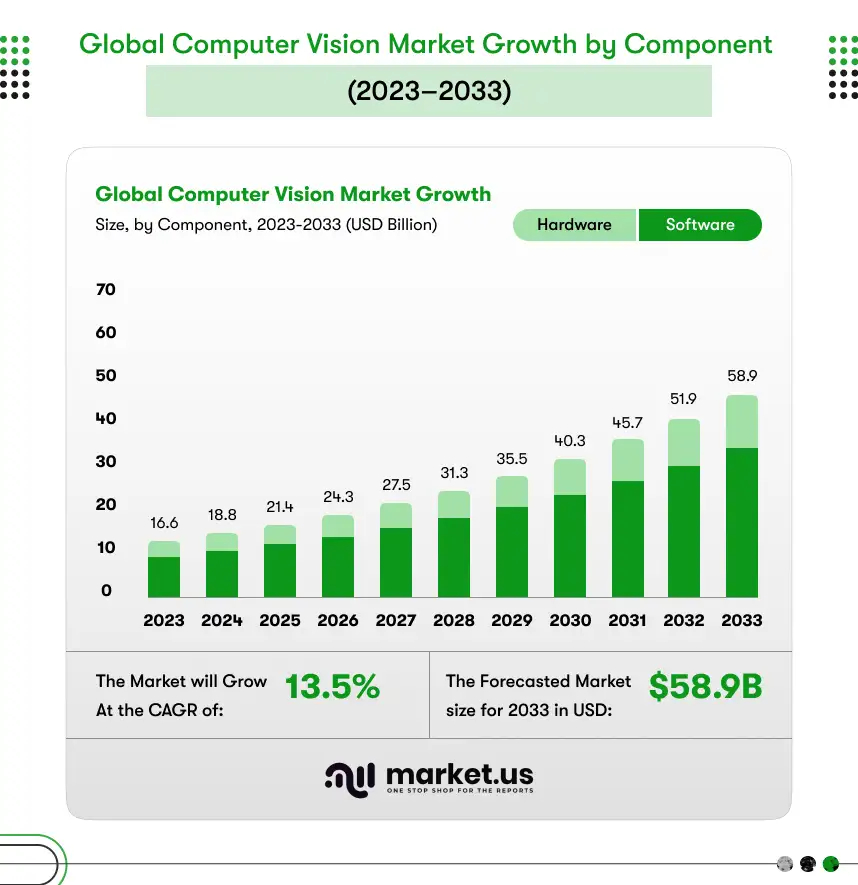
Adoption expands because results remain measurable. Continuous visual inspection reduces scrap, lowers repeat work, and strengthens compliance reporting. Those outcomes explain steady investment growth from USD 16.6 billion in 2023 toward an expected USD 58.9 billion by 2033. A 13.5% annual growth rate reflects confidence in proven returns.
Many computer vision programs stall after early deployment phases. Common causes include weak data preparation, unstable environments, undefined success criteria, and development partners without industrial depth. Software capability alone does not determine success.
This guide explains planning steps, validation methods, and partner evaluation criteria for custom computer vision software development. Each section helps decision makers move forward with clarity and confidence.
Want a clear understanding of how computer vision works and how computer vision in industries operates in real operations, then read our Computer Vision Development Guide.
What Industries Use Computer Vision for Industries?
Visual inspection problems appear across many sectors, not just in manufacturing. Any operation that depends on cameras, human observation, or visual confirmation faces similar limits at scale. Computer vision adoption increases where visual errors create cost, risk, or compliance exposure. Industry type matters less than the role visual judgment plays inside daily workflows.

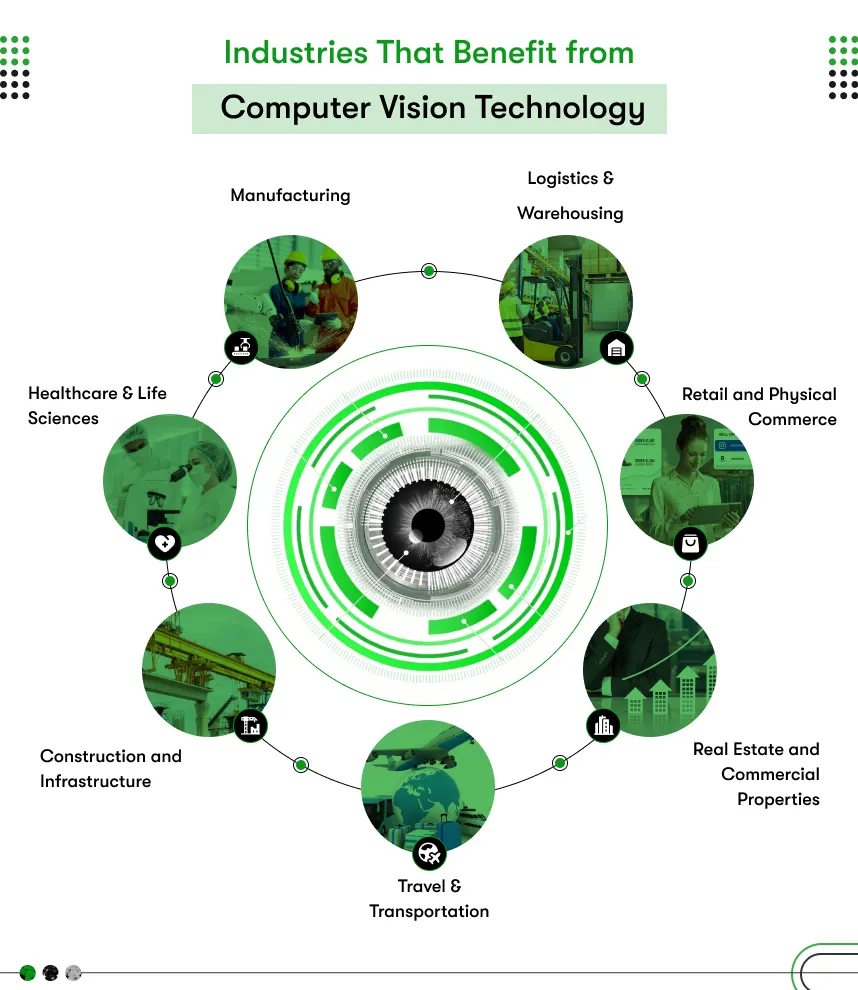
Computer Vision in Industries appears wherever visual decisions affect operational outcomes. Manufacturing organizations apply industrial computer vision applications for defect detection, assembly verification, and surface inspection, enabling continuous checks across shifts and production lines.
Logistics and warehousing operations use AI computer vision for Industries to track pallets, verify loads, and monitor movement, improving inventory accuracy without manual counting. Retail operations apply computer vision to shelf compliance, store audits, and loss prevention, which improves consistency across physical locations.
Healthcare and life sciences teams rely on industrial computer vision solutions for imaging analysis and process validation within regulated workflows. Energy, utilities, and large infrastructure operators use computer vision technology in Industry for asset inspection, safety monitoring, and early anomaly detection across wide sites.
Construction and smart infrastructure projects adopt computer vision in different industries for site monitoring, progress validation, and safety enforcement, using computer vision examples such as activity tracking, hazard detection, and compliance checks. Adoption follows operational pressure tied to cost control, risk management, and accountability.
What Specific Business Problems Can Computer Vision for Industries Solve?
Organizations rarely seek computer vision out of curiosity. The search begins after recurring issues surface inside daily operations. Defects escape inspection. Safety checks lose consistency. Process delays hide inside visually driven workflows. These problems share a common root. Visual decisions lack structure and repeatability.
Core business problems computer vision addresses
Industrial operations rely heavily on visual judgment across quality, safety, and process control. As volume and complexity increase, human inspection struggles to maintain accuracy, speed, and accountability.
Quality inconsistency across operations
Quality variation increases when inspection depends on human attention and shift-based judgment. Understanding how computer vision works helps teams see why automated visual checks apply the same decision logic to every unit, preventing defects from passing through production unnoticed.
- Manual inspection accuracy declines under fatigue, time pressure, and production volume.
- Industrial Computer Vision Applications apply identical inspection rules to every unit without deviation.
- Early defect detection reduces scrap, rework, warranty claims, and downstream customer issues.
Lack of real-time operational visibility
Operational decisions often rely on delayed reports instead of live conditions. Delayed insight increases response time and magnifies losses.
- Manual reporting reflects historical conditions rather than current operational states.
- AI Computer Vision for Industries converts visual activity into structured, real-time operational data.
- Operations teams respond faster to deviations across production lines, warehouses, and facilities.
Safety risks and compliance exposure
Large sites and high-risk zones challenge consistent human supervision. Missed violations increase incident risk and regulatory exposure.
- Human monitoring struggles to maintain continuous coverage across expansive environments.
- Industrial Computer Vision Solutions monitor restricted zones and safety compliance continuously.
- Visual records support audits, investigations, and regulatory reporting with objective evidence.
Hidden process inefficiencies
Visually driven workflows often hide bottlenecks that traditional metrics fail to capture. Process delays compound when visibility remains limited.
- Bottlenecks remain unnoticed inside complex movement and assembly workflows.
- Computer Vision Technology in Industry identifies abnormal motion patterns and process delays.
- Process teams improve throughput and resource utilization using visual performance data.
Asset degradation and failure risk
Large assets degrade gradually, making early warning difficult through manual inspection alone. Missed indicators increase downtime and repair costs.
- Manual inspections miss early signs of wear across distributed assets.
- How Computer Vision Is Used in Industries includes visual anomaly detection for critical infrastructure.
- Maintenance teams address risks earlier and avoid unplanned failures.
Computer vision succeeds when applied to specific, measurable problems. Teams evaluating Computer Vision Project Ideas see stronger results in quality, safety, efficiency, and asset health when visual judgment moves from individual interpretation to consistent system-based analysis.
What ROI Can Businesses Expect from Computer Vision for Industries?
Investment discussions focus quickly on returns. Leaders want to understand where savings appear and how fast impact becomes visible. Computer vision affects costs tied directly to inspection, rework, labor, compliance effort, and response time. Financial value depends on where visual control influences daily decisions.

How ROI materializes across industrial operations
Return on investment depends on where visual decisions influence cost, risk, or throughput. Computer Vision in Industries produces value when visual inspection shifts from sampling to continuous control, supported by Computer Vision Tools that apply consistent rules across every inspection point.
Quality cost reduction
Quality failures carry direct and indirect financial impact. Defects increase scrap, warranty claims, and customer escalations.
- Industrial Computer Vision Applications detect defects earlier within production flows.
- Early detection prevents defective units from reaching downstream stages.
- Manufacturing teams see measurable reductions in scrap, rework, and returns.
Labor efficiency and productivity
Manual inspection consumes skilled labor without scaling effectively. Volume growth increases inspection cost faster than output.
- AI Computer Vision for Industries performs continuous inspection without fatigue.
- Teams reassign skilled staff from repetitive checks to higher-value work.
- Labor cost per unit declines as throughput increases.
Compliance and risk cost avoidance
Audits, incidents, and non-compliance generate financial exposure beyond fines.
- Industrial Computer Vision Solutions maintain visual records for audits and investigations.
- Compliance teams reduce preparation time and audit disruption.
- Organizations avoid shutdowns, penalties, and reputational damage.
Faster operational decisions
Delayed insight increases loss magnitude.
- Computer Vision Technology in Industry converts visual activity into near real-time data.
- Operations leaders correct deviations earlier within production and logistics flows.
Predictable returns come from disciplined scope, clear metrics, and tight integration with existing operations. Organizations that treat Computer Vision for Industries as an operational system rather than an experiment achieve sustained financial impact over time.
Will Computer Vision Work Reliably in Real Industrial Environments?
Reliability remains the primary concern during computer vision evaluation. Industrial environments introduce constant variation across lighting, motion, temperature, and surface conditions. Vision systems maintain accuracy only when software design, data preparation, and hardware selection reflect daily operating conditions from the start.
Reliability depends on how well the system matches physical operating conditions
Industrial environments differ from lab settings in every way that affects vision accuracy. Reliability improves when software design reflects real workflows, equipment behavior, and environmental stress, as seen across proven Computer Vision Applications and Examples deployed in live operations.
How lighting conditions affect computer vision accuracy
Lighting varies across shifts, seasons, and facility layouts. Poor control causes glare, shadows, and contrast loss that reduce detection accuracy.
- Industrial Computer Vision Applications require training data that reflects actual lighting conditions on site.
- Camera placement and lens selection reduce glare, blur, and inconsistent exposure.
- Supplemental lighting stabilizes image quality in critical inspection zones.
How motion and vibration impact vision performance
Production lines, conveyors, and mobile equipment introduce motion and vibration that distort images.
- AI Computer Vision for Industries uses high-frame-rate cameras to capture fast-moving objects.
- Mechanical mounting isolates cameras from vibration sources.
- Model training includes motion blur and angle variation to maintain accuracy at speed.
How environmental stress affects long-term system stability
Dust, heat, humidity, and temperature fluctuation degrade equipment and image quality over time.
- Industrial Computer Vision Solutions rely on ruggedized cameras and sealed enclosures.
- Edge processing limits dependence on unstable networks.
- Hardware specifications align with site-specific environmental exposure.
How operational change causes model performance decline
Layout changes, new products, and material variation alter visual patterns inside operations.
- Computer Vision Technology in Industry requires periodic performance reviews against defined benchmarks.
- Controlled retraining cycles maintain accuracy after process changes.
- Monitoring dashboards track drift before failures occur.
Sustained performance depends on disciplined engineering and ongoing validation. Systems built around real operating constraints continue delivering stable results despite environmental change, process updates, and long production cycles.

Which industries benefit most from computer vision technology
Computer vision technology transforms industries by automating visual tasks, enhancing quality control, and increasing efficiency. Industries like manufacturing, logistics, retail, and healthcare benefit from using computer vision to reduce costs, improve safety, and optimize operations. Vision systems drive business value through consistent, real-time decision-making.
Manufacturing
Computer vision in manufacturing plays a critical role in defect detection, assembly verification, and surface inspection. It allows businesses to detect issues early in production, improving quality control and minimizing costs associated with defects.
Use Cases of Computer Vision in Manufacturing
- Defect Detection: Computer vision systems analyze the products during production, automatically identifying any defects, such as surface imperfections or dimensional deviations. This ensures that faulty products are removed before they can progress to the next production stage, preventing them from reaching customers.
- Assembly Verification: Vision systems inspect assembly lines to ensure that parts are correctly positioned and aligned. This eliminates human errors, reducing costly rework and assembly mistakes. Ensuring that every component is correctly assembled leads to fewer issues with product quality.
- Surface Inspection: Computer vision systems continuously scan surfaces for defects, ensuring a uniform finish across products. This is especially important in industries that rely on precise surface quality, such as automotive and electronics manufacturing.
How Computer Vision Can Benefit Manufacturing
- Improved Quality Control: Continuous and automated quality checks allow manufacturers to detect defects in real time, ensuring only products that meet quality standards reach the market. This improves brand reputation and reduces the risk of costly product recalls.
- Cost Reduction: Identifying defects early in production reduces scrap and rework costs. By eliminating manual inspection, companies save on labor costs and increase the speed of production, leading to better resource utilization.
- Higher Throughput: With automated inspection processes, manufacturers can keep production lines running faster while maintaining high-quality standards. This leads to an increase in throughput without sacrificing product quality.
Logistics and Warehousing
Logistics and warehousing operations benefit greatly from computer vision, improving inventory management, tracking shipments, and optimizing warehouse organization. This leads to faster, more accurate order fulfillment and reduced operational errors.
Use Cases of Computer Vision in Logistics and Warehousing
- Inventory management: Real-time tracking and monitoring of products ensure accurate stock levels, preventing discrepancies.
- Pallet verification: Vision systems confirm pallet contents, reducing errors in shipping and receiving.
- Movement tracking: Continuous monitoring of material movement ensures proper handling and improves efficiency.
How Computer Vision Can Benefit Logistics and Warehousing
- Reduced errors: Automates tracking and verification, lowering the risk of human mistakes.
- Faster fulfillment: Real-time monitoring speeds up order processing and delivery.
- Cost efficiency: Reduces labor costs by automating tasks traditionally performed manually.
Retail and Physical Commerce
Retailers rely on computer vision in retail for shelf monitoring, loss prevention, and store audits. Vision systems support product availability, planogram compliance, and shrinkage reduction. Businesses gain better stock accuracy and improved customer experience across locations.
Use Cases of Computer Vision in Retail and Physical Commerce
- Shelf monitoring: Ensures products are always in stock and properly arranged for customers to find easily.
- Loss prevention: Detects theft and suspicious activity, reducing shrinkage and improving security.
- Customer behavior analysis: Tracks how customers interact with products, providing insights for better layout and placement.
How Computer Vision Can Benefit Retail and Physical Commerce
- Improved stock accuracy: Automates inventory management, ensuring accurate and up-to-date product availability.
- Enhanced customer experience: Reduces stockouts and enhances the shopping experience with consistent product availability.
- Reduced shrinkage: Prevents theft by continuously monitoring and tracking movements in the store.
Healthcare and Life Sciences
Healthcare organizations use computer vision for imaging analysis, workflow verification, and quality checks. Vision improves consistency in regulated processes, reduces manual review effort, and strengthens compliance documentation. Better accuracy supports patient safety and operational reliability.
Use Cases of Computer Vision in Healthcare and Life Sciences
- Medical imaging analysis: Vision systems analyze X-rays, MRIs, and CT scans for accurate disease detection.
- Workflow verification: Ensures medical protocols are followed, reducing human error in patient care.
- Regulatory compliance: Validates processes to ensure medical practices meet industry standards.
How Computer Vision Can Benefit Healthcare and Life Sciences
- Improved diagnostic accuracy: Automates image analysis, providing more consistent and reliable diagnostic results.
- Enhanced patient safety: Ensures compliance with medical protocols and reduces the risk of human error.
- Operational efficiency: Reduces manual workload by automating routine tasks, allowing medical professionals to focus on patient care.
Real Estate and Commercial Properties
Real estate operators use computer vision for footfall analysis, security monitoring, and facility management. Vision systems provide insight into visitor movement, space utilization, and safety compliance. Property managers improve tenant experience, optimize layouts, and strengthen operational oversight.
Use Cases of Computer Vision in Real Estate and Commercial Properties
- Footfall analysis: Monitors the movement of people in commercial spaces to optimize layouts and improve customer engagement.
- Security monitoring: Detects unauthorized access and ensures compliance with safety regulations.
- Facility management: Tracks the condition of assets, optimizing maintenance schedules and reducing downtime.
How Computer Vision Can Benefit Real Estate and Commercial Properties
- Optimized space usage: Helps maximize property value by improving space utilization and layout efficiency.
- Enhanced security: Increases tenant safety by continuously monitoring premises for unauthorized activity.
- Reduced maintenance costs: Automates facility management tasks, preventing issues before they escalate.
Travel and Transportation
Computer vision for travel apply by travel hubs and transport operators for passenger flow monitoring, safety enforcement, and operational coordination. Vision systems support crowd management, queue optimization, and incident detection. Businesses improve service efficiency, safety response, and overall traveler experience.
Use Cases of Computer Vision in Travel and Transportation
- Passenger flow monitoring: Tracks passenger movement to optimize queue management and prevent bottlenecks.
- Automated security checks: Vision systems identify prohibited items in luggage, speeding up security processes.
- Incident detection: Monitors for safety violations or emergencies, ensuring swift responses.
How Computer Vision Can Benefit Travel and Transportation
- Improved passenger experience: Reduces waiting times and enhances the travel experience with automated check-ins and smoother transitions.
- Enhanced safety: Automates security checks, improving detection and preventing potential threats.
- Operational efficiency: Optimizes crowd management and queueing, leading to faster boarding times and reduced delays.
Construction and Infrastructure
Construction teams use computer vision for site monitoring, progress tracking, and safety compliance. Vision systems improve reporting accuracy, detect delays earlier, and strengthen safety enforcement. Projects benefit from better visibility, reduced risk, and tighter schedule control.
Use Cases of Computer Vision in Construction and Infrastructure
- Site monitoring: Continuously checks worksite conditions to ensure safety and compliance with regulations.
- Progress tracking: Tracks construction milestones, ensuring projects stay on schedule and within budget.
- Safety compliance: Monitors workers for proper safety gear and adherence to protocols, reducing accidents.
How Computer Vision Can Benefit Construction and Infrastructure
- Reduced risk: Ensures safety compliance, reducing accidents and preventing costly delays.
- Better project visibility: Tracks progress in real-time, providing insights to keep projects on schedule.
- Improved reporting: Automates data collection and reporting, providing accurate and up-to-date project status.
Each industry adopts computer vision to solve different operational problems, but the driver remains the same. Reduce errors, improve visibility, and maintain control as operations scale. Results appear when computer vision targets workflows where visual decisions directly affect cost, safety, efficiency, or customer experience.
How Does Computer Vision Integrate with Existing Systems?
Computer Vision for Industries integrates with existing systems through structured data pipelines that connect vision outputs to MES, ERP, WMS, PLCs, and analytics platforms. Industrial Computer Vision Solutions deliver value when integration respects latency needs, data ownership, and established operational workflows.
Integration depends on alignment with existing operational architecture
Industrial environments already operate through layered technology stacks that manage execution, control, and reporting. Computer vision delivers value only when visual intelligence strengthens current systems instead of introducing parallel tools or workflow disruption.
Integration with manufacturing execution and control systems
Manufacturing operations rely on MES and PLC platforms for real-time control, traceability, and quality governance. Vision systems must exchange signals with those platforms in a predictable and auditable manner.
- Industrial Computer Vision Applications send inspection outcomes to MES for quality records and audit traceability.
- PLC systems receive vision-based signals to trigger reject mechanisms, alerts, or controlled line actions.
- Inspection results link directly with batch numbers, lot identifiers, and serial records.
- Production teams gain consistent quality data without manual logging or separate tracking systems.
Integration with enterprise business platforms
Enterprise platforms manage planning, costing, and performance accountability. Vision data becomes operationally meaningful after connection with business systems.
- AI Computer Vision for Industries feeds defect trends, yield metrics, and downtime indicators into ERP platforms.
- Operations leaders review visual performance through existing dashboards and reporting tools.
- Finance teams correlate inspection outcomes with scrap cost, rework effort, and margin impact.
- Business teams maintain a single source of operational truth instead of fragmented reports.
Architecture choices shape integration reliability
Integration strategy depends on response time, data volume, and system resilience. Architecture decisions influence stability across daily operations.
Role of edge processing in system integration
Low-latency response remains critical inside production and material handling workflows. Edge processing supports real-time execution.
- Industrial Computer Vision Solutions perform image processing close to cameras and control systems.
- Edge deployment reduces dependency on network availability for time-sensitive decisions.
- Control actions execute without delay inside operational environments.
Role of cloud platforms in enterprise integration
Enterprise reporting and analytics require aggregation and long-term storage.
- Cloud platforms collect vision results for analytics, reporting, and historical analysis.
- Centralized data supports trend analysis and performance benchmarking.
- Hybrid architectures balance real-time execution with enterprise visibility.
Data governance and security define long-term integration success
Vision systems generate operational data that affects compliance, accountability, and risk exposure. Governance planning prevents future operational issues.
Data access, storage, and retention planning
Clear governance rules protect data integrity and compliance.
- Computer Vision Technology in Industry enforces controlled access across vision data pipelines.
- Storage policies align with internal security standards and regulatory requirements.
- Retention rules define availability of visual records for audits and investigations.
- Ownership boundaries prevent misuse or uncontrolled data exposure.
Integration planning protects daily workflows
Poor integration creates friction across teams and slows adoption. Strong planning preserves existing workflows and user familiarity.
Workflow alignment and operational continuity
Vision insights must fit naturally into daily operations.
- Vision outputs appear inside interfaces operators already use.
- Engineering teams manage fewer system dependencies and maintenance points.
- Operations continue without process disruption or retraining burden.
Integration determines whether computer vision strengthens operations or adds complexity. Clear integration planning also clarifies Computer Vision Software Development Cost, since vision systems deliver durable value only when visual intelligence flows cleanly into existing execution, control, and business platforms while preserving operational continuity.
How quickly can computer vision be deployed and scaled?
Deployment speed depends on problem clarity, data availability, and environment stability. Computer Vision for Industries deploys faster when scope remains focused, validation happens early, and Industrial Computer Vision Solutions integrate with existing workflows instead of creating parallel systems.
Deployment of computer vision software depends on operational readiness
Computer vision deployment refers to building, validating, and running vision models inside live industrial workflows. Timelines vary based on how prepared the organization is across data, infrastructure, and decision ownership.
Deployment steps involved in a computer vision implementation
The initial deployment phase focuses on proving accuracy and operational fit under real conditions.
- Teams first review available image or video data generated during normal operations.
- Data preparation and labeling follow to ensure training data reflects real lighting, motion, and material variation.
- Model training and validation confirm performance against clearly defined acceptance criteria.
- Pilot deployment runs inside live workflows while teams monitor accuracy and operational impact.
Factors that delay computer vision deployment
Deployment slows when foundational decisions remain unclear.
- Poor or inconsistent data quality increases retraining cycles and validation time.
- Undefined success metrics prevent teams from deciding when pilots should move into production.
- Unassessed environmental variation causes repeated accuracy degradation.
- Late integration discovery introduces rework across control and reporting systems.
Scaling computer vision across production lines and facilities
Scaling computer vision means expanding deployment beyond a single use case, line, or site while maintaining consistent performance. Computer Vision in Industries scales reliably only when repeatability becomes part of system design.
Scaling computer vision across multiple operational environments
Each new site introduces variation that must be handled deliberately.
- AI Computer Vision for Industries scales faster when models train on diverse operating conditions early.
- Standardized camera placement and lighting reduce performance differences between locations.
- Consistent hardware specifications simplify maintenance and operational support.
- Central performance monitoring maintains visibility across all deployed systems.
Ownership and responsibility during scaled deployment
Clear ownership prevents performance decline during expansion.
- Engineering teams manage model updates, retraining, and validation schedules.
- Operations teams monitor daily accuracy and respond to exceptions.
- Business teams track financial and operational impact using consistent metrics.
Technology choices affect deployment speed and scaling effort
Architecture decisions influence how easily systems grow without disruption.
Role of modular software architecture in computer vision scaling
Modular design reduces friction during expansion.
- Industrial Computer Vision Solutions separate data ingestion, processing, and output layers.
- New workflows integrate without modifying existing deployments.
- Expansion avoids full system redesign or operational downtime.
Infrastructure planning required for scalable deployment
Infrastructure readiness supports growth without performance loss.
- Edge processing supports low-latency decisions inside operational environments.
- Central platforms aggregate results for analytics and long-term performance tracking.
- Compute capacity scales in line with operational growth.
Deployment speed improves when teams prepare data, scope, and integration early, often guided through focused computer vision consulting during initial planning. Scaling succeeds when systems support repeatability, ownership, and operational consistency. Organizations that plan deployment and expansion together avoid stalled pilots and uneven results.
Is the solution secure, compliant, and ready for global operations?
A computer vision solution becomes ready for global operations when security controls, compliance governance, and operational standards remain embedded throughout design and deployment. Industrial Computer Vision Solutions meet enterprise expectations through controlled data handling, audit readiness, and consistent execution across regions.
Security readiness depends on how visual data moves and stays protected
Computer vision systems generate sensitive operational data that influences quality decisions, safety actions, and compliance reporting. Security planning must address data flow, access control, and system boundaries across all environments.
How computer vision systems secure operational and visual data
Security begins with strict control over data access and movement.
- Computer Vision Technology in Industry enforces role-based access policies that limit data visibility to authorized personnel only.
- Encrypted communication protects image data and metadata during transfer between cameras, edge devices, and enterprise systems.
- Segmented system architecture separates vision pipelines from core operational platforms to limit exposure.
- Detailed logging records access activity and configuration changes to support accountability and audits.
How deployment architecture influences security posture
Deployment architecture plays a critical role in data exposure and risk control.
- AI Computer Vision for Industries processes visual data at edge locations to reduce unnecessary data movement.
- On-premise and hybrid deployments support organizations with strict internal security and network policies.
- Centralized monitoring detects abnormal access patterns and system behavior early.
Compliance readiness depends on traceability and governance discipline
Regulated industries require consistent records, process transparency, and audit-ready evidence. Computer vision systems must support compliance requirements without relying on manual documentation.
How computer vision supports regulatory and audit obligations
Compliance relies on verifiable and structured records.
- Industrial Computer Vision Applications store visual evidence with timestamps and operational context.
- Defined retention policies ensure visual records remain available for audits and investigations.
- Controlled versioning tracks changes across models, configurations, and inspection logic.
How governance supports regional regulatory requirements
Global operations face varying data and compliance regulations.
- Industrial Computer Vision Solutions support region-specific data storage and access requirements.
- Governance frameworks define data ownership, usage boundaries, and approval processes.
- Compliance teams review policies and records without disrupting daily operations.
Global readiness depends on consistency across locations and teams
Expanding computer vision across regions requires repeatable standards rather than custom implementations for every site.
How computer vision systems support global operational consistency
Consistency reduces risk during expansion.
- Computer Vision in Industries scales more reliably when camera standards and validation methods remain consistent across locations.
- Central performance benchmarks provide visibility into accuracy and system health across regions.
- Local operations follow shared governance and escalation processes.
How operational accountability supports global deployment
Clear ownership prevents performance drift across regions.
- Engineering teams manage model lifecycle, validation schedules, and updates across locations.
- Operations teams monitor daily performance and handle location-specific exceptions.
- Business teams track operational and financial impact using standardized metrics.
Security, compliance, and global readiness define long-term success. Organizations that hire computer vision developers with experience in governance, architecture, and enterprise accountability build sustainable computer vision programs that avoid rework, reduce risk exposure, and prevent fragmented deployments.

Conclusion
Successful computer vision programs start with clear intent and disciplined execution. Industrial teams gain value when visual inspection targets defined workflows, measurable costs, and operational risk. Strong outcomes follow preparation around data quality, environment realities, system integration, and ownership models.
Each decision made early shapes reliability, return, and long-term adoption. Technology choice alone never determines results. Planning rigor and partner capability decide performance.
Enterprise leaders benefit from a structured approach that evaluates readiness before investment, validates performance under real conditions, and scales with governance in place.
Such preparation protects budgets, shortens deployment cycles, and builds confidence among operations, engineering, and finance teams. Sustainable results emerge when visual intelligence supports daily decisions with consistency and accountability.
Kody Technolab Limited supports organizations through custom computer vision software development grounded in industrial reality. The team guides problem definition, architecture design, validation planning, and system integration for production environments.
Organizations seeking predictable outcomes, secure deployments, and scalable growth can engage Kody Technolab Limited as a long-term development partner.
FAQs
1. When does computer vision make sense for an industrial business?
Computer vision makes sense when visual decisions directly affect cost, safety, quality, or compliance. Typical triggers include rising defect rates, inconsistent inspections, safety incidents, audit pressure, or manual checks that fail at scale. Clear operational pain usually signals readiness.
2. What business problems inside industrial operations should be solved first with computer vision?
The first problems to solve are those where visual judgment directly causes cost, risk, or delay. These include defect detection on production lines, assembly verification, safety compliance monitoring, asset inspection, and inventory movement tracking. Start where errors already create measurable loss.
3. How accurate are industrial computer vision systems in real environments?
Accuracy depends on data quality, environment coverage, and validation discipline. Systems perform reliably when training data reflects real lighting, motion, and material variation. Accuracy improves further through controlled retraining and continuous performance monitoring after deployment.
4. How long does it take to deploy a production-ready computer vision solution?
Timelines vary by complexity and readiness. Well-prepared teams often reach pilot deployment within weeks and production rollout within a few months. Delays usually come from poor data availability, unclear success criteria, or late integration planning.
5. What return on investment does computer vision software deliver for industrial operations?
Return on investment comes from reduced scrap, lower rework effort, improved inspection labor efficiency, fewer safety incidents, and faster compliance reporting. Financial impact appears when computer vision replaces manual sampling with continuous inspection across production, logistics, or facility operations.
6. Does computer vision software replace workers in industrial environments?
Computer vision software does not replace skilled workers. The software replaces repetitive and fatigue-prone visual inspection tasks. Teams continue handling supervision, exception resolution, and process improvement while vision systems maintain consistency and coverage.
7. How does computer vision software integrate with existing industrial systems?
Computer vision software integrates with MES, ERP, WMS, and PLC platforms through APIs and event-based signals. Inspection outcomes, alerts, and performance metrics flow into systems already used for execution, reporting, and decision-making, without creating parallel workflows.
8. What should decision makers evaluate when selecting a computer vision development partner?
Evaluation should focus on industrial experience, data strategy, validation methodology, system integration capability, security practices, and long-term support readiness. Proven execution inside real operating environments matters more than demo accuracy or algorithm claims.