


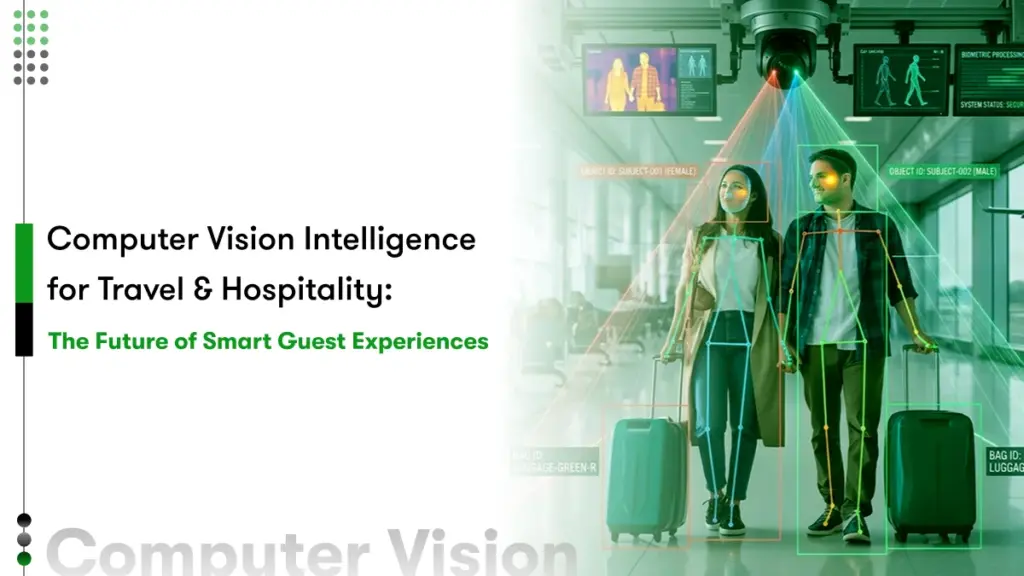
Quick Summary: Computer vision for travel is indeed a great long-term investment, but it is also a competitive advantage for your business that your competitors are already adapting to. This blog discusses the actual uses, genuine pitfalls, as well as a roadmap that can be followed to the latter in terms of biometric check-in, predictive crowd management, and in hotels, airports, and resorts. If you are an executive, and you want to know where intelligent automation can fit into your growth strategy, begin here.
The travel and hospitality industry is experiencing one of the greatest changes in decades. Visitors no longer simply desire clean rooms and hospitable employees, but it has come to be smooth, personal, and hassle-free experiences where a guest feels welcome throughout their stay at the place they reserve till the time they leave.
This change has AI in the center stage, and one of the most effective uses of AI is computer vision in travel. Intelligent vision systems are also quietly redefining the operations of hotels, airports, airlines, and resorts through automated check-ins, real-time crowd flow management, and more.
Did you know that the global AI market for hospitality and tourism is projected to grow to nearly $198.9 billion by 2034, at a CAGR of 28.9%? So, when evaluating where to invest, understanding the Computer Vision Software Development Cost upfront helps in planning scalable deployments. The bottom line is that organizations that adopt computer vision for travel in the current times are laying the groundwork for the future guest experience and better ROI.
What is Computer Vision Intelligence?
Computer vision is a branch of artificial intelligence that allows machines to read and comprehend visual data and display information such as images, video streams, and physical scenes in a similar way that the human eye and brain work together.
Computer vision, at its essence, is a combination of image recognition, object detection, face recognition, and behavior analysis, accompanied by deep learning models trained on large visual datasets. Edge computing further enhances it by enabling data processing at the edge, allowing real-time decisions without latency and delivering the best performance for your business operations.
The most significant difference you can see is that a traditional surveillance system just records, whereas an intelligent vision system understands and comprehends. They identify abnormalities, patterns, and issue commands independently.
To better understand how these systems are built and trained for your business, you can visit our detailed guide on How Computer Vision Works. The blog discusses the entire architecture underlying what you are going to read in this blog.
Why Travel & Hospitality Needs Computer Vision?
Experience is the key driver in the travel and hospitality industry. Late check-in, a crowded lobby, and an unaddressed security issue; all this may cost a property not just a review, but a loyal customer. The margin of inefficiency is declining rapidly as demands rise and operations become more complex. This is exactly where computer vision for travel comes in, no longer as a figment of the future, but rather as an operational tool.
High Customer Experience Expectations
Guests expect speed, personalization, and smooth service at every touchpoint, and they will switch to a competitor that delivers it. Computer vision for travel helps properties identify guests, shortening wait times and personalizing services on the spot without imposing an additional burden on already stretched staff.
Labor Shortages and Operational Inefficiencies
Outsourcing and retaining employees for high-volume, routine jobs is expensive and unsustainable. Smart vision systems automate front desk surveillance, housekeeping verification, and queue management, so that your human resources are able to concentrate on what a computer cannot duplicate, like human hospitality. It acts as an additional hand to your operation, making sure it take cares of operational and security efficiency.
Security and Compliance Demands
We know manual surveillance is reactive and inconsistent at some point in time, and it can cost a lot more than just a bad review. Computer vision in travel and hospitality is changing the whole industry with the adoption of computer vision by identifying anomalies, patrolling restricted areas, and generating an auditable documentation of the incidents in real time. In the case of large properties and airports, that is not a nice-to-have, but a liability management tool.
The Move Toward Data-Driven Personalization
Operations that are based on intuition do not scale. Computer vision takes the physical (guest) behavioral patterns, movement patterns, dwell time, sentiment, etc., and transforms them into usable intelligence that guides staffing, layout optimization, and customized service delivery. The infrastructure layer is the one that enables the achievability of personalization at scale.
If you are an executive who is looking at the beginning point, after knowing why computer vision in travel and hospitality is essential, our Computer Vision Development Guide provides a practical approach to developing these capabilities into your existing infrastructure, without the need to re-invent what has already been working.
How Travel and Hospitality Use Computer Vision: Core Applications
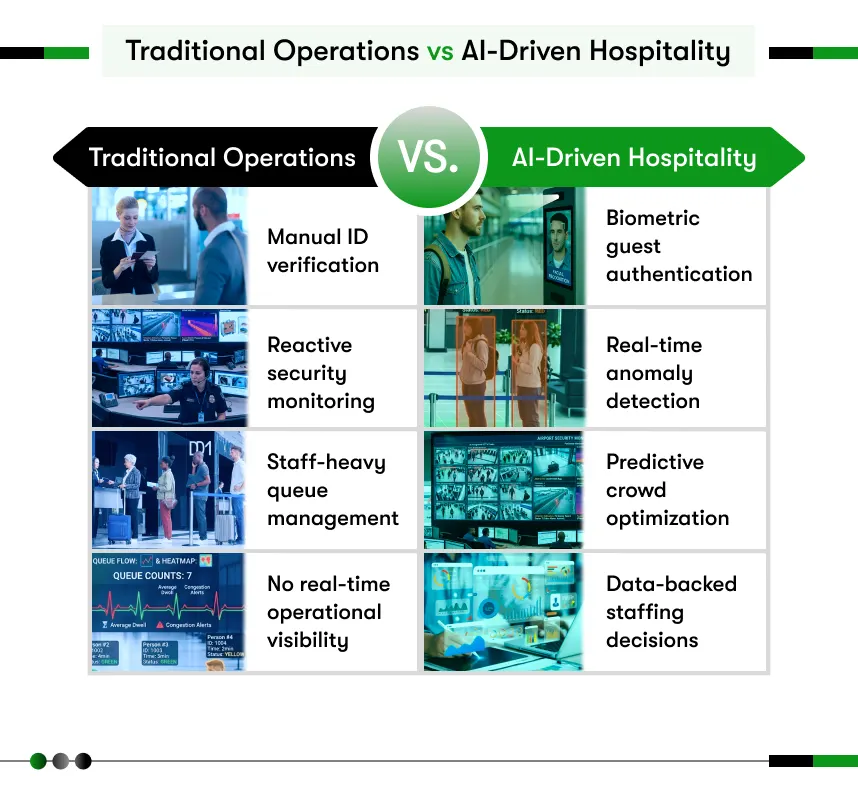
AI computer vision for travel and hospitality has various applications. From the moment a visitor opens the door to booking their flight, every touchpoint in the travel experience generates visual data. Whether or not to capture it is no longer controversial, just as most operations currently do. The actual competitive advantage is what you can do with it. Computer vision for the travel industry is converting passive visual feeds into real-time operational intelligence in hotels, airports, airlines, restaurants, and resorts. Here are the innovations the most progressive businesses have implemented:

Key Applications in Hotels
Hotels create high volumes of visual information every single day, including lobby movement, guest contact, and housekeeping activity. The issue has never been insufficient data; it has been the inability to act on it in real time. That is the gap computer vision for travel closes. To get a bigger picture of what you can do, our Computer Vision Applications and Examples blog lists use cases across industries, but the hotel business is a rich field for intelligent vision implementation.
Smart Check-In & Identity Verification
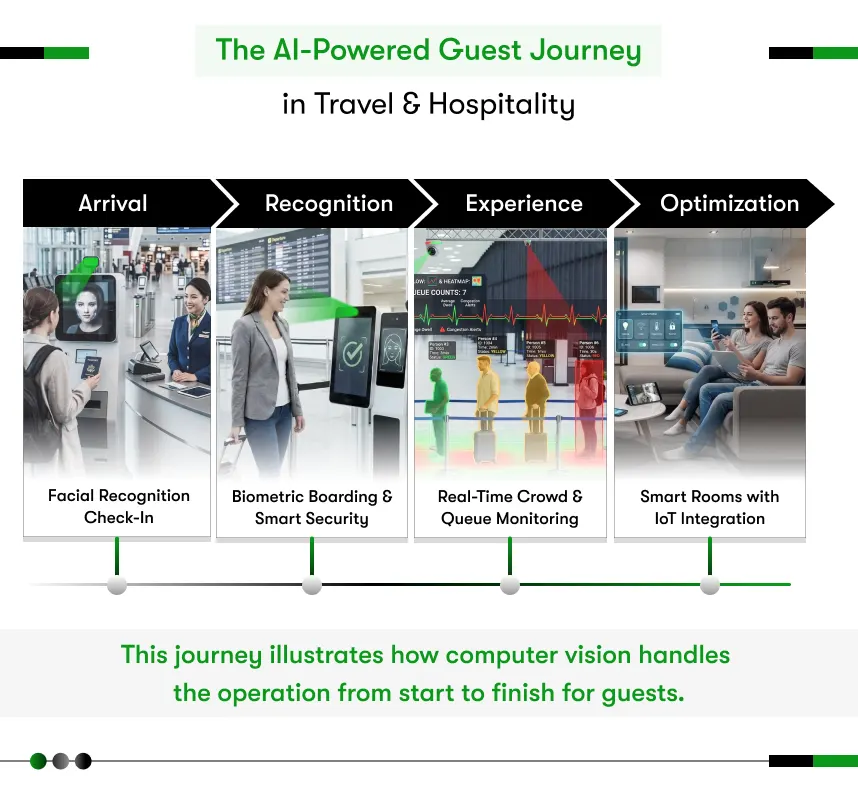
Facial recognition handles check-in, which eliminates the bottleneck at the front desk. Authenticating guests is instantaneous as they enter their premises, no queues, no key card systems, no manual ID check-in systems, or other hustle. In the case of major chains of hotels with hundreds of guests arriving daily, contactless guest authentication allows them to please their customers and also increases operational efficiency.
Guest Behavior & Sentiment Analysis
Computer vision tracks the movement of guests in lobbies, restaurants, and other common areas, tracing crowding patterns, identifying indicators of discomfort, and determining where services are not provided before they become complaints. It provides an operational team with a real-time pulse of guest experience without being invasive.
Housekeeping Automation
Room occupancy detection informs housekeeping when a room is free, allowing staff to service it without unnecessary visits and enabling efficient staff allocation per floor. Vision systems can also validate cleaning completion without adding supervisory overhead while maintaining quality standards.
Security & Loss Prevention
Intelligent vision systems provide security personnel with real-time alerts (instead of hours of video footage to scan after an intrusion) by detecting intrusion attempts in restricted zones and tracking suspicious behavior. The system automatically records all events, creating a consistent compliance and investigation trail.
Applications in Airports & Airlines
Assuming that the most personalized frontier in computer vision is hotels, the most complex one is airports. Thousands of passengers pass through security and immigration, through gates to boarding points and baggage claim, and the system tolerates no errors or delays. The stakes of operation in this case are exceptionally high, and so is the payoff on smart automation.
Biometric Boarding & Security
Facial recognition passport control is already operational in high-capacity international airports, and the outcomes are self-evident. Passengers complete identity verification in seconds instead of minutes, security teams reduce queue times, and the system significantly reduces the likelihood of human errors during document verification. In the case of airlines with constrained turnaround management, faster boarding is not only a win in passenger experience, but it also has a direct, on-time, and cost impact.
Baggage Handling & Tracking
One of the most harped on and avoidable frustrations of air travel is lost luggage. Computer vision systems detect and monitor bags during each handling stage, from check-in to the carousel. Visual tagging and automated monitoring significantly decrease the occurrence of misrouting and provide airlines and passengers with accurate and real-time information on the luggage location. In the case of airline operations teams, it would directly affect the reduced number of compensation claims and higher customer retention.
Passenger Flow Optimization
The gathering of people at the security checkpoints, immigration counters, and boarding gates is not only a nuisance but also a safety and revenue hazard. Computer vision for the travel industry, specifically for airports, can provide real-time monitoring of the queue length and density of passengers, which then initiates a dynamic change in the number of staff and redistributes gates before a crisis of congestion occurs. Crowd management is a predictive operation using both historical flow forecasts and real-time doodles to enable airport operations to work beyond peak-hour pressure instead of just responding to it.
Combined, these computer vision examples for travel and hospitality show that the technology is not about eliminating airport employees; it is about providing them with situational awareness to make quicker and smarter decisions in one of the most demanding operational environments in the world.


Applications in Restaurants & Resorts
Restaurants and resorts are businesses that run on slim margins where each open table, missing meal, and unoccupied customer is a lost source of revenue. Computer vision for travel environments allows a degree of operational visibility that previously managers had to strive to obtain by instinct and manual observation.
Table Occupancy & Wait Time Estimation
Smart seating management powered by computer vision gives front-of-house teams a live view of table turnover, occupancy rates, and estimated wait times without a host manually walking the floor. Resorts with several dining outlets on large properties can centralize this visibility, minimizing waiting time for guests and maximizing covers during peak dining periods.
Food Quality Monitoring
The repetition of presentation and adherence to hygiene standards is a non-negotiable aspect in hospitality dining. A computer vision system installed in the kitchen will scan every plate prior to delivery to the guest, identifying issues in portion consistency, presentation anomalies, and any possible hygiene infraction in real time. It is the control of quality that does not delay service.
Retail & Amenity Analytics
In resorts, spas, retail, and recreation areas, computer vision can monitor the active behavior of guests in these areas, including what areas will contribute to dwell time, what areas might be underutilized, and what the layout redesign might offer to enhance the experience and profitability. It converts the gut-feel choices regarding the investment in amenities to factual ones.
For resort and restaurant operators, the common thread across all three applications is simple: better visibility leads to better decisions.
What are the Benefits of Computer Vision in Travel & Hospitality?
The applications are very enticing, but what do they finally bring to the business? To executives considering investment choices, some form of computer vision for travel should be translated outside of technology into quantifiable operational and commercial results. This is what proactive operators are really reaping.
Enhanced Guest Experience
Each moment of unnecessary waiting of the guest, each service gap that was not noticed, each impersonal contact with the guest, these are the moments that undermine loyalty. Computer vision removes the hustle aspect of guest experience management, so that the employees are able to react to need immediately and not after the inconvenience has occurred. The outcome is a service that is effortless for the guests and much easier to maintain operationally.
Operational Cost Savings
Repetitive, high-volume processes, such as occupancy monitoring, queue management, security surveillance, quality checks, and so on, will be automated without affecting the quality of services, so to speak. In the case of large-scale hospitality operations, such efficiency escalates rapidly through departments, shifts, and locations.
Real-Time Insights
Conventional reporting informs you of what occurred yesterday. AI computer vision for travel and hospitality informs you of what is happening immediately and, in certain instances, what is likely to happen next. It is that transition to real-time intelligence rather than retrospective that distinguishes reactive operations and really agile ones.
Improved Safety and Compliance
Computer vision transforms security posture by providing a consistent, always-on, and audit-ready security posture in areas with limitations and automated incident documentation capabilities. That consistency is priceless to the operators who have to deal with compliance requirements in more than a single location.
Data-Backed Decision Making
Gut feeling works in hospitality; however, it does not scale. Computer vision provides decision-makers with color-coded data on behavior, flow patterns, and operational metrics that can render investment, staffing, and layout decisions much more justified. This data-driven transformation is being played out in the industries, as we discover in our resource Computer Vision for Industries, and hospitality is one of the most significant industries.
These added-up benefits do not add to a cumulative improvement; it is a fundamentally smarter operation, designed to satisfy the desires of the traveler.
So, Satisfied Traveler = Loyal Customer = Better ROI.
What are the Challenges & Ethical Considerations of Computer Vision for Travel?
There is no revolutionary technology that comes without resistance, and computer vision for the travel industry is not an exception. To executives who are developing a responsible and long-term AI strategy, being familiar with these issues prior to starting is not a reason to delay; it is a precondition to getting implementation right.
| Challenge | What It Means | What to Do About It |
| Privacy & Facial Recognition Regulations | GDPR, BIPA, and regional frameworks impose strict obligations around consent, data retention, and biometric usage. Legal clarity must come before technical deployment. | Conduct a jurisdiction-specific compliance audit before any biometric system goes live. Make guest consent transparent and explicit. |
| Data Security | Visual and biometric data captured at scale is highly sensitive. A breach carries reputational and legal consequences that far outweigh the cost of prevention. | Build encryption, access controls, and data governance policies into the architecture from day one, not as an afterthought. |
| Bias in AI Models | Some facial recognition systems have demonstrated lower accuracy across certain demographics. In guest-facing environments, that’s both an ethical and commercial liability. | Demand diverse training datasets, rigorous model evaluation, and ongoing performance auditing from your technology partner. |
| Infrastructure & Integration Complexity | Deploying intelligent vision systems across large hotels, airports, or resorts isn’t plug-and-play. Legacy systems and edge computing requirements add cost and complexity. | Adopt a phased implementation approach, start with the highest-impact use cases and scale deliberately. |
The fact that these issues are being discussed openly is in itself a sign of strategic maturity. The companies that will be leaders in Computer Vision in Travel 2026 and beyond are not the ones that have the technical capability, but rather are based on the principles of trust, compliance, and considered governance.
What are the Future Trends of Computer Vision in Travel 2026?
The implementations that we currently witness are impressive, but these are only a preview of what computer vision systems will ultimately bring to the travel and hospitality sector. To executives who think beyond the next quarter, here is where the computer vision for travel is taking us.
| Trend | Where to Implement | Impact to Expect |
| AI-Powered Hyper-Personalization | Hotel lobbies, resort check-ins, loyalty touchpoints | Guests are anticipated, not just recognized — preferences, room settings, and services are pre-configured before they even ask |
| Integration with IoT & Smart Rooms | Guest rooms, common areas, resort facilities | Fully responsive environments that adjust lighting, temperature, and entertainment automatically based on guest presence and behavior |
| Predictive Guest Journey Mapping | Airports, large hotel properties, multi-outlet resorts | End-to-end friction identification and proactive service interventions — before complaints happen, not after |
| Fully Autonomous Hotel Operations | Front desk, housekeeping, scheduling, and security monitoring | Dramatically reduced operational overhead with consistent, around-the-clock service delivery at scale |
The trend is evident: Computer Vision Solutions for Travel and Hospitality will no longer be the support mechanism, but at the heart of the whole guest experience. There are already building blocks in place, which are portrayed in the computer vision examples resource. The only difference is the ambition and the scale with which forward-thinking operators are implementing them.
Implementation Roadmap for Businesses
Acknowledging the potential of computer vision for travel is one thing, but putting it into a framework implementation plan is another. Considering operators who are willing to leave the evaluation part and proceed to the implementation, here is a feasible roadmap to take that’ll help you implement a computer vision system seamlessly into your existing operations.
1. Assess Operational Pain Points
Begin with your largest areas of friction or problem that need improvement, not the most interesting technology, just to keep up with the trend. Is it check-in queues? Housekeeping inefficiency? Security gaps? By determining the location of the quickest, most quantifiable impact made by intelligent vision, the business case remains concise, and the buy-in by the stakeholders remains high, benefiting your business.
2. Choose Scalable Vision Solutions
Not all computer vision platforms are built for hospitality’s complexity. Look for solutions that will work with your current systems of property management, security, and guest experience system, and that will be able to have a presence in multiple locations without necessitating a total upgrade of the entire infrastructure, which would require more financial resources, whereas when you choose a scalable computer vision solution suitable to you rexisting operation, you quantify the results.
3. Ensure Regulatory Compliance
Your legal and compliance framework must be airtight to the point where a guest is in front of a camera. Data governance, approval procedures, and regional regulatory controls need to be considered during architecture construction, not added on at the end.
4. Staff Training & Integration
Technology will deliver nothing if it’s not adopted, so your departments should know how to decipher the outputs of the vision systems, respond to warning signals, and require the human hospitality overlay that visitors continue to desire. You don’t have to worry if you don’t have an existing in-house team, as you can always outsource and hire computer vision developers with experience in the hospitality domain, or hire a professional in computer vision consulting to bridge the gap between technical deployment and operational reality.
5. Measure ROI
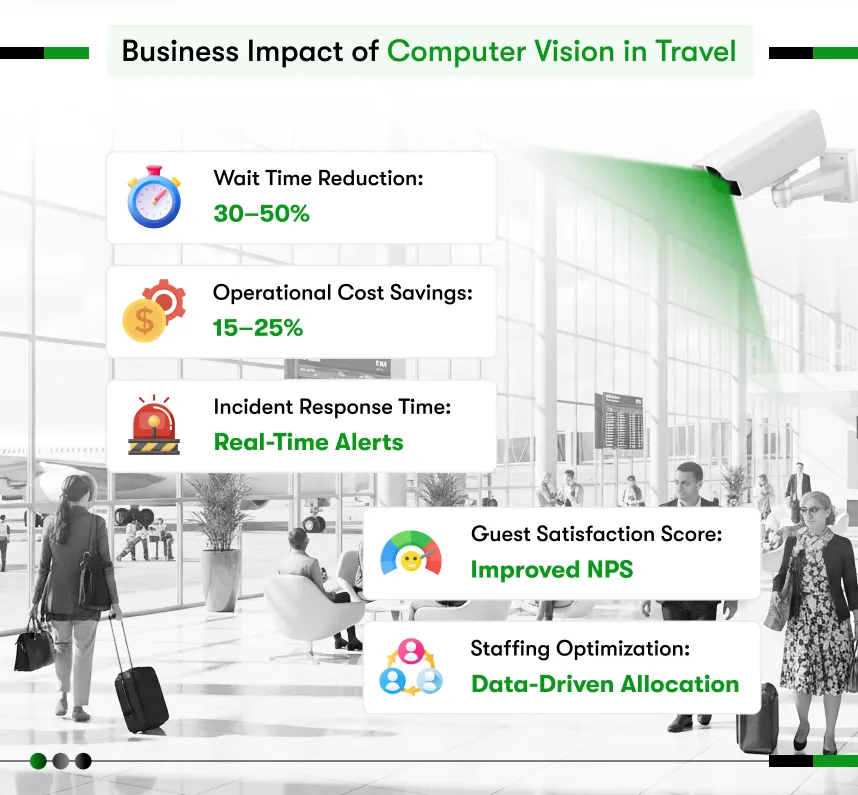
This is the last, yet most important, step, as it lets you keep track of your results and KPIs. Define your success metrics before you go-live, such as wait time reduction, cost per clean, incident response time, and guest satisfaction scores. All of the KPIs you define will be measured, and what gets measured, therefore, gets improved.
To Sum Up
The travel and hospitality business is at a crossroads. Guests’ expectations are high, the complexity of the operations is increased, and the inefficiency margin is minimal as never before. Computer vision for travel is not something to be considered for the future; it is something that can be used as a competitive advantage for operators who are not afraid to do so.
Whether it was through biometric boarding to automated housekeeping, the businesses that are adopting such systems are creating the operational structures that will shape tomorrow’s guest experience. Leaders who are early adopters of computer vision technologies have a huge advantage in travel and hospitality, and you can be one of them if you take action now.
If your organization is ready to explore what intelligent vision can deliver, Kody Technolab brings domain expertise, technical depth, and end-to-end capability as a specialist Computer Vision Development Company, turning your operational vision into a measurable reality to boost your business growth and your customers’ experience.
FAQ
We already have CCTV across our property. How is computer vision different from what we have today?
Traditional CCTV records, but computer vision understands. Intelligent vision systems analyze footage in real time, detecting patterns, triggering alerts, and generating operational insights automatically. In many cases, computer vision can be layered onto your existing camera infrastructure, so you don’t necessarily need to start from scratch.
How long does it typically take to see ROI from a computer vision deployment?
High-impact touchpoints, check-in automation, queue management, and housekeeping optimization tend to show measurable returns within 6 to 12 months. The key is starting with use cases tied to your highest operational cost or guest experience gap, rather than deploying broadly from day one.
How do we handle guest privacy and stay compliant with facial recognition regulations?
Compliance requirements vary by region. GDPR, BIPA, and evolving Asia-Pacific frameworks all impose different obligations. A responsible deployment starts with a jurisdiction-specific legal audit, transparent guest consent mechanisms, and data retention policies built into the architecture from day one, not retrofitted later.
Is computer vision only viable for large hotel chains and international airports, or can mid-sized operators benefit too?
Operators of all sizes can absolutely benefit. Cloud-based and modular deployment models have made intelligent vision systems increasingly accessible without enterprise-scale infrastructure. A boutique hotel using smart occupancy detection or a mid-sized resort tracking table turnover can see a meaningful impact at a fraction of the cost of a full-scale rollout.
Where should we realistically start if we want to explore computer vision for our business?
Start with an honest operational audit, identify your biggest friction points across guest experience, staffing, or security. Then engage a specialist in computer vision consulting to help you move from business problem to the right technology solution, without over-investing in the wrong place first.