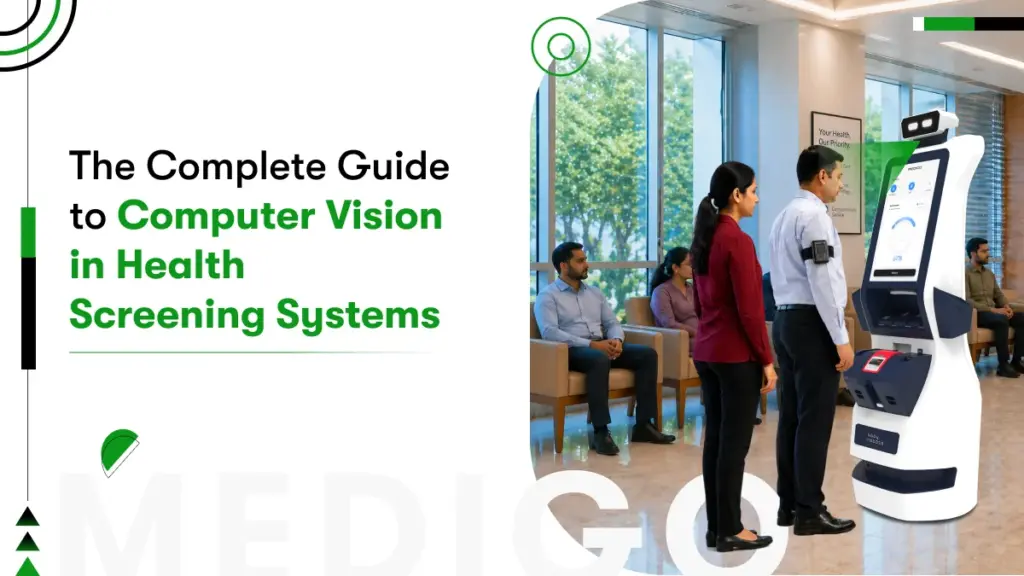
Blog Summary: Millions of people miss early health warnings simply because screening infrastructure cannot reach them. Medigo, Kody Technolab’s AI health screening robot, uses computer vision to assess 65+ parameters in 3 minutes, without a doctor, nurse, or waiting room. Read on to see exactly how the technology works and whether it fits what you are building.
Every year, hundreds of millions of preventable health conditions go undetected, not because medicine lacks the answers, but because the screening infrastructure to catch them early does not exist at the scale people actually need.
The global computer vision in healthcare market is projected to reach USD 54.28 billion by 2034 (Fortune Business Insights), which tells you exactly how urgently the world is looking for a faster and smarter way to screen large populations before conditions like hypertension, elevated blood glucose, and early kidney stress cross the point of no return.
People do not visit a doctor unless something already hurts, which means entirely manageable conditions keep progressing in silence until they become expensive and irreversible.
Automated health screening using computer vision solves that problem in a practical way. Medigo, Kody Technolab’s AI-powered health screening robot, shows how that solution works when fully engineered, deployed, and scaled in real environments.
What Is Computer Vision in Healthcare Screening?
Computer vision in healthcare screening is the use of AI-powered camera systems and algorithms to observe, measure, and interpret visual health data from the human body, without physical contact, without a nurse, and without a waiting room.
A trained clinician looks at a patient and reads skin tone, pupil response, posture, and facial symmetry before touching a single instrument. Computer vision in healthcare screening does exactly the same, but does it in milliseconds, applies identical measurement logic to every person regardless of who is operating the system, and delivers consistent output whether it is the first screening session of the day or the five hundredth.
In a computer vision health screening system, the camera does more than record. Instead, it actively measures.
Medigo tracks subtle colour changes in facial skin to estimate heart rate. In addition, it captures infrared signals from the skin to read body temperature.
Next, Medigo analyzes spine and shoulder alignment to detect posture risk. Finally, it uses facial landmark geometry to confirm biometric identity.
All of this happens in one guided session, and the output is a structured digital health report that a clinician can act on immediately.
A standard health kiosk takes measurements. An AI health screening system observes, interprets, flags risk indicators, and generates an actionable report. That is the difference between hardware and clinical intelligence, and it is the difference that determines whether your screening program produces data or produces outcomes.

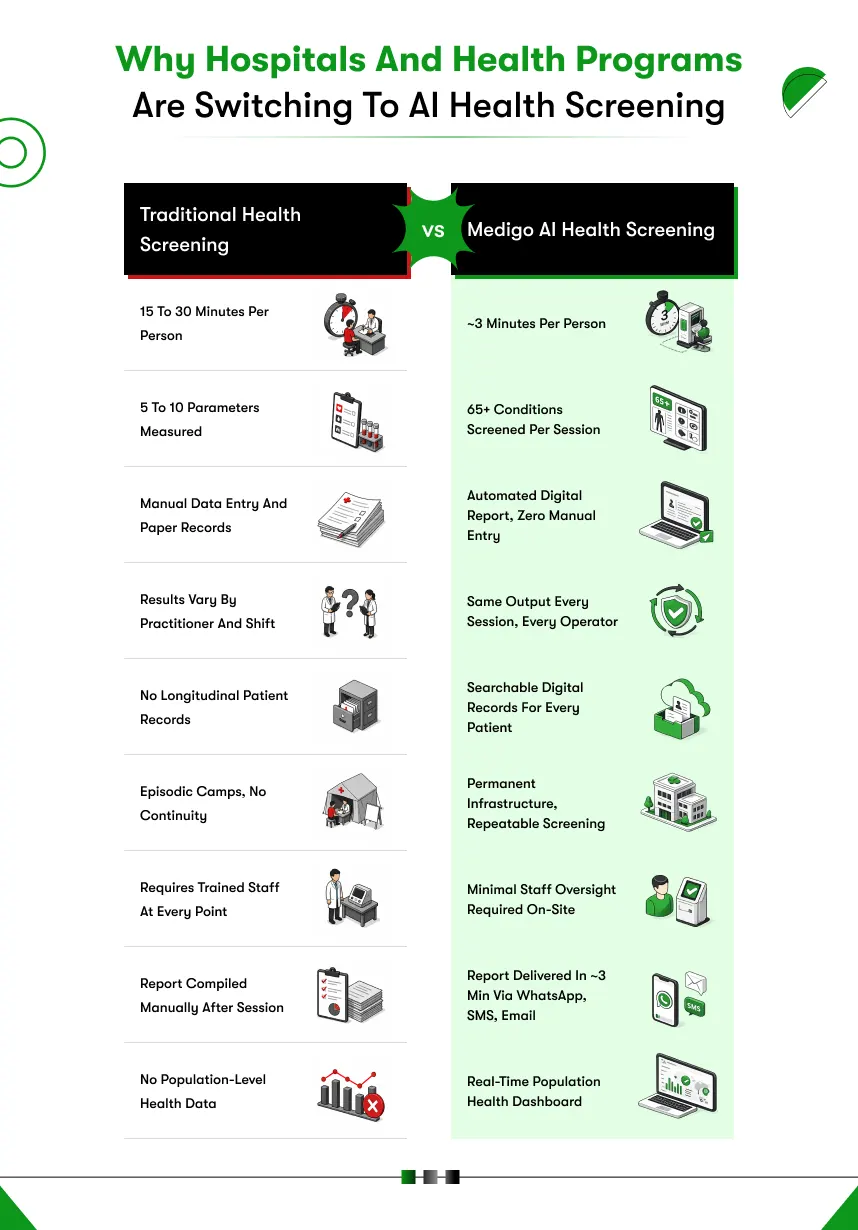
Here is what that intelligence delivers in practice:
- Speed: A complete AI health screening session takes approximately 3 minutes. A traditional nurse-administered check takes 15 to 20 minutes at minimum.
- Consistency: Human observation varies between practitioners and across shifts. Computer vision in healthcare screening applies the same measurement logic to every person, every time, without exception.
- Scale: A single AI health screening unit can assess hundreds of individuals per day in a high-footfall environment with minimal staff involvement, something no clinic-based model can replicate at that cost or speed.
- Objectivity: No fatigue, no distraction, no subjective interpretation at the data collection stage. The system captures exactly what the sensors and cameras observe.
If you are managing a hospital OPD, a government health program, a corporate wellness initiative, or an industrial worksite, that combination is exactly what you need to run preventive health at actual volume.
What Are the Core Computer Vision Technologies Inside an AI Health Screening System?
A computer vision health screening system is not built on one single technology. It is a stack of specialised techniques, each assigned to a specific screening function. Here is how each one works.
Remote Photoplethysmography (rPPG): Heart Rate and Respiratory Rate Without Any Contact
Remote photoplethysmography, or rPPG, is one of the most powerful technologies in computer vision health screening. Human blood absorbs and reflects light differently depending on how much blood is present in the skin at any given moment. When the heart beats, blood volume in the skin changes, and so does the intensity of light the skin reflects back to a camera.
A standard RGB camera captures micro-fluctuations frame by frame. Then, computer vision algorithms process the video stream to extract heart rate and respiratory rate.
As a result, you get accurate readings without any wearable, clip, probe, or physical contact.A standard RGB camera captures those micro-fluctuations frame by frame. Computer vision algorithms process that video stream and extract heart rate and respiratory rate, without any wearable, clip, probe, or physical contact at all.
Peer-reviewed research using CNN-based rPPG recorded a heart rate measurement error of 2.70 beats per minute and a respiratory rate error of 1.47 breaths per minute at a distance of 0.6 to 1.2 metres (MDPI Sensors, 2022). For population-level health screening, that level of accuracy is clinically meaningful and operationally practical.
The rPPG pipeline inside an AI health screening system works through these steps:
- Face detection: The system locates the face in the camera frame and separates it from background noise.
- Region of interest (ROI) selection: The forehead and cheeks are identified as optimal measurement zones because of their high vascular density close to the skin surface.
- Signal extraction: Frame-by-frame pixel intensity across the ROI produces a raw photoplethysmographic signal.
- Noise filtering: Motion artefacts, lighting variation, and compression noise are filtered out before the physiological signal is extracted.
Parameter calculation: Heart rate, respiratory rate, and in some configurations blood oxygen saturation, are computed from the cleaned signal.

Thermal Imaging: Contactless Body Temperature Detection at Scale
Thermal imaging stands among the most widely used applications of computer vision in healthcare screening. The camera captures infrared radiation from the body surface and converts it into a temperature reading, without any physical contact during screening
In a high-footfall deployment, Medigo creates a fast, non-contact fever detection layer at the start of every screening session. As a result, you can screen individuals quickly without delays.
When an individual approaches the unit, the thermal camera reads surface temperature from facial landmarks. Then, Medigo flags any reading above the configured clinical threshold within seconds.
The five-step process that makes this work:
Face localisation: The algorithm identifies the face in the thermal frame and maps landmark points around the forehead and inner canthi, the areas most reliably correlated with core body temperature.
Temperature map generation: The thermal image is converted into a pixel-by-pixel temperature map across the full facial region.
Reference point extraction: The system identifies the warmest reliable point within the facial landmark zone, corresponding to maximal skin temperature.
Threshold comparison: The system compares the extracted reading against pre-configured clinical thresholds defined for that deployment environment.
Output generation: The system logs the result in the patient’s screening record and flags it for review when values exceed safe limits.
In primary health centres, defense institutions, and industrial worksites where teams screen large groups every day, you need a system that detects fever quickly and consistently. Medigo delivers that capability as part of its core screening workflow.
Facial Landmark Detection and Biometric Identity Verification
To generate meaningful longitudinal health data, your screening system must identify each individual reliably. Medigo handles identification automatically, so you avoid manual input during every visit.
Facial landmark detection handles two distinct functions simultaneously:
- Identity verification: The system maps facial landmarks to create a unique biometric identifier for each person. Medigo automatically recognises returning individuals and retrieves their previous screening records without requiring any ID card, manual entry, or staff involvement.
- Measurement guidance: Landmark detection ensures accurate camera-based measurements such as rPPG, temperature, and body composition by capturing data from the correct anatomical regions. Additionally, if a person shifts position during the session, Medigo prompts repositioning before recording the measurement. As a result, you maintain consistent data quality across every screening.
The landmark detection model uses a convolutional neural network trained on large facial datasets. As a result, Medigo identifies between 68 and 478 facial points, depending on the model architecture.
Key landmarks used in health screening include:
Forehead midpoint — temperature extraction
Inner canthi — alternate temperature reference point
Cheeks and nose bridge — rPPG signal extraction
Pupil centres — gaze and attention detection
Jawline and facial contour — BMI and body composition estimation inputs
Body Composition Estimation Through Vision-Based Analysis
Body mass index and body composition metrics can be estimated using depth cameras or calibrated standard cameras. First, Medigo measures height directly from the camera frame and combines it with weight data from an integrated scale.
Then, the system calculates BMI automatically. As a result, you complete the entire process without requiring any staff involvement.
In more advanced configurations, Medigo combines depth camera data with machine learning models to estimate waist circumference and body shape metrics. With this approach, you gain insights that correlate with metabolic risk beyond BMI. As a result, you gain deeper health insights without relying only on BMI-based evaluation.
At the same time, corporate wellness programs and government health camps often depend on trained attendants for anthropometric measurements. Medigo removes that dependency and eliminates manual entry errors, improving both speed and accuracy.
Posture Analysis for Musculoskeletal and Occupational Risk Detection
Computer vision can assess how an individual stands during a screening session to identify musculoskeletal risk markers. Multi-angle or depth cameras capture body posture and track key skeletal points across the shoulders, spine, hips, and knees. Next, Medigo compares these points with clinical reference models based on validated occupational health datasets. This helps you detect posture deviations more accurately.
In manufacturing facilities, construction sites, and defense institutions, significant spinal curvature deviation or shoulder asymmetry is a meaningful occupational risk flag. Catching it early enables targeted intervention before injury occurs and before operational productivity absorbs the cost of a preventable absence.
AI-Based Facial Skin Analysis
The face carries visible markers of systemic health that trained clinicians learn to observe over years of practice. Skin tone abnormalities can suggest anaemia or jaundice. In addition, Medigo detects periorbital changes that indicate fatigue or thyroid involvement. Furthermore, it identifies facial oedema that may signal cardiac or renal conditions requiring further investigation.
Computer vision systems trained on medical-grade labelled datasets flag these visual indicators during the screening session. Detected anomalies appear as flag conditions in the final report, prompting clinical follow-up with appropriate urgency. A manual screening process focused only on vitals and blood markers would miss these surface-level clinical signals entirely. A well-built AI health screening system does not.

How Does Computer Vision Work in a Health Screening Workflow, Step by Step?
Understanding the individual technologies is one thing. Seeing how they run together in a single structured session is where the real value of the computer vision health screening system becomes clear.
Here is exactly how it works.
Step 1: Registration and Identity Verification
The individual approaches the unit and starts a session. To begin with, Medigo verifies identity through facial recognition and links the session to an existing record or creates a new one.
For new users, the system collects basic demographic details via the touchscreen interface. This keeps onboarding quick and completes it in under a minute.
Step 2: Contactless Vitals Capture
The guided workflow takes the individual through each measurement in sequence. First, Medigo captures body temperature through thermal imaging and measures heart rate and respiratory rate using rPPG without any physical contact.
Next, the individual follows on-screen instructions to position correctly, while Medigo continuously monitors positioning and compliance. Finally, the system collects blood pressure, SpO2, and blood glucose through integrated sensor modules at the appropriate step.
Step 3: Blood and Diagnostic Testing
The system integrates with on-unit devices for haemoglobin, lipid profile, HbA1c, creatinine, random plasma glucose, HIV, and TB screening. As a result, results flow directly into the screening record without manual transcription or mismatched data.
At the same time, Medigo eliminates delays in the workflow, so you get complete and reliable records instantly.
Step 4: AI-Based Assessment Modules
Skin analysis, body composition estimation, and posture assessment modules run during or after the measurement steps. At the same time, Medigo processes the visual data captured during the session to generate structured outputs.
As a result, all insights flow directly into the final report without any manual effor
Step 5: Consolidated Digital Report in Under 3 Minutes
The system generates a structured digital health report covering all 65+ parameters measured during the session. The report includes flagged risk indicators, structured readings across every parameter category, and recommended next actions based on what the data shows.
Step 6: Instant Video Consultation When the Report Warrants It
If the report flags a result that needs immediate clinical review, the system enables instant video consultation with a physician within the same session. The physician receives the full structured report simultaneously, enabling a properly informed teleconsultation without the individual needing to go anywhere else or book a separate appointment.
How Computer Vision Is Used in Medigo to Deliver AI Health Screening at Scale
Medigo is a robotic health screening infrastructure built to expand how preventive healthcare is delivered. Designed as a single integrated system, it combines intelligent robotics, connected diagnostic devices, and a unified software layer to enable structured screening in high-footfall environments.
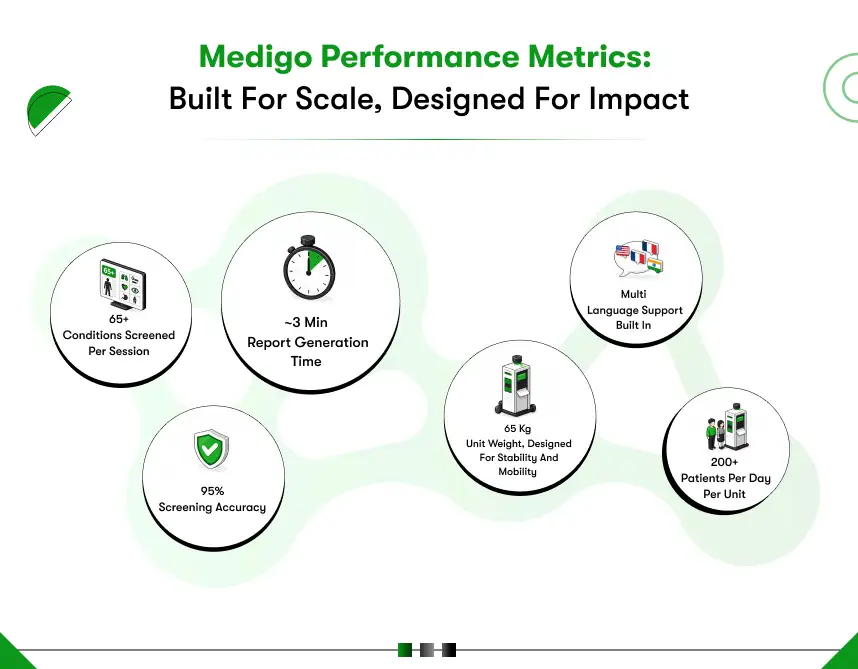
A user starts the screening through an AI-guided interface in their preferred language and completes a series of connected diagnostic tests. Then, Medigo delivers a consolidated health report in approximately 3 minutes.
At the same time, Medigo standardises how screenings are conducted and reported. As a result, you can move preventive health screening from occasional camps to a scalable system across institutions, workplaces, and communities.

What Does Medigo Actually Screen?
A single Medigo session covers 65+ health conditions across four core modules:
- Blood Markers
Haemoglobin (Hb), Lipid Profile, Renal Function (Creatinine), Blood Glucose, HbA1c
- Vitals and Physicals
Blood Pressure, Temperature, Height, BMI, 6-Lead ECG, SpO2
- Core Diagnostics
Lung Health (Spirometry), Hearing Test, Vision Test, HIV, TB Symptom Screening, Malaria RDT, Pregnancy (UPT), Fever Surveillance, Dental Check
- AI-Based Assessments
Eye Checkup, Oral Health Check, Mental Health Screening, Autism (ASD) Screening
What Powers the Intelligence Inside Medigo?
The AI intelligence layer running across every session is what separates Medigo from a collection of connected devices. Four distinct AI capabilities drive the screening experience:
Multilingual Conversational AI: Understands patient-described symptoms in their native language and recommends the appropriate screening pathway before the session begins.
Adaptive Protocol Engine: Dynamically prioritises screening tests based on patient responses, demographics, and captured readings as the session progresses.
Clinical-Grade Interpretation: AI models trained on large-scale validated clinical datasets analyse screening data to deliver high-accuracy results across every parameter measured.
Post-Result Analysis: Transforms raw screening data into clear, plain-language insights, highlighting critical values and recommended next steps the patient can act on immediately.
How Does Medigo Deliver Results?
Once the session is complete, Medigo delivers the consolidated health report instantly through the patient’s preferred channel:
- WhatsApp, SMS, or email for patients with digital access
- On-site thermal printed report for patients without digital access
- Real-time transmission to a centralized government or institutional dashboard
When the report flags results that need immediate clinical review, Medigo’s built-in telemedicine module connects the individual to a physician via real-time video consultation, with instant prescription issuance, all within the same session and the same unit.
Medigo also runs on offline-capable architecture for deployment in areas with intermittent connectivity, with all data synced securely to the centralized dashboard the moment connection resumes.
Who Is Medigo Designed For and How Does Deployment Work?
Medigo is purpose-built for high-footfall environments where large populations need structured preventive screening delivered consistently, at volume, without building full clinical infrastructure at every site. If your current screening depends on episodic health camps, fragmented devices, and manual reporting, Medigo replaces all of that with a single, standardised, auditable workflow.

Which Environments Is Medigo Built For?
| Environment | What Medigo Solves | Why Organisations Adopt It |
| Government and Public Health | NCD risk screening at public touchpoints, school health camps with standardised reporting, district-wide pilots for NPCDCS and RBSK programs. | Provides the standardisation and measurable outputs needed for government tenders; delivers multi-test screening with shareable PDF reports. |
| Hospitals and Healthcare Networks | OPD pre-check lane for vitals before doctor consultation, preventive health desks for walk-in packages, outreach camps requiring consistent fast reporting. | Unifies fragmented device outputs and reduces staffing bottlenecks through a single digital guided workflow. |
| Diagnostic Chains | Micro-branches in Tier-2 and Tier-3 towns, standardised screening packages across all franchises, offsite corporate programs. | Enables rapid expansion without building full clinics; uses connected device capture with instant WhatsApp and email report sharing. |
| Corporate Wellness and Large Workforces | On-site periodic employee health screenings, factory and manufacturing fitness audits, executive wellness drives. | Replaces manual episodic camps with permanent, auditable screening infrastructure and digital record continuity. |
| Transport Hubs | Driver and operator periodic fitness screening for bus, metro, and rail, depot-level workforce programs, transport authority health drives. | Consolidates multi-device screening into a single workflow easy to manage at hubs; delivers safety and audit-ready records. |
| Defense and Institutional Healthcare | Periodic health checks for personnel in cantonments, standardised screening for recruitment and fitness audits, centralized health data for institutional clinics. | Built for high-footfall environments; provides governable programs with structured data for command and institutional operations. |
What Does the Deployment Process Look Like?
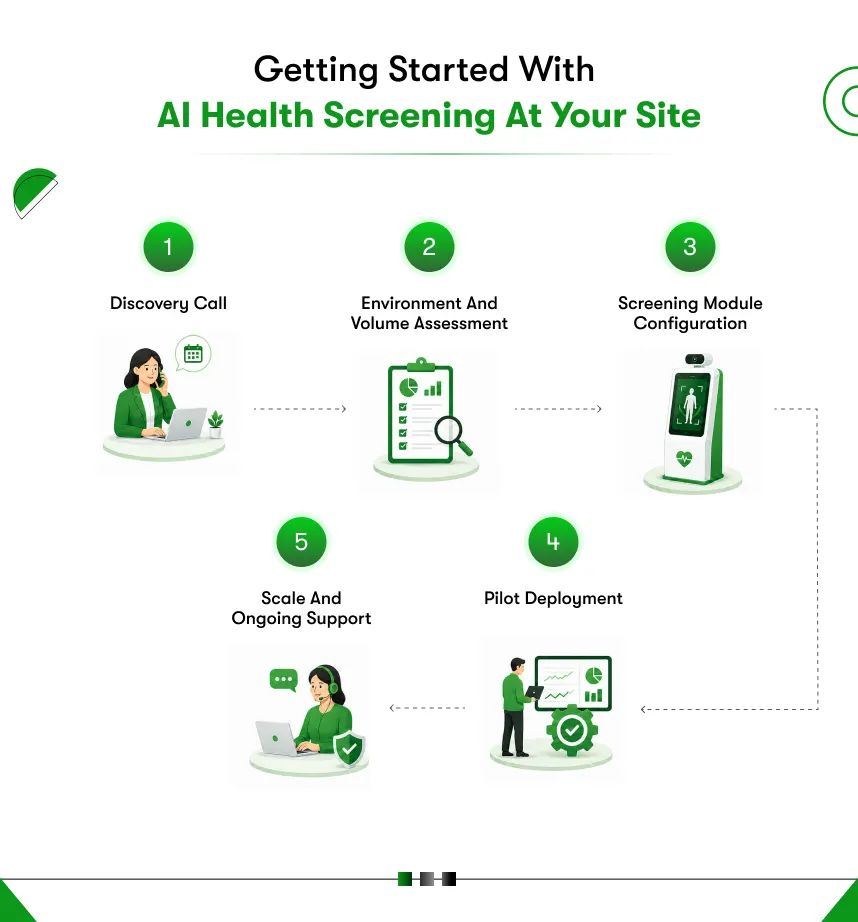
Kody Technolab works directly with each partner organisation to configure and deploy Medigo for the specific environment, volume, and reporting requirements of that partner. The process follows a clear path from first conversation to live operation:
What Does Medigo Give Your Organisation Beyond the Screening Session?
- Structured digital records stored for every individual screened, searchable and retrievable for follow-ups and long-term tracking.
- Centralized cloud dashboard transmitting all screening data securely to your government or institutional reporting system in real time.
- Standardised reporting across every deployment location, producing consistent outputs regardless of which site or operator is running the session.
- Population-level intelligence that gives health authorities real-time regional disease surveillance, resource allocation data, and early-warning detection that no fragmented device approach can match.
- Repeatable infrastructure that creates continuity and coverage across deployments, replacing the one-off camp model with a permanent, measurable screening program.
How to Build a Scalable AI Health Screening System with Medigo
Building a scalable AI health screening system does not mean assembling a technology stack from scratch or running annual health camps that produce inconsistent data and no longitudinal insight. It means deploying infrastructure that standardises how screenings are conducted, unifies how results are reported, and gives your organisation a live, continuously updated picture of the population you are responsible for.
Medigo combines intelligent robotics, connected diagnostic devices, a multilingual AI interface, clinical-grade interpretation, and real-time institutional reporting into a single deployable unit. As a result, you get a complete screening system designed for real-world environments. Because of this, Medigo fits seamlessly into government health centres, hospitals, corporate campuses, transport hubs, and industrial worksites where preventive screening demand remains high.
Kody Technolab has built, validated, and deployed the system. Every deployment is configured for the specific environment, volume, and reporting requirements of the partner organisation, with ongoing support built into the partnership from day one.
The organisations that build this infrastructure today will have the population health data, the early detection outcomes, and the operational advantage their peers will spend years trying to replicate. Reach out to the Kody Technolab team and start that conversation now.