


You are managing a facility where your clinical staff is stretched across multiple rooms, multiple patients, and multiple priorities simultaneously. When something goes wrong in a room nobody is watching, you are the one answering for it.
The challenge is not your team. Every hospital administrator running a serious facility deals with the same structural problem: continuous patient visibility is impossible to achieve with human observation alone, regardless of how well-trained or well-staffed the floor is.
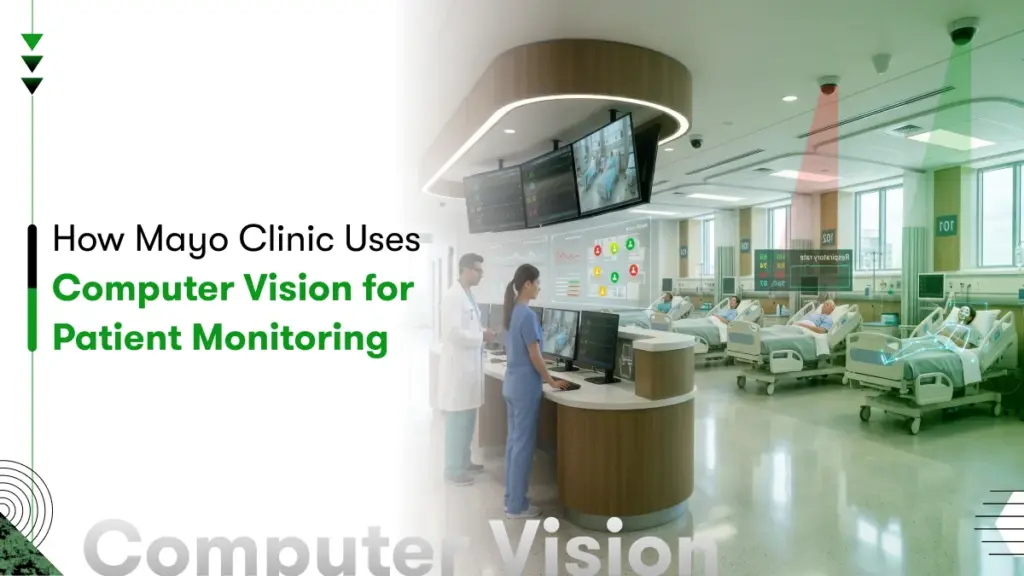
Mayo Clinic addressed that structural problem directly with computer vision in patient monitoring, building AI-powered systems that monitor every patient continuously, detect behavioral changes and fall risks in real time, and deliver alerts to clinical staff before conditions escalate into incidents.
Computer vision in healthcare was valued at USD 2,692.5 million in 2024 and is projected to reach USD 15,600.8 million by 2030 at a CAGR of 32.7%, which reflects how many serious hospital systems have already decided this technology is worth investing in.
If you are evaluating whether your facility should do the same, this blog gives you the clearest possible picture of what that looks like in practice.
5 Key Takeaways From This Blog
- Mayo Clinic proves that continuous AI-powered patient monitoring is achievable, scalable, and clinically validated in real hospital environments.
- Fall detection, ambient inpatient monitoring, and neurological assessment are three areas where computer vision delivers measurable improvements manual observation cannot match.
- A successful deployment starts with defining one specific clinical problem first, and that sequencing determines whether the system scales or stalls.
- Camera infrastructure, clinically trained AI models, EHR integration, and a HIPAA compliant privacy framework are the four layers that determine real clinical value.
- Any serious healthcare facility can build a patient monitoring system like Mayo Clinic by starting with a focused pilot and scaling based on real clinical evidence.
What Is Computer Vision in Patient Monitoring and How Does It Actually Work?
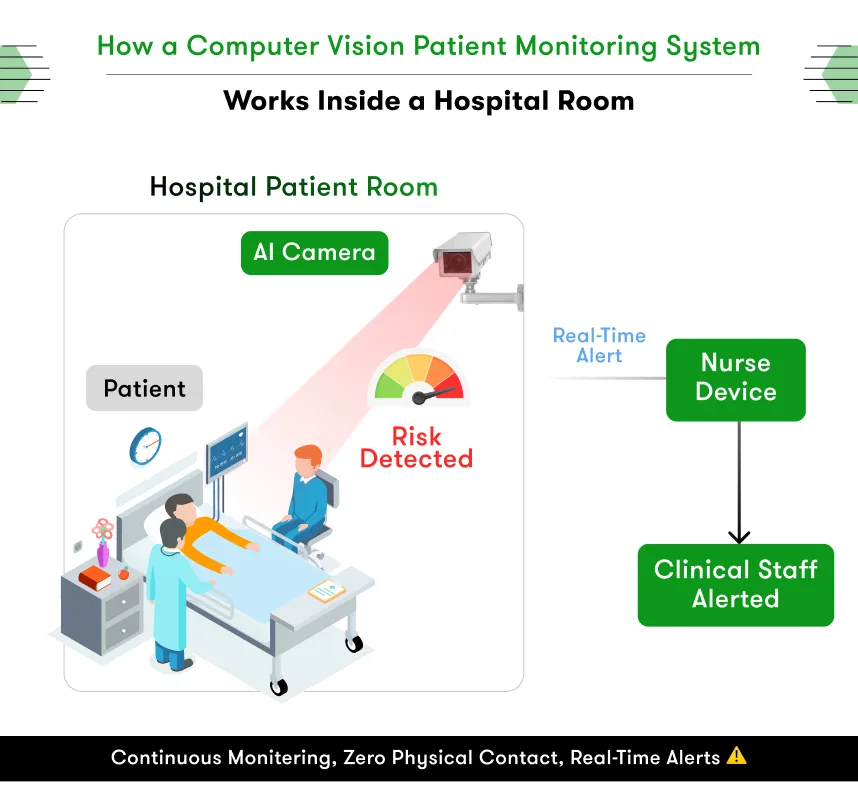
A computer vision based patient monitoring system uses AI-powered cameras placed inside patient rooms. These cameras read body posture, movement patterns, and behavioral changes continuously without attaching any sensor to the patient.
When a patient shifts toward the edge of a bed or shows unusual stillness, the system sends an alert to clinical staff instantly. Your team receives actionable information before the situation gets worse.
Traditional monitoring depends on a nurse being physically present at the right moment. Computer vision watches every room simultaneously, around the clock, without fatigue or gaps between shifts.
The system does not replace your clinical team. It gives your clinical team the visibility layer that human observation alone cannot provide, regardless of how experienced or well-staffed your floor is.
Mayo Clinic deployed this capability across patient rooms and fundamentally changed how the institution manages patient safety at scale.
How Mayo Clinic Uses Computer Vision for Patient Monitoring
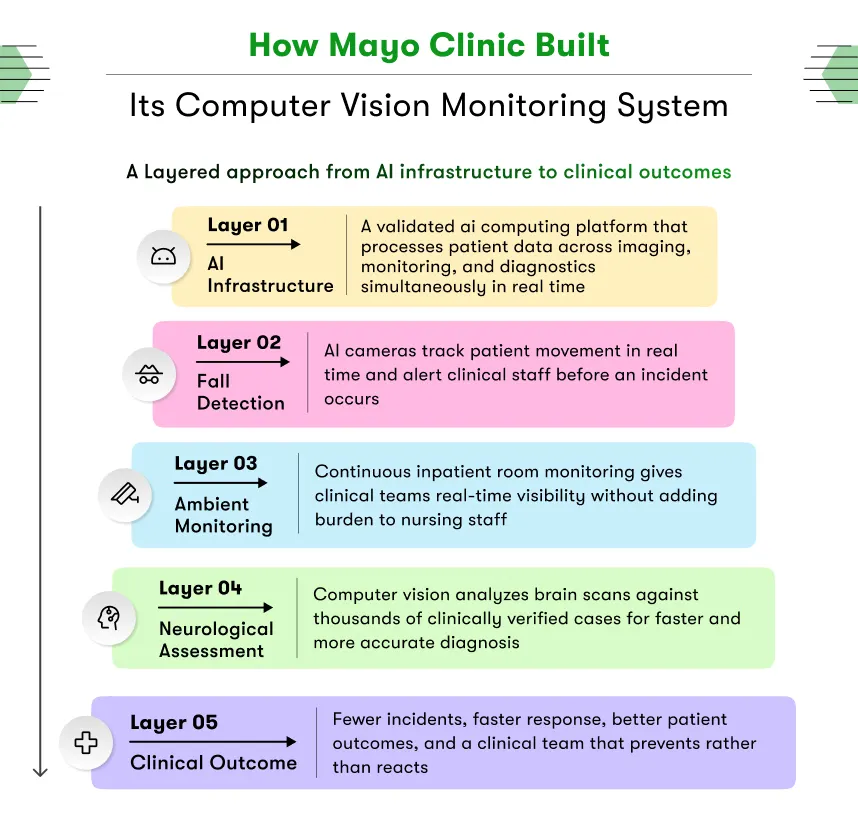
Mayo Clinic did not adopt computer vision as an experiment. The institution built a structured, clinically validated AI infrastructure that addresses the most critical patient safety gaps in hospital care. Every system deployed went through rigorous ethics, privacy, and safety reviews before reaching a single patient room.

Real-Time Fall Detection in Patient Rooms
Mayo Clinic uses AI-powered camera systems that monitor patient rooms continuously and detect fall risks before an incident occurs. When a patient’s movement pattern signals danger, clinical staff receive an immediate alert on their devices. The Minnesota Star Tribune reported in August 2025 that Mayo Clinic actively deploys computer vision in patient monitoring to detect falls in hospital rooms in real time.
Ambient Clinical Intelligence for Continuous Inpatient Monitoring
Mayo Clinic Florida built a computer vision based patient monitoring system that watches every inpatient room continuously. Clinical teams receive real-time visibility without additional burden on nursing staff. When a patient’s condition changes, the right person gets alerted immediately. Clinicians spend less time monitoring and more time delivering direct patient care.
AI Infrastructure That Supports Clinical Decision-Making at Scale
Mayo Clinic built an AI computing infrastructure that processes patient data across imaging, monitoring, and diagnostics simultaneously. Clinical teams get real-time decision support without waiting on manual analysis. Every algorithm deployed goes through rigorous safety and ethics review before reaching a patient room, which means the insights your clinical staff acts on are reliable, validated, and built for real hospital environments.
Reducing Preventable Incidents Before They Reach the Incident Report
Every incident report your facility files represents a moment where the clinical team had no visibility until it was too late. Mayo Clinic built a computer vision based patient monitoring system that identifies risk patterns early, giving clinical staff enough time to intervene before a situation becomes an incident. Fewer incidents mean better patient outcomes, lower liability, and a clinical team that spends energy on care rather than damage contro
What Mayo Clinic proves is simple. When your clinical team has the right visibility tools, patient safety stops being a reactive problem and starts being a manageable one. Understanding how computer vision works in a real clinical environment is what separates facilities that deploy this technology confidently from those that hesitate while the same preventable incidents keep occurring.
Every use case covered above exists because continuous, intelligent monitoring catches what manual observation misses. Your facility faces the same gaps Mayo Clinic faced before building this infrastructure.
What Are the Real Benefits of Computer Vision in Patient Monitoring for Your Facility?
Hospital administrators do not adopt new technology because it looks impressive. They adopt it because it solves a real operational problem that existing resources cannot solve. Every benefit listed below reflects what facilities using computer vision in patient monitoring are experiencing on the ground, in real clinical environments, with real patient populations.
Continuous Patient Visibility Without Adding Staff
Most hospital floors run on a ratio of one nurse to five or six patients. Computer vision in patient monitoring gives that one nurse the visibility of having eyes in every room at the same time, without adding a single person to the payroll:
- AI-powered cameras watch every patient room continuously and do not require breaks, handovers, or shift rotations to maintain coverage.
- Clinical staff receive an alert the moment a patient’s movement or behavior moves outside the normal range, so problems get caught early rather than during the next scheduled check.
- Nurses redirect their time toward direct patient care instead of spending hours on routine visual checks that rarely catch anything significant.


Faster Clinical Response Before Conditions Worsen
The window between a warning sign and a clinical response determines how serious an incident becomes. Patient monitoring using computer vision shortens that window significantly:
- The system detects early signs like unusual stillness, increasing restlessness, or movement toward the bed edge and immediately alerts the right staff member.
- Your clinical team arrives at the room knowing exactly what is happening rather than responding to a vague alarm with no context.
- Reaching a patient during early deterioration requires far fewer resources and produces far better outcomes than managing a fully developed emergency.
Reduced Patient Falls and Preventable Incidents
A patient fall during recovery creates consequences that go well beyond the physical injury your facility has to manage:
- Cameras track patient position and movement continuously, alerting clinical staff the moment a patient begins moving toward a fall-risk position.
- Your team reaches the room with enough time to assist the patient safely rather than arriving after the incident has already occurred.
- Fewer preventable incidents mean shorter patient stays, lower legal exposure, and a safety record that builds genuine trust with patients and families.
Lower Operational Costs Over Time
Many hospital administrators assume that deploying AI monitoring infrastructure is an expensive addition to an already stretched budget. The reality works in the opposite direction once the system is running:
- Preventing a single patient fall eliminates the cost of extended stay, additional treatment, incident management, and potential legal proceedings that follow.
- Clinical staff spend less time on routine monitoring tasks, which means your existing workforce covers more ground without burning out or requiring additional headcount.
- Fewer preventable incidents reduce the administrative burden on your team, from incident reports to family communications to regulatory reviews.
Better Patient Outcomes and Satisfaction
Patients and their families judge your facility on one thing above everything else: whether they felt safe and cared for throughout the entire stay:
- Continuous monitoring means clinical staff catch deterioration early, which directly improves recovery times and reduces complications during the hospital stay.
- Patients who experience fewer incidents, faster response times, and more attentive care leave your facility with a level of trust that drives referrals and positive reputation.
- Families who can see that your facility uses intelligent monitoring infrastructure make admission decisions with significantly more confidence in the quality of care their loved one will receive.
The benefits of computer vision in patient monitoring go beyond what any staffing plan or manual process can deliver. Many healthcare administrators who explore the cost of implementing computer vision discover that preventing a single patient fall covers a significant portion of the investment.
Facilities already running this infrastructure are seeing measurable improvements in patient safety, staff efficiency, and clinical outcomes. Your facility faces the same visibility challenges every serious hospital manages daily. The real question is whether your clinical team has the tools to act before those challenges become incidents your facility has to explain.
What Does a Computer Vision Patient Monitoring System Actually Need to Work?
Before your facility commits budget and resources to this technology, you need a clear picture of what actually goes into building it. Most hospital administrators who explore computer vision in patient monitoring start by asking about cameras and software.
Getting this infrastructure right requires understanding four foundational layers that determine whether your system delivers real clinical value or becomes an expensive tool your staff learns to ignore.

Camera and Sensor Infrastructure That Matches Your Clinical Environment
The quality of the camera setup determines the quality of every clinical insight the system produces. A poorly positioned or low resolution camera does not just miss details. It gives clinical staff inaccurate information to act on, which is more dangerous than having no information at all. Here is what getting this layer right actually looks like:
- Cameras must cover the full patient area including the bed, surrounding floor space, and room entry points without blind spots that create gaps in coverage.
- Infrared and depth sensing cameras maintain reliable visibility during low light conditions, which is when patient incidents are most likely to occur undetected in your facility.
- Edge computing devices installed locally in each room process video data in real time without routing raw footage through external servers, protecting patient privacy while keeping alert response times fast.
AI Models Built Specifically for Your Clinical Environment
Patient monitoring using computer vision only works when the AI model interpreting the footage has been trained on clinical data from real hospital settings. Running a generic model built for retail security or traffic monitoring means clinical staff will receive alerts they cannot trust and will stop relying on the system entirely:
- Models must be trained on hospital specific scenarios covering patient body types, bed configurations, lighting conditions, and movement patterns that actually occur in real clinical environments.
- The system needs to distinguish accurately between routine patient movement and genuine fall risk behavior, and that precision only comes from clinical context embedded in the training data from the beginning.
- Models require regular validation and updates as patient populations change, clinical environments evolve, and performance benchmarks are reviewed against real world outcomes.
EHR Integration and Alert Systems That Fit Into Clinical Workflows
A monitoring system that sits outside existing clinical infrastructure forces staff to manage two separate workflows simultaneously. That creates friction, reduces adoption, and means the system gets ignored when clinical pressure increases:
- Alerts need to reach the right staff member on the right device with enough context about what the patient is doing so the response is informed rather than reactive.
- Connecting the computer vision system with the Electronic Health Record allows patient behavior data to sit alongside clinical notes, vitals, and medication records for a complete picture in one place.
- Alert thresholds need careful calibration from the start so clinical teams receive meaningful notifications rather than a constant stream of low quality alarms that erode confidence in the system over time.

Privacy, Compliance, and Ethics Framework Your Facility Can Stand Behind
Camera based patient monitoring carries legal and ethical responsibilities that cannot be treated as an afterthought. Skipping this layer exposes your facility to regulatory risk, patient complaints, and legal liability that far outweigh the cost of addressing it properly from day one:
- Every patient in a monitored room must be clearly informed about the monitoring system and must provide documented consent before any recording or analysis begins.
- All video data must be handled under strict HIPAA compliance protocols with role based access controls that define exactly who can view footage and under what circumstances.
- Face anonymization and data minimization practices ensure the system captures only the clinical information needed for patient safety, nothing beyond what is necessary and consented to.
Getting these four layers right is what separates a computer vision based patient monitoring system that genuinely improves patient safety from one that adds operational complexity without delivering real clinical value. You do not need the most expensive setup available. You need the right setup built on a foundation your clinical team trusts and your patients feel safe within.
How to Build a Patient Monitoring System Like Mayo Clinic
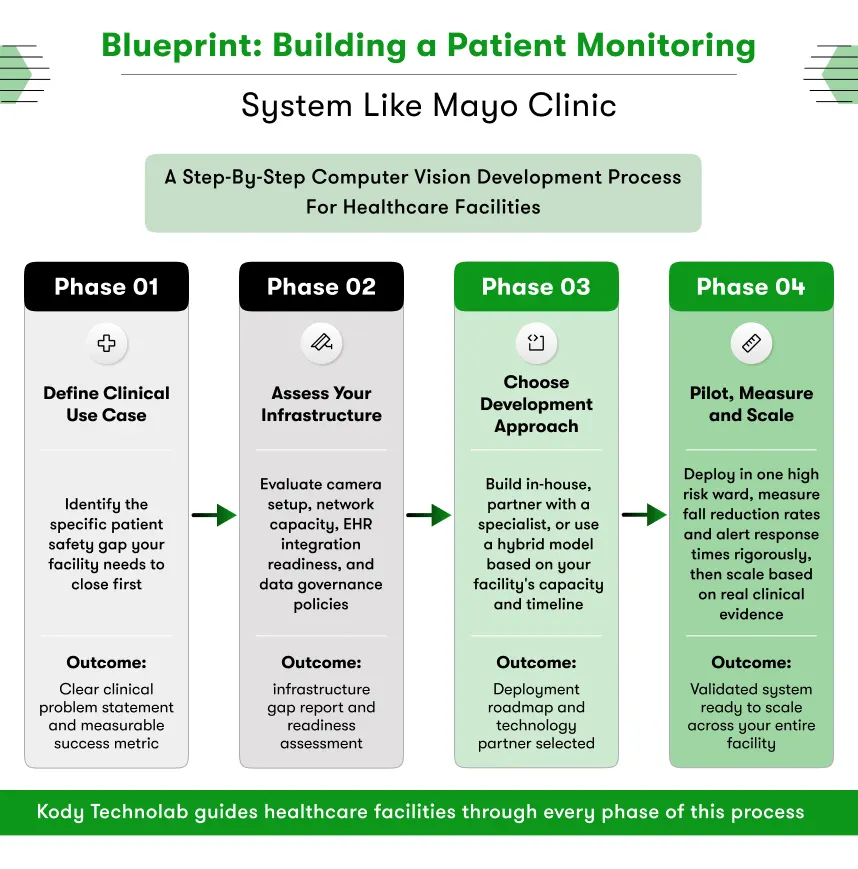
Wanting to build a patient monitoring system like Mayo Clinic and actually knowing how to do it are two very different positions. Mayo Clinic did not deploy this infrastructure overnight. The institution followed a deliberate, phased approach. Any healthcare facility can replicate it with the right planning, the right technology partner, and a clear clinical goal defined before a single camera goes up.

Start by Defining the Clinical Problem You Are Solving
The facilities that struggle most with computer vision in patient monitoring are the ones that start with the technology instead of the problem. Before evaluating any vendor, any camera system, or any AI model, your facility needs clarity on one question: which specific patient safety gap are you trying to close?
- Fall prevention in high risk wards is the most common starting point because the problem is measurable, the risk is documented, and the ROI is clear from day one of deployment.
- Delirium monitoring in the ICU is a strong second use case because behavioral changes that indicate delirium are subtle, fluctuate throughout the day, and are consistently missed during standard nursing observation cycles.
- Defining success in clinical terms before deployment means your facility has a concrete benchmark to measure against, which is what separates a successful rollout from an expensive pilot that never scales.
Assess the Infrastructure Your Facility Already Has
Building on a weak foundation creates problems that no AI model can fix. Before your facility commits to any development path, an honest infrastructure assessment tells you exactly where the gaps are and what needs to be addressed before deployment begins:
- Evaluate whether your existing camera hardware is positioned and calibrated for clinical monitoring or whether new infrastructure needs to be installed across patient rooms.
- Review your current Electronic Health Record system and confirm what integration capabilities are available so alerts and monitoring data can connect to the workflows your clinical staff already uses daily.
- Assess your data governance policies, storage capacity, and network infrastructure to confirm your facility can handle real time video processing at the scale you are planning to deploy.
Choose the Right Development Approach for Your Facility
When healthcare administrators decide to build a patient monitoring system like Mayo Clinic, the first instinct is often to build everything in house. That works for institutions with large internal engineering teams. For most facilities, a hybrid approach delivers faster results with significantly less risk:
- Building in house gives your facility full control over every component but requires a dedicated AI engineering team with deep experience in clinical computer vision systems, which most hospitals do not have internally.
- Partnering with a specialist technology provider gives your facility access to pre-validated AI models, clinical deployment experience, and a faster path to a working system without the overhead of building from scratch.
- A hybrid approach, where a technology partner builds and configures the core system while your internal team manages clinical workflows and integration, is the model that delivers the best outcomes for most healthcare facilities evaluating this technology seriously.
Pilot in One Ward, Measure Rigorously, Then Scale
Every successful computer vision deployment in a clinical environment starts small, measures honestly, and scales based on evidence rather than assumption. Skipping the pilot phase is the single most common reason these projects fail to deliver:
- Deploy the system in one high risk ward first, define your measurement criteria before go live, and give the system enough time to generate meaningful data before drawing conclusions.
- Measure fall reduction rates, alert response times, false positive rates, and clinical staff feedback consistently throughout the pilot so decisions about scaling are based on real performance data.
- Use the pilot results to refine alert thresholds, retrain models on your specific patient population data, and address any workflow friction your clinical staff identifies before rolling out across additional wards.
Building a system like Mayo Clinic does not require Mayo Clinic’s budget. It requires the right clinical use case, the right infrastructure foundation, and a technology partner who understands both the AI and the clinical environment well enough to build something your facility can trust at scale. That is exactly the kind of partnership Kody Technolab brings to healthcare organizations evaluating this technology today.
Wanting to build a patient monitoring system like Mayo Clinic and actually knowing how to do it are two very different positions. Any healthcare facility can replicate it by following a step-by-step computer vision development process built around your specific clinical environment and the patient outcomes your facility needs to achieve.
Is Your Facility Ready to Deploy a Computer Vision Patient Monitoring System?
Not every facility is at the same stage of readiness, and that is completely fine. The question worth asking honestly is whether the patient safety gaps your facility manages today are costing more than solving them would.
Here is a straightforward way to assess where your facility stands:
Your facility is ready to move forward if:
- Patient falls, delayed deterioration alerts, and undetected behavioral changes are recurring problems your clinical team reports consistently.
- Your nursing staff spends significant time on routine visual checks that pull attention away from direct patient care.
- Your facility has budget allocated for patient safety infrastructure and needs a clear, proven direction to invest it.
- Leadership has already identified continuous patient monitoring as a priority and needs a credible technology roadmap to act on.
Your facility needs more groundwork if:
- Your existing camera and network infrastructure is not yet in place or has not been evaluated for clinical monitoring requirements.
- Your data governance and HIPAA compliance frameworks need to be reviewed and strengthened before any video based monitoring system can be deployed responsibly.
- Your clinical staff has not been consulted about how an AI monitoring system would fit into existing workflows, and change management planning has not started.
If your facility falls into the first category, the path forward is clearer than you might think. A focused discovery process with the right technology partner identifies your exact infrastructure gaps, defines your clinical use case precisely, and gives you a realistic deployment roadmap based on what your facility actually needs, not a generic solution built for someone else’s problem.
Kody Technolab works with healthcare organizations at exactly this stage. When you hire computer vision developers who understand real clinical environments, the difference shows in every layer of the system, from how alerts are calibrated to how the AI model performs on your specific patient population. Whether your facility is evaluating computer vision in patient monitoring for the first time or has already tried a pilot that did not deliver, the right starting point is a conversation about your specific clinical environment, your existing infrastructure, and the patient safety outcomes your facility needs to achieve.

Conclusion
Patient safety gaps in your facility are a visibility problem. Mayo Clinic recognized that and built a computer vision based patient monitoring system that gives clinical teams the visibility layer human observation alone can provide only partially.
The facilities closing these gaps today will define the standard of care in their regions tomorrow. The ones acting now will file fewer incident reports, deliver better patient outcomes, and build a reputation that families and referring physicians trust.
If you are evaluating how to build a patient monitoring system like Mayo Clinic for your facility, the starting point is understanding your specific clinical environment, your infrastructure readiness, and the patient outcomes you want to achieve.
That is exactly the conversation Kody Technolab starts with every healthcare organization we work with. As a specialized computer vision development company focused on healthcare, Kody Technolab brings the clinical AI expertise and infrastructure knowledge your facility needs to build this right.
Book a consultation with Kody Technolab today and take the first step toward continuous, intelligent patient monitoring your clinical team can rely on.
FAQs
Q1. How does computer vision in patient monitoring actually work inside a hospital room?
AI-powered cameras are installed inside patient rooms and analyze video continuously. The system reads body posture, movement patterns, and behavioral changes in real time. When a patient shows a risk signal, clinical staff receive an immediate alert on their device. No wearable sensor is attached to the patient and no manual check is required for the system to function.
Q2. How did Mayo Clinic implement computer vision for patient monitoring?
Mayo Clinic deployed AI-powered camera systems across patient rooms to detect falls and flag behavioral changes in real time. The institution also built ambient clinical intelligence infrastructure for continuous inpatient monitoring and developed a computer vision platform for neurological assessment. Every system deployed went through rigorous clinical validation, ethics review, and privacy assessment before reaching a single patient room.
Q3. What is the cost of building a computer vision patient monitoring system?
The cost depends on four factors: the size of your facility, the number of rooms requiring coverage, your existing camera and network infrastructure, and the complexity of EHR integration your system requires. Facilities that start with a focused pilot in one high risk ward manage costs effectively before scaling. A technology partner with healthcare AI experience will give you a realistic cost estimate based on your specific infrastructure rather than a generic price point.
Q4. How long does it take to deploy a patient monitoring system like Mayo Clinic?
A focused pilot covering one ward typically takes between eight and sixteen weeks from infrastructure assessment to go live. Full facility deployment depends on the scale of your rollout, the complexity of your EHR integration, and how much model calibration your specific patient population requires. Facilities that invest time in proper planning during the discovery phase consistently achieve faster and more reliable deployments.
Q5. Is computer vision patient monitoring HIPAA compliant?
A properly built computer vision based patient monitoring system operates within full HIPAA compliance. Patient consent protocols, role based access controls, face anonymization, and data minimization practices are built into the system architecture from day one. Every piece of video data captured is handled under strict security and governance frameworks that protect patient privacy throughout the monitoring process.
Q6. Will a computer vision monitoring system replace nursing staff?
A computer vision monitoring system gives your nursing staff better information, not a replacement role. Nurses still make every clinical decision. The system handles continuous observation and delivers targeted alerts so your clinical team spends less time on routine visual checks and more time on direct patient care. Facilities using this technology consistently report higher staff satisfaction because the system reduces reactive workload rather than adding to it.
Q7. What patient safety problems does computer vision monitoring solve most effectively?
Patient monitoring using computer vision addresses three problems most effectively. Fall prevention in high risk wards produces measurable results from the first weeks of deployment. Delirium detection in ICU settings catches behavioral patterns that standard nursing observation misses consistently. Early deterioration alerts give clinical teams the response window needed to intervene before a situation demands emergency level resources.
Q8. How do we know if our facility is ready to build a computer vision patient monitoring system?
Your facility is ready when two conditions are met. Clinical leadership has identified a specific patient safety gap that manual observation cannot close reliably, and infrastructure assessment confirms your camera, network, and data governance foundations can support real time AI monitoring. If either condition needs work, a structured discovery process with the right technology partner identifies exactly what needs to be addressed before development begins.