


Summary: What if you could predict customer demand with 90%+ accuracy, reduce inventory waste by a third, and respond to market shifts in real-time instead of weeks? Demand forecasting in manufacturing has catalysed significant advancements. Smart manufacturers are adopting AI to optimize production and cost. If you want to join the club of these innovative manufacturers and know how AI is enhancing demand forecasting in the manufacturing industry, this blog is for you.
What if we told you that you can actually know what your customers were going to buy before they did, and how much to produce to meet that demand? Would you believe us? If not, you will because that’s the power of demand forecasting in manufacturing. We understand that manufacturers face significant trouble when they have excess inventory, which ties up capital, while stockouts cost sales and damage customer relationships. This leaves manufacturers constantly wondering and drained.
However, with the help of Artificial Intelligence, demand forecasting in manufacturing is here to save all manufacturers. The manufacturing industry is advancing and changing the narrative. According to McKinsey & Company research, applying AI to manufacturing demand forecasting can reduce errors by 20-25%.
AI-powered demand forecasting for manufacturers is changing how they predict and respond to demand. AI-powered demand forecasting is helping companies cut forecasting errors in half and reduce inventory waste up to 30%. If you are someone who is exploring how AI is transforming demand forecasting in manufacturing, its practical implementation strategies, and how you can get the most out of this, you are at the right place.
For a broader perspective on how AI is reshaping the industry, check out our AI in Manufacturing guide.
What is Demand Forecasting in Manufacturing?
Demand forecasting in manufacturing is the process that predicts future product demand using parameters such as historical data, market trends, seasonal patterns, economic indicators, and, most importantly, customer behaviour. It is like a wizard that balances supply and demand, avoiding stockouts while preventing excess inventory.
Unlike AI-powered demand forecasting in manufacturing, Traditional forecasting methods rely on past data and often fail to capture real-time market changes, and that’s why manufacturers face forecasting challenges. However, demand forecasting in the manufacturing industry changes the narrative for all manufacturers. How? It improves accuracy by analyzing large, complex datasets and uncovering patterns humans might miss. AI-powered demand forecasting benefits manufacturers by reducing inventory costs, improving cash flow, reducing stockouts, and optimizing production.
You must be wondering what exactly the use cases of demand forecasting in manufacturing are. Well, there are several use cases of it, such as production planning, supply chain optimization, seasonal goods, scenario planning, risk assessment, and more. AI-powered demand forecasting has become a daily part of the manufacturing industry, improving operations and ROI.


How Traditional is Different From AI-Powered Demand Forecasting for Manufacturers
A major difference between traditional and AI-powered demand forecasting for manufacturers is that the traditional method relies heavily on historical data and analyzes past behaviour, creating an imbalance in the supply-and-demand cycle. Whereas AI-powered demand forecasting utilises both past and real-time data, enabling better decision-making by understanding what is happening right now, not what happened before.

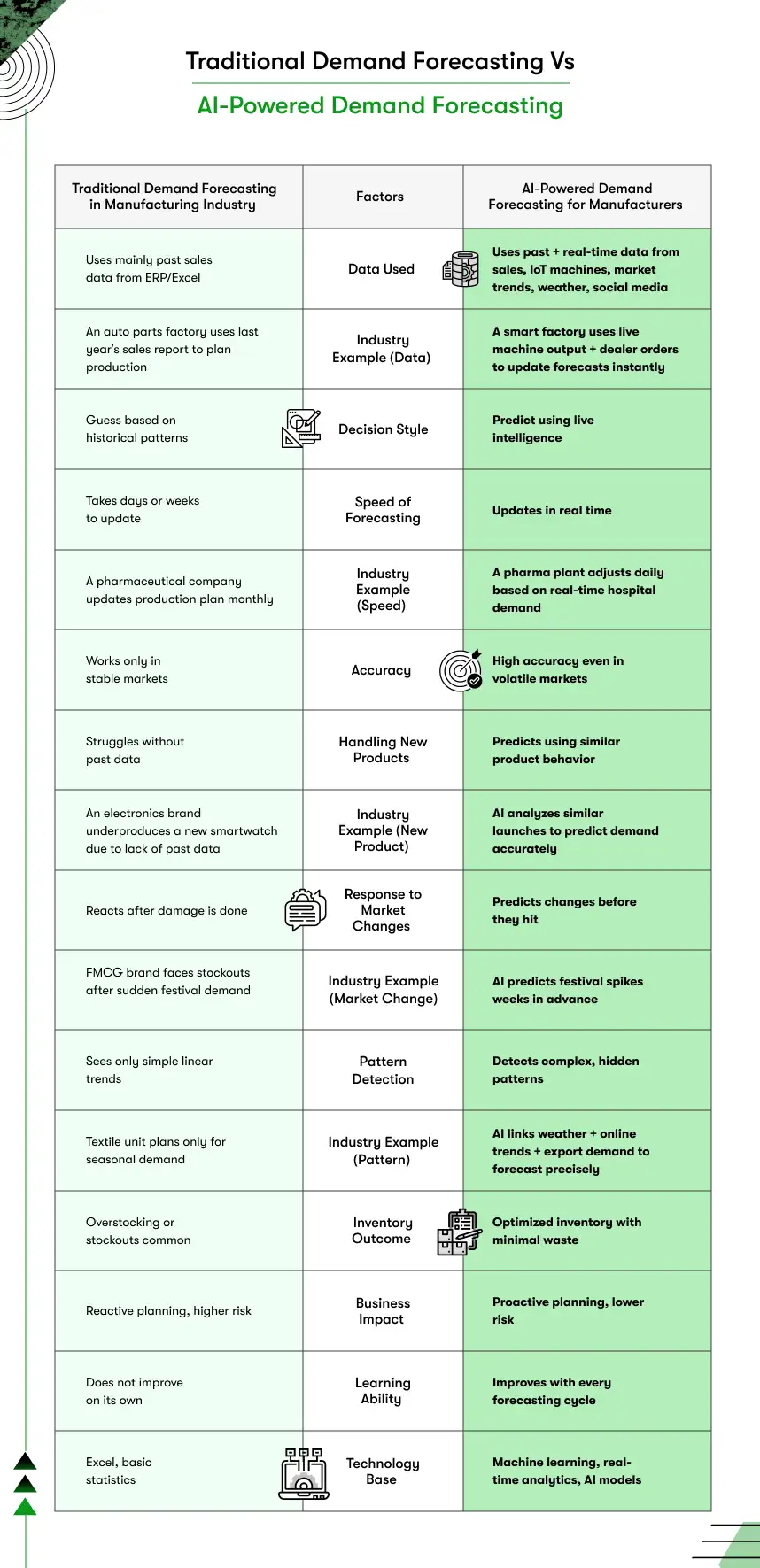
In simple terms, traditional forecasting uses historical data to predict the future, whereas AI-powered forecasting uses live, connected intelligence to do so. The traditional method relies on past sales and basic market trends, which can fail to account for market changes, social trends, and customers’ real-time demands. It assumes the future will behave like the past did. On the other hand, AI-powered demand forecasting uses live sales data, past sales data, IoT machine data, market trends, weather, social media, economic indicators, and, most importantly, supplier delays. It understands what is happening right now and what has happened before to provide the most accurate forecasting.
The concept of traditional and AI-powered demand forecasting for manufacturers shows how manufacturers can approach prediction and planning to achieve a better balance and better management. Understanding the differences between these methods will help you understand why so many companies are making the transition and why you should be next.
AI-powered demand forecasting can identify unexpected correlations and continuously improve predictions through feedback loops, a core advantage of AI in this domain. The system analyses data and learns from its own prediction accuracy, automatically adjusting its models to improve future forecasts for manufacturers.
Manufacturers gain a major advantage from AI demand in manufacturing and AI predictive maintenance operational efficiency beyond forecasting.

What are the Key Benefits of AI in Demand Forecasting?
There are several benefits of AI in manufacturing and AI-powered demand forecasting for manufacturers: significant cost savings, highly accurate results, reduced errors, enhanced operational efficiency, and risk mitigation. These improvements reflect changes in AI in manufacturing trends, where forecasting, automation, and predictive insights work together to streamline operations.
| Your Concerns | The Solution [Benefits] | How It Works |
| Will this save money? | Cost Savings | AI predicts demand accurately, so you don’t overproduce or underproduce. This reduces excess inventory, avoids emergency manufacturing, cuts storage costs, and improves cash flow. |
| Will forecasts be reliable? | Accuracy & Reduced Errors | AI analyzes real-time sales, market trends, and customer behavior instead of relying only on past data. It updates predictions continuously, minimizing human error and guesswork. |
| Will operations improve? | Operational Efficiency | AI aligns production schedules, raw material procurement, and workforce planning with actual demand, so machines, labor, and inventory are used at the right time and in the right amount. |
| Will we be safe from surprises? | Agility & Risk Mitigation | AI monitors demand shifts, supplier delays, and market changes in real time and adjusts forecasts instantly, allowing businesses to respond early instead of reacting late. |
Substantial Cost Saving
AI reduces overproduction and underproduction across manufacturing by more accurately predicting demand. It also helps manufacturers buy only the required raw materials at the right time, improving overall cash flow.
For instance, a packaged food manufacturer uses AI to forecast snack products. Earlier, it overproduced before the festival season and had to discard expired product, but with AI forecasting, snack production aligned with real demand, reducing waste, cutting warehouse expenses, and improving profit margins.
Improved Accuracy and Reduced Errors
AI analyzes massive amounts of data from multiple sources to improve accuracy, including past sales data, sales trends, weather patterns, customer behavior, and market conditions. It continuously updates the data for its prediction, making the forecast more accurate and consistent.
For instance, a textile manufacturer previously used spreadsheets to estimate seasonal demand, leading to incorrect assumptions and stock imbalances. After implementing AI demand forecasting in manufacturing, the system detected early changes in fashion demand and adjusted production accordingly. Through AI in automation, these adjustments were pushed directly to production lines, improving forecast accuracy and execution.
Enhanced Operational Efficiency
When your planning is perfect, your operations are perfect as well, and demand forecasting in the manufacturing industry helps you do exactly the same. It schedules production, procurement, labour planning, and machine utilization based on your customers’ actual demand and trends. This reduces idle machine time and avoids last-minute production, ensuring smoother daily operations in your manufacturing department.
For instance, an automotive parts supplier used AI forecasting to align production schedules with real customer orders. In normal situations, the machine remained ideal during low demand but ran out of stock during sudden spikes. But not when AI is here. AI studies demand and production, and the two balance out, as does on-time delivery.
Agility and Risk Mitigation
By continuously monitoring real-time data, AI identifies risks early and updates forecasts in real time, enabling businesses to act before problems grow. So, the manufacturers can respond to the sudden request as soon as possible ot match the demand and satisfy their customers.
For instance, AI forecasting began detecting early market interest signals and ramping up production in advance for an electronics manufacturer, thereby protecting both revenue and brand reputation during peak launches.
These four benefits, together, address every major financial, operational, and strategic challenge manufacturers face in demand forecasting. Renowned brands such as Nestle, BMW, C3 AI Food manufacturer, Siemens, and Poloplast are real-world examples of AI in manufacturing that use manufacturing demand forecasting.


| Use Case | Key Applications | Benefits | Example |
| Production Planning | Forecasts raw material needs precisely; dynamically adjusts production schedules based on demand fluctuations | Reduces storage costs, prevents delays, cuts downtime, minimizes overproduction waste, and idle costs | Metal fabrication company predicts demand for alloy grades, avoids excess inventory of specialty alloys, and plans proactively for complementary orders |
| Supply Chain Optimization | Predicts product and component demand; shares forecasts with suppliers; anticipates disruptions like supply constraints | Smoother logistics, better supplier coordination, resilient supply chain with proactive alternatives | AI analyzes supplier data, shipping delays, and commodity prices to trigger alternative sourcing before impacts |
| Seasonal and Perishable Goods | Analyzes weather, events, holidays, and historical patterns for precise predictions | Minimizes spoilage, ensures availability, and reduces waste in food/beverage manufacturing | Beverage manufacturer forecasts regional spikes using weather, events, and promotions for targeted production/distribution |
| Scenario Planning and Risk Assessment | Models “what-if” scenarios (e.g., competitor exit, price changes, supplier disruptions) | Data-driven strategic decisions, informed risk management | Novolex achieved 16% inventory reduction and shorter planning cycles; scalable for retailers’ vast networks |
Collectively, these demand forecasting use cases demonstrate how manufacturers move from reactive planning to proactive, data-driven operations. By aligning production, supply chains, and risk planning with accurate demand signals, organizations reduce waste, improve resilience, and unlock measurable cost and efficiency gains. Whether managing perishable goods or complex global supply networks, advanced demand forecasting enables smarter decisions at every level of the enterprise.
How to Implement AI-Powered Demand Forecasting?
Successfully implementing AI-powered demand forecasting requires a strategic approach that balances technical requirements with organizational readiness to perform effectively. Here’s a step-by-step guide on how you can implement AI-powered demand forecasting in manufacturing.
1. Gather Your Business Data
You start with what you already have. Collect all the past sales data, crucial inventory records, production output, supplier delivery times, and other material that can be a learning resource for the AI. The AI uses all the provided data to understand the necessary parameters and patterns to accurately predict, reduce errors, and improve operations.
2. Choose How You Want to Build It
It is crucial to understand your options before you start building it. You have two easy options: either hire an AI developer or an AI development service provider:
Option A: Hire AI Developers
When you choose option A and hire AI developers, they study your manufacturing data thoroughly and then build a custom forecasting model. They integrate it with your ERP or planning system and maintain and improve it over time. It is best if you want to control a custom-built system that works best for you. It also offers long-term in-house capability.
Option B: Use an AI Development Services Company
When you choose option B and work with an experienced AI development service provider, they can set up the data, build the forecasting model, test the system’s accuracy, and then deploy it into your system. Furthermore, they handle system maintenance and upgrades. This option is best if you prefer faster implementation, lower risk, and no hiring headache.
3. Train the AI Model
This step is the most important, as it defines how smart and accurate your system will perform after deployment. The AI studies past demand trends, learns and understands seasonal patterns and sudden demand changes, and then connects multiple factors that affect sales.
4. Connect It to Your Planning System
This is quite technical as the AI is connected to your ERP, inventory software, and most importantly, production planning tools. Once connected to all systems, it suggests how much to produce, tells when to reorder materials, and warns about demand spikes or drops.
5. Use Predictions for Daily Decisions
This is the last step: your team will use the AI outputs to plan factory production, manage stock levels, and avoid overproduction and stockouts to protect your brand reputation.
By following these steps and choosing what’s best for your manufacturing department you can move guesswork to data-driven decision making without disrupting existing operations, So whether you choose to hire AI developers for a fully customized solution or partner with an AI development services company for faster deployment, the outcome remains the same, more accurate forecasts, optimized production planning, and stronger control over inventory and costs.
Demand forecasting in manufacturing is the future for your business.
AI-powered demand forecasting in manufacturing delivers high accuracy, speed, and real-time intelligence that your industry can use, and manufacturers that use AI are reducing forecasting errors and cutting inventory costs by up to 35%. This initiative delivers measurable business results alongside technical and operational improvements, helping with forecasting, planning, and decision-making.
If you are ready to address your stock imbalance and business losses and lead with durable leadership early in the market, Kody Technolab is here for you. We help you adapt to AI-powered demand forecasting in your industry to grow faster and more scalably.

FAQ
1: What is demand forecasting in manufacturing?
Demand forecasting in manufacturing is the process of predicting future product demand by analyzing past data, market trends, customer behaviour, and other factors to balance supply and demand effectively.
2: What are the main differences between traditional and AI-powered demand forecasting?
The main difference is how they rely on data. Traditional forecasting relies mostly on past sales data and assumes future demand will be like the past. However, AI-powered forecasting uses past and real-time data from multiple sources and identifies hidden patterns to accurately predict.
3: What benefits does AI bring to demand forecasting for manufacturers?
AI reduces forecasting errors by up to 25%, cuts inventory waste by 30% and improves cash flow. In addition, it enhances operational efficiency by removing risk and enabling faster decision-making.
4: Is AI demand forecasting suitable for small and medium manufacturers?
Yes, it is. Several scalable AI-powered demand forecasting solutions cater to manufacturers of all sizes, offering customizable and faster-deployment options that suit different budgets and technical capabilities.
5: What industries or product types benefit most from AI demand forecasting?
All industries can use AI demand forecasting. Industries such as automotive parts, food and beverage, electronics, and textiles gain notable advantages from AI forecasting’s agility and precision.