



Quick Summary: This guide explains digital twin in manufacturing in clear business terms, showing how leaders gain earlier decision control, avoid common execution failures, and structure initiatives that deliver value. You learn where to start, what data matters, how to govern decisions, and how to choose the right partner with confidence.
Digital twin in manufacturing matters when delivery targets slip despite stable plans and healthy uptime metrics. Overtime approvals increase, expediting becomes routine, and margin pressure grows without a clear source. Manufacturing leaders face this pattern when planning models rely on static assumptions while shop floor conditions change across materials, machines, and sequencing every day.
A digital twin provides you a continuously updated operational model built from live production data. Machines, flows, and capacity limits remain visible as conditions evolve, allowing your teams to see constraint formation before schedules break and commitments suffer.
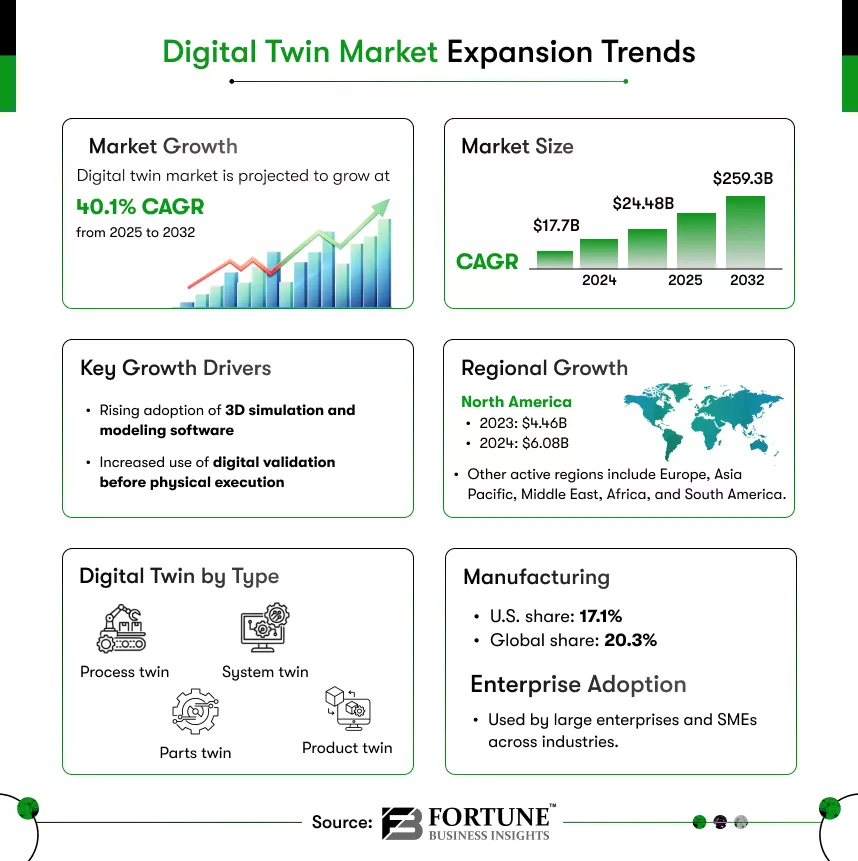
McKinsey analysis indicates the global market for digital twin technology grows close to 60 percent annually over the next five years, reaching 73.5 billion dollars by 2027, driven by manufacturers seeking earlier visibility and steadier execution rather than reactive correction.
The sections ahead explain what is a digital twin in manufacturing, how digital twin technology in manufacturing operates on real factory floors, and where digital twin applications in manufacturing deliver measurable control during pilot deployment.
If you are planning to implement digital twin technology but are unsure where to start, read our AI app development guide for a clear, in-depth path forward.

What is Digital Twin in Manufacturing?
Digital twin in manufacturing refers to a continuously updated digital representation of your production systems. The model mirrors machines, process flows, capacity limits, and operating conditions using live manufacturing data instead of static planning assumptions.
The model connects machine behavior, material movement, scheduling logic, and constraint dynamics into one operational view. Data from equipment, MES, ERP, and quality systems feeds the model so production behavior reflects current shop floor conditions.
Unlike dashboards or historical reports, a digital twin explains cause and effect across a production line. When cycle times drift, material quality varies, or sequencing changes, downstream impact on throughput, delivery risk, and capacity utilization becomes visible early enough for corrective action.
Digital twin technology in manufacturing supports decision-making during live operations rather than analysis after failure, a shift many leaders explore further through an AI in manufacturing guide. Teams use the model to test schedule adjustments, assess constraint movement, plan maintenance windows, and evaluate trade-offs without disrupting production.
This understanding forms the foundation for selecting use cases, assessing readiness, and defining pilot scope across real manufacturing environments.
Why Manufacturing Leaders Are Investing in Digital Twin Technology
Manufacturing leaders invest in digital twins in manufacturing to gain earlier visibility into production behavior, reduce reactive decision-making, and protect delivery and margin commitments. Digital twin technology helps teams understand how plans perform under real operating conditions and enables intervention before constraints escalate cost and risk.
Persistent gap between planning intent and execution reality
Production plans rely on assumed stability, while factory conditions shift continuously during live operations.
- Planning systems calculate schedules using average cycle times that fail to reflect machine wear, material variation, and shift-level performance differences.
- Execution teams respond to deviations only after schedules begin to drift, reducing the window for low-cost corrective action.
- Leadership reviews outcomes once delivery risk and margin impact already exist.
Digital twin technology in manufacturing aligns planning logic with current operating behavior across machines, materials, and sequencing.
Late discovery of production constraints
Constraints rarely remain fixed at a single workstation and often shift as conditions change.
- Bottlenecks migrate across machines and shifts when changeovers, quality variation, or equipment condition alters throughput.
- Reporting confirms constraint impact after overtime approvals, expediting, or missed OTIF targets occur.
- Decision flexibility declines because constraint visibility arrives after commitments harden.
Digital twin applications in manufacturing expose constraint movement early enough to preserve scheduling flexibility and margin protection, a capability often aligned with broader AI for supply chain initiatives.
Rising cost of reactive decision-making
Late problem detection forces operational responses that increase cost pressure.
- Overtime approvals rise because capacity limits appear without sufficient lead time for planned adjustments.
- Expediting replaces optimized sequencing once material and machine conflicts emerge.
- Maintenance activity shifts toward reactive intervention when early warning signals fail to reach decision owners.
Manufacturing leaders adopt digital twins to replace firefighting with planned intervention supported by earlier operational insight, which is where practical Digital twin usecases in manufacturing begin to deliver measurable control.
Limited confidence in operational data during critical decisions
Decision quality declines when production data lacks shared context and causal clarity.
- Planning, operations, and maintenance teams interpret performance signals differently because each system reflects a partial operational view.
- Leadership hesitation increases when dashboards conflict and fail to explain cause-and-effect relationships, even as generative AI in manufacturing expands analytical expectations.
- Experience substitutes for evidence during high-risk periods because data does not clearly identify the source of pressure.
A digital twin provides a unified operational reference that connects production data to observable behavior and decision impact.
Difficulty scaling improvement initiatives across plants
Local success often fails to extend beyond initial deployment.
- Improvement initiatives lose momentum because decision ownership remains unclear after pilot completion.
- Execution breaks down when planning logic stays disconnected from live production behavior.
- Value remains localized because operational learning does not translate into repeatable decisions.
Digital twin in manufacturing supports scalable execution by tying every decision to measurable operational outcomes across sites.
Manufacturing leaders invest in digital twins in manufacturing when recurring delivery pressure signals a deeper visibility gap inside operations. Early insight into constraint behavior, cost exposure, and execution risk creates room for planned decisions rather than forced reactions.
The next section explains how digital twin technology in manufacturing works at a system level and what data enables practical deployment inside active plants.
How Digital Twin Technology in Manufacturing Actually Works
Digital twin technology in manufacturing works through a connected loop that links physical operations with a living digital model. The digital model mirrors production behavior using live plant data, then converts model signals into decision outputs leaders can act on. A working digital twin system has five layers: physical operations, data capture, context mapping, behavior modeling, and decision output.
Layer 1: Physical operations produce signals every minute
Factories already generate signals that describe real production behavior.
- Equipment generates cycle time, run state, stop reasons, speed loss, and micro-stoppage signals.
- Production operations generate order progress, routing steps, changeover events, and shift handovers.
- Quality operations generate inspection outcomes, defect codes, rework triggers, and yield patterns.
A digital twin system starts with operational truth already present inside the plant.
Physical operations remain the source of truth for the digital twin model.
Layer 2: Data capture collects signals from systems already running
Digital twin value starts when the system pulls signals from existing platforms without forcing a rebuild.
- PLC and sensor signals provide machine state, cycle time, and stoppage events.
- MES provides work orders, line status, step completion, and operator actions.
- ERP provides demand, promised dates, order priority, and material availability signals.
- Quality systems provide measured values and defect patterns tied to product lots.
A strong pilot uses minimum viable data, then expands coverage after early value becomes visible.
Data capture must stay aligned with reliability, not maximum volume.
Layer 3: Context mapping turns raw data into a production map leaders recognize
Raw signals alone do not create a digital twin. A digital twin requires context that explains how the factory runs.
Context mapping defines:
- Asset hierarchy: plant, line, cell, workstation, machine, tool.
- Process routing: step sequence, changeover rules, batch logic, parallel paths.
- Capacity constraints: bottleneck candidates, buffers, WIP limits, shift patterns.
- Business rules: priority logic, service level rules, maintenance windows, quality gates.
Context mapping converts disconnected signals into a single operational picture.
Without context mapping, dashboards increase noise instead of clarity.
Layer 4: Behavior modeling represents how production actually behaves
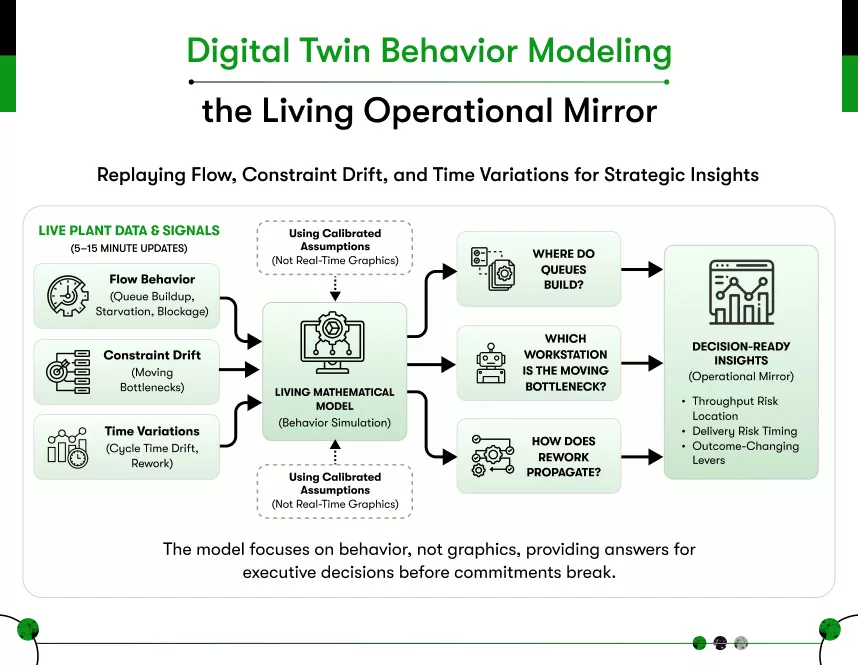
A digital twin model focuses on behavior, not graphics. Behavior modeling answers executive questions such as: where throughput risk forms, when delivery risk rises, and which lever changes outcomes fastest.
Behavior modeling commonly includes:
- Flow behavior: queue buildup, starvation, blockage, buffer limits.
- Constraint behavior: constraint movement across workstations under mix change, changeover pressure, or quality variation.
- Time behavior: cycle time drift, changeover duration drift, rework propagation effects.
- Utilization behavior: effective capacity under real conditions, not nameplate capacity.
Update cadence matters. Many plants gain value with updates every 5 to 15 minutes for line behavior and hourly refresh for planning alignment. Accuracy comes from stable signals and calibrated assumptions, not from chasing perfect real time.
Behavior modeling creates a living operational mirror that reflects current operating conditions.

Layer 5: Decision output converts model signals into leadership actions
Executives do not need another technical dashboard. Executives need decisions supported with clear timing, location, and business impact so action can occur before delivery and cost commitments break.
High-value decision output from a digital twin translates operational behavior into leadership-relevant signals.
- Constraint alerts identify the specific workstation under pressure, indicate when throughput impact will occur, and quantify the expected effect on output.
- Schedule risk evaluation links current capacity conditions with promised delivery dates, order priority, and available production windows to support informed replanning.
- Maintenance timing guidance explains how different intervention windows influence throughput and delivery performance rather than relying on fixed calendar assumptions.
- Cost exposure forecasting estimates overtime likelihood and expediting risk based on current operating conditions and constraint behavior.
Decision output must connect directly to operational ownership to create results.
- The planning function owns sequencing and schedule changes when capacity or delivery risk becomes visible.
- The production function owns labor allocation and execution priorities when imbalance or throughput pressure emerges.
- The maintenance function owns intervention timing and reliability actions when performance drift signals rising risk.
- The quality function owns containment and yield protection actions when variation begins to affect flow or rework levels.
Clear ownership ensures that digital twin insight turns into coordinated action rather than delayed discussion.
How the feedback loop completes and improves over time
A digital twin stays valuable only when model behavior matches plant behavior and when action improves outcomes.
The feedback loop includes:
- Validation: compare predicted throughput, queue buildup, and schedule adherence against actual results.
- Calibration: adjust assumptions such as changeover times, effective rates, and buffer behavior.
- Learning: record actions taken and measure impact on OTIF, overtime, and expediting frequency.
A digital twin program becomes stronger when leadership treats calibration as operational hygiene, not a one-time setup task.
Feedback and calibration protect credibility with CTO and operations leadership.
Practical example leaders can visualize in one minute
A high-mix production line runs frequent changeovers across shifts with varying operator experience and tooling conditions.
A digital twin highlights operational signals early enough for intervention.
- Changeover duration extends beyond planned thresholds during the active shift rather than after shift completion.
- Queue buildup forms upstream of the packaging station as downstream throughput begins to slow.
- Constraint movement shifts from the machining cell to packaging as sequencing pressure increases.
Leadership response becomes clear once constraint behavior and timing are visible.
- Planning adjusts order sequencing to reduce changeover frequency for remaining high-priority production.
- Production reallocates labor to stabilize packaging throughput and prevent downstream starvation.
- Maintenance schedules tooling intervention during a planned downtime window instead of emergency response.
The outcome improves because operational visibility arrives early enough to avoid overtime and delivery escalation.
Digital twin technology in manufacturing works through a structured loop that many AI development services teams follow: capture plant signals, map context, model behavior, and deliver decision outputs tied to ownership. The approach gives leadership earlier constraint visibility and clearer trade-offs without turning operations into an experiment.
Digital Twin Applications in Manufacturing Leaders Care About First
Manufacturing leaders apply digital twins in manufacturing at points where decisions carry immediate delivery, cost, or capacity consequences. Adoption usually begins with a narrow operational problem rather than a broad transformation effort. Early use focuses on areas where production variability hides constraints, forces reactive action, or weakens confidence in daily decisions.
Each application below reflects where leadership teams see measurable impact first, before expanding digital twin usage across the plant or enterprise.
Throughput and constraint visibility across production lines
Manufacturing leaders struggle to identify where throughput limits form before delivery performance deteriorates.
- A digital twin reveals how flow, queues, and capacity limits behave across machines and shifts under current conditions.
- Constraint movement becomes visible as product mix, changeovers, or equipment condition changes during production.
- Leadership gains time to intervene through sequencing, staffing, or maintenance decisions before output shortfalls escalate.
Earlier constraint visibility enables planned intervention and throughput stabilization without relying on overtime or emergency corrective actions.
Maintenance and downtime risk management
Unplanned downtime often results from late detection rather than sudden failure.
- Digital twin technology in manufacturing tracks cycle time drift, micro-stoppages, and performance degradation patterns.
- Maintenance teams evaluate intervention timing based on throughput impact rather than fixed service intervals.
- Leaders balance reliability actions against production commitments using real operational context.
Maintenance decisions become proactive and coordinated instead of reactive and disruptive.
Schedule reliability and OTIF performance support
Meeting delivery commitments becomes harder when planning assumptions fail under live conditions.
- A digital twin connects current capacity behavior with promised dates and order priority.
- Schedule risk becomes visible before OTIF targets are missed.
- Planning teams adjust sequencing and priorities while flexibility remains.
This application improves delivery confidence without inflating inventory or overtime.
Energy and cost pressure visibility
Rising energy and operating costs require tighter control during production.
- Digital twins expose energy-intensive operations under current load and sequencing conditions.
- Cost exposure linked to overtime, expediting, and inefficient execution becomes visible earlier.
- Leaders evaluate trade-offs between cost, throughput, and delivery during decision windows.
Cost control improves through informed choices rather than after-the-fact correction.
Digital twin applications in manufacturing deliver value where leadership decisions carry the highest operational and financial impact, especially when teams move beyond Digital twin vs traditional simulation and rely on live production behavior. Throughput stability, maintenance timing, schedule reliability, and cost visibility improve when decisions reflect how operations actually run.
Benefits of Digital Twin in Manufacturing for Leadership Teams
Benefits of digital twin in manufacturing emerge when leadership decisions move earlier in the production cycle, where delivery risk, cost exposure, and execution stability remain controllable. Manufacturing leaders see value when decisions rely on current operational behavior instead of delayed explanations.
Earlier intervention before cost and delivery commitments lock
Manufacturing leaders benefit when problems surface early enough to avoid forced decisions.
- A digital twin highlights constraint formation while schedules still allow adjustment without penalty.
- Leadership teams intervene before overtime approvals, expediting, or delivery renegotiations become unavoidable.
- Cost exposure remains contained because corrective action happens within planned operating windows.
Earlier intervention protects margin and reduces dependence on emergency responses.
Higher confidence in daily operational decisions
Decision quality improves when leaders trust the signals guiding trade-offs across throughput, cost, and delivery. Digital twin insight replaces assumption-based judgment with evidence grounded in current operating conditions. Leadership confidence increases because consequences remain visible before execution begins.
- A digital twin connects production behavior to measurable impact across throughput, delivery risk, and cost exposure.
- Leaders evaluate trade-offs using current conditions rather than historical averages or static planning assumptions.
- Planning, operations, and maintenance teams reference the same operational reality during high-pressure decision moments.
- Decision debates shorten because cause-and-effect relationships become visible instead of inferred.
- Leadership alignment improves because actions follow shared signals rather than competing interpretations.
Higher decision confidence reduces hesitation and accelerates execution across functions.
Reduced dependence on firefighting and emergency actions
Operational instability forces leaders into repeated emergency responses that inflate cost and exhaust teams. Digital twin visibility reduces surprise by exposing risk while options remain available. Stability improves because intervention replaces escalation.
- Digital twin insight reduces weekend overtime by highlighting throughput risk before output shortfalls accumulate.
- Expediting declines because sequencing adjustments occur earlier under controlled conditions.
- Maintenance shifts from reactive response to planned intervention based on performance trends.
- Production teams experience fewer last-minute priority changes because constraints surface sooner.
- Leadership time shifts from crisis management to proactive execution oversight.
Reduced firefighting stabilizes operations and improves organizational resilience.
Stronger accountability across planning, operations, maintenance, and quality
Execution improves when ownership aligns clearly with operational insight. Digital twin output clarifies responsibility across functions without adding governance layers. Accountability strengthens because decisions link directly to observable behavior.
- Planning teams own sequencing and schedule adjustments when capacity pressure threatens delivery.
- Production teams own labor allocation and execution priorities when flow imbalance emerges.
- Maintenance teams own intervention timing when performance drift increases reliability risk.
- Quality teams own containment actions when variation begins affecting throughput or rework.
- Leadership gains transparency into how each decision influences operational outcomes.
Clear accountability improves follow-through and reduces cross-functional friction.
Better return from improvement and technology investments
Manufacturing leaders benefit when improvement efforts scale with evidence rather than assumption. Digital twin programs support disciplined investment by validating value before expansion. Capital efficiency improves because results precede rollout.
- Digital twin pilots focus on narrow operational problems tied to throughput, delivery, or cost outcomes.
- Leadership evaluates performance improvement using measurable execution metrics.
- Expansion decisions rely on demonstrated impact rather than projected benefit.
- Technology investment aligns with operational value instead of experimentation.
- Improvement initiatives sustain momentum because results remain visible and repeatable.
Return on investment improves when execution discipline guides scale decisions.
Manufacturing leaders realize the value of the digital twin in manufacturing when daily decisions reflect actual operating conditions instead of assumption, often with guidance from a generative AI development company that understands production realities.
Earlier visibility reshapes trade-offs across delivery, cost, and capacity, allowing action while options remain open. The advantage comes from disciplined execution grounded in real production behavior rather than reactive recovery.


Things You Must Keep Ready Before Starting a Digital Twin in Manufacturing
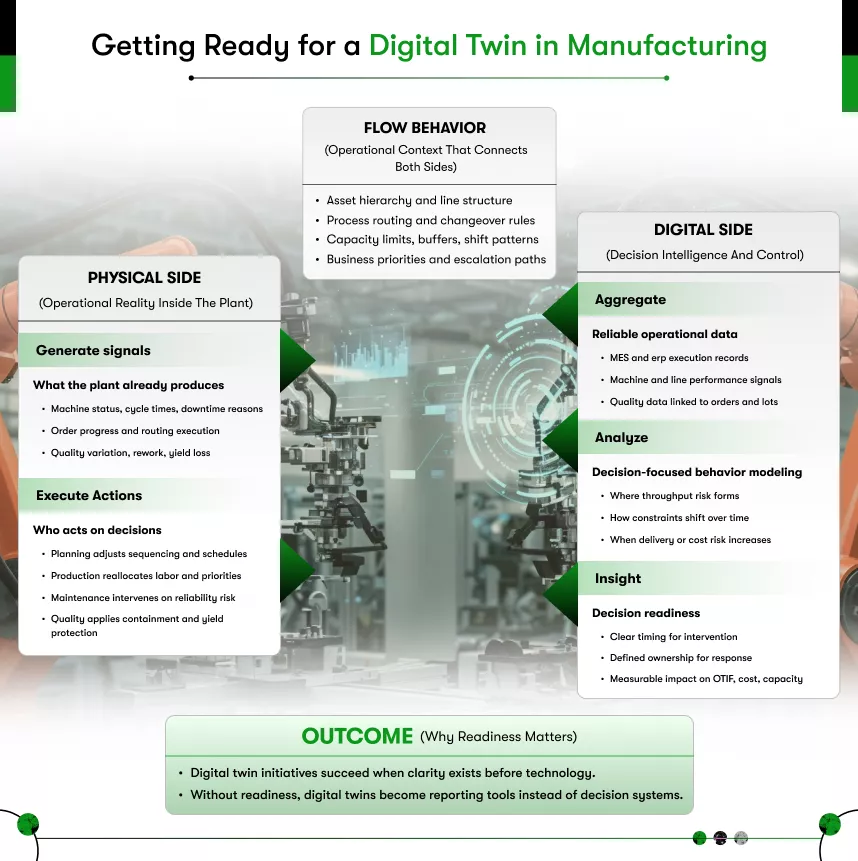
Before starting a digital twin in manufacturing, you need more than software approval or a technology roadmap. You need clarity on decisions, ownership, and operational reality. When these elements are not ready, digital twin initiatives stall, lose credibility, or turn into reporting tools instead of decision systems.
A clearly defined operational problem
Digital twin initiatives succeed when one decision problem is clearly identified from the start.
- The problem should relate directly to throughput instability, schedule volatility, or reactive maintenance pressure.
- The problem must connect to metrics already reviewed in leadership meetings, such as OTIF performance, overtime cost, or expediting frequency.
- Success criteria should describe improved decision timing and decision quality rather than system deployment.
Clear problem definition keeps digital twin applications in manufacturing anchored to measurable business outcomes.
Reliable operational data at decision points
Digital twin technology in manufacturing depends on dependable signals where decisions get made.
- Machine status, cycle times, and downtime reasons should already exist for stations that frequently limit output.
- MES or ERP records should reflect order progress, routing steps, and production status with consistent timestamps.
- Quality data should link to lots or orders when variation affects flow, rework, or yield.
Reliable signals support confident decisions without delaying progress in pursuit of perfect data.
Defined ownership for decisions across functions
Insight without ownership rarely changes outcomes.
- Planning responsibility should cover sequencing and schedule adjustments when capacity risk appears.
- Production responsibility should cover labor allocation and execution priorities under throughput pressure.
- Maintenance responsibility should cover intervention timing when performance drift increases reliability risk.
- Quality responsibility should cover containment and yield protection actions when variation affects flow.
Clear ownership ensures digital twins in manufacturing industry environments lead to action instead of debate.
Willingness to start with a narrow pilot
Early traction with a digital twin comes from disciplined focus rather than broad, premature scale. A narrow pilot allows leadership teams to validate decision value without introducing operational risk or organizational resistance.
- The first pilot should concentrate on a single production line, a clearly identified constraint, or one recurring operational decision that affects delivery or cost.
- A defined baseline period should be established in advance so changes in throughput, delivery performance, or cost exposure can be measured objectively.
- Expansion decisions should be made only after the pilot demonstrates consistent improvement across delivery reliability, operating cost, or capacity utilization.
A focused pilot builds credibility, reduces execution risk, and creates a clear foundation for scaling digital twin in manufacturing across additional lines or plants.
Alignment on decision timing and response cadence
Digital twin insight matters only when action remains possible.
- Review cadence should match plant operating rhythm rather than theoretical real-time ambition.
- Decision authority should align with shift structure and escalation paths.
- Response expectations should remain consistent across planning cycles and production shifts.
Aligned cadence allows digital twinning in manufacturing to support execution instead of adding noise.
Preparation determines success for a digital twin in manufacturing more than software selection, especially when teams aim to build a digital twin solution for manufacturing that supports real decisions. Clear problems, dependable data, defined ownership, disciplined scope, and aligned decision timing create the conditions where insight drives action. The next section explains how to structure an initiative that proves value without disrupting active operations.
Common Failure Patterns Manufacturing Leaders Must Avoid in Digital Twin in Manufacturing
Digital Twin in Manufacturing initiatives fail more often due to execution mistakes than technical limits. Many leaders approve the right concept but underestimate how decision habits, ownership gaps, and scope choices affect outcomes. The following failure patterns appear repeatedly across manufacturing programs and can derail value early.
Treating the digital twin as a visualization or reporting upgrade
- Many leaders approach a digital twin expecting clearer dashboards instead of earlier decision control.
- Reporting explains outcomes after impact, while a digital twin must influence decisions before damage occurs.
- Teams focus on charts and screens, but schedules, staffing, and maintenance timing remain unchanged.
- The program stalls because leadership behavior does not change, even though information improves.
Digital twins in manufacturing deliver value only when decision timing changes, not when reporting improves.
Starting with enterprise scale instead of operational focus
- Leaders often attempt to model the entire plant in the first phase to appear comprehensive.
- Large scope slows progress because complexity hides early learning and delays measurable results.
- Teams spend months integrating data while daily execution problems continue unchanged.
- Credibility weakens when value remains theoretical for too long.
Digital twin technology in manufacturing succeeds faster when programs start narrow and expand after proof.
Launching without clear decision ownership
- Many programs surface operational risk without defining who must act on each type of signal.
- Planning, production, and maintenance teams wait for alignment instead of making timely adjustments.
- Meetings increase because insight exists, but responsibility remains unclear.
- Execution outcomes remain unchanged because accountability was never assigned.
Digital twin applications in manufacturing require ownership to exist before insight appears.
Waiting for perfect data before acting
- Teams often delay pilots while attempting to clean every dataset and resolve every inconsistency.
- Production decisions continue using averages and assumptions during prolonged preparation.
- Leadership confidence declines as timelines extend without visible operational change.
- Data quality improves slower because real decisions never stress the model.
Benefits of digital twins in manufacturing appear through disciplined use, not prolonged data cleanup.
Expecting automation instead of decision support
- Some leaders expect a digital twin to automatically optimize schedules and resource allocation.
- Digital twins clarify trade-offs and consequences but do not replace leadership judgment.
- Programs stall when teams wait for automated answers instead of acting on insight.
- Strong results appear when leaders treat the model as decision support, not an autopilot.
Digital twin in smart manufacturing strengthens leadership discipline rather than removing responsibility.
Measuring success through deployment milestones instead of behavior change
- Many programs track integrations and go-live dates instead of decision improvement.
- Dashboards exist while overtime, expediting, and firefighting continue unchanged.
- Leadership interest fades when results remain abstract and disconnected from execution.
- Real success appears when decisions shift earlier and surprises reduce.
Digital twins in manufacturing proves value through execution behavior, not installation progress.
Most digital twins in manufacturing failures follow predictable execution patterns rather than technical limits, even when organizations hire AI developers with strong technical skills. Leaders avoid these outcomes by enforcing focus, ownership, timely action, and behavior change. When execution aligns with intent, digital twins become operational control systems instead of expensive visual tools.
Digital Twin in Manufacturing Development Cost Breakdown
Digital twin in manufacturing development cost depends on scope, data readiness, integration depth, and decision coverage. Real-world implementations focused on one production line or decision area typically range from $120,000 to $350,000, covering discovery, integration, modeling, validation, and rollout without enterprise-wide overbuild.
What drives the cost of a digital twin in manufacturing
Cost reflects operational complexity, not visual polish. Focused scope keeps spend controlled and outcomes measurable.
| Cost Factor | What the cost covers | Realistic cost range USD |
| Problem definition and discovery | Decision scoping, success metrics, baseline analysis | 15,000 – 30,000 |
| Data integration | PLC, MES, ERP, quality data ingestion | 35,000 – 80,000 |
| Context mapping | Asset hierarchy, routing rules, capacity logic | 25,000 – 50,000 |
| Behavior modeling | Flow, constraint movement, time variation | 30,000 – 70,000 |
| Decision outputs | Alerts, risk scoring, ownership mapping | 20,000 – 40,000 |
| Validation and rollout | Testing across shifts and product mix | 15,000 – 30,000 |
Controlled scope prevents cost creep. Each line item ties directly to decision improvement rather than feature expansion.
Technology components that influence the cost of digital twin in manufacturing
Technology choices influence how quickly a digital twin integrates with existing systems and how reliably it scales over time. The selection of tools affects implementation effort, operating stability, and long-term cost control across manufacturing environments.
| Technology layer | Common tools used | Cost impact USD |
| Data ingestion | OPC UA, MQTT, REST APIs | 10,000 – 25,000 |
| Data processing | Kafka, Spark, cloud pipelines | 15,000 – 35,000 |
| Modeling engine | Discrete-event or hybrid models | 20,000 – 50,000 |
| Analytics layer | Python, SQL, rules engines | 15,000 – 30,000 |
| Visualization | Web dashboards for leaders | 10,000 – 20,000 |
Technology serves decisions. Simpler stacks reduce cost without limiting value when modeling stays focused.
Digital twin investments deliver return when spend follows operational maturity instead of ambition. Leaders control cost by anchoring scope to one decision, validating impact under real conditions, and expanding only after execution improves. That approach keeps digital twin development practical, defensible, and aligned with business outcomes rather than budget escalation.
How to Structure a Digital Twin in Manufacturing Initiative That Actually Delivers Value
Execution pressure exposes weak assumptions faster than any strategy review. When delivery slips, overtime rises, and explanations arrive late, structure becomes the deciding factor. A digital twin effort either brings control early or amplifies confusion.

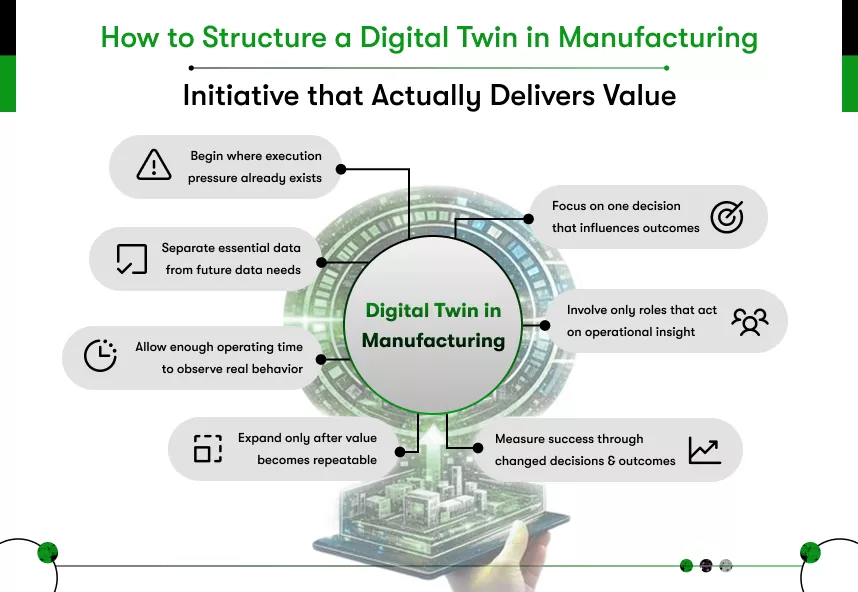
Begin where execution pressure already exists
Execution pressure exposes weaknesses faster than any planning review. Areas with recurring overtime or rescheduling already show where assumptions break. Starting here removes guesswork and surfaces value quickly.
- The starting point should be a production line, work cell, or process that repeatedly drives overtime, expediting, or schedule changes.
- The selected area should experience visible variability in throughput, sequencing, or equipment performance.
- Starting where pressure already exists makes value clear without internal persuasion.
Starting in a low-pressure area hides the constraints that actually damage delivery and margin. High-pressure environments expose decision gaps faster because variability already stresses the system. That exposure creates faster learning and clearer proof of value.
Focus on one decision that influences outcomes
Clarity comes from narrowing attention, not expanding ambition. One recurring decision shapes delivery, cost, and capacity every day. Improving that decision first creates visible impact.
- The initiative should target one recurring decision such as order sequencing, capacity allocation, or maintenance timing.
- The decision should directly influence delivery reliability, throughput stability, or avoidable operating cost.
- Combining multiple decisions in the first phase reduces clarity and delays learning.
A single decision focus keeps learning clean and measurable during early execution. When multiple decisions compete, accountability weakens and signals lose clarity. Progress depends on improving one decision end-to-end before expanding scope.
Separate essential data from future data needs
Early success depends on usable signals, not perfect datasets. Many decisions already rely on partial information. The goal is to improve timing and confidence, not data completeness.
- Initial data should include machine status, cycle times, order routing, and basic downtime reasons for the selected area.
- MES and ERP data should support only the targeted decision, not enterprise reporting.
- Additional data sources such as advanced quality metrics or cost modeling can follow later.
Early progress depends on reliable operational signals rather than complete data coverage. Decisions improve once teams act on available data and observe outcomes. Data quality strengthens naturally after decision behavior begins changing.
Involve only roles that act on operational insight
Insight creates value only when someone acts on it. Too many participants slow response and dilute ownership. Decision authority must stay clear from the start.
- Planning involvement matters only when sequencing or schedule changes fall within scope.
- Production leadership involvement remains essential because execution response determines outcomes.
- Maintenance involvement matters only when reliability or intervention timing affects the decision.
- Senior leadership involvement should focus on outcome review rather than daily execution.
Speed improves when decision ownership remains clear during live operations. Too many participants slow response and create hesitation when action matters most. Clear responsibility turns insight into execution without debate.
Allow enough operating time to observe real behavior
Production behavior changes across shifts, product mix, and conditions. Short observation periods hide risk and distort learning. Time allows patterns to repeat and reveal truth.
- The initiative should run long enough to cover multiple shifts, product mixes, and changeover conditions.
- Most environments require several operating cycles before meaningful patterns emerge.
- Short observation windows often hide variability and produce misleading conclusions.
Operational patterns appear only after shifts, product mix, and variability repeat. Short observation windows hide risk and produce false confidence. Time allows the system to reveal consistent execution behavior.
Measure success through changed decisions and outcomes
System activity does not equal progress. Value appears when decisions move earlier and execution stabilizes. Outcomes must reflect behavioral change, not usage statistics.
- Decisions should occur earlier than before when delivery or capacity risk begins forming.
- Teams should rely less on overtime, expediting, or emergency maintenance within the selected scope.
- Confidence should improve during daily trade-off discussions because cause and effect remain visible.
Success appears when decisions shift earlier and reduce forced reactions inside the selected scope. System usage alone proves nothing without execution change. Real value shows through steadier delivery and lower recovery cost.
Expand only after value becomes repeatable
Early success proves direction, not readiness for scale. Repeatability protects confidence when conditions change. Growth should follow evidence, not enthusiasm.
- The same decision logic should perform consistently across similar production conditions.
- Learning should transfer cleanly without rework or reinterpretation.
- Expansion without proof often creates resistance and erodes trust.
Scaling multiplies whatever already exists, including weaknesses. Repeatable results across similar conditions protect confidence during expansion. Proof must come before growth to avoid spreading confusion.
A well-structured Digital Twin in Manufacturing initiative builds trust through focus, discipline, and visible decision improvement. When leaders see earlier control over variability and risk, confidence replaces caution. From that point, expansion becomes a logical progression rather than a leap of faith.
Conclusion
Digital Twin in Manufacturing becomes valuable when production decisions rely on current operating behavior instead of static assumptions. Manufacturing leaders seek clarity when schedules appear reasonable but execution continues to drift. Earlier visibility into constraint formation allows planning, operations, and maintenance teams to act before delivery risk and cost escalation appear. That change restores confidence during daily trade-off discussions.
Manufacturers who succeed follow a disciplined approach. Leadership selects one meaningful decision, uses available production data, and observes behavior across real operating cycles. Teams avoid premature expansion and focus on learning under live conditions. Over time, decision timing improves, recovery actions reduce, and delivery performance stabilizes across shifts and product mix.
Kody Technolab Limited supports manufacturers through custom Digital Twin in Manufacturing development built around real execution needs. Our software teams align data, systems, and decision logic to match how production actually runs. If your organization wants predictable delivery and controlled execution, Kody Technolab can guide the journey with clarity and confidence.

FAQs: Digital Twin in Manufacturing
How is a digital twin in manufacturing different from simulation software?
Simulation software analyzes hypothetical scenarios using fixed assumptions and historical data. Digital Twin in Manufacturing operates on live production data and reflects current shop floor behavior. The digital twin updates continuously as conditions change, which allows leaders to act during execution rather than after outcomes occur.
Can Digital Twin in Manufacturing work with legacy MES and ERP systems?
Yes, Digital Twin in Manufacturing works with existing MES and ERP systems when integration focuses on decision-relevant data. Most initiatives succeed without replacing core systems. The digital twin consumes signals such as machine status, order routing, and cycle time instead of duplicating enterprise workflows.
What level of data accuracy is required before starting digital twinning in manufacturing?
Digital twinning in manufacturing does not require perfect data accuracy at the start. Reliable directional signals matter more than precision. Data quality improves once decisions begin changing and teams observe real outcomes. Waiting for complete accuracy often delays value and weakens momentum.
How does a digital twin support leadership decisions without automating operations?
Digital twin technology in manufacturing clarifies trade-offs and timing rather than replacing judgment. The model shows how decisions affect throughput, delivery, and cost under current conditions. Leadership retains control while gaining earlier insight into consequences.
What industries within manufacturing gain the most from digital twin applications?
Digital twin applications in manufacturing deliver strong value in high-mix, high-variability environments. Discrete manufacturing, automotive suppliers, electronics, industrial equipment, and process manufacturing benefit when execution variability affects delivery and cost control.
When does Digital Twin in Manufacturing become a poor investment?
Digital Twin in Manufacturing struggles when leadership expects reporting improvements instead of decision change. Weak ownership, unclear scope, and delayed action also reduce value. Success depends on discipline, not software complexity.
What technologies are typically used to build a Digital Twin in Manufacturing?
Digital Twin in Manufacturing solutions combine several technologies rather than a single platform. Implementations use industrial IoT data ingestion, event processing, and behavior modeling to reflect production conditions. Integration layers connect MES, ERP, and machine data, while cloud or edge infrastructure supports scalability. Visualization supports understanding, but decision logic creates value.