


Quick Summary: This blog compares Digital Twin vs. Traditional Simulation, discussing the differences between the two and when each method would add value. It assists leaders in identifying gaps between planning models and operational models, when simulations no longer add value, and in how digital twins enhance uptime, quality, and operational control. The practical comparisons, uses, and decision frameworks guide manufacturers in making smarter modeling investments without disrupting existing operations.
The pressures faced by manufacturing leadership teams include increased downtime, quality defects, higher operating expenses, and compliance requirements. The systems of production are more complex, narrow, and intolerant of disturbances. In such circumstances, planning methods affect plan accuracy, operational stability, and long-term competitiveness. According to Siemens’ True Cost of Downtime 2024 report, the 500 biggest companies globally lose approximately $1.4 trillion annually due to unplanned downtime, equivalent to 11% of their total revenues. Theaemt In the automotive sector production line alone can cost up to $2.3 million per hour. Digital Twin vs. Traditional Simulation has thus become a strategic rather than a technical issue that manufacturers need to consider before determining which operations can be made future-ready.
Understanding Digital Twin vs. Traditional Simulation
Manufacturing planning relied on traditional simulation, particularly during layout design and capacity estimation. The current production environments undergo regular change due to fluctuations in demand, equipment wear and tear, and reliance on supply chains. This type of variability reveals a disconnect between expected performance and reality, prompting a more in-depth comparison of digital twins vs. simulation methods. To explore the foundational exploration of the Digital Twin in Manufacturing, leadership teams that aim for clarity in their operations start by examining how real production behavior can be digitalized.
Why the Choice of Modelling Methodology Matters
The selection of the modelling methodology directly influences production efficiency, quality consistency, and audit preparedness. Having a clear understanding of what a digital twin and simulation mean enables manufacturing leaders to make digital investment decisions based on operational priorities rather than theoretical ability. The following sections will outline the two approaches step by step, beginning with a clear description of the traditional simulation in manufacturing settings.
What is Traditional Simulation in Manufacturing?
Traditional simulation in manufacturing is the development of a computerized model used to approximate how a manufacturing process operates under specific conditions. Traditional simulation is used by manufacturing leaders only in the planning or design phase to assess decisions before actual implementation. In Digital Twin vs Traditional Simulation, traditional simulation is a planning-oriented approach characterized by prediction rather than live operational insight. Most startups conduct initial digital analysis through simulation, then look at the AI in Manufacturing guide materials to get a broader picture. Traditional simulation provides a framework during planning, when the operating environment is stable and predictable.
How Traditional Simulation Works in Manufacturing?
The traditional simulation uses a fixed digital model created from old data or estimated values. After the configuration is complete, the model’s behaviour will not change, even when production conditions vary. The use of scenarios enables the estimation of production volumes, layout alternatives, and resource placement without interfering with factory operations, a weakness often noted in Digital Twin vs. simulation analyses.
The art of static modeling is used in foresight in the design stage and has little visibility in the active production stage.
What Are Common Types of Traditional Simulation in Manufacturing?
A discrete-event simulation model simulates discrete events, such as machine cycles and material flow times. Process simulation is applied to continuous manufacturing facilities, typically in chemical or energy-intensive manufacturing. Monte Carlo simulation is useful for assessing uncertainty by running probability-based scenarios for input variables. Both approaches rely on a set of assumptions, which is another commonality in the debate over the distinction between digital twins and simulations. The selection of the simulation type aligns with the planning goals and the process’s predictability.
The traditional simulation remains useful for early decisions in manufacturing. Later, operational complexity brings in constraints that will motivate greater consideration of more adaptive modeling strategies.
What Is a Digital Twin?
A digital twin is a constantly updated digital representation of a real manufacturing system, process, or physical object. Digital twins enable manufacturing leaders to gain insights into operational behaviour during live production, rather than under assumed conditions. In digital twin vs traditional simulation, a digital twin is a functional model that represents real performance on the factory floor. Digital twins in manufacturing are a starting point for many leadership teams to adjust technical concepts to operational reality. A digital twin is dedicated to monitoring actual production behavior rather than expected results.
How does a Digital Twin operate in manufacturing?
A digital twin operates by integrating real-time operational data from machines, equipment, and production systems into a coordinated digital representation. The sensors record information on machine speed, load status, temperatures, and consumption, which manufacturing teams can use to monitor current performance along the production lines.
When comparing digital twins and simulations, the main working principle is usually continuous data synchronization, and companies building these capabilities often use an AI app development guide or frameworks to frame data ingestion and analytics. Real-time data alignment enhances operational awareness during active manufacturing.
A digital twin creates a live digital mirror of the manufacturing process that evolves in real time with the physical activity. Clarity of concepts during this stage would enable manufacturing leaders to learn how digital twins operate, and later sections would assess their differences, use cases, and business impact.

Digital Twin vs Traditional Simulation
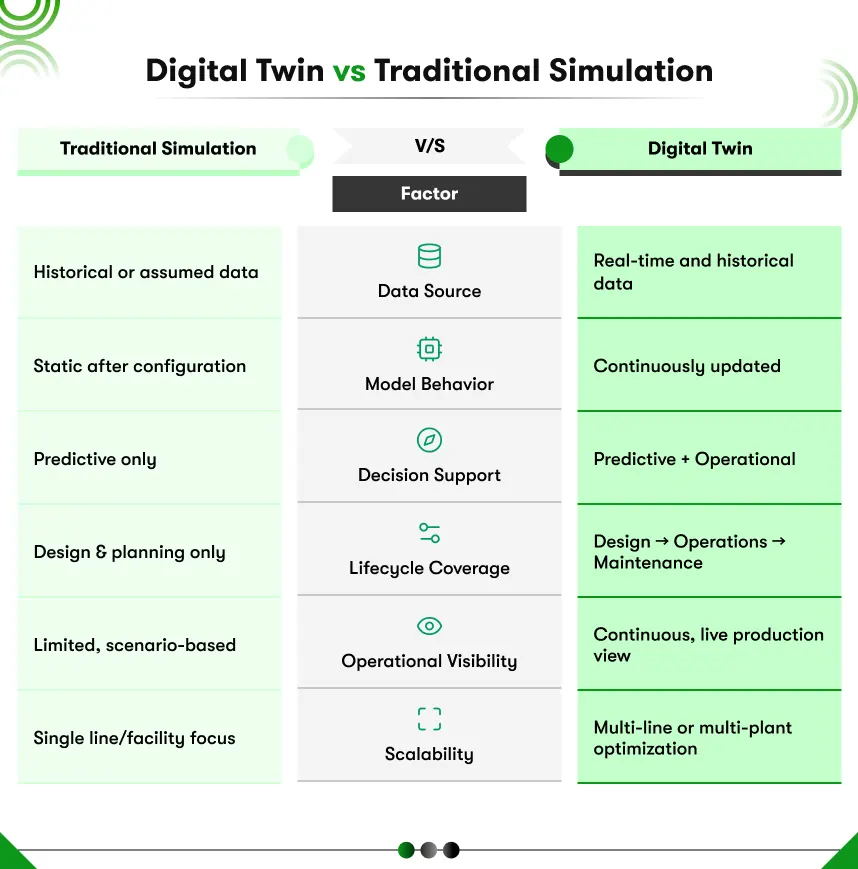
A comparison of digital twins vs. traditional simulations defines how manufacturing organizations plan production, daily operations, and long-term business growth. All of the approaches affect visibility, decision speed, cost control, and risk exposure differently. Understanding the impact these disparities have on operational performance is more beneficial to manufacturing leaders than emphasizing technical design. Clarity in the comparison enables you to align modeling decisions with the maturity of operations and long-term manufacturing objectives.
Data Source and Operational Visibility
Traditional simulation is based on historical or assumed information gathered during model development and is clear in the planning phase, but becomes less visible as the production environment varies. Once variability is introduced, operations are forced to manually adjust models to new conditions, which delays responses based on real-time data from machine and system operations, enabling manufacturing teams to monitor actual behavior during production. This difference is common across digital twin vs. simulation assessments, where operational visibility helps detect and respond to issues. Increased visibility facilitates intervention at an earlier stage and reduces the risk of escalation in the production setup.
Model Behavior Setup Decision Timing
Traditional simulation models are fixed once configured, which is suitable for accuracy but not for ongoing manufacturing. Digital twins are updated dynamically as operating conditions evolve, indicating deviations, performance drift, and the emergence of inefficiencies. The distinction between digital twins and simulations is particularly significant when the timing of the decision affects downtime, throughput, or quality stability. Early detection will enable quicker corrective measures and continuity in plant operations.
Decision-Making Capability
The traditional simulation helps predict outcomes before implementation, enabling teams to make approximations and identify results based on known assumptions. After the process begins, the aspect increases considerably, making the models less effective and ceasing to mirror and no longer reflect circumstances. Digital twins can support predictive and operational decision-making by aligning production behavior with the live environment. The digital twin vs traditional simulation in manufacturing is a capability widely valued and highly transformative for leaders in control. Operation decision support enhances consistency and cost control of production.
Lifecycle Protection and Precision over Time
The existing simulation achieves the best results in the design and early planning phases, when assumptions closely match anticipated behavior. The older the assets, the more complicated the production, and the greater the variability, the less accurate the production becomes. Digital twins remain consistent with physical processes throughout the lifetime of assets, enabling tracking, optimization, and continuous improvement. Lifecycle alignment affects long-term scalability and performance reliability, whereas constant precision promotes manufacturing resilience, which is important for your plant business.
| Business Benefit of Traditional Simulation | Traditional Simulation | Feature | Digital Twin | Business Benefit of Digital Twin |
| Faster setup and lower effort during planning | Historical or assumed data | Data Source | Real-time and historical data | Continuous visibility into live operations |
| Stable reference for early design decisions | Static after configuration | Model Behavior | Continuously updated | Faster response to operational variation |
| Reduced risk before execution | Predictive planning only | Decision-Making Capability | Predictive and operational | Improved control during production |
| Cost efficiency during early projects | Design and planning stages | Lifecycle Coverage | Design through operations | Sustained value across the asset lifecycle |
| Acceptable accuracy under stable conditions | Declines with variability | Accuracy Over Time | Maintains operational alignment | Consistent performance insight |
| Suitable for isolated planning needs | Limited to defined scenarios | Scalability | Enterprise-level scalability | Supports multi-plant optimization |
These distinctions between traditional simulation and digital twins will enable you, as a leader in the manufacturing sector, to foresee the implications of modeling decisions for operational control, cost predictability, and long-term plant performance. Planning-oriented models help make early decisions to align with live production.

Digital Twin vs Simulation Use Cases in Manufacturing
When assessing modeling practices, manufacturing leaders tend to evaluate approaches based on their support for real operational requirements in both planning and live production. Use cases also provide insight into where each approach delivers value and where constraints arise as production complexity increases. A systematic review of Digital Twin vs. simulation use cases helps decision-makers align modeling decisions with operational maturity, cost-control objectives, and performance expectations.
Traditional Simulation Use Cases in Manufacturing
- Production line design
Conventional simulation is used to help teams test various line arrangements before actual installation. With estimated throughput and cycle time, manufacturing leaders can be confident in making layout decisions early in the project.
- Factory layout planning
Simulation helps visualize equipment positioning, material movement, and space utilization. This application is used to minimize planning risk by determining spatial constraints before the commencement of construction or expansion activities.
- Capacity planning
Manufacturing teams use simulation to approximate output under projected demand conditions. This strategy helps identify equipment requirements and plan the workforce when demand is stable.
- Identification of bottlenecks in planning.
Simulation identifies potential points of congestion before operations go live. This ensures that corrective design changes can be implemented early without interfering with production schedules.
Historical uses of simulation are based on foresight and planning accuracy, not on real-time operational control.
Digital Twin Use Cases in Manufacturing
- Real-time production optimization
Constant feedback on the performance of the production is provided through digital twins, enabling adjustments when needed. This knowledge helps manufacturing teams balance throughput and idle time and level output between shifts. By synchronizing production indicators with logistics operations and planning, organizations can improve supply chain programs by using AI to coordinate all supplies, inventory, and delivery without interfering with shop-floor operations.
- Predictive maintenance planning
Digital twins track equipment operation via live operational signals. Maintenance teams detect the earliest signs of degradation, minimizing unplanned downtime and improving asset utilization.
- Quality deviation monitoring
Digital twins monitor process behavior during the production phase to identify deviations that may lead to defects. Quality teams can gain quicker insight into root causes without waiting to analyze them after production.
- Energy and resource efficiency management
Digital twins track the consumption patterns of machines and production lines. This transparency helps enhance efficiency and save costs in the facilities.
Several organizations are investigating digital twin use cases in manufacturing as a broader performance-enhancement strategy for operational adoption. The application of digital twins focuses on continuous awareness and responsiveness in operations to improve overall plant performance.
What are the Benefits of Digital Twin vs. Simulation to Manufacturers?
Manufacturing leaders consider the method when making modeling decisions based on quantifiable contributions to cost, uptime, quality, and compliance. Another clue to the digital twin vs. simulation benefits is the ability to discuss the methods leadership teams use to articulate the strengths of each method in both the planning and in-service processes. The benefits vary depending on timing, required data, and areas of operation; hence, it is vital to have side-by-side clarity to make sound investment decisions.
Benefits of Traditional Simulation for Manufacturers
Lower upfront investment and faster setup
Conventional simulation requires minimal system integration, resulting in higher initial costs. Planning teams have faster access to performance estimates during the initial project phases without interfering with production activity.
Stronger confidence during design decisions
The use of simulation enables leaders of the manufacturing process to test layouts, line shapes, and capacity assumptions before physical implementation. Valuation at an early stage minimizes risk during design and enhances the accuracy of capital planning.
Effective planning under stable conditions
In predictable production settings, simulation provides certain estimates of throughput and resource distribution. This reliability supports preliminary viability testing and the approval of plans.
The positive aspects of traditional simulation revolve around futuristic forecasting and the efficiency of planning.

Benefits of Digital Twin for Manufacturers
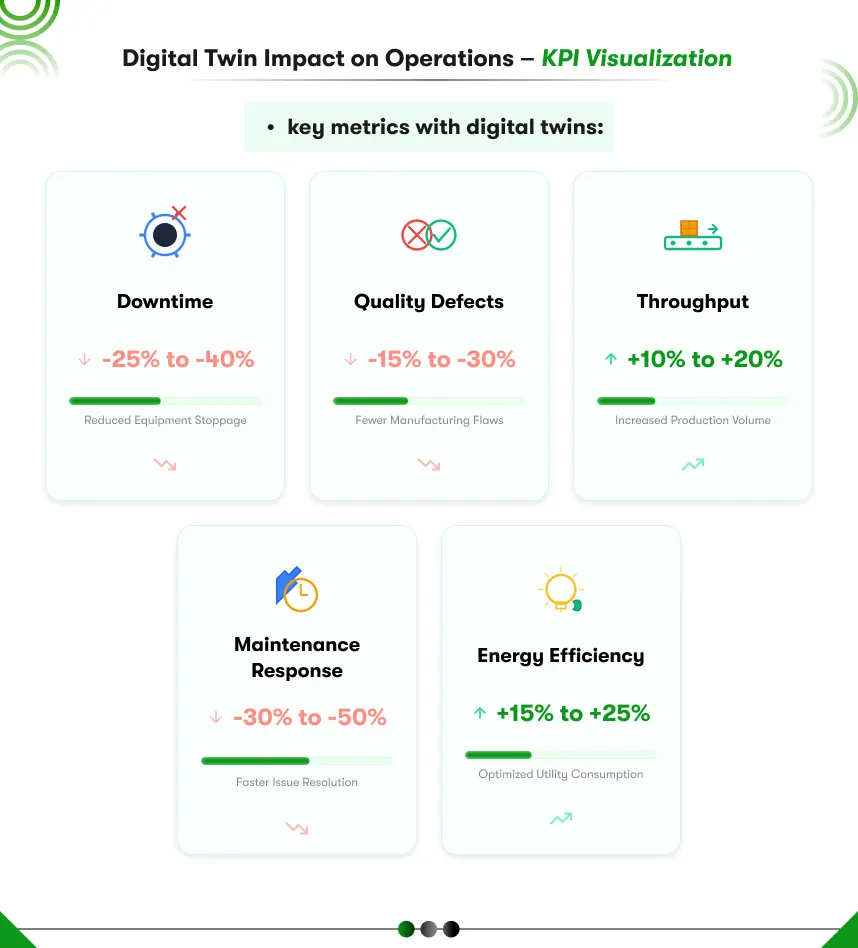
Reduced unplanned downtime
Digital twins also allow you to have a constant view of production conduct and machine state. Early detection of deviations helps prevent disruptions before they escalate, enhancing uptime.
Continuous process optimization
Operational knowledge enables production teams to modify performance in real-time production. By conducting continuous monitoring and analysis, organizations enhance throughput, equalize workloads, and stabilize output across shifts.
Faster quality issue detection and resolution
Digital twins capture process behavior during production runs and enable quality teams to spot deviation trends early. Increased insight speed reduces scrap, rework, and defect propagation between batches.
Improved compliance and traceability
Traditional simulation requires limited system integration, which helps keep initial costs under control. Planning teams gain quicker access to performance estimates during early project stages without affecting production activity.
Audit readiness and process traceability are enhanced by operational records maintained using digital twins. Digital twin solutions in manufacturing are aligned with many organizations to ensure scalability and governance across facilities.
Understanding differences in benefits helps manufacturing executives align modeling strategies with operational priorities and maturity levels. Simulation planning can be used to make early decisions, whereas digital twins provide long-term operational value. The second part provides a practical tip on applying each method in manufacturing settings.
When Should Manufacturers Use Digital Twin vs Traditional Simulation?
Very often, manufacturing leaders base their evaluation of modeling approaches on operational readiness rather than on a technical basis. The decision is based on the production stage, data availability, and the degree of control needed in day-to-day operations. The Digital Twin vs. Traditional Simulation is a decision framework to ensure the organization invests in modeling aligned with actual business situations.
| Business Fit for Traditional Simulation | Traditional Simulation | Decision Factor | Digital Twin | Business Fit for Digital Twin |
| Supports confident planning before execution | Pre-production or redesign phase | Production Stage | Active and running production | Supports visibility during live operations |
| Works well without real-time infrastructure | Limited or historical data | Data Availability | Continuous operational data | Enables real-time performance awareness |
| Suitable for infrequent change scenarios | Periodic planning decisions | Decision Frequency | Ongoing operational decisions | Supports continuous adjustment and control |
| Maintains accuracy under stable conditions | Low and predictable | Production Variability | High and dynamic | Adapts as conditions change |
| Reduces planning-stage risk | Design validation and feasibility | Improvement Objective | Continuous optimization and stability | Improves uptime, quality, and efficiency |
| Effective for isolated planning efforts | Single line or facility focus | Scalability Needs | Multi-line or multi-plant operations | Supports enterprise-wide operational insight |
Here’s a decision-making framework for manufacturers: The Traditional simulation is most applicable for decisions at early stages, where assumptions are accurate and operational changes are negligible. Digital twins are superior in active manufacturing settings because the performance of daily operations, quality stability, and cost control are based on continuous observations. The two approaches are applied by many manufacturers at various levels, with their modeling strategies evolving in line with the operations’ maturity and growth objectives, as required. However, if you are looking for a smart and practical solution that drives real growth and lets you operate your plant without disrupting the current operations, the digital twin is the preferred model.
What is the Future Outlook of Digital Twin vs Simulation in 2026 Manufacturing?
Traditional simulation will still be significant for design, expansion planning, and feasibility analysis, where assumptions remain constant. However, digital twins will become increasingly involved in everyday processes as factories require greater speed, flexibility, and integration. The future trends of Digital Twins vs. Traditional Simulation point to coexistence, with each approach playing a specific role throughout the manufacturing lifecycle.
As the production environment becomes more productive in generating operational data, digital twins will serve more as a live operational aid than an analysis add-on. Continuous mapping of physical assets and digital models will enable performance monitoring, awareness of deviations, and plant optimization. Simulation will not become obsolete because it will remain a rigorous setting for testing change. Still, digital twins will provide value throughout execution, cementing the distinction between digital twins and simulation in the real world.
Digital twins will become more intertwined with operational systems, analytics tools, and decision-making by 2026 and beyond. This type of integration facilitates faster coordination among maintenance, quality, and planning teams. With AI Development Services, many manufacturers will quickly embrace AI, and digital twin platforms will be able to easily scale across all facilities without disaggregating insight.
Companies that maintain equilibrium between planning and operational sensitivity do well by ensuring stability, compliance, and continued growth in the ever-changing manufacturing landscape.
Choosing the Right Approach for Your Manufacturing Strategy
So, at the end of the day, picking the right manufacturing strategy really comes down to what makes the most sense for your business. When manufacturing executives choose modeling methods, they should select ones that align with the maturity of their operations. Usually, when we’re dealing with straightforward assumptions, old-school simulations are really helpful for planning, checking designs, and figuring out how much we can handle at first. Digital twins are super helpful for day-to-day work because they keep the physical and digital versions in sync. This means less downtime, better quality, and it can save you money.
It’s important to know the difference between digital twins and simulations so companies don’t waste money planning simulations that won’t actually help with what they’re doing right now. Running simulations helps you feel more confident before you actually start doing something. Then, when you are actually doing it, digital twins let you stay in control. Most places find that it’s a good idea to mix and match both methods at different points in their manufacturing process, but how do you analyze it? And most importantly, who to ask for help, you can always contact experts in this matter to get a consultation for your plant.
Like Kody Technolab Ltd., we have helped manufacturers bridge the gap between planning and execution. We really aim to bridge the gap between planning and doing, using advanced AI systems to get things done effectively. We’re a deep-tech company that creates AI platforms and automation tools to help manufacturers make their operations smarter and more scalable. If you’re looking to bring in AI, you can always hire AI developers who really know their stuff about manufacturing, what the rules are, and how things actually work day-to-day.
FAQ
1. What is the difference between Digital Twin vs Traditional Simulation in manufacturing?
The difference between Digital Twin vs Traditional Simulation lies in how the models interact with real operations. Traditional simulation uses fixed assumptions to predict outcomes during planning, while a digital twin continuously updates itself using live operational data to reflect actual production behavior.
2. Is Digital Twin vs Traditional Simulation a replacement decision or a complementary one?
Digital Twin vs Traditional Simulation is not a replacement decision for most manufacturers. Traditional simulation is typically used for early-stage planning, while digital twins are applied during active production to monitor, optimize, and control operations in real time.
3. What data is required when comparing Digital Twin vs Traditional Simulation?
Traditional simulation relies on historical or estimated data, whereas digital twins require real-time data from machines, sensors, and production systems. When evaluating Digital Twin vs Traditional Simulation, data availability and quality are often the deciding factors.
4. Which manufacturing environments benefit most from Digital Twin vs Traditional Simulation?
Manufacturing environments with high variability, frequent downtime, or complex operations benefit more from digital twins. In contrast, stable and predictable environments may find traditional simulation sufficient. Digital Twin vs Traditional Simulation outcomes depend largely on operational complexity.
5. How does Digital Twin vs Traditional Simulation impact downtime and maintenance?
Traditional simulation helps reduce risk before execution, but it does not track live equipment behavior. In Digital Twin vs Traditional Simulation comparisons, digital twins offer superior downtime reduction by detecting early performance deviations during production.
6. What is the typical ROI difference in Digital Twin vs Traditional Simulation?
Traditional simulation delivers ROI mainly during the design and planning stages. Digital twins deliver ongoing ROI by improving uptime, quality, and efficiency throughout the production lifecycle. Digital Twin vs Traditional Simulation ROI differs significantly based on usage duration.
7. When should a manufacturer transition from Traditional Simulation to a Digital Twin?
Manufacturers typically transition when operations are live, data infrastructure is available, and performance variability impacts cost or quality. In Digital Twin vs Traditional Simulation decision-making, this transition reflects operational maturity rather than technology preference.