


Quick Summary: AI Health ATM features determine how well your screening program performs in daily operations. The right setup increases screening capacity, reduces staff involvement, and delivers reports your clinical team can use immediately. This guide showed what to evaluate. Connect with Kody Technolab and request a Medigo demo based on your workflow and expected screening volume.
AI Health ATM deployments fail when buyers evaluate the wrong parameters. Teams approve machines based on demonstrations, not real operating conditions. A high device count looks impressive, but weak workflows keep staff involved at every step. Low upfront cost often comes with poor integration, disrupting screening, reporting, and follow-up.
After installation, daily screening capacity stays constrained. Reports come late or split across systems, slowing decisions and cutting the value of the setup.
This article focuses on that decision point. You already understand what an AI Health ATM is. What matters now is which AI Health ATM features enable high daily screening volumes, reduce dependence on staff, and deliver structured reports your clinical team can use immediately.
McKinsey research estimates that AI automation of administrative workflows, including documentation, scheduling, and reporting, could deliver 13 to 25 percent in cost savings for healthcare organizations. That efficiency is only achievable when screening systems eliminate manual steps end to end, from session guidance to report delivery.
This article explains the AI Health ATM features you should evaluate when selecting a solution like Medigo.
Key Takeaways
- AI Health ATM features decide how many people you can screen each day and how smoothly the process runs.
- A guided workflow allows users to complete screenings independently, which reduces staff workload.
- A connected digital health ATM system ensures all test data flows into one report without manual effort.
- Fast screening and clear reports help your clinical team take immediate action.
- A reliable smart health ATM solution supports consistent performance across locations and real-world conditions.
What is an AI Health ATM?
An AI Health ATM is a self-contained screening unit that combines multiple diagnostic devices with a guided software system. You deploy it in a hospital, workplace, or public location to run standardized health screenings without continuous staff supervision.
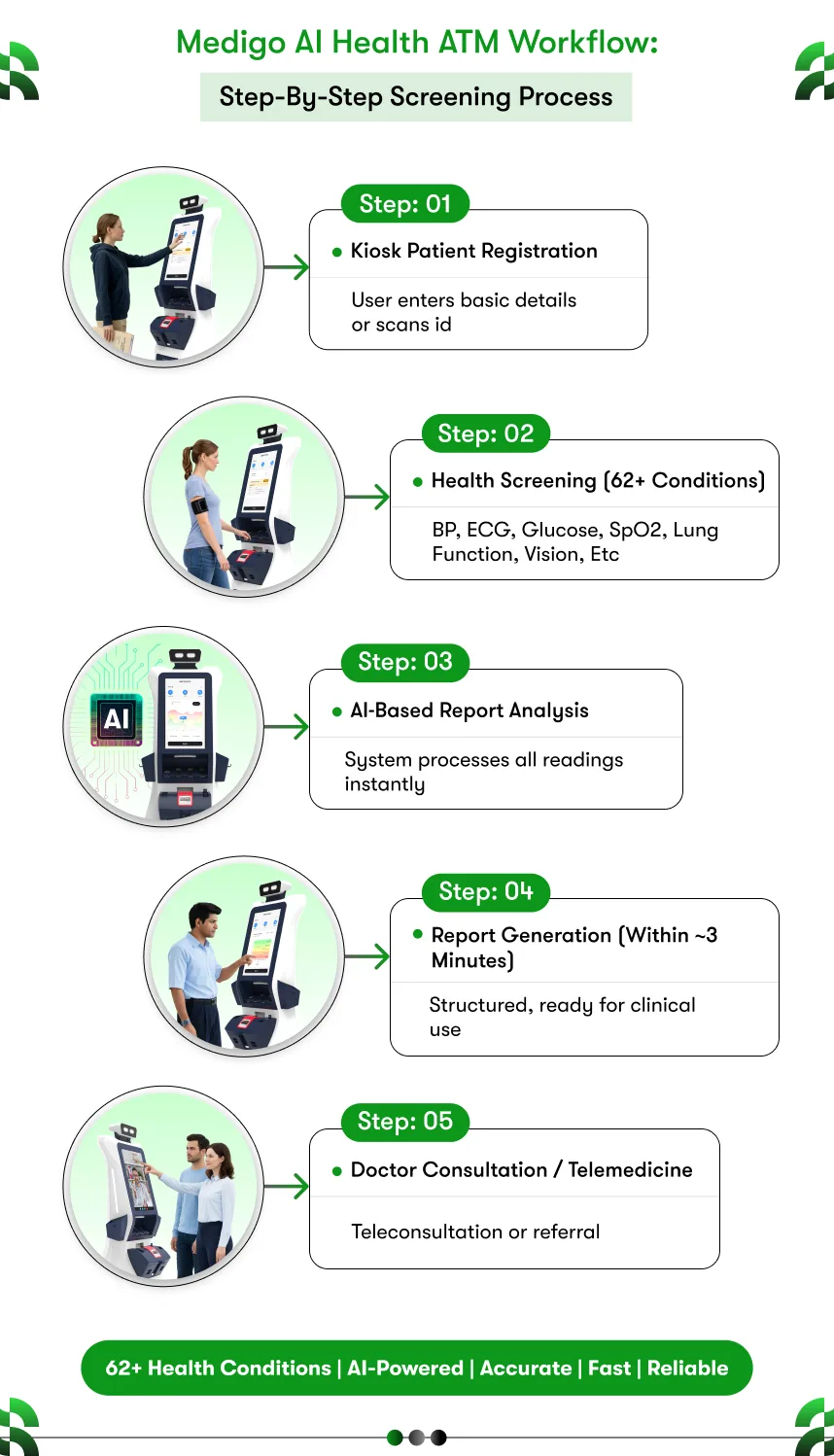
A user starts the session through an on-screen interface and follows a fixed sequence of tests such as blood pressure, glucose, ECG, lung function, and vision. Each connected device captures readings, and the system records and processes the data in one continuous workflow. At the end of the session, it generates a single report with all results.
The system removes the need to operate separate machines or transfer data manually between steps. It records each session, stores patient history, and makes reports available for immediate clinical review or follow-up.
For you, this means you can complete more screenings each day while maintaining the same report format across all locations, supported by the consistency that AI in healthcare brings to screening workflows.

Why AI Health ATM Features Matter in Real Deployments
Your results depend on how the system performs during continuous use. When you evaluate options, you need to focus on what affects daily screening capacity, staff effort per patient, and how quickly reports reach your clinical team.
Surface-level comparisons do not reflect real performance
Many buyers compare a health ATM machine on device count, interface, or upfront cost. These do not predict performance during high footfall. The key checks are throughput per hour, steps per patient, and report turnaround time.
What actually drives performance
The way the system is designed controls throughput and data flow. A guided workflow allows users to complete screenings without staff assistance. A connected digital health ATM system moves readings from devices into a single report without manual entry.
Poor design reduces efficiency and scale
Weak health ATM machine features create queues. Staff step in at multiple points, sessions run one at a time, and reports arrive late or in separate files. Clinical decisions slow down.
The right design improves adoption and decision-making
Features of AI health ATM systems should support quick sessions, structured reports, and immediate access for clinicians. When these are in place, you maintain steady throughput and your team can act on results without delay.
The difference comes down to how the health ATM system performs when you put it into daily use across your locations. If the workflow slows down, if reports are delayed, or if your team has to step in at every stage, the deployment will not scale.
Before you move forward, you need clarity on what you are actually investing in, whether it is a large deployment or a Health ATM for PHC. The right combination of capabilities will increase your screening capacity, reduce operational effort, and give your clinical team reports they can act on without delay.
In the next section, you will see the AI Health ATM features that directly influence these outcomes, so you can evaluate your options with confidence or move ahead with a solution like Medigo based on clear criteria
Top AI Health ATM Features to Look For in a Smart Health ATM Solution
The performance of your screening program depends on the capabilities built into the system you choose. AI Health ATM features determine whether you increase daily screening capacity or continue dealing with delays, manual work, and limited output.

01. Device Integration For Consistent Sessions
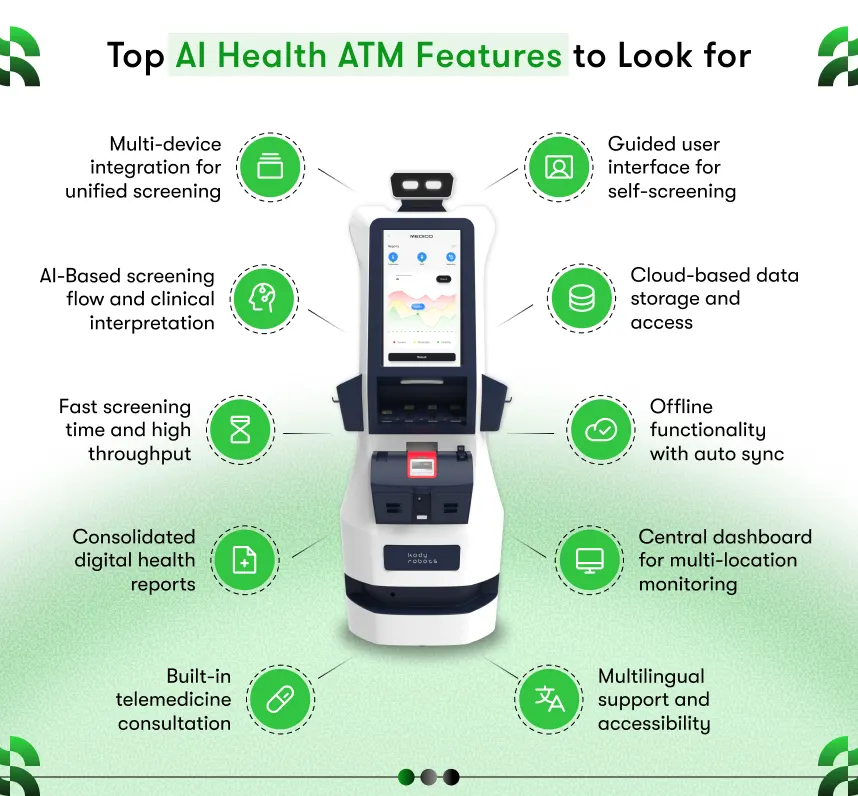
Effective digital health ATM systems link all of the used diagnostic devices together into one session. For example, the blood pressure, glucose, ECG, spirometry, and vision testing will all be done in one go, with each measurement automatically going to one final report.
The lack of proper integration means that the process of data transmission will become necessary, increasing error rate and decreasing efficiency. With proper integration, your screening sessions become consistent and efficient, leading to a significantly increased capacity per person.
02. Real-Time Screening Algorithm And Report Interpretation
AI health ATM features have to include real-time screening algorithms and interpretations. It means that the AI will be able to modify the process of tests depending on what was captured from the patient, identifying any abnormalities and marking them clearly.
The inability to produce a structured report means that you will still have to rely on interpreting them manually. Features of AI health ATMs provide an opportunity to make quick and informed decisions by providing structured outputs directly in real-time.
03. Short Session Time With High Throughput
Screening speed determines the maximum number of people who could be tested within one day. Features of health ATM machines allow for increasing the speed at which you conduct each session without making it slower. The lower the speed is, the higher the chance of reduced adoption in busy areas. High throughput provides a way to ensure consistent session times and therefore a greater amount of sessions within one hour.
04. Digital Health Reports That Are Consolidated In One Place
An effective digital health ATM system generates only one report containing all data in a structured format. It needs to be produced instantaneously after screening without any additional steps.
Having several reports created for one screening requires much more time for your clinical team to compile them. A single report provides better readability, fewer errors, and fast decision-making.
05. Direct Access To Doctors After The Screening Is Done
An essential feature of an AI health ATM solution would be the possibility to get in touch with a doctor after screening. The system should allow doing that immediately after producing a report without the need to manually transmit it.
Without the possibility to communicate directly, any screening will be incomplete, providing no follow-ups.
06. Guide Users On How To Self-Screen Themselves
Features of health ATM kiosks should provide users with a guided UI that will allow conducting sessions without any need for assistance. The interface should be intuitive and guide the user through each step until it is finished.
The necessity of helping the person with their screening will significantly reduce throughput and adoption in public areas.
07. Cloud-Based Storage For All Your Reports
A digital health ATM solution should store all generated reports in the cloud. Reports should be easily accessible for further review. Lack of cloud storage will lead to continuity being broken, and the data won’t be available for future use.
Cloud-based data storing is an essential element of a comprehensive solution for conducting health screenings.

08. Offline Mode And Automatic Synchronization
One of the crucial elements of a digital health ATM system is its ability to conduct screenings even when there is no internet connection. The data should be stored temporarily and synchronized automatically once the network connection returns. This ensures that the screening procedure is not interrupted by temporary outages.
09. Dashboard To Monitor The Performance Of Each Unit
Health ATM features should include a central dashboard that shows screening activity, device status, and report generation across all locations.
Without this visibility, managing multiple units becomes difficult. A centralized view allows you to track performance, identify issues, and maintain consistency across deployments.
10. Support Multiple Languages For Enhanced Accessibility
The Medigo health ATM solution provides multi-language support so that people are able to use instructions in languages they understand. This ensures that they will be able to use the device properly, minimizing the chance of errors. Lack of language support will make the screening process too complicated and lengthy for some.
Each of these AI Health ATM features directly affects how your deployment performs in real conditions, especially as part of a broader robotics healthcare infrastructure. When these capabilities are built correctly, you increase screening capacity, reduce staff effort, and enable faster clinical decisions.
If these features are not built into the system, your deployment will struggle to scale. Evaluate each capability carefully before you commit, or move forward with a solution like Medigo that is designed to handle real-world screening demands.
How to Evaluate an AI Health ATM Solution Before You Buy
Before you choose any system, focus on how it will perform during daily use in your environment. A smart health ATM solution should increase the number of people you can screen, reduce staff effort, and produce reports your team can use immediately. The following points will help you judge whether the system can actually deliver that outcome.

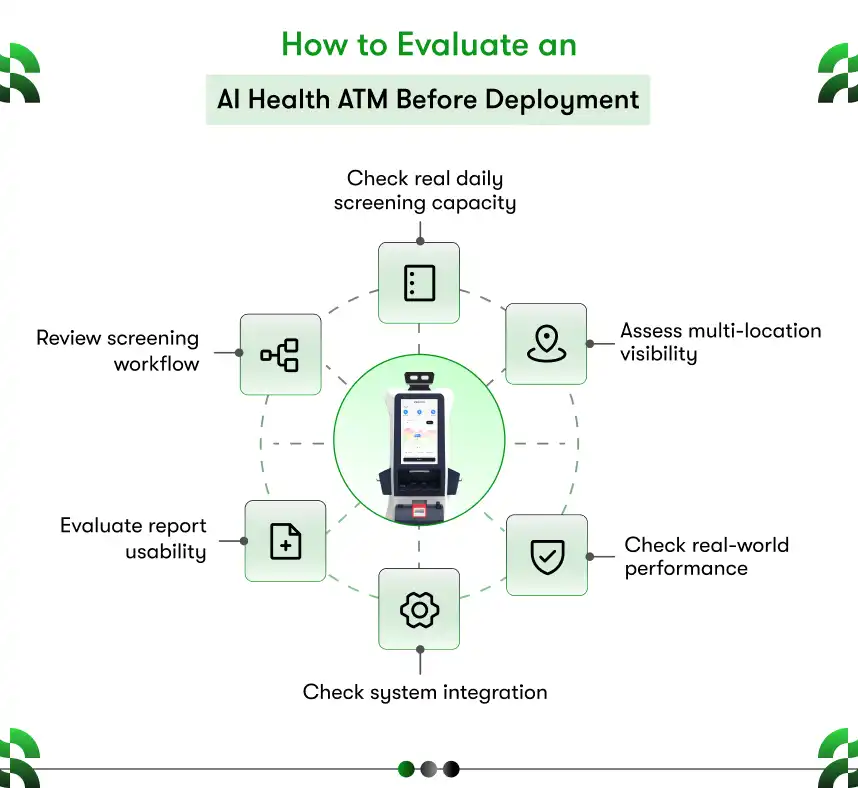
Check real daily screening capacity, not device count
Vendors often highlight how many devices or tests are included, but that does not tell you how many people you can screen in a day.
What matters is how long one complete session takes and whether that time stays consistent when multiple users are using the system continuously.
A strong digital health ATM system completes each session in a predictable time without pauses between tests. If the process slows down or depends on staff at any step, your daily output will remain limited regardless of how many devices are present.
Understand how the screening flow actually runs
A smooth workflow is one of the most important health ATM features. The system should guide users from one test to the next without confusion or manual intervention. If users hesitate, require help, or need staff to move them through steps, the entire process slows down.
Strong AI healthcare kiosk features ensure that every transition is automatic and clear. This reduces handling time per patient and allows you to maintain consistent throughput across different locations.
Evaluate report usability, not just report availability
A report has value only if your clinical team can use it immediately. Features of AI health ATM systems should ensure that all test results appear in a single, structured report with clear labeling and reference ranges.
If your team needs to interpret raw numbers or combine data from different sources, you lose time on every patient.
A well-designed system produces reports that support quick decisions without additional processing.
Check how well the system fits into your existing workflow
An AI health ATM should work as part of your operations, not as a separate unit. Data should move directly into your records, and reports should be accessible without extra steps. Weak integration creates duplicate work, delays, and gaps in follow-up.
Strong health ATM machine features ensure that screening, reporting, and data access remain connected so your team can act without interruption.
Assess visibility across multiple locations
If you plan to deploy across hospitals, corporate sites, or public locations, you need to track performance centrally.
A reliable digital health ATM system should allow you to see how many screenings are happening, how each unit is performing, and whether any issues need attention. Without this visibility, you lose control over operations and cannot maintain consistency at scale.
Consider how the system performs in real conditions
A system may perform well in controlled settings but struggle during continuous use. A smart health ATM solution should handle long hours, high usage, and unstable connectivity without affecting performance.
If the system slows down, stops during network issues, or requires frequent intervention, it will affect your screening program. Consistent performance under real conditions is one of the most important health ATM machine benefits you should look for.
At this point, your decision shifts from comparing options to understanding how your screening operations will run every day, especially as robotics in healthcare continues to shape more automated care delivery. The right combination of AI Health ATM features will increase your screening capacity, reduce reliance on staff, and ensure your team receives reports they can act on immediately.
If you are evaluating solutions, use these points to assess real performance before making a decision. A solution like Medigo is designed to meet these requirements and support large-scale screening without adding operational complexity.
Why Medigo Fits Real Factors Impacting Screening Performance
The design of Medigo is based on the elements impacting the screening capacity in everyday operations. In particular, Medigo considers throughput, workflow consistency, report preparation, and reliable system performance during use. Every capability offered by Medigo is useful in operations, and not in demonstrations.
Provides consistent screening capacity
Since multiple screenings are performed within a single guided session, users perform tests for blood pressure, glucose levels, ECG, spirometry, and vision assessment continuously in one session. This way, Medigo connects the outputs of different devices to a single flow of data and provides you with a consistent session time. As a result, you can sustain the same level of productivity throughout the entire working day.
Minimizes the participation of staff in the screening process
In order to provide users with guidance on their actions, Medigo offers step-by-step instructions automatically. Moreover, readings are taken and recorded without requiring any input from users. This way, your staff does not have to participate in the process and guide patients through each step of the session.
Provides instantly usable reports
After the completion of each session, Medigo creates one report containing all test results in a consistent format. Consequently, your clinicians will be able to analyze results instantly as they do not have to compile data from various sources.
Supports operation in many locations
Since all screenings are processed and saved by Medigo, you will have access to screening data from different locations at once. As a result, you will be able to assess the utilization rates and screening volume in a consistent manner.
Performs well under real conditions
Even if connectivity issues arise in a specific location, or the screening lasts for an extended period of time, Medigo works well. All screening will still go uninterrupted, and the data will synchronize as soon as the connection gets restored.
Most systems meet expectations during evaluation and fall short after deployment. The difference comes from how they handle real workload. Medigo is built to operate under continuous use without slowing down your process, which becomes clear when you look at how Medigo works in real conditions. If these outcomes matter for your setup, it is worth validating them in a live environment before making a decision.

Conclusion
Now you know which criteria should be considered when evaluating an AI Health ATM from the standpoint of its ability to enhance screening efficiency. Provided that the right AI Health ATM features are in place, you can handle higher screening volumes, keep operations smooth, and generate reports your clinical team can act on immediately. This combination supports consistent performance across hospitals, public health programs, and corporate environments.
The next step is to see how this translates into your setup. Every organization has its own screening volume, workflow, and operational priorities. A practical evaluation will show how well a system fits into your environment and what level of performance you can expect.
As the team behind Medigo, Kody Technolab works with organizations to plan deployments, align the system with existing workflows, and ensure it performs under real conditions. If you are exploring options, you can request a demo, share your use case, and see how Medigo fits your requirements before making a decision.
This gives you a clear view of how the system performs with your expected load and helps you make a confident decision.
FAQs
What is an AI Health ATM and how does it work?
An AI Health ATM is a self-contained screening system that combines multiple diagnostic devices with a guided interface. A user completes tests such as blood pressure, glucose, ECG, and others in one session. The system captures data from each device, processes it, and generates a single report within minutes. Some systems also include teleconsultation, allowing users to connect with a doctor immediately after screening.
How many tests can an AI Health ATM perform?
The number of tests depends on the system configuration and how well devices are integrated. Most AI Health ATM solutions cover vitals, blood markers, ECG, lung function, vision, and hearing. What matters is not just the count, but how efficiently these tests run in one session.
Medigo supports screening for 65+ conditions within a single guided workflow. All tests are connected, so users complete the full screening without switching systems or repeating steps. This allows faster sessions and more consistent output compared to setups where devices operate separately.
Who operates the AI Health ATM during screening?
The person being screened operates the system by following simple on-screen instructions. The design supports self-screening, so users do not need medical training to complete the process. Staff are only required for supervision, assistance in special cases, or managing the overall setup. In systems like Medigo, the workflow is structured to minimize staff involvement and reduce operational load.
What tests are included in an AI Health ATM?
An AI Health ATM can include tests such as blood pressure, glucose, ECG, lung function, vision, hearing, and other health checks depending on configuration. The key factor is not just the number of tests, but how they are connected. Medigo integrates multiple tests into one guided process so users can complete all screenings without interruption.
How are the reports generated and where do they come from?
Reports are generated directly by the AI Health ATM system after a person completes all the tests. Each device, such as blood pressure monitor, glucose meter, ECG, and others, sends its readings to the system during the screening. The software then combines all these readings into one structured report automatically.
In Medigo, the full report is generated within about 3 minutes after the screening is completed. It can be viewed on the screen, printed instantly, or shared digitally. All data comes directly from the connected medical devices and is processed by the system without any manual entry.
Does an AI Health ATM require constant staff involvement?
No, the system is designed to reduce staff dependency. Users follow instructions and complete the screening themselves. Staff do not need to assist at every step. In Medigo, the guided workflow ensures that most screenings can be completed independently, which helps organizations handle higher volumes without increasing manpower.
Can AI Health ATMs be used in rural or low-connectivity areas?
Yes, many systems are built to operate in environments with unstable internet. Screenings can continue even without a live connection, and data is stored and synced later. Medigo supports this kind of operation, which allows deployment in rural locations, public setups, and transport hubs where connectivity may not always be stable.
How do I know if an AI Health ATM is right for my organization?
The best way to decide is to see how the system works with your expected volume and workflow. You need to understand how many people you can screen in a day, how much staff involvement is required, and how reports are used. A practical evaluation gives you clarity beyond specifications.
How can I evaluate Medigo for my use case?
You can request a demo and share your requirements such as location, expected screening volume, and use case. This allows you to see how Medigo performs in a real scenario and whether it fits your operations before making a decision.