


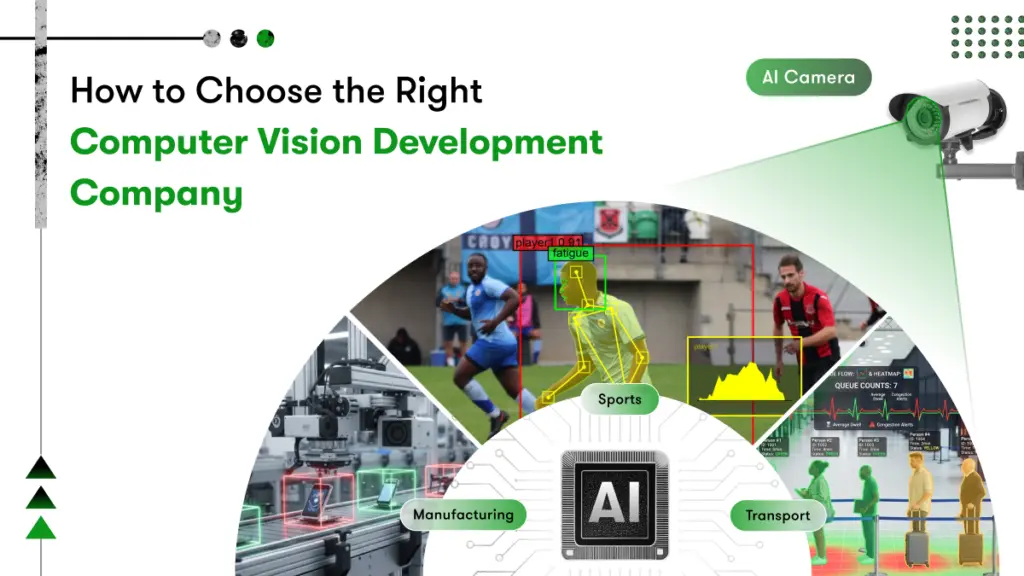
We have been serving as a deep tech company for over a decade now. We offer AI-powered robots, AI solutions, and scalable platforms for automation across industries, but we have seen one thing common in our consultations, i.e., businesses make the wrong vendor choice.
Making the right choice matters because McKinsey’s 2025 State of AI survey found that 88% of organizations report regular AI use in at least one business function, but only about one-third have begun scaling AI programs. The data proves that making the wrong vendor choice is expensive, not just in money but in time, morale, and missed market windows.
If you are searching for how to choose a computer vision development company, you already sense the risk. A development partner promised the world, but you delivered less and left your team cleaning up the mess. But this guide will help you break the loop and choose the best computer vision companies for startups and other full-fledged businesses.
By the end of this blog, you will know exactly what to look for, what to avoid, what questions to ask, and how to make the final call with confidence.
Why Does Choosing the Wrong Computer Vision Company Cost More Than You Think?
Choosing the wrong computer vision partner does not just cost money. It costs time, momentum, and often your window to compete. The full financial and operational damage typically reveals itself six to twelve months in.
The Financial Impact
Budget overruns in poorly managed computer vision projects average 40 to 70 percent above the original estimate, and the number compounds fast. You pay for rework, you pay for new vendors to fix old code, you pay for delayed launches in lost revenue.
Timeline Delays and Missed Markets
Computer vision projects fail on timelines more often than any other type of AI development. Models need iteration. Data pipelines need rebuilding. Hardware integrations surface unexpected problems. When a vendor underestimates the complexity, your go-to-market date slips. Competitors move first.
The Operational Toll on Your Team
Your internal team bears the burden of managing a failing project. Engineers spend weeks in meetings reviewing broken deliverables. Product managers lose focus. Morale drops. The hidden cost of a failing vendor relationship reaches deep into your organization.
Technical Debt That Follows You
A poorly built computer vision system creates lasting damage. Hardcoded parameters break when conditions change, and models trained on narrow datasets fail in the real world. Poor documentation leaves your team unable to maintain or improve the product; fixing the problem later costs far more than building it right the first time.
A Realistic Example
A retail business hired a low-cost vendor to build an automated inventory scanning system. The vendor delivered a model with 78 percent accuracy. Industry requirements demanded 95 percent. Fixing the model required a full rebuild, the total cost tripled, and the launch was nine months late.
Understanding the cost of implementing computer vision before you sign a contract is one of the smartest moves you can make.

What Does a Computer Vision Development Company Actually Do?
A computer vision development company builds AI systems that teach machines to see and interpret visual data. These companies design, train, and deploy models that can detect objects, recognize faces, read documents, monitor processes, and analyze images or video at scale.
If you want a deeper understanding of the technology before evaluating vendors, start with a solid computer vision development guide that walks through the fundamentals in plain business language.
What Services These Companies Deliver
A full-service computer vision partner covers the entire project lifecycle:
- Discovery and scoping: Defining the problem, identifying data requirements, and outlining technical feasibility
- Data acquisition and annotation: Sourcing, labeling, and preparing training data
- Model development: Training, testing, and optimizing the AI model for your use case
- Integration: Connecting the model to your existing systems, hardware, or applications
- Deployment: Launching the solution in your production environment
- Monitoring and maintenance: Tracking model performance and retraining as conditions evolve
What You Should Expect at Each Stage
The discovery stage takes two to four weeks. The team asks hard questions about your data, your environment, and your accuracy requirements. Data preparation takes the most time. Many companies underestimate this phase. Expect it to consume 30 to 50 percent of the total project effort. Model training and testing follow. Deployment and integration come last. Each stage requires your active participation. A good partner keeps you involved throughout.


What Technical Capabilities Should You Look For in a Computer Vision Development Company?
Strong technical capability in computer vision goes beyond general AI knowledge. Look for depth in specific domains, proven framework expertise, MLOps maturity, and hardware integration experience. Shallow technical teams produce shallow results.
A. Computer Vision-Specific Skills
Evaluate vendors on the specific sub-disciplines relevant to your project:
- Experience with object detection, image classification, semantic segmentation, and face recognition
- Hands-on knowledge of frameworks, including TensorFlow, PyTorch, and OpenCV
- Expertise with model architectures, including CNN, YOLO, R-CNN, and Vision Transformers
- Proven experience deploying models to production environments, not just research settings
Sample question to ask vendors: “Which computer vision models have you deployed in production, and what were the accuracy benchmarks achieved?”
B. Industry and Use Case Experience
Technical skill without industry context produces systems that fail in the real world. Ask for portfolio examples directly relevant to your space, whether healthcare, retail, manufacturing, logistics, or autonomous systems. Verify that the vendor has handled projects of similar scope and complexity.
Sample question to ask vendors: “How many projects similar to ours have you completed, and can we speak with those clients directly?”
C. MLOps and Deployment Knowledge
Building the model is only half the job; let’s evaluate how vendors handle everything after launch:
- Model optimization for edge devices and mobile environments
- Model versioning and retraining protocols
- Performance monitoring and alerting systems post-deployment
- Data pipeline architecture and scalability planning
D. Hardware Integration Expertise
Many computer vision applications run at the edge, not in the cloud. Confirm the vendor’s capability with:
- GPU optimization and specialized hardware configuration
- Edge device deployment on platforms including NVIDIA Jetson and Intel NUC
- Real-time processing for video streams and IoT sensor inputs
- Embedded system integration where the use case demands it
Technical Capability Comparison Table
| Capability Area | Strong Partner | Weak Partner |
| CV-Specific Skills | Specific model experience with production metrics | Generic AI claims with no CV depth |
| Industry Experience | Case studies in your industry with named outcomes | Vague references to “similar projects.” |
| MLOps | Defined retraining and monitoring protocols | No post-deployment plan |
| Hardware Integration | Edge deployment experience with named platforms | Cloud-only experience |
How Do You Evaluate the Team Behind a Computer Vision Company?
Evaluating the team matters as much as evaluating the portfolio, as companies write the portfolio, people build the product. Assess the team’s credentials, leadership depth, communication quality, and ability to explain complex work in plain language.
A. Team Composition and Credentials
Look for:
- Advanced degrees in Computer Science, Machine Learning, or AI from accredited programs
- Published research or meaningful open-source contributions that demonstrate real expertise
- Current certifications in cloud AI platforms, model deployment, or related disciplines
- Team depth across data science, ML engineering, computer vision research, and DevOps
B. Leadership and Experience
The quality of the CTO or Lead Computer Vision Engineer shapes every project decision. Research the professional background of the leadership before the first call. Years of experience specifically in computer vision matter far more than years in general software development. Ask about the team’s track record managing complex, multi-phase projects.
C. Depth of Knowledge
A technically excellent team communicates clearly, whereas a weak team hides behind jargon.
- Ask the team to explain their model selection process in plain language
- Ask how the team stays current with new research and tools
- Probe for recent innovations that the team has actually implemented in production
Sample question to ask: “Tell us about a recent computer vision innovation your team has implemented in a live production environment.”
D. Reference Checks
Reference checks separate real capability from strong sales pitches. Speak with a minimum of three to five previous clients. Ask specific questions like:
- “Were deliverables completed on time and within budget?”
- “How did the team respond when problems arose mid-project?”
- “Would you hire this team again for a larger, more complex project?”
Listen for specifics, not vague answers, as they don’t answer your question, and specific answers tell you everything.
What Are the Right Questions to Ask a Computer Vision Development Company?
Asking the right questions separates skilled vendors from smooth talkers, and these 35 questions across six categories will help you spot the skilled vendors. The quality of answers reveals as much as the content of answers.
A. Technical Questions
- What are your specific strengths within computer vision?
- How do you select the right model architecture for a given problem?
- What is your process for identifying and fixing data quality issues?
- How do you define and validate model accuracy for production environments?
- What is your approach to model explainability for non-technical stakeholders?
- How do you handle edge cases and rare scenarios during model training?
- What is your strategy for continuous model improvement after launch?
- How do you optimize models for latency and hardware constraints?
B. Development Process and Methodology Questions
- Walk us through your full project lifecycle from discovery to deployment.
- How do you approach requirements gathering for complex computer vision work?
- What is your process for building an MVP and iterating from the MVP?
- How do you manage scope creep and protect project timelines?
- What version control and documentation practices does your team follow?
- How do you maintain code quality and testing standards throughout the project?
C. Data and Privacy Questions
- How do you handle sensitive and proprietary data shared during the project?
- What data security certifications and compliance measures does your company maintain?
- How does your team approach GDPR, CCPA, and relevant regional data regulations?
- What is your process for data annotation and labeling at scale?
- How do you protect our data ownership and intellectual property rights contractually?
D. Project Management and Communication Questions
- Who serves as our primary point of contact from start to finish?
- How often do we receive status updates and what format do those updates take?
- What project management tools does your team use and can we access those tools?
- How do you handle change requests and revisions to scope mid-project?
- What is your escalation process when critical issues arise during development?
- How do you document and transfer knowledge to our team at project close?
E. Support and Maintenance Questions
- Do you provide ongoing support after the product launches?
- What service level agreements cover response times and uptime commitments?
- How do you handle critical bugs and production failures after launch?
- Will your team train our internal team to maintain and improve the solution?
- What is your long-term commitment to supporting the product beyond the initial contract?
F. Cost and Commercial Terms Questions
- How do you structure your pricing model and what triggers cost changes?
- What happens if the project extends beyond the original timeline estimate?
- Are there any fees or costs not reflected in the initial proposal?
- What is your policy on early termination or project cancellation?
- Do you offer any performance guarantees or warranty terms on delivered work?
What Does the Computer Vision Company Selection Checklist Look Like?
When you are selecting a computer vision development company, a structured selection process protects your budget, your timeline, and your decision. Use this four-phase checklist to stay organized, objective, and protected throughout the vendor evaluation process.

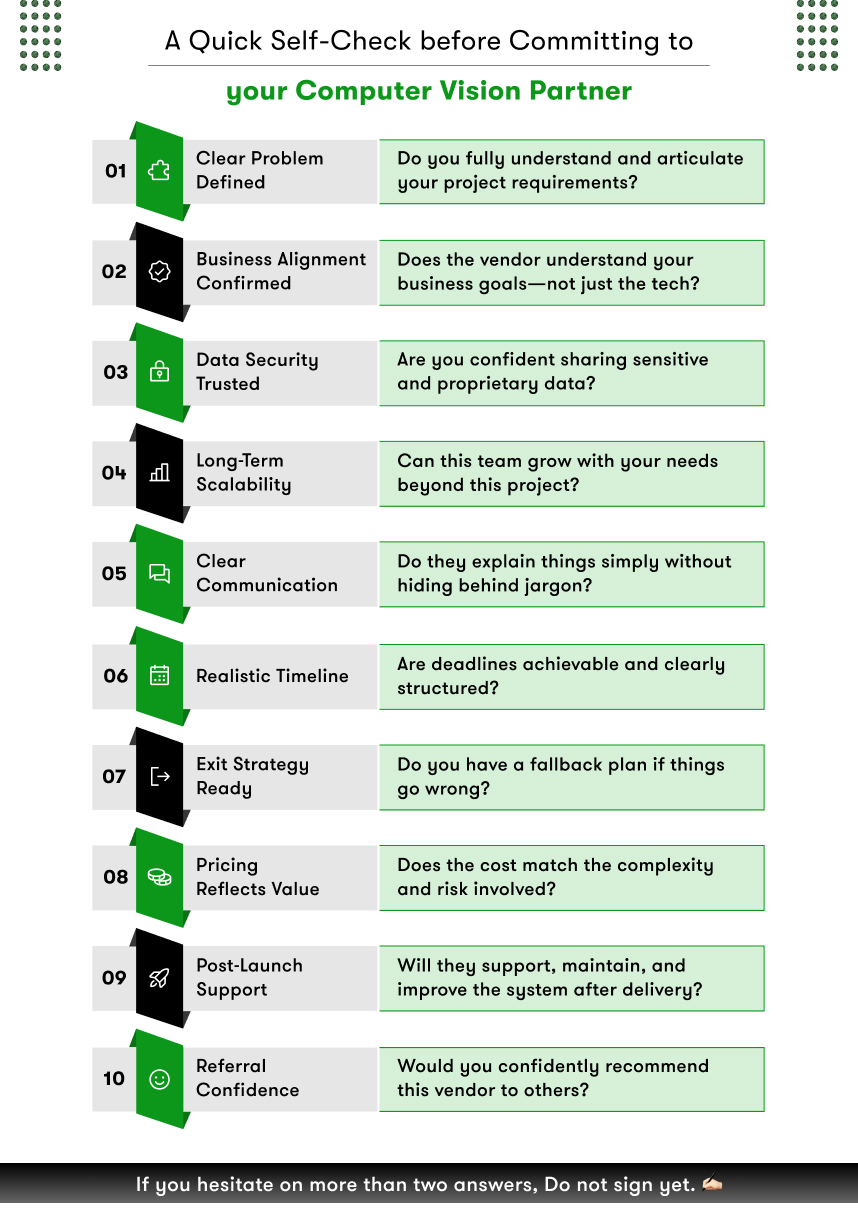
1: Before Contacting Any Company
- Define your project scope, expected outputs, and success criteria precisely
- Set a realistic budget range based on honest research into market rates
- Identify your hard deadlines and non-negotiable deliverables
- List all industry-specific compliance requirements that apply to your data
- Assess your internal team’s capacity to manage and support a vendor relationship
2: During the Evaluation Process
- Review at least five relevant case studies from each shortlisted company
- Assess technical capability for depth of experience, not just breadth of claims
- Verify team credentials and years of experience specifically in computer vision
- Complete reference checks with at least three past clients per vendor
- Evaluate communication quality and response time during the sales conversation
- Verify all security certifications and data compliance protocols
- Compare pricing across a minimum of three to five qualified vendors
- Review all contract terms with legal counsel before signing anything
3: Red Flags to Watch For
- Vague or templated portfolio with no real project detail or measurable outcomes
- Inability to explain their development methodology in clear, structured terms
- Pricing dramatically lower than every other qualified vendor on your list
- Reluctance to sign a non-disclosure agreement or protect intellectual property
- No defined project management structure or named point of contact
- Slow or inconsistent communication during the evaluation phase
- Claims of 100% accuracy guarantees, which are technically impossible in computer vision
- Refusal or inability to provide contact details for past clients
4: Green Flags That Signal a Strong Partner
- Asks thoughtful, specific questions about your business, not just the technology
- Communicates honestly about project limitations, risks, and realistic timelines
- Presents a clear and detailed methodology with defined milestones
- Demonstrates strong team credentials with recent and relevant experience
- Provides post-deployment support terms in clear, written form
- Offers transparent pricing with a full breakdown of costs and payment milestones
- Provides references who speak with specifics, not just general praise
- Communicates consistently, proactively, and clearly throughout the process
How Does Pricing Work for Computer Vision Development Projects?
Computer vision pricing follows several models, and each model fits different project types, risk profiles, and budget structures. Understanding pricing before you negotiate protects you from surprises and overpayments.

A. Common Pricing Models
Fixed Price
- Best for well-defined projects with stable, documented requirements
- Carries risk of scope limitations if the initial requirements were underestimated
- Always confirm exactly what the fixed scope excludes, in writing, before signing
Time and Materials
- Best for exploratory projects, research phases, and early-stage MVP development
- Offers flexibility to adjust scope as technical learning accumulates
- Requires disciplined project management to prevent cost overruns
Retainer or Dedicated Team
- Best for long-term development relationships and continuous improvement work
- Provides predictable monthly costs and straightforward team scaling
- Ideal when ongoing model updates and retraining are expected after launch
Hybrid Pricing
- Example: Fixed price for Phase 1 scoping, Time and Materials for Phase 2 development
- Best for managing financial risk across projects with distinct and separable phases
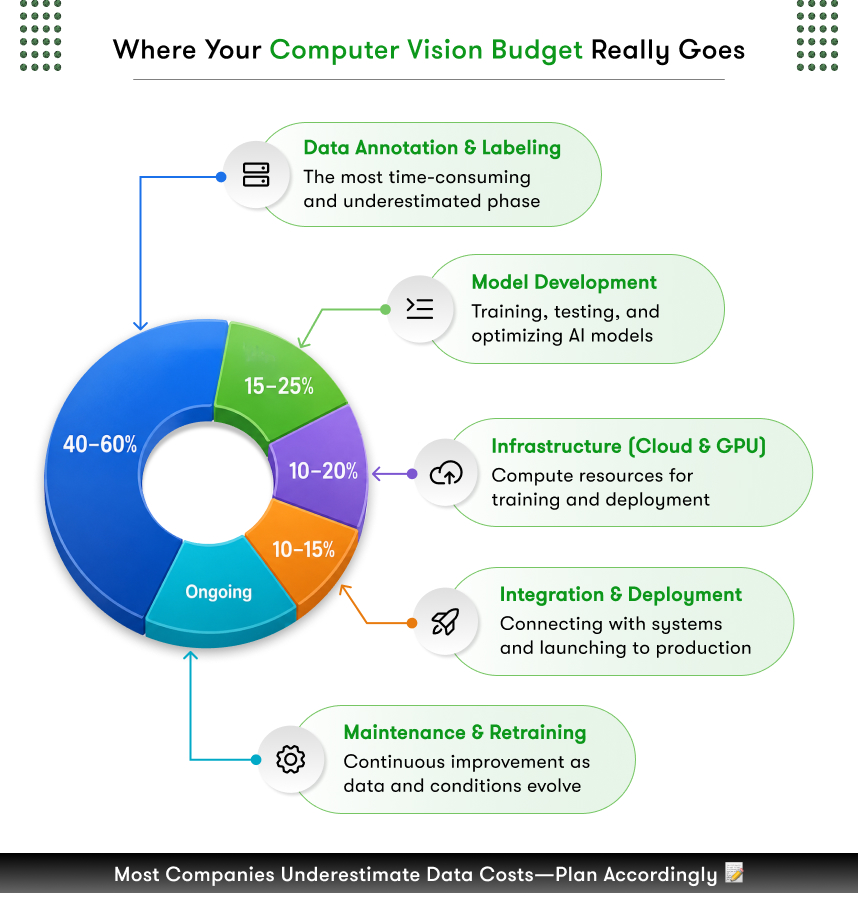
B. Hidden Costs to Ask About Before Signing
- Data annotation and labeling: Often represents 40 to 60 percent of the total project budget
- Cloud infrastructure and GPU compute: Training and production costs can grow quickly
- Knowledge transfer and training: Costs for onboarding your internal team to maintain the solution
- Post-deployment support: Ongoing maintenance, monitoring, and model retraining fees
- Environment change updates: Costs when production conditions shift and models need adjustment
C. Cost Negotiation Tips
- Always request a detailed cost breakdown before signing anything
- Clarify what is included versus excluded in every line item of the proposal
- Confirm payment milestones and the specific conditions attached to each milestone
- Lock in ongoing support rates at contract signing, not after the project ends
- Negotiate transition assistance terms so you are protected if the relationship ends early
What Framework Helps You Choose the Right Computer Vision Partner Decisively?
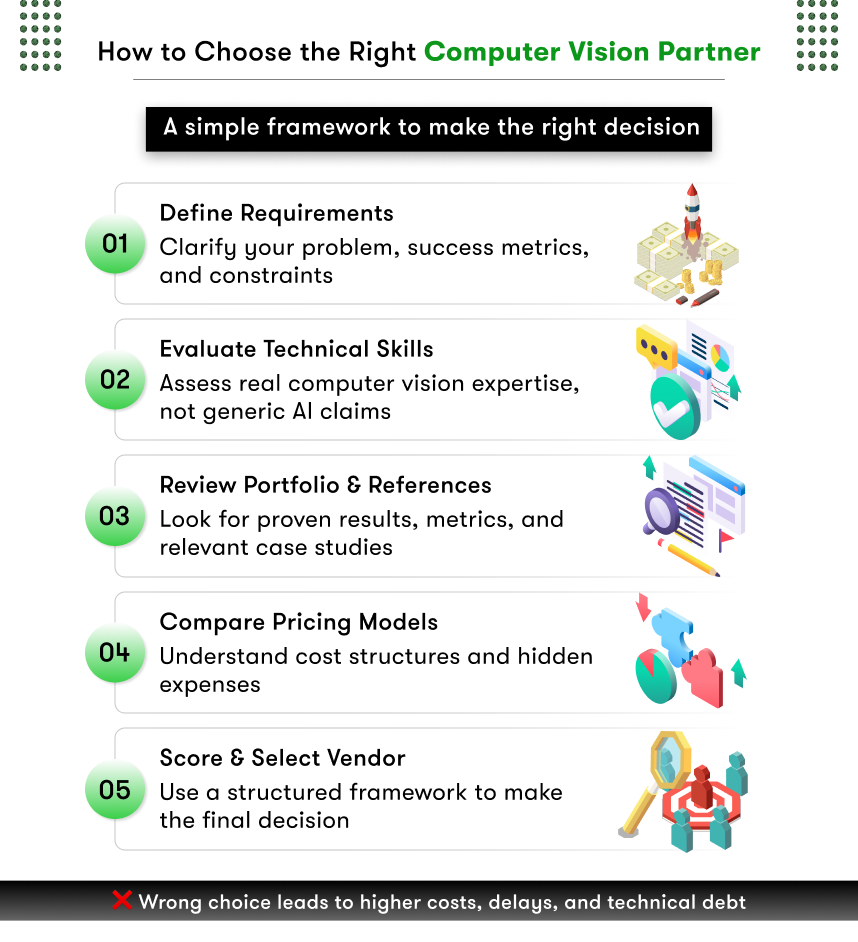
A weighted scoring framework takes the guesswork out of choosing the right computer vision partner. Instead of relying on gut instinct, you evaluate each vendor across five key dimensions and assign weights based on what matters most to you. By scoring vendors against these criteria, you get a clearer and more objective comparison, making it easier to identify the best fit with confidence.
Step 1: Score Technical Capability (30% of Total Score)
Score each vendor from one to ten across core technical areas. Consider depth of computer vision experience, quality of credentials, and demonstrated production results. Any vendor scoring below seven does not advance to the next stage.
Step 2: Evaluate Process and Communication (20% of Total Score)
Score the clarity of methodology, responsiveness during the sales process, and the overall project management approach. Poor communication before the contract predicts poor communication during the project. Trust this signal.
Step 3: Assess Business Fit and Team Chemistry (20% of Total Score)
Evaluate how well the vendor understands your specific business goals, not just the technology. Relevant industry experience matters here. The team should feel like a natural extension of your organization, not a distant contractor.
Step 4: Verify References (15% of Total Score)
Contact a minimum of three references per shortlisted vendor. Ask specific questions about results, reliability, and the experience of working with the team under pressure. Positive references are a minimum requirement to proceed. Hesitant or vague references are a disqualifier.
Step 5: Compare Costs Against Value (15% of Total Score)
Evaluate cost in relation to capability. The lowest bid almost never represents the best value in computer vision projects. Compare what each vendor delivers for the price, not just what each vendor charges.
Final Decision Process
- Calculate weighted scores for each shortlisted vendor
- Shortlist the top two or three highest-scoring candidates
- Negotiate final commercial terms with the leading candidate
- Trust your judgment on team fit when scores land close together

Conclusion: Your Path to the Right Computer Vision Partner
Choosing the right computer vision development company is one of the most consequential decisions your team will make. The wrong choice costs money, time, and market position. The right choice accelerates your product, your team, and your competitive edge.
Here is your immediate action plan:
- Define your project scope with precision before contacting any vendor
- Build your question list from the list given, and use the list in every vendor conversation
- Use the four-phase checklist to structure your evaluation process
- Score vendors objectively using the weighted framework
- Verify references directly and listen for specifics, not praise
- Run the final reflection checklist before you sign anything
Understanding How Computer Vision Works gives you an edge in every vendor conversation. You ask better questions, you recognize strong answers, and you spot weak ones faster.
When you are ready to Hire Computer Vision Developers who bring genuine depth to your project, look for a team that asks more questions than it answers in the first meeting. That habit separates partners who build for your business from vendors who build for their portfolio.
At Kody Technolab, we have guided startups and enterprise teams through this exact process. We know the questions that matter, the risks that hide in proposals, and the technical decisions that shape long-term outcomes. We share this knowledge freely because well-informed clients build better products. The decision is yours; make it with clarity.
FAQ – How to choose a computer vision development company
1: How do I choose the right computer vision development company?
Start with three things: a relevant portfolio, technical depth, and clear communication. Check references. Ask specific questions about past projects. A company that understands your business goals will always outperform one that only understands the technology.
2: How much does a computer vision development project cost?
Computer vision projects typically range from $15,000 for a small proof of concept to $250,000 or more for an enterprise solution. Data annotation, infrastructure, and post-launch support add to the total cost. Always ask for a detailed cost breakdown before signing.
3: How long does a computer vision project take to build?
Most computer vision projects take three to nine months from discovery to deployment. Timeline depends on project complexity, data availability, and integration requirements. A reliable development company gives you a realistic timeline in writing before the project begins.
4: What should I look for when hiring computer vision developers?
Look for developers with hands-on experience in your specific use case. Check their knowledge of frameworks like TensorFlow, PyTorch, and OpenCV. Evaluate how well the developers communicate technical concepts to non-technical stakeholders. That communication skill matters as much as technical ability.
5: Can startups afford to work with a computer vision development company?
Yes, many boutique AI firms and deep tech companies like Kody Technolab work with startups on focused, budget-conscious projects. Start with a clear MVP scope. A good partner helps you build what you need now and scale the solution as your business grows.