


Key Takeaways
- OPD delays are caused by process inefficiency, not just high patient volume, and robots in hospital directly address this gap.
- Manual pre-consultation tasks create the biggest bottleneck, which can be eliminated to reduce OPD waiting time with healthcare robot solutions.
- Automating screening with robots in hospital frees doctors to focus only on clinical decisions.
- Healthcare robots enable consultations to start with complete patient data and help reduce OPD waiting time with healthcare robot infrastructure.
- Replacing 10-minute manual tasks with automation using robots in hospital unlocks massive daily capacity.
- Faster workflows powered by robots in hospital lead to shorter queues and improved patient satisfaction.
- Hospitals that adopt early can reduce OPD waiting time with healthcare robot systems while gaining a strong operational and competitive edge.
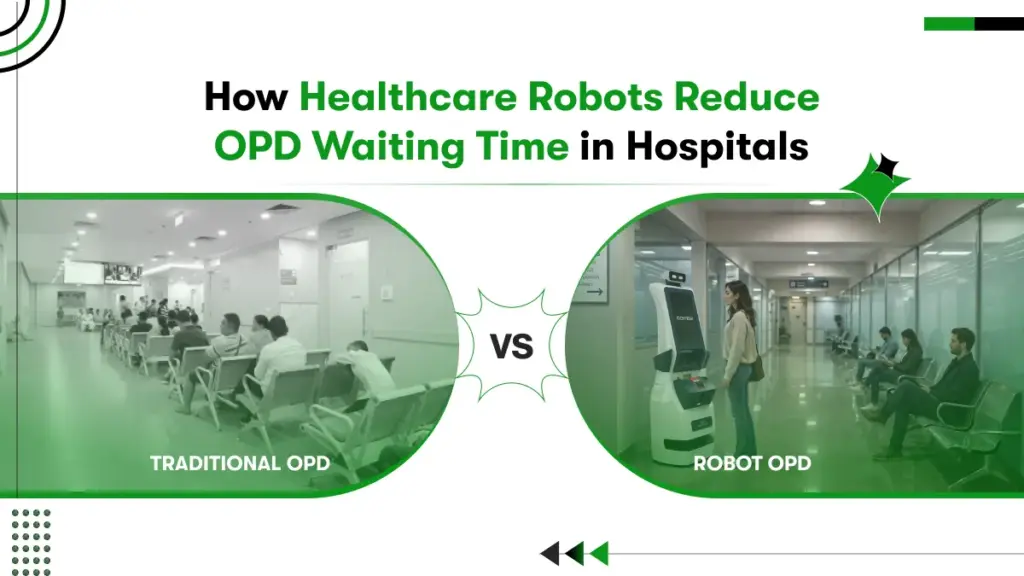
Patients in Indian hospital OPDs often face long waiting times that reflect deeper operational inefficiencies. A study in BMC Health Services Research found a median outpatient waiting time of around 93 minutes, with many patients waiting over 2 hours (Springer). For high-volume hospitals, this is lost clinical capacity and a delay of better preventive healthcare.
Robots in hospital environments are addressing this at the root by eliminating manual pre-consultation bottlenecks. Through hospital automation using robots, hospitals can streamline intake, improve efficiency, and reduce OPD waiting time with healthcare robot-driven hospital workflow optimization, changing the way patient flow is managed from entry to consultation.
What is OPD, and Why Does Waiting Time Matter for Hospitals?
The Outpatient Department, or OPD, is the front door of every hospital. It is where the majority of patient interactions happen, where first impressions are formed, and where the operational efficiency of the entire facility is most visible. When the OPD works well, everything downstream works better. When it does not, the entire hospital feels the pressure.
Waiting time in the OPD is not just a patient comfort issue. It is a clinical, financial, and reputational metric that hospital administrators cannot afford to ignore. Research published in the Journal of Clinical and Diagnostic Research found that mean OPD waiting times in Indian tertiary care hospitals range from 49 to 54 minutes for consultation alone, not counting registration, diagnostics, or pharmacy. Studies from multiple Indian hospitals show that patients often spend 1 hour 10 minutes or more from arrival to entry into the consultation room.
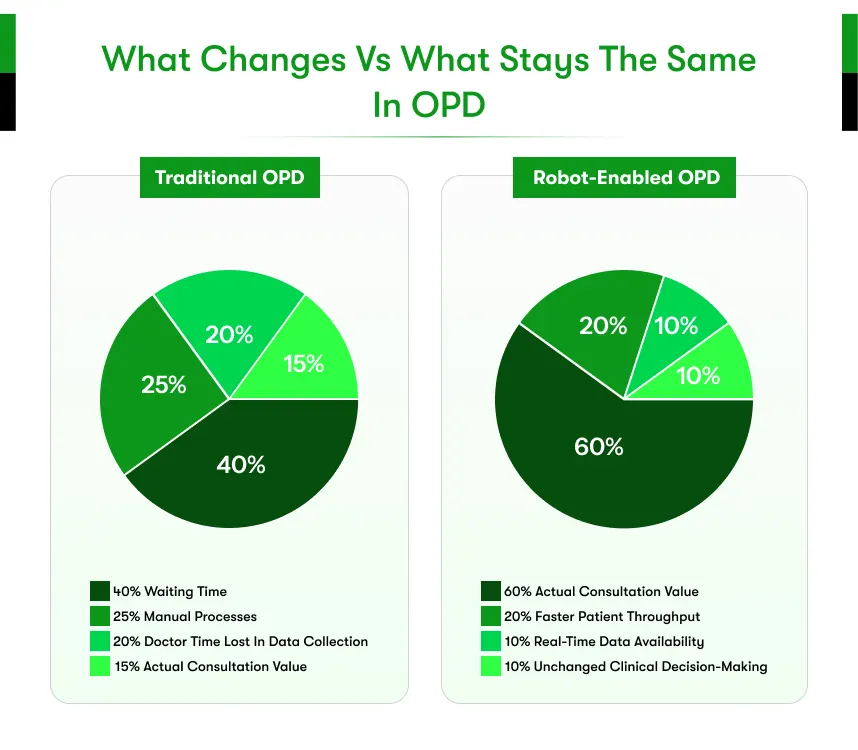
Every minute a patient waits before seeing a doctor is a minute the doctor is not consulting. Every minute the doctor spends collecting baseline data that could have been automated is a minute taken away from clinical judgment. A hospital that sees 300 OPD patients daily, where each pre-consultation process takes 10 minutes, loses over 50 hours of collective consultation capacity every single day to tasks that a healthcare robot in a hospital can handle autonomously.
The WHO recommends OPD waiting times stay below 50 minutes. Most public hospitals in India exceed that threshold significantly. The gap between where OPD performance sits today and where it needs to be is not a staffing gap. It is an infrastructure gap.
What Are the Root Causes of Long OPD Waiting Times in Hospitals?
The root cause of long OPD waiting times is not patient volume. Most high-volume OPDs are failing at a single, preventable point: the pre-consultation process. Everything that happens before the patient walks into the doctor’s room is manual, slow, staff-dependent, and entirely automatable.
| Root Cause | Practical Manifestation | Impact on OPD Queue |
| Manual Pre-consultation Vitals | Nurse manually records BP, weight, and temperature before each consult. | Adds 8 to 12 minutes per patient before the doctor is even involved. |
| No Pre-screening at Entry | Patient enters OPD with no health data ready for the doctor. | Doctor spends the first few minutes of every consult collecting baseline data. |
| Staff Dependency | A single nurse or technician handles all pre-consult checks. | One absence or slow session creates a bottleneck for the entire OPD. |
| Registration Bottlenecks | Manual registration forms and physical card searches at the front desk. | Patients queue twice: once to register and once to see the doctor. |
| Fragmented Patient Data | Previous visit records are unavailable or not integrated. | Doctor repeats questions already answered on prior visits. |
| No Triage Intelligence | All patients treated as equal priority regardless of severity. | Urgent cases wait behind routine ones, wasting critical consultation time. |
What these root causes have in common is that every single one of them exists at the entry point of the OPD, before the doctor is even involved. The consultation room is not where the queue builds. The queue builds in the 10 to 15 minutes of manual activity that precedes every consultation, multiplied by every patient who walks through the door that day.
Solving this does not require more nurses, a larger OPD space, or a new appointment system. It requires removing the dependency on manual pre-consultation processes entirely, and that is precisely where hospital automation using robots delivers its most direct value.
How Are Robots in Hospitals Already Changing Healthcare Workflow?
Robots in hospital settings are already handling tasks that were previously dependent entirely on human staff, and the results across multiple healthcare systems are measurable. Hospital automation using robots has moved beyond back-office logistics into direct patient care pathways, and the OPD is the next and most impactful frontier.
Understanding how robotics work in hospitals requires looking at the full spectrum of deployment.
- Surgical robots like the da Vinci system have demonstrated precision-assisted surgery for over two decades.
- Autonomous delivery robots transport medications, specimens, and supplies across hospital floors without human intervention. Disinfection robots use UV sterilization to reduce hospital-acquired infections between patient sessions.
- Medigo, which is a health screening infrastructure, screens 65+ health parameters and generates a consolidated report in 3 min* with 95% accuracy, which helps reduce OPD waiting time and helps screen more patients.
- Each of these represents a specific operational problem solved by removing human dependency from a task that does not require human judgment to complete.
Robotics in Healthcare is now moving into the most patient-facing layer of hospital operations: the screening and triage layer. This is where the volume is highest, where the human dependency is most costly, and where automation delivers the greatest throughput gain. A robot that conducts pre-consultation health screening at the OPD entry point does not just replace a manual task. It restructures the entire patient flow from the moment a person walks through the hospital door.
A 2021 study published in BMC Health Services Research found that AI-assisted pre-consultation modules, which automated history collection and examination ordering for outpatients, significantly reduced total OPD waiting time. A separate study from Hospital das Clinicas in Sao Paulo, published in JMIR, found that digital automation of medical registration saved over 2,500 hours of cumulative staff time annually at a single facility. The evidence is not theoretical. The operational gains from hospital automation are documented and replicable.
How Does a Healthcare Robot in a Hospital Reduce OPD Waiting Time Specifically?
A healthcare robot in a hospital reduces OPD waiting time by eliminating the pre-consultation bottleneck entirely. When a health screening robot is positioned at the OPD entry point, every patient completes a comprehensive health assessment before the doctor sees them. The doctor receives a full report on arrival. The manual data collection phase disappears from the consultation entirely.

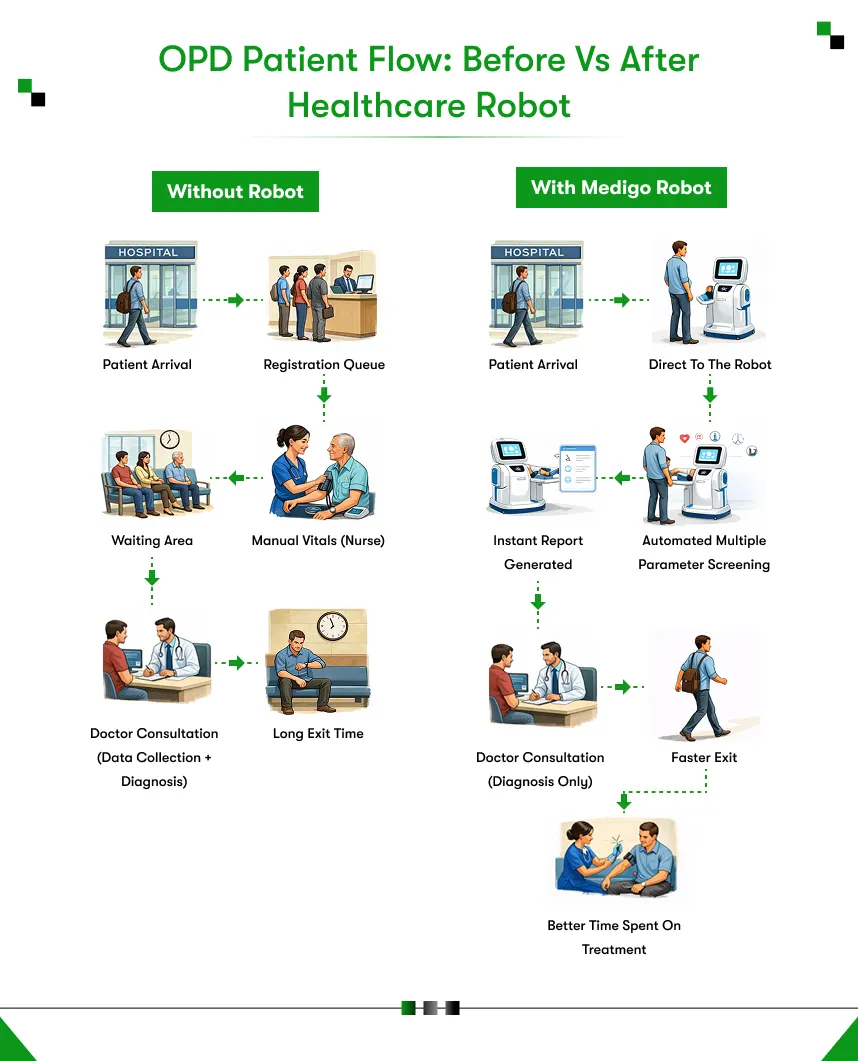
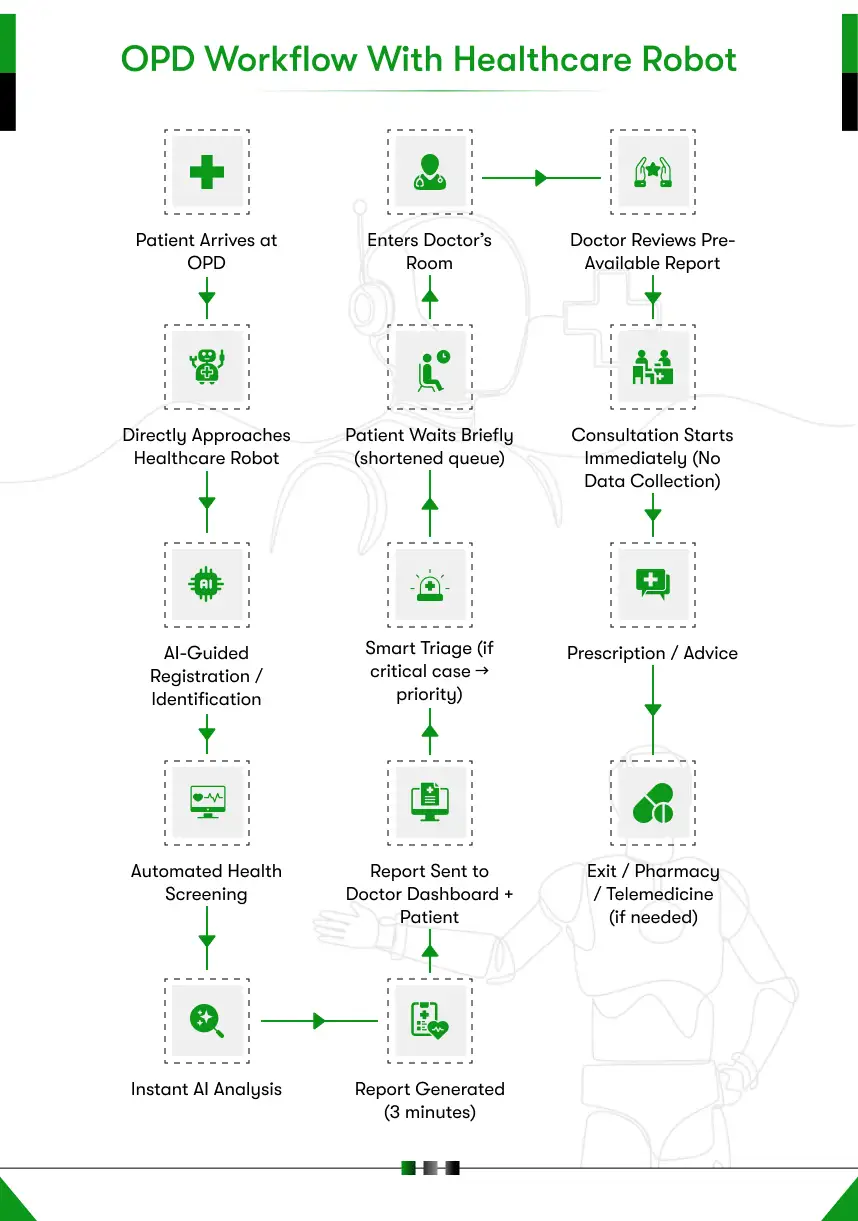
Here is exactly what that patient journey looks like with Medigo deployed at the OPD entry point:
- The patient arrives at the OPD and approaches the Medigo unit. The AI interface greets them in their preferred language and begins a guided screening session.
- Medigo conducts a comprehensive assessment covering over 65 conditions, including blood pressure, ECG, blood glucose, HbA1c, body composition, lung efficiency, vision, hearing, and infectious disease markers, all within approximately 3 minutes.
- The AI interprets the results using clinical-grade models trained on large-scale validated datasets, achieving 95% screening accuracy.
- A complete health report is generated and delivered instantly to the patient via WhatsApp, SMS, email, or on-site thermal print.
- The same report is simultaneously available to the treating doctor on the hospital dashboard before the patient enters the consultation room.
- If the screening flags a critical value, the built-in telemedicine module connects the patient to a physician immediately for real-time guidance and digital prescription within the same session.
The doctor now begins every consultation with a full data picture already in hand. No baseline vitals to collect. No time spent on tasks that do not require clinical judgment. The consultation starts where it should: with the doctor analyzing the data and making clinical decisions.
For a hospital seeing 300 OPD patients daily, replacing a 10-minute manual pre-consultation process with a 3-minute automated one frees over 35 hours of combined consultation time every single day. That translates directly into more patients seen, shorter queues, and measurably better doctor utilization.
What Role Does Hospital Workflow Optimization Play in Reducing OPD Queues?
Hospital workflow optimization is what turns a single Medigo deployment into a system-wide improvement in patient flow. Reducing pre-consultation time per patient is the first gain. The downstream gains, in triage accuracy, staff utilization, data quality, and throughput, compound that improvement across the entire OPD operation.
| OPD Stage | Without Medigo | With Medigo |
| Patient Arrival | Queue for registration and manual card processing. | Walk directly to Medigo unit; guided by multilingual AI interface. |
| Pre-consultation Screening | Nurse manually records vitals (8–12 mins per patient). | Medigo completes 65+ condition screening in 3 mins autonomously. |
| Data Availability | Doctor receives fragmented or no pre-consult data. | Doctor receives a full health report before the patient enters the room. |
| Consultation | Doctor spends the first minutes collecting baseline data. | Doctor begins clinical assessment immediately; no data collection needed. |
| Report Delivery | Manual notes, delayed summary, paper-based, or typed later. | Instant digital report via WhatsApp, SMS, email, or thermal print. |
| Telemedicine Access | Separate, often tedious referral process if a specialist is needed. | Built-in video consultation with a physician in the same session. |
| Data Synchronization | Fragmented; entered manually across various systems. | Real-time, centralized, and cloud-synced automatically. |
How Hospital Workflow Optimization Improves Patient Flow and OPD Efficiency
The workflow table above shows the transformation at each stage. The gains are not isolated. Every improvement feeds the next. When the doctor starts consultations with data already ready, the consultation duration decreases. When consultation duration decreases, throughput increases. As throughput increases, the queue clears faster. As the queue clears faster, patient satisfaction improves, and the hospital’s OPD reputation strengthens.
At the robotic healthcare infrastructure level, the data advantage adds another dimension entirely. Every screening conducted through Medigo feeds into a centralized, encrypted hospital dashboard in real time. Hospital administrators see live OPD performance data: patient volumes, screening results, flagged conditions, and throughput rates across every unit deployed. This is not retrospective reporting. It is operational intelligence that enables same-day decisions about resource allocation, triage priority, and workflow adjustment.
For multi-unit hospital deployments, the impact scales non-linearly. Two Medigo units at the OPD entry point handle twice the screening volume without doubling staff. The centralized dashboard gives administrators a unified view across every unit simultaneously, with all data standardized and comparable. This is what modern hospital workflow optimization looks like when it is built on intelligent infrastructure rather than manual process improvement.

What Are the Robots Used in Hospitals for OPD Automation and Patient Flow?
Multiple categories of robots are used in hospitals today, but not all of them address the OPD waiting time problem. Understanding which robot type solves which specific hospital challenge is critical for administrators making infrastructure investment decisions.
| Robot Type | Primary Function | OPD Relevance | Impact on Waiting Time |
| Surgical Robots | Precision-assisted surgical procedures. | None; operates in the theatre. | Indirect: Faster recovery reduces bed pressure but not OPD queues. |
| Delivery Robots | Medication and specimen transport within hospital. | Low; primarily a back-of-house function. | Marginal: Reduces staff movement time but patients still wait. |
| Disinfection Robots | UV sterilization of hospital spaces. | None; operates between patient sessions. | None directly: Primarily a safety and compliance benefit. |
| Diagnostic Kiosks | Basic vitals: BP, temperature, weight. | Moderate; handles limited pre-consult checks. | Low: Limited screening depth still requires staff follow-up. |
| Health Screening Robots | 65+ condition screening with AI interpretation and telemedicine. | Direct; deployed at the OPD entry point. | High: Eliminates the pre-consult bottleneck entirely. |
The table makes the distinction clear. Surgical, delivery, and disinfection robots serve important functions, but none of them touch the pre-consultation bottleneck that drives OPD queues. Diagnostic kiosks handle limited vitals but cannot screen across 65 conditions, interpret results with clinical-grade AI, or connect a patient to a physician in the same session.
A health screening robot positioned at the OPD entry point is the only robot category that directly and comprehensively addresses the root cause of OPD waiting time. Robotic healthcare kiosks of this type function as intelligent pre-consultation infrastructure, not just measurement devices. The difference between a kiosk that records a blood pressure reading and a robot that screens 65 conditions, interprets them with AI, and delivers a doctor-ready report in 3 minutes is the difference between a tool and an infrastructure transformation.
What Business and Clinical Impact Does a Healthcare Robot Deliver for Hospital Administrators?
The business and clinical impact of deploying a healthcare robot at the OPD entry point is measurable across four dimensions: patient throughput, staff utilization, clinical data quality, and patient satisfaction. Each of these dimensions has a direct financial and operational implication for hospital administrators.
The Problem
A high-volume public hospital OPD handles 500 patients daily across three general medicine and two surgical departments. Pre-consultation vitals collection takes an average of 10 minutes per patient, handled by four nurses rotating across entry points. Doctors spend the first 4 to 6 minutes of every consultation collecting baseline data that the nurses could not fully complete. The queue builds from the first hour and never clears by the end of the day. Patient satisfaction scores for OPD services are below the hospital’s own benchmark, and two senior doctors have formally flagged inefficiency in the pre-consultation process as affecting their ability to deliver quality consultations.
The Insight
Research from BMC Health Services Research confirms that AI-assisted pre-consultation processes significantly reduce total OPD waiting time. A study from Hospital das Clinicas found that automating medical registration alone saved over 2,500 hours of staff time annually at a single hospital. For a 500-patient daily OPD, replacing 10 minutes of manual pre-consultation with a 3-minute automated process frees approximately 58 hours of combined consultation and staff time every day.

The Business Action
The hospital deploys Medigo units at all five OPD entry points. Each unit operates autonomously from the first patient to the last, requiring no dedicated operator. Patients complete their pre-consultation screening before reaching the doctor’s room. The hospital dashboard receives real-time data from all five units simultaneously. Doctors begin consultations with a full health report already on screen.
The Result
Average OPD waiting time drops measurably within the first month. Doctor consultation capacity increases because each consultation starts with data, not data collection. Nurse staff are redirected from manual vitals collection to clinical support roles that require human judgment. Patient satisfaction scores for OPD services improve within the first quarter. The hospital generates a real-time health intelligence layer across all OPD departments for the first time, giving administrators the data they need to make informed decisions about resource allocation, capacity planning, and triage prioritization.
How Should a Hospital Deploy Robots to Reduce OPD Waiting Time Effectively?
Deploying a healthcare robot to reduce OPD waiting time effectively requires four decisions: where to place the unit, how to integrate it with existing systems, how to measure success, and how to frame the investment. Each decision is straightforward when the deployment model is clear.

Where to Place Medigo
Medigo should be positioned at the OPD entry point, before the registration counter if possible, or immediately after registration as the first physical step before the patient joins the doctor queue. The goal is to ensure every patient completes their pre-consultation screening before they sit in the waiting area. This removes the pre-consultation task from the consultation entirely and ensures the doctor receives the report before the patient walks in.
How Integration Works
Medigo requires no construction, no dedicated room, and no additional staffing. It is a self-contained unit that is operational from day one. Screening data is transmitted to the hospital’s centralized dashboard in real time via the cloud, and the offline-capable architecture ensures data is captured and synced even in areas with intermittent connectivity. Report delivery to patients happens instantly via WhatsApp, SMS, email, or on-site thermal print, with no manual intervention required.
How to Measure Success
- Track the average pre-consultation time per patient before and after deployment. The target reduction is from 8 to 12 minutes to 3 minutes or less.
- Monitor daily OPD throughput: number of patients seen per doctor per day. Expect a measurable increase within the first month.
- Review doctor utilization rates: what percentage of consultation time is spent on clinical assessment versus data collection?
- Track patient satisfaction scores specifically for OPD waiting time and pre-consultation experience.
- Monitor the centralized dashboard for real-time health intelligence: condition prevalence, flagged cases, and triage priority data.
How to Frame the Investment
Medigo is available on a buy model, positioned as a long-term hospital infrastructure asset. Unlike a health lounge vs health screening robot comparison, where a fixed wellness room ties capital to a single location, Medigo is a deployable unit that generates return from every patient it screens from day one. For hospital administrators evaluating preventive healthcare infrastructure investment, the calculation is straightforward: the cost of one Medigo unit against the operational savings, throughput gains, and patient satisfaction improvements it delivers within the first quarter.
The hospitals that deploy this infrastructure now will not just reduce OPD waiting time. They will build a data-driven, AI-powered patient flow model that scales with demand rather than collapsing under it.
Conclusion
The OPD waiting time problem is structural, and it has a structural solution. Manual pre-consultation processes that eat 10 minutes per patient, multiplied by hundreds of patients daily, do not require more staff to fix; healthcare requires automation and robots in hospital. A healthcare robot positioned at the OPD entry point removes that bottleneck entirely, freeing doctors to consult instead of collect data, and freeing staff to do work that requires human judgment.
At Kody Technolab, Medigo is the healthcare screening infrastructure. It is deployable, operational from day one, and built to deliver measurable OPD performance improvement from the first week. If you want to be the leader in your industry, you know robots in hospitals are not a trend or just about aesthetic looks; instead, the robots are about throughput, efficiency, and outcomes. So, be the first one to adapt to the healthcare robot in hospital and set the benchmark for operational excellence, improve patient flow at scale, and position your institution as a forward-thinking leader in modern healthcare delivery.
Frequently Asked Questions
How do robots in hospitals help reduce OPD waiting time?
Robots in hospital OPD settings reduce waiting time by automating the pre-consultation screening process. Instead of a nurse manually recording vitals and basic health data before each patient sees the doctor, a health screening robot conducts a comprehensive assessment across 65 or more conditions in approximately 3 minutes. The doctor receives a full health report before the patient enters the consultation room, eliminating the data collection phase from every consultation and increasing the number of patients a doctor can see per day.
What types of robots are used in hospitals for patient flow and screening?
Several categories of robots are used in hospitals today, including surgical robots for precision procedures, delivery robots for medication and specimen transport, and disinfection robots for UV sterilization. For OPD patient flow and pre-consultation screening specifically, health screening robots are the most directly relevant. These units conduct comprehensive diagnostic assessments autonomously at the OPD entry point, deliver instant reports, and feed real-time data to the hospital dashboard, directly addressing the pre-consultation bottleneck that drives OPD queues.
How does a healthcare robot work in a hospital OPD setting?
A healthcare robot in an OPD setting is positioned at the entry point before patients join the doctor queue. The patient approaches the unit, selects their preferred language, and follows an AI-guided screening protocol. The robot conducts a comprehensive health assessment covering vitals, metabolic markers, cardiac function, lung efficiency, and more. Results are interpreted by a clinical-grade AI layer and delivered instantly as a structured health report to both the patient and the treating doctor. If the screening flags a critical result, the built-in telemedicine module connects the patient to a physician in real time within the same session.
Can hospital automation using robots replace nursing or front-desk staff?
Hospital automation using robots does not replace nursing or front-desk staff. It redirects them. Nurses freed from manual vitals collection can perform higher-value clinical support tasks that genuinely require human judgment: monitoring patients, assisting with complex cases, providing emotional support, and responding to critical flags in real time. Front-desk staff can focus on patient communication, coordination, and exception handling rather than data entry. The robot removes the repetitive, automatable task from the human workload. It does not remove the human.
What is the fastest way to reduce OPD waiting time in a hospital today?
The fastest way to reduce OPD waiting time today is to deploy a health screening robot at the OPD entry point or robots in hospitals altogether. This single intervention removes the pre-consultation bottleneck that drives the majority of queue build-up in high-volume OPDs. Unlike appointment system changes, digital queue management, or staffing restructures, which take weeks or months to design and implement, Medigo is operational from day one with no construction, no dedicated room, and no additional staffing required. The impact on pre-consultation time, doctor throughput, and patient waiting experience is measurable within the first week of deployment.