


Summary: Your competitor just cut downtime by 40% while you were in that last budget meeting. No, they didn’t buy new equipment; they implemented AI, and now their machines can predict failures before they happen and offer numerous benefits of AI in manufacturing. The implementation of AI has led to lower operating expenses and better decision-making with predictive maintenance, intelligent automation, and more. While you are debating about whether AI is worth the investment, others are already reaping the benefits in your manufacturing industry. This guide walks you through the benefits of AI in the manufacturing industry, its importance, real-world examples, and strategic considerations for implementing it.
AI in manufacturing is expected to grow up to nearly $155.04 billion by 2030. (Source: Markets and Markets) It is an extraordinary acceleration powered by companies seeking measurable improvements in efficiency, quality, and resilience. For CEOs and CTOs, understanding the benefits of AI in manufacturing is essential to lead their industry and sustain competitiveness in 2026 and beyond.
Whether you’re exploring fundamentals through the AI in Manufacturing guide or diving deeper into specialized applications like AI for supply chain enhancements, we are sure you’ll gain a practical understanding of how AI drives outcomes that matter, reduces downtime, increases yields, lowers costs, and enables more intelligent decision-making. Also, if you’ve been asking, what are the benefits of AI in manufacturing, this guide lays out the most critical insights you need right now.
How is AI Technology Transforming Manufacturing Operations and Innovation?
If you walk into a modern factory today, you’ll notice the hum of machinery sounds the same, but the intelligence behind it has fundamentally changed. AI in manufacturing is already on the production floor, solving problems and enabling the smoothest operations. AI systems are ready to defeat any problem. They can spot a defective part in milliseconds, predict when a critical machine will fail days before it happens, and optimize production schedules faster than any team of analysts ever could.
What makes this unique AI trend remarkable is its technologies and capabilities. Machine learning, computer vision, robotics, and industrial analytics work together like a great team. All of this combines to create a system that watches your back and empowers your manufacturing in real-time with the highest accuracy.
The Rise of Agentic AI
Agentics AI has worked like magic for businesses that are looking for systems that operate autonomously. It plans, executes, and adapts actions towards achieving your complex goals with minimal human intervention. So, you can sit back and rest while this system does the work. The benefits of agentic AI in manufacturing become important when things like production schedules or machine output suddenly change.
For instance, a supply delay, a machine breakdown, or a rush order can put a strain on factories, and Agentic AI, like a hero, spots these issues, adjusts plans on its own, and keeps everything running without making people wait.
This directly reduces downtime, minimizes waste, and strengthens process stability, all of which are key contributors to the overall benefits of AI in manufacturing strategies.
Generative AI’s Manufacturing Revolution
While agentic AI supports dynamic decision-making, generative AI is radically reshaping innovation cycles. The benefits of generative AI in manufacturing stretch across product design, process optimization, and even virtual testing environments.
Generative AI can rapidly generate thousands of design variations, simulate their performance, and highlight the strongest candidates long before physical prototyping begins. It can also produce synthetic datasets for training quality inspection models, making them more adaptable and accurate.
Manufacturers using generative AI often experience:
- Faster R&D cycles
- Optimized components with reduced weight and superior durability
- Earlier identification of process bottlenecks
- Highly scalable virtual testing environments
These improvements reinforce why leaders consistently cite generative AI as one of the most groundbreaking contributors to the benefits of AI in manufacturing ecosystems.

What is the Importance of AI-Driven Automation in Manufacturing?
Think of AI automation as giving your machines a brain. They can come up with their own and operate efficiently. Instead of just following the same programmed steps over and over, AI-powered machines can actually learn and adapt. They watch what’s happening on the production line, remember what worked before, and automatically adjust when something changes.
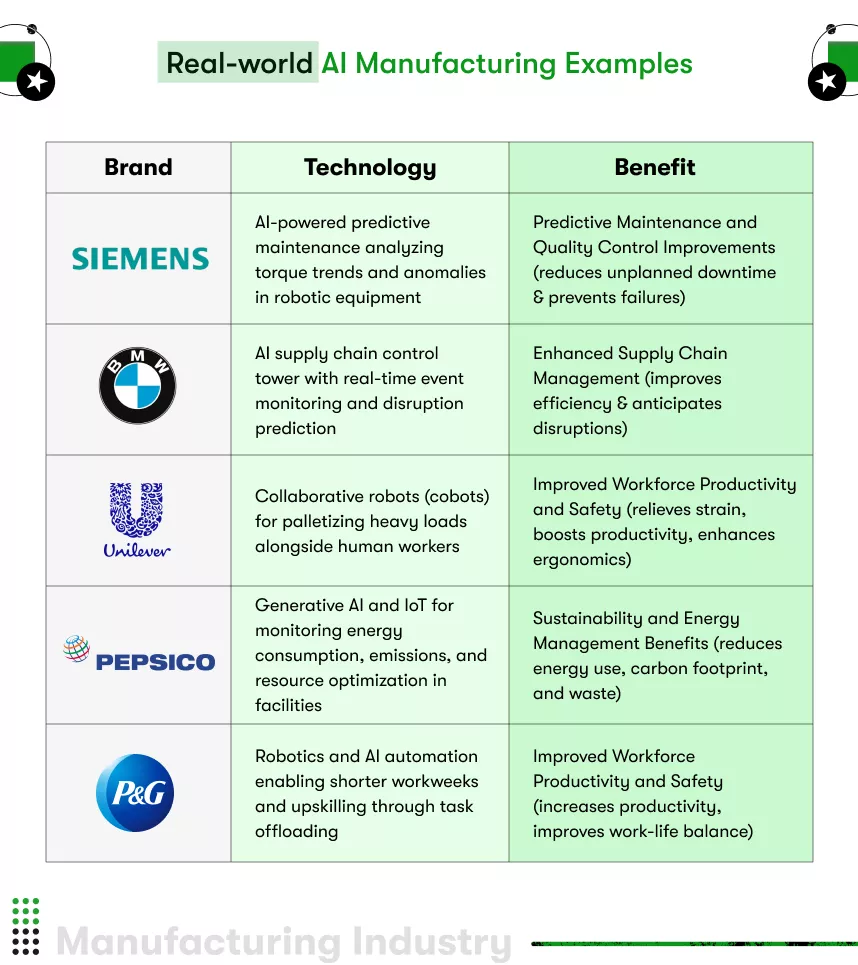
But here’s the real question before we move forward: where do you actually start? By understanding foundational AI manufacturing trends and exploring applications across AI in automation, manufacturers gain clarity on where to begin and how to scale. This convergence of automation and intelligence is fast becoming a core driver of AI’s benefits for manufacturing industry performance metrics.
What are the Major Benefits of AI in Manufacturing Industry?
The benefits of AI in manufacturing industry extend across every area of operations, from planning and production to quality, safety, and sustainability. Below are the most critical advantages of transforming factories worldwide.


Cost Reduction and Operational Efficiency Gains
Cost efficiency remains one of the strongest motivators for AI adoption. The benefits of using AI in manufacturing directly impact nearly all cost centers, production, labor, materials, and energy.
AI-powered planning tools help:
- Reduce changeover time – It helps to spend less time switching between different products
- Improve production sequencing – It runs operations in a smart order to avoid delays.
- Increase equipment utilization – It gets more out of your existing machines without burning them out.
Most organizations report a 20–30% improvement in efficiency when implementing these systems, showcasing another dimension of the benefits of AI in manufacturing.
Energy optimization is another high-impact area. AI-based facility management systems can analyze consumption patterns, detect inefficiencies, and automatically adjust equipment to reduce waste. Many manufacturers achieve 15–25% reductions in energy costs through AI-guided optimization.
Even in workforce management, AI enhances productivity without replacing talent. Workers can offload repetitive or physically demanding tasks, allowing them to focus on more strategic objectives. This improves morale, reduces burnout, and enhances overall output quality, reinforcing the long-term benefits of AI in the manufacturing industry.
Predictive Maintenance and Quality Control Improvements
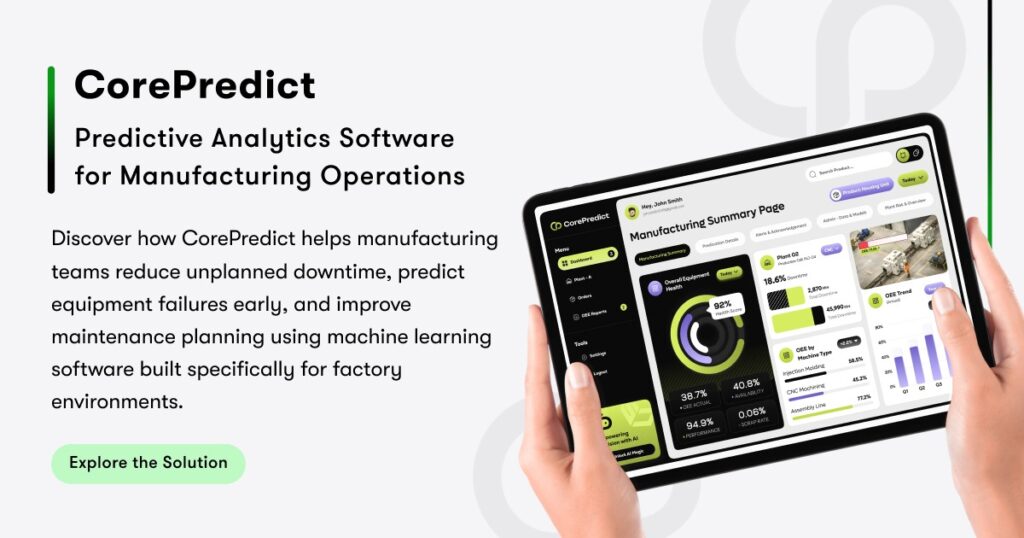
Predictive maintenance is one of the most mature and widely deployed applications and one of the clearest examples of the benefits of AI in manufacturing, delivering measurable ROI.
Unlike traditional preventive maintenance, AI analyzes data from vibration, temperature, and acoustic sensors to flag issues weeks before failures. Connected to this are algorithms trained on years of equipment behavior, which deliver highly accurate early warnings.
Organizations using advanced monitoring systems, including AI predictive maintenance, report:
- 30–50% less unplanned downtime
- 20–40% longer equipment lifespan
- 10–40% lower maintenance spending
Quality control is evolving just as rapidly. Computer vision systems using deep learning improve inspection accuracy to levels that humans cannot consistently achieve. They detect micro-level defects, measure minute variations, and track recurring patterns. These are all crucial elements within the broader benefits of AI in manufacturing strategy.
Exploring practical AI manufacturing trends and real AI in manufacturing examples helps manufacturers identify where these improvements can be integrated most effectively.

Enhanced Supply Chain Management
In an era of global volatility, supply chain resilience has become a strategic necessity. AI helps manufacturers predict demand, optimize logistics, and manage supplier performance — all of which are significant contributors to the benefits of AI in manufacturing adoption wave.
AI tools enhance demand forecasting by analyzing:
- Market conditions – It tracks what’s happening in your industry right now.
- Seasonal cycles – It forecasts when demand naturally rises and falls.
- Consumer behavior change – It helps predict customer patterns and preferences.
- Social media sentiment – It also analyses what customer are saying online and their sentiments.
- Economic data – It tracks broader trends affecting your business.
With accurate forecasting, companies see reductions in excess inventory, fewer backorders, and smoother production cycles — all essential for maintaining the benefits of AI in the manufacturing industry and improving competitiveness.
AI also optimizes transportation routes and logistics schedules, reducing delays and improving delivery efficiency. And in supplier management, AI models identify risks early, helping companies avoid disruptions.
With 41% of manufacturers already using AI for supply chain visibility and data management, these capabilities continue to expand as organizations look to deepen the benefits of using AI in manufacturing across global operations.
Improved Workforce Productivity and Safety
Contrary to widespread fear, AI is not replacing the industrial workforce; it is elevating it. When AI takes over repetitive, hazardous, or precision-heavy tasks, employees gain the freedom to focus on skilled, strategic responsibilities. This alignment is a core benefit of AI in manufacturing transformation.
Collaborative robots powered by AI assist human workers by handling:
- Repetitive component placement – It helps by doing the same assembly task thousands of times without error.
- Hazardous lifting – It moves heavy or dangerous materials, so workers don’t get injured.
- High-precision tasks – It takes on task that requires perfect accuracy every single time.
Manufacturers report 30–40% productivity boosts in areas where cobots are deployed. It is another powerful proof point of the benefits of AI in manufacturing industry.
AI-powered training platforms, AR-enabled guidance, and real-time safety monitoring further reinforce this change. From detecting unsafe behaviour using computer vision to predicting incident likelihood from operational data, AI helps manufacturers dramatically reduce workplace injuries. Companies leveraging AI for safety improvements often record 40–60% fewer incidents, a significant boost to the broader benefits of AI in manufacturing.
Sustainability and Energy Management Benefits
Sustainability is now tied directly to cost efficiency and regulatory compliance. AI has become pivotal in helping manufacturers meet environmental goals while improving operational discipline.
Key sustainability-driven benefits of AI in manufacturing include:
- Reducing energy waste
- Optimizing resource usage
- Improving recycling accuracy
- Enhancing emissions monitoring
- Detecting leaks and inefficiencies in real time
AI systems continuously analyze facility data to make intelligent decisions about energy use, equipment operation, and environmental conditions. These capabilities help organizations lower their carbon footprint while strengthening production reliability, which is another significant advantage within the framework of AI benefits in the manufacturing industry.
Manufacturers commonly achieve:
- 15–30% lower energy costs
- 20–40% waste reduction
- Up to 25% less water consumption
- 15–35% carbon emission reduction
These combined outcomes illustrate why sustainability remains one of the strongest motivators for using AI in manufacturing today.


How Manufacturers Are Already Capitalizing on the Benefits of AI in Manufacturing?
If there’s one thing global manufacturers agree on, it’s this: fundamental transformation happens only when AI moves beyond theory. Today, factories across industries are already experiencing the benefits of AI in manufacturing, leveraging predictive intelligence, automation, and agentic workflows to unlock new efficiencies.

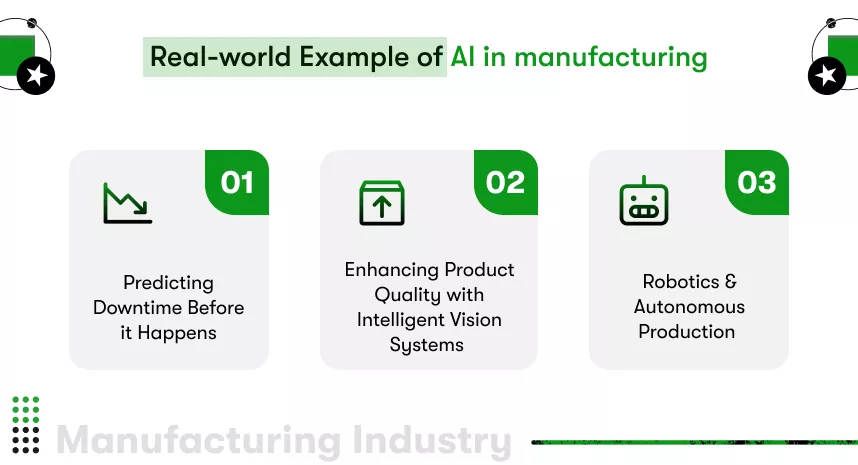
Below are real use cases that illustrate the benefits of AI in manufacturing when deployed strategically.
Predicting Downtime Before It Happens
Unexpected machine failures don’t just delay output; they derail production targets, inflate maintenance budgets, and impact customer commitments. This is where the benefits of AI in manufacturing industry become truly evident.
Manufacturers using AI-powered predictive maintenance tools are now able to:
- Monitor vibration, heat, and performance anomalies in real time
- Predict breakdowns days or weeks in advance
- Auto-trigger maintenance or work orders using the benefits of agentic AI in manufacturing
- Reduce unplanned downtime by 40–70%
- Extend equipment lifespan significantly
Smart factories in automotive and metals have seen massive gains simply by applying the benefits of using AI in manufacturing to legacy equipment.
Enhancing Product Quality with Intelligent Vision Systems
One of the most practical benefits of AI in manufacturing is the ability to maintain consistent product quality without inflating inspection time or cost.
Computer vision models now:
- Catch micro-defects that humans often miss
- Analyze surface consistency, alignment, finishing, and precision
- Auto-separate faulty units
- Provide defect root-cause insights
In sectors like electronics and pharmaceuticals, companies report up to 90% reduction in quality variance, supported by the benefits of generative AI in manufacturing when generating synthetic defect datasets to train high-accuracy models.
Intelligent Supply Chain Planning and Inventory Optimization
Supply chains remain one of the most significant cost centers in manufacturing. Today, many leaders are leveraging the benefits of AI in manufacturing industry to transform planning accuracy.
AI-driven systems can now:
- Forecast demand using real-time market signals
- Auto-adjust inventory based on sales velocity
- Predict supplier delays
- Optimize procurement cycles end-to-end
What once took hours of cross-team coordination can now be handled by agentic systems, proving the benefits of AI in manufacturing in rapidly changing environments.
For readers seeking a deeper understanding of intelligent supply chains, explore our internal guide, AI for supply chain optimization.
Robotics & Autonomous Production
AI-powered robotics are among the most substantial benefits of using AI in manufacturing. With more manufacturers embracing autonomous robots, production lines have become:
- Faster
- Safer
- More stable
- Less dependent on manual labor
Modern robots use vision, automation logic, and real-time learning to handle tasks like:
- Packaging
- Welding
- Palletizing
- Material movement
- Precision assembly
Combined with the benefits of agentic AI in manufacturing, robots can now adapt to new tasks autonomously without the need for code-heavy reprogramming.
Strategic Considerations for Manufacturing Leaders in 2026
By 2026, manufacturers will face a defining moment. Those who strategically capitalize on AI’s benefits in the manufacturing industry will outpace global competitors, while others will struggle to maintain margins.

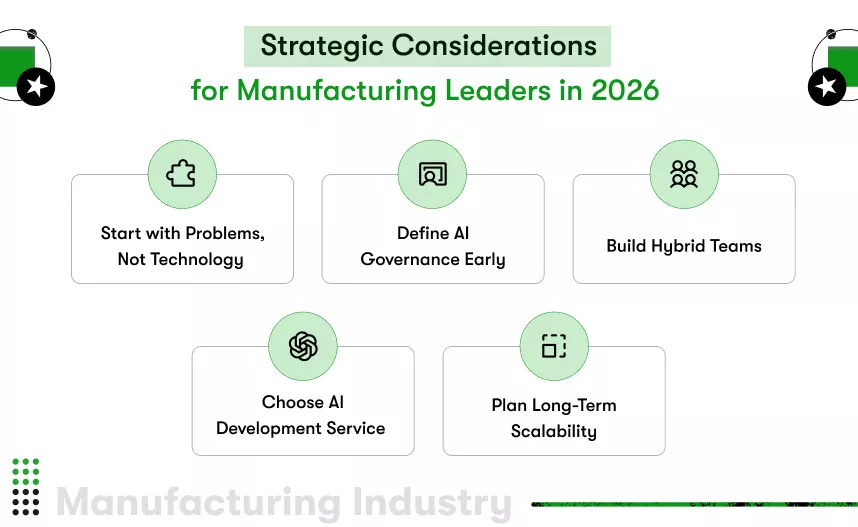
To help CEOs, CTOs, and operations heads make informed decisions, here are essential considerations.
Start with Problems, Not Technology
Many companies rush to adopt AI without a clear business outcome in mind. To truly leverage the benefits of AI in manufacturing, leaders must:
- Identify bottlenecks
- Prioritize business-critical challenges
- Map AI solutions to measurable ROI
This approach avoids experimental spending while accelerating value creation.
For a more structured approach, refer to our internal resource: AI in Manufacturing guide.
Define AI Governance Early
As adoption scales, governance becomes non-negotiable.
To maximize the benefits of using AI in manufacturing, define guardrails around:
- Model security
- Data ownership
- Compliance
- Deployment workflows
- Monitoring and continuous improvement
Good governance doesn’t slow innovation; instead, it speeds it up by eliminating guesswork.
Build Hybrid Teams: Domain + AI Specialists
AI succeeds when manufacturing experts work alongside AI engineers or adapt to the best AI development services.
This blend ensures the benefits of generative AI in manufacturing and predictive AI are applied correctly across:
- Production planning
- Maintenance
- Quality workflows
- Logistics
- Workforce augmentation
The most successful manufacturers don’t outsource everything; they build internal muscle.
Plan Long-Term Scalability
Deploying a single model delivers value.
Building an intelligent factory delivers transformation.
To unlock long-term benefits of AI in manufacturing, leaders should plan for:
- Standardized data pipelines
- Modular AI architectures
- AI-driven MES and ERP integrations
- Crossline and cross-plant scalability
By now, the evidence is clear: 2026 will reward manufacturers who think big and build systems that evolve with them. Manufacturers have already started to capitalise on AI implementation. The question is: what will you do next, or even better, when you start implementing AI to capitalise your business?
Conclusion
Every day you delay, your competitor’s AI is getting smarter. Their machines are learning. Their costs are dropping, and quality is improving. And the gap is widening. Why settle for less when you can have more with AI in your manufacturing business?
The benefits of AI in manufacturing are literally changing the narrative of what factories can achieve. For organizations planning fundamental transformation, the path forward is clear. You start small, scale fast, and build intelligently. You can hire AI developers and start addressing your problems. And if you need structured guidance, explore our internal insights, such as the AI in Manufacturing guide, AI for supply chain optimization, and AI for manufacturing use cases, to accelerate your strategy.
Manufacturers that act today will redefine industry standards for the next decade, and for this massive, meaningful transformation, Kody Technolab is with you. If you want to implement AI in your business to get your hands on all the benefits of AI in manufacturing, you can contact us and get started today!

FAQ
1. What are the benefits of AI in manufacturing?
AI in manufacturing boosts efficiency through automation, cuts costs by 20-30% via optimized resource use, and enhances decision-making with real-time data analysis. Predictive maintenance reduces downtime by 30-50%, while quality control improves defect detection accuracy. Supply chain optimization and workforce productivity gains further amplify these advantages for 2026 operations.
2. How does AI reduce costs in manufacturing?
AI drives cost reduction by optimizing production sequencing, energy use, and inventory, often achieving 15-25% energy savings and 25-40% reductions in operational costs. Predictive tools minimize unplanned downtime and maintenance expenses by 10-40%.
3. What is predictive maintenance with AI?
AI predictive maintenance to analyze sensor data, such as vibration and temperature readings, and to forecast failures weeks in advance with 95% accuracy.
4. What are the benefits of agentic AI in manufacturing?
Agentic AI autonomously monitors conditions, rebalances production lines, and triggers corrections, reducing waste and downtime. It optimizes inventory by 30%, predicts supply disruptions, and enables self-optimizing workflows for higher throughput.
5. How does generative AI benefit manufacturing?
Generative AI accelerates design by creating thousands of variations, optimizing components for weight and durability before prototyping. It generates synthetic data to improve model quality and speeds R&D cycles through virtual testing.
6. Can AI improve supply chain management in manufacturing?
Yes, AI enhances supply chains by forecasting demand from market data and sentiment, reducing excess inventory and delays.
7. Is AI improving workforce safety and productivity?
Yes, AI elevates productivity by 30-40% through cobots handling repetitive tasks, freeing workers for strategic roles. Computer vision detects unsafe behaviors, cutting incidents by 40-60%. AR training and real-time monitoring further enhance safety and output without displacing jobs.