


Quick Summary: AI Trends in Manufacturing help you focus on improvements that deliver clear operational gains. In this blog, you see which trends hold the strongest value for 2026 and how each one supports better scrap control, steadier cycles and accurate planning. You also learn how to judge readiness, select the right entry point and align your plant teams toward outcomes that support predictable performance and confident decision-making.
AI Trends in Manufacturing now determine which plants protect margin and which plants lose it. Leaders who manage complex production lines face rising material costs, labour constraints and quality drift that erodes output without warning.
Pressure from these factors pushes factories to adopt AI systems that stabilise performance and deliver stable output regardless of workload fluctuations. The University of Sheffield’s recent work provides a strong reference point for this shift.
The AI-driven spinout DigitalCNC applies machining science and machine learning to reduce waste and improve accuracy for complex parts.
DigitalCNC’s technology, developed with the Advanced Manufacturing Research Centre, has delivered measurable gains for UK manufacturers and attracted interest from global aerospace organisations.
Executives across the United States, United Kingdom and UAE follow similar advances because artificial intelligence in the manufacturing market will expand from USD 390.91 billion in 2025 to USD 3,497.26 billion by 2033 with a projected CAGR of 30.6 percent from 2026 to 2033. (Source: Grand View Research)
The following analysis presents the top AI trends in manufacturing for 2026 that help modern plants achieve predictable and high-return performance.
If you want to build AI in your manufacturing operations but do not know where to begin, this AI in Manufacturing guide gives you a clear starting point.


What Manufacturing Leaders Need to Fix Before Applying AI Trends in Manufacturing
AI trends in manufacturing promise better throughput, lower scrap and more predictable output. Yet most plants discover that machine learning only performs well when the underlying production environment is stable.
Many factories struggle not with the AI itself but with the conditions the models rely on. Before adopting any AI trends for manufacturing industry operations, executives focus on the structural issues that distort data, weaken insights and delay ROI.
Key Operational Barriers That Slow Down AI Adoption
Executive teams committed to AI-driven transformation quickly realise that algorithms cannot outperform an unstable production floor. Leaders exploring AI for supply chain reach the same conclusion. Several deep-rooted operational constraints must be addressed before any AI trends for manufacturing industry initiatives deliver measurable ROI. The next set of factors explains where most transformation programmes stall and why early stability matters.
Output Stability and Variability Control
Factories want predictable patterns before deploying AI. Many lines generate data that shifts faster than models can learn.
- Scrap bursts with no upstream warnings, usually caused by tool wear, coolant contamination, or material variation.
- Cycle-time creeps during high load, making scheduling and predictive algorithms unreliable.
- Batch-to-batch behavioural differences, even when supplier specifications appear identical.
- Operator-driven variability, where identical machines deliver different results under different teams.
Reliable AI requires stable operating baselines so Artificial Intelligence in manufacturing industry systems can learn meaningful patterns.
Micro-Stops and Mistuned Machines That Hide Real Costs
Plants lose more ROI through micro-interruptions than major failures. Executives prioritise:
- Machines drifting within tolerance, creating small, unreported defects.
- Mismatched PLC timestamps, preventing accurate event reconstruction.
- Limited historian coverage, capturing too few parameters for effective root-cause analysis.
- Irregular tag structures, forcing teams to manually normalise data before training any model.
When these issues persist, AI pilots deliver inconsistent signals and stall.
Quality Blind Spots That Undermine Predictive Systems
Predictive quality thrives only when plants maintain precise, structured, station-level visibility. Plants refine:
- Inspection practices that detect defects too late for proactive action.
- Operator notes recorded in inconsistent formats, complicating model interpretation.
- Shift-to-shift variations in defect categories, obscuring patterns.
- Quality data scattered across spreadsheets and tools, limiting integration.
Without unified visibility, even the top AI trends in manufacturing for 2026 cannot deliver repeatable improvements.
Workforce Readiness and Cognitive Load Management
AI dissolves when the workforce feels overwhelmed. Leaders prepare teams by ensuring:
- Simple, single-action operator screens instead of cluttered dashboards.
- Alerts that explain the specific change and expected response, not vague warnings.
- Hands-on training that demonstrates measurable benefit, not theoretical slides.
- Change-management frameworks that build trust, reducing resistance.
Executives know AI adoption depends on operator confidence, not algorithm complexity.
Addressing these constraints gives manufacturing leaders the conditions needed for high-confidence AI adoption. Plants that invest in this foundation see stronger model accuracy and shorter time-to-value. With that groundwork complete, the core AI trends for manufacturing industry operations can be applied with far greater impact.
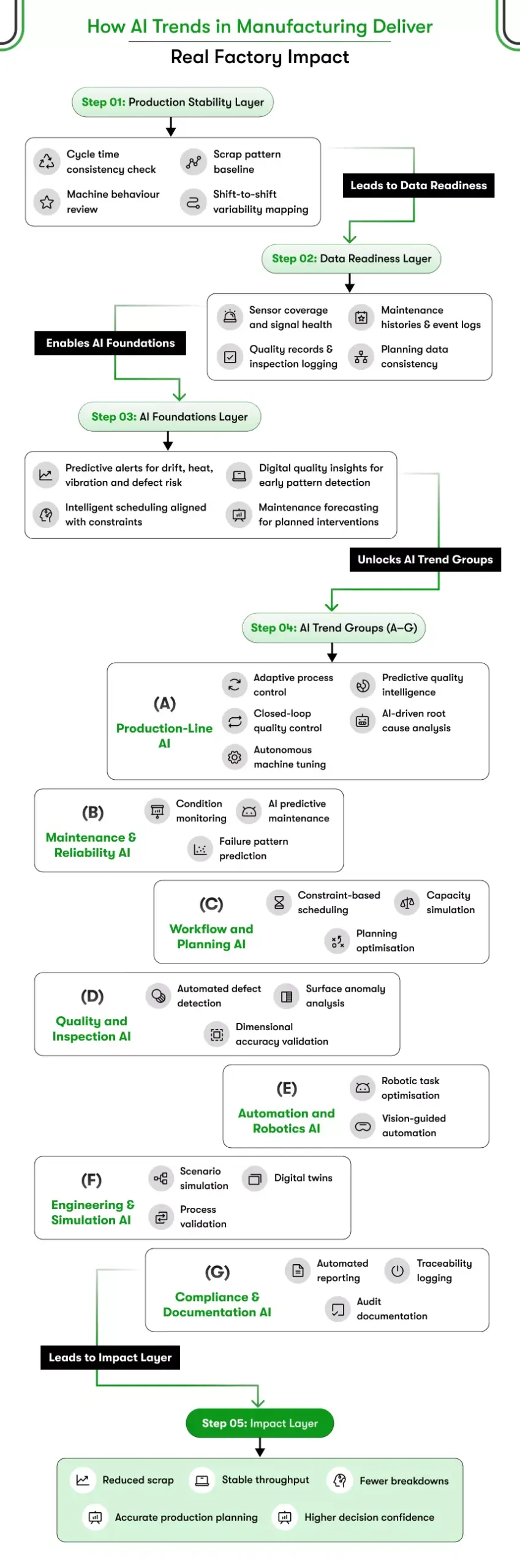
Seven Groups of AI Trends in Manufacturing Every CEO Should Prioritize in 2026
AI trends in manufacturing create real operational and financial impact only when the production environment is stable and well prepared for machine learning. Many leaders exploring AI in automation follow the same sequence because early stability drives consistent results. Once the earlier constraints are resolved, several advanced AI capabilities start producing measurable gains in throughput, quality consistency and asset reliability.


The trends outlined below reflect what high-performance factories are adopting in 2026 to secure predictable improvements and stronger returns across modern manufacturing operations.
Trend Group A – Adaptive Process Control for Real-Time Production Stabilisation
Adaptive Process Control (APC) adjusts machining, forming, molding and stamping parameters in real time by interpreting torque, vibration, thermal patterns and other sensor inputs. APC provides the continuous feedback needed to stabilise machines under changing conditions.
1: APC Creates Predictable Performance Through:
- Real-time adjustments during machining or forming, maintaining dimensional accuracy even as tools age.
- Compensation for tool wear detected through vibration or load signatures, preventing drift long before scrap rises.
- Stable cycle times supported by continuous micro-optimisation, allowing planners to schedule with greater confidence.
- Extended tool and spindle life enabled by balanced load distribution, reducing consumable expenditure.
- Progressive model improvement via learning from each completed cycle, strengthening predictive accuracy with every shift.
APC forms a reliable foundation for other AI trends for manufacturing industry operations by ensuring each line behaves consistently.
2. Predictive Quality Intelligence for Upstream Defect Prevention
Predictive quality models evaluate multivariate data across machines, sensors and stations to identify where defects are likely to occur. This prevents quality issues from reaching downstream inspection.
Predictive Quality Intelligence Improves Stability Through:
- Early alerts based on subtle changes in torque, pressure, thermal behaviour or signal patterns, reducing scrap and rework.
- Correlation analysis across machines and shifts, revealing patterns not visible through manual review.
- Automated mapping of defect signatures to specific process conditions, strengthening diagnostic precision.
- Operator and supervisor dashboards that present real-time risk, enabling timely adjustments.
- Reduction of shift-based variability, because decisions follow consistent, data-supported guidance.
Predictive Quality Intelligence strengthens artificial intelligence in manufacturing industry ecosystems by improving reliability across every upstream step.
3. Closed-Loop Quality Control for Automatic Process Correction
Closed-loop quality systems use inspection data to correct machine parameters automatically. When a measurement shifts, the system directs the machine to adjust offsets, speeds or feed rates before the next part.
Closed-Loop Quality Delivers Measurable Gains Through:
- Immediate corrections after small deviations, preventing extended runs of defective parts.
- Offset adjustments based on measurement data, improving consistency across batches.
- Minimised reliance on manual tuning, reducing outcome variation between operators.
- Faster containment during quality drift, helped by fast feedback cycles.
- Predictable conditions for downstream assembly, supported by tighter dimensional control.
Closed-loop quality control is one of the Top AI trends in manufacturing for 2026 due to its direct impact on yield and repeatability.
4. AI-Driven Root Cause Analysis That Accelerates Problem Resolution
AI-driven root cause analysis evaluates hundreds of variables simultaneously to identify the real source of defects, slowdowns or variability. Traditional problem-solving tools cannot process this level of complexity.
AI Root Cause Analysis Strengthens Operations Through:
- Discovery of hidden interactions between machine settings, material properties and environmental factors, improving accuracy.
- Identification of upstream conditions that create downstream failures, reducing recurring issues.
- Evaluation of low-frequency or rare event combinations, often missed by manual investigation.
- Clear evidence that speeds corrective action, improving collaboration between engineering and maintenance teams.
- Structured insights that inform long-term improvements, guiding future investments in process optimisation.
AI-driven analysis increases the efficiency of several AI Trends in Manufacturing by accelerating diagnostic cycles.
5. Autonomous Machine Tuning for Parameter Optimisation Across Shifts and Batches
Autonomous tuning systems learn the optimal setup for each machine based on historical performance, part type, material behaviour and shift-specific patterns. The system sets initial parameters automatically for each job or batch.
Why Autonomous Tuning Improves Productivity
- Faster setup through automatic parameter selection, reducing operator workload.
- Removal of shift-dependent tuning variation, creating stable results.
- Consistent parameter windows across material changes, improving repeatability.
- Reduced reliance on expert operators, because the system retains tuning knowledge.
- Stronger baseline for future AI models, supported by consistent starting conditions.
Autonomous tuning creates a consistent environment where other AI Trends in Manufacturing can operate with high accuracy.
Consistent output arrives when every shift runs with stable parameters and predictable flow. Plants that work at this level experience fewer surprises and steadier margins, which reflects many core AI benefits in manufacturing. Leadership gains the space to plan forward-looking improvements instead of reacting to disruptions that slow progress.

Trend Group B: Maintenance and Reliability AI That Reduces Unplanned Downtime
Predictive maintenance remains one of the strongest AI Trends in Manufacturing because stable lines depend on early detection of mechanical wear and thermal drift. Many factories use AI predictive maintenance to prevent unplanned stoppages and protect equipment health. High-utilisation plants rely on these systems to reduce secondary damage and support dependable production planning.
The following technologies strengthen asset reliability through accurate forecasting and intelligent scheduling.
6. Remaining Useful Life (RUL) Modeling for Precise Failure Window Forecasts
RUL modeling interprets vibration behaviour, temperature drift, acoustic patterns and load fluctuations to predict how long a component can operate safely. This allows maintenance teams to intervene at the correct moment instead of reacting to unplanned breakdowns.
RUL Modeling Improves Reliability Through:
- Accurate prediction of bearing, motor, pump and spindle degradation, giving teams clarity on upcoming downtime windows.
- Early identification of abnormal mechanical signatures, long before alarms trigger.
- Better coordination between production and maintenance, because teams understand exactly when failures are likely.
- Reduced secondary damage, supported by intervention before a component fails under load.
- Optimised spare-parts planning, because consumption becomes predictable instead of reactive.
RUL forecasting directly supports Artificial Intelligence in manufacturing industry operations by giving leaders the confidence to run assets closer to their optimal limits.
7. Edge-Level Anomaly Detection for Instant Condition Awareness
Edge AI models run directly on machine controllers or local devices to detect unusual behaviour in real time. This eliminates latency and enables immediate response during abnormal sound, vibration, torque or temperature events.
Edge Anomaly Detection Strengthens Plant Stability Through:
- Instant evaluation of raw sensor signals without sending data to the cloud, reducing response time.
- Local detection of high-risk conditions, including over-torque, temperature spikes and abnormal frequency patterns.
- Continuous monitoring during high-speed operations, where centralised systems may miss sudden changes.
- Lower network dependence, ensuring reliability even in environments with limited connectivity.
- Fast response from maintenance teams, because alerts are delivered the moment abnormal behaviour occurs.
Edge detection aligns with several AI trends for manufacturing industry environments that require real-time visibility during fast, variable and high-load processes.
8. Maintenance Prioritisation Algorithms for Smart Scheduling Decisions
Maintenance prioritisation models evaluate risk, cost, production impact and asset hierarchy to determine which machine requires attention first. These models help planners replace intuition-based decision-making with structured, data-supported logic.
Maintenance Prioritisation Improves Uptime Through:
- Risk-based ranking of assets, ensuring high-impact machines receive immediate intervention.
- Analysis of downtime cost for each potential failure, improving decision quality.
- Integration with production schedules, so maintenance plans support output targets.
- Clear justification for each maintenance event, improving communication across engineering, planning and leadership functions.
- Balanced workload distribution, supporting efficient resource allocation across teams.
Maintenance prioritisation supports several top AI trends in manufacturing for 2026 by giving leaders a reliable, structured method to protect throughput and reduce avoidable stoppages.
Many AI in manufacturing use cases depend on this stability since accurate predictions require consistent machine behaviour. Planning accuracy strengthens once production behaviour reflects real constraints rather than ideal assumptions.
Leaders gain the clarity required to approve schedules with confidence and prepare the plant for upcoming demand.
Trend Group C: Planning, Scheduling and Supply Chain AI That Protects Delivery Commitments and Working Capital
Planning and supply chain leaders manage a narrow margin between committed output and real capacity. These AI Trends in Manufacturing strengthen that margin by improving schedule accuracy, stabilising material flow, and reducing the financial impact of inventory misalignment.
Factories with high product mix, complex routing or unpredictable demand signals rely on these trends to maintain dependable delivery performance.
9. AI Scheduling and Dynamic Routing for Real-Time Production Prioritisation
AI scheduling engines evaluate job urgency, tool readiness, operator availability, material status and equipment condition to determine the most efficient production sequence. This replaces static spreadsheets with models that adapt to real-time plant behaviour.
AI Scheduling Improves Throughput Through:
- Automatic resequencing of work orders during machine downtime, setup delays or operator shortages.
- Routing decisions that reflect live material and tooling availability, preventing avoidable stalls.
- Evaluation of multiple scheduling scenarios, helping leaders choose the optimal path for cost or speed.
- Better coordination between departments, because the system aligns maintenance, production and material flow.
- Faster recovery after disturbances, supported by immediate schedule regeneration.
AI scheduling reflects several AI trends for manufacturing industry operations that prioritise predictable output under high variability.
10. Real-Time Demand Sensing for Short-Horizon Forecast Accuracy
Real-time demand sensing models analyse customer orders, distributor signals, market behaviour and seasonality patterns to predict short-term demand changes. This gives planners accurate visibility into production volumes required for the next few days or weeks.
Demand Sensing Strengthens Planning Through:
- Fast detection of demand spikes or drops, improving resource allocation.
- Integration of channel-level signals, reducing reliance on outdated monthly forecasts.
- Closer alignment between actual demand and production output, improving utilisation.
- Reduction of emergency changeovers, because planners see volume swings earlier.
- Better customer service levels, supported by improved short-horizon accuracy.
Demand sensing supports artificial intelligence in manufacturing industry planning functions that depend on agile, responsive forecasting.
11. Multi-Objective Optimization Engines for Balanced Production Decisions
Multi-objective optimisation engines evaluate throughput, cost, delivery deadlines, equipment condition and energy use simultaneously. Leaders gain a structured method to select the best operating point for current business priorities.
Optimisation Models Strengthen Decision Quality Through:
- Simultaneous evaluation of speed, cost, energy and quality impact, removing guesswork.
- Selection of the best trade-off, based on explicit production goals.
- Scenario comparison that highlights operational trade-offs, helping executives choose the most resilient plan.
- Alignment between technical constraints and commercial expectations, reducing cross-functional tension.
- Continuous recalculation as conditions evolve, keeping operations on the most efficient trajectory.
Multi-objective optimization appears consistently across top AI trends in manufacturing for 2026 because the technique connects operational variables directly to financial outcomes.
12. Inventory Optimization AI for Working Capital Protection
Inventory optimisation models analyse consumption patterns, supplier reliability, production lead times and demand uncertainty to determine the ideal stock level. The output maintains service reliability without tying cash in excess material.
Inventory Optimization Strengthens Supply Chain Performance Through:
- Precise calculation of safety stock, based on real consumption behaviour and risk.
- Early detection of material imbalance, including slow-moving items or volatile demand segments.
- Reduction in emergency procurement, supported by stable replenishment cycles.
- Lower carrying cost, because inventory aligns with real requirements instead of inflated assumptions.
- Improved supplier planning, supported by reliable mid-term visibility.
Inventory optimization reinforces broader AI trends for manufacturing industry operations by aligning material availability with actual production needs while protecting working capital.
Quality holds steady when detection, feedback and correction align across equipment and operators. Plants that maintain this alignment deliver reliable parts, reduced rework and stronger customer trust.


Trend Group D: Workforce Augmentation and Knowledge Capture That Strengthens Skill, Speed and Consistency
Manufacturing leaders face a structural skills gap driven by retirements, high turnover and the growing complexity of automated equipment. These AI trends in manufacturing provide a systematic way to preserve expert-level knowledge, shorten training cycles and improve operator performance across every shift.
The factories that scale these capabilities achieve more consistent output and reduce the dependency on a small group of senior technicians.
13. AI-Generated Standard Operating Procedures That Capture Expert-Level Knowledge
AI-driven SOP engines analyse high-performing operator behaviour, sensor patterns and machine data to generate detailed, accurate and continuously updated instructions. Plants no longer rely on outdated documents or tribal knowledge stored with a few experienced technicians.
AI-Generated SOPs Strengthen Operational Consistency Through:
- Automatic extraction of best practices from recorded actions performed by senior operators during setups, changeovers and inspections.
- Version updates based on live performance data, ensuring instructions evolve when machines or materials change.
- Role-specific guidance, giving operators clear instructions tailored to their skill level and workstation requirements.
- Consistent execution across every shift, because instructions reflect proven behaviours instead of personal habits.
- Faster onboarding, supported by clear and accurate documentation grounded in real production scenarios.
AI-generated documentation creates the stable knowledge base required for reliable performance across the AI trends for the manufacturing industry ecosystem.
14. Operator Assistance Systems That Elevate Performance in Real Time
Operator assistance systems analyse machine behaviour, process conditions and task complexity to guide technicians during high-impact activities. This support reduces variation and builds confidence among operators with limited experience.
Operator Assistance Systems Improve Daily Execution Through:
- Real-time changeover guidance, allowing precise step-by-step execution.
- Context-aware prompts that highlight torque settings, alignment targets or temperature requirements before errors occur.
- Camera-supported verification, confirming each step before the next task begins.
- Guided maintenance procedures, including calibration, lubrication, alignment and sensor checks.
- Consistent performance across shifts, supported by logic that applies uniformly across operators.
Operator guidance reinforces Artificial Intelligence in manufacturing industry operations by stabilising positions that influence quality and throughput.
15. AR and VR Skill Transfer Environments for High-Complexity Training
AR and VR simulation environments recreate machine behaviour, line configurations and maintenance steps with high accuracy. Operators gain hands-on practice without production risk.
AR and VR Skill Transfer Strengthen Capability Building Through:
- Immersive practice sessions for complex tasks such as spindle adjustments, mold changes or robotic teaching.
- Safe repetition of high-risk procedures, reducing the chances of accidents on the shop floor.
- Clear visibility into internal mechanisms, improving understanding of mechanical interactions.
- Faster certification cycles, driven by measurable milestones inside the training environment.
- Consistent training outcomes across all sites, supported by unified learning modules.
AR and VR technology appear across the top AI trends in manufacturing for 2026 due to measurable improvements in capability development and workforce readiness.
Machine health stays stable when decisions rely on data instead of intuition. Predictable performance across equipment supports cleaner schedules, fewer stoppages and smoother daily operations.
Trend Group E: Energy and Sustainability AI Built for Plants With High Utility Cost and Strict Compliance Targets
Factories spending heavily on electricity, compressed air, cooling or furnace heat need accuracy in how energy is consumed and where loss occurs. Plants operating under ISO, customer audits or export requirements need traceable measurements for emissions and waste. Trend Group E covers the capabilities that strengthen cost control and compliance without relying on slogans or broad ESG statements.
16. Energy Optimization Engines Built From Machine-Level Load Behavior
Energy optimization engines study how each machine consumes power during warmup, cutting, forming, idle periods and cool-down cycles. The models identify avoidable peaks, inefficient patterns and equipment combinations that overload specific hours of the day.
Energy Optimization Creates Practical Savings Through:
- Detection of unnecessary load spikes during warmup, tool change and non-cutting movements.
- Adjustment of batch timing during high-tariff intervals without affecting takt time.
- Identification of equipment that performs better under stable temperature conditions, lowering wasted consumption.
- Shift-wise energy benchmarks, giving supervisors clear comparisons for reduction.
- Integration with scheduling, allowing planners to avoid stacking high-load equipment at the same hour.
Energy optimization supports several AI trends for manufacturing industry operations that must show measurable cost improvement, not theoretical savings.
17. Carbon Measurement Models Built From Real Process Data Instead of Estimates
Carbon models convert electricity usage, furnace cycles, compressed air consumption, material selection and inbound transport into accurate emission values. Managers gain verified numbers tied directly to machine logs and process steps, not assumptions.
Carbon Measurement Strengthens Compliance Through:
- Direct conversion of power consumption into CO₂ values, broken down by process and shift.
- Automatic creation of Scope 1, 2 and 3 summaries, aligned with auditor expectations.
- Forecasting for next-quarter emissions, supporting procurement and capacity decisions.
- Identification of high-emission assets, giving engineering teams a clear upgrade roadmap.
- Evidence-based reporting for customer audits, replacing manually stitched data.
Carbon models reinforce Artificial Intelligence in manufacturing industry environments where customers demand transparent, verifiable sustainability records.
18. Waste Reduction Engines That Pinpoint the Exact Sources of Material Loss
Waste reduction engines track scrap, rework and over-consumption by linking machine behaviour, tooling condition, humidity, operator variation and process temperature. Leaders receive a ranked view of where loss originates and which improvements carry the highest financial return.
Waste Reduction Strengthens Yield Through:
- Correlation of scrap categories with specific offsets, tool wear states and environmental factors.
- Detection of subtle dimensional drift, supported by thermal and vibration signatures.
- Breakdown of material loss into avoidable and unavoidable components, improving decision focus.
- Identification of patterns linked to shift changes, batch transitions or operator technique.
- Quantification of financial impact, helping teams prioritise actions with clear payback.
Waste reduction engines appear in the Top AI Trends in Manufacturing for 2026 because they cut raw material cost with measurable accuracy.
Energy, compliance and material discipline shape profitability as directly as throughput. When numbers reflect true floor behaviour, leaders direct cost and compliance actions with accuracy instead of approximation.
Trend Group F: Safety, Traceability and Compliance AI Built for Zero-Tolerance Manufacturing Environments
Plants with hazardous zones, complex assembly sequences or tight regulatory oversight depend on accuracy in how incidents are prevented, how evidence is captured and how product history is preserved. Trend Group F focuses on the AI Trends in Manufacturing that protect license-to-operate conditions and reduce exposure to human error during critical operations.
19. Computer Vision Safety Systems That Observe What Supervisors Cannot See in Real Time
Computer vision safety engines analyse movement around presses, CNC doors, robot cages, furnace fronts, loading pits and forklift intersections. The models detect unsafe proximity and missing protective equipment without relying on manual supervision.
Operational Impact Observed in High-Risk Zones:
- Automated detection of incorrect PPE during handling of hot parts, sharp tools or chemical containers.
- Proximity alerts near robotic arms and automated gantries, reducing reaction time for operators.
- Heat-zone boundary monitoring around furnaces and industrial ovens, grounded in infrared signatures.
- Collision-prevention logic for forklift pathways and pedestrian crossings inside tight aisles.
- Shift-level trend reports, showing repeat-risk locations inside the plant.
Computer vision contributes directly to AI trends for manufacturing industry environments that require precise incident prevention.
20. Traceability Engines That Build a Verified History for Every Unit and Every Step
Traceability engines capture machine parameters, calibration values, torque curves, inspection readings and operator actions for each part or batch. The captured data forms an unbroken history that auditors can verify without relying on recollection or manual notes.
Capabilities That Support Regulated Production Lines:
- Recording of critical parameters per serial number, including thermal behaviour, spindle torque, pressure curves and tool offsets.
- Linking of every step to a timestamp and resource ID, creating a forensic record for medical, aerospace and automotive workflows.
- Environmental condition tracking, including humidity, airflow and temperature during sensitive processes.
- Deviation tagging with context, drawn directly from machine logs and sensor behaviour.
- Seconds-level retrieval during FDA, ISO and IATF audits, eliminating manual document assembly.
Traceability engines reinforce Artificial Intelligence in manufacturing industry operations that must withstand regulator scrutiny.
21. AI-Driven Quality Documentation That Removes Manual Interpretation From Compliance Reporting
Quality documentation engines assemble dimensional results, visual checks, calibration cycles and machine logs into inspector-ready files. Consistency improves because the record follows a structured logic instead of operator experience.
Execution-Level Advantages Observed on the Shop Floor:
- Auto-generated inspection files, based on actual readings rather than copied text.
- Machine-verified calibration evidence, pulled from motion profiles and internal sensors.
- Structured deviation reports, with supporting images, timestamps and parameter shifts.
- Consistent formatting for compliance submissions, aligned with regulatory templates.
- Significant reduction in QA bottlenecks, because the system removes transcription work.
Documentation engines appear repeatedly in the top AI trends in manufacturing because regulated plants need clear, error-free evidence for every delivered unit. Many leadership teams explore AI development services during this stage to streamline compliance work and reduce manual effort.
Simulation then brings clarity to decisions that influence capacity, layout and investment. Each improvement gains validation before reaching the floor, which protects uptime and removes uncertainty from high-impact choices.
Trend Group G: Digital Twins and Simulation AI for Plants That Need Predictable Output and Faster Decision Cycles
High-variation factories, multi-line facilities and plants with recurring flow disruptions rely on simulation-driven planning to protect throughput. Trend Group F focuses on the AI Trends in Manufacturing that reveal bottlenecks before a shift begins, test alternative routing strategies without pausing the line and forecast performance under real constraints.
22. Digital Twin Models That Mirror Line Behaviour With Engineering Accuracy
A digital twin mirrors machine interactions, buffer behaviour, tool change sequences, warmup curves, setup patterns and material arrival timing. The model recreates how a real line behaves during the first hour of changeover, the last hour of a shift or the 20 minutes before maintenance arrives.
Digital Twin Models Support Confident Decision-Making Through:
- Recreation of actual cycle time behaviour, including micro-stops, early-cycle variation and operator influence.
- Validation of new tooling, fixture designs and routing sequences, without interrupting live production.
- Visibility into inter-machine dependencies, allowing engineers to see where hold-ups originate.
- Simulation of batch transitions, showing how upstream changes affect downstream accuracy.
- Forecast accuracy during peak periods, grounded in historical sensor behaviour and real takt-time movement.
Digital twin capability sits within major AI trends for manufacturing industry teams that want predictable performance instead of reactive problem-solving.
23. Throughput Simulation Engines Built to Predict Output Under Real Constraints
Throughput simulation engines model how equipment health, staffing levels, job sequencing, maintenance windows and material arrival variation influence output. Leaders rely on these forecasts to understand how far production can stretch without crossing risk thresholds.
Throughput Simulation Provides Operational Clarity Through:
- Prediction of hourly and shift-level output, based on live and historical production constraints.
- Identification of hidden bottlenecks, including load imbalance, slow feeders and late-arriving materials.
- Testing of multiple scheduling paths, comparing their impact on throughput and stability.
- Evaluation of maintenance timing, showing which intervention window protects the most capacity.
- Scenario analysis for new product introductions, supporting confident ramp-up planning.
Throughput simulation supports Artificial Intelligence in manufacturing industry environments that require high confidence in output before committing to customer deadlines.
24. Material Flow Optimisation for Faster, Safer Floor Movement
Material movement shapes take time more strongly than machine cycle speed. Flow-analysis systems study every motion: operator travel distance, pallet traffic, staging congestion, aisle bottlenecks and AGV interactions. Insights come directly from movement data gathered across several shifts.
Material Flow Optimisation Improves Plant Stability Through:
- Identifying choke points created by layout decisions or high-frequency travel paths.
- Rebalancing staging zones to match consumption rhythm and reduce backtracking.
- Eliminating unnecessary loops in material movement that drain productivity.
- Smoothing AGV routes to prevent blocking and accidental delays.
- Validating revised layouts inside the digital twin to ensure improvements hold up under load.
Production-line intelligence proves its value only when performance remains stable under pressure. Plants that deploy these capabilities gain predictable output, lower scrap and faster recovery after disruptions.
Leadership teams move from reactive firefighting to disciplined control, which becomes the foundation for every further advancement across the factory.
Operations gain structure once every trend moves in the same direction. Engineering, planning, quality, maintenance, energy and simulation efforts support one another instead of working in isolation. Leaders guide production with clearer insight, steadier performance and decisions grounded in measurable plant behaviour.

Which AI Trends in Manufacturing Deserve Priority for 2026? A Practical Filter for Leaders Who Need Hard ROI
Many factories chase every new idea without checking whether the improvement can deliver financial impact within a reasonable window. Decision-makers face far more pressure than vendors admit: limited budgets, strict delivery commitments, shortage of skilled talent and rising customer penalties.

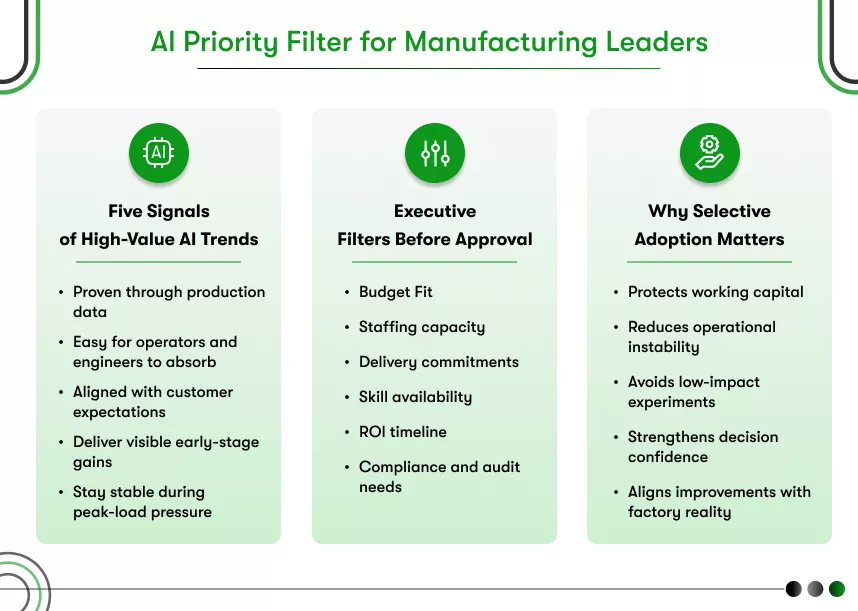
A strong plan focuses only on the trends that return measurable value, not every trend available on the market.
Executives across advanced plants apply a simple filter before approving any investment. The filter focuses on outcomes that strengthen profit, protect schedules and reduce operational instability.
Once the noise is removed, only a small set of trends carry enough weight to justify serious attention.
The Trends Worth Prioritising Share Five Traits
- Improvements supported by production data, not vendor slides.
- Changes that operators and engineers can absorb without stretching capacity or adding new headaches.
- Techniques that match customer expectations for consistency, traceability and schedule discipline.
- Gains that show up early enough for leadership to judge whether the direction is worth deeper investment.
- Practices that hold steady during peak load, tight deadlines and unexpected variation.
A concise set of priorities sends a stronger signal than a long catalogue of ideas. Leaders value partners who understand real production challenges and can separate high-impact improvements from distracting concepts.
A focused shortlist reflects judgement shaped by real factory experience rather than theory gathered from trend reports. Manufacturers commit faster when recommendations match practical limits around staffing, equipment behaviour and scheduling pressure.
Leadership often brings in external support to fill short-term skill gaps, and many teams choose to hire AI developers for project-only work to keep momentum steady.
A selective approach signals that every step aligns with operational reality, which builds confidence in the partnership and strengthens conversations about improvement, budgets and long-term capability planning.
Conclusion
Operational clarity grows when every improvement follows a sequence shaped by real factory behaviour. Plants that organise priorities with this discipline secure gains that hold steady across shifts, load changes and scheduling pressure. Leadership also gains room to plan with confidence because outcomes follow a pattern they can rely on quarter after quarter.
A brief review of your processes often reveals improvement routes that deliver value without major disruption. Some production environments need tighter control on variation, others need deeper planning insight or simulation-led decision support. The correct entry point depends on the operational friction your leadership wants to reduce next.
Kody Technolab supports manufacturers with a delivery model built around practical floor conditions. Our work includes assessment of current operational behaviour, design of improvement paths that match your constraints and implementation support that holds up under real load. A short conversation with our team can help you identify a precise starting point and advance with confidence.

FAQs for AI Trends in Manufacturing
1. Which AI trends should a manufacturing leader prioritise first?
Start with trends that directly influence cost and delivery such as adaptive process control, predictive quality and flow simulation. These areas produce measurable gains in scrap reduction, throughput stability and scheduling accuracy. A short assessment usually reveals which trend aligns with the plant’s current performance gaps.
2. How can I judge whether an AI trend is proven or only marketing?
A proven trend shows measurable results from real deployments and produces consistent improvements across multiple shifts. Reliable trends also integrate with existing systems without forcing a major process overhaul. Ask for evidence tied to scrap rates, takt stability or maintenance outcomes rather than presentations.
3. How much data do we need before applying any of these AI trends in manufacturing?
Most trends begin with sensor logs, machine histories, quality records and planning data that already exist inside the plant. Accuracy improves over time, but early results do not require perfect datasets. A structured data check highlights what can be used immediately and what needs refinement.
4. How can a manufacturing leader identify which AI trend will give the strongest financial return?
The fastest way is to measure where the plant loses money today. Loss usually comes from scrap, rework, slow cycles, flow delays, unplanned downtime or scheduling mistakes. Once those areas are measured, only a few AI trends match each loss pattern. A short review links each trend to actual cost impact, so leadership sees which option delivers savings within a realistic timeline.
5. Will AI adoption force major workflow changes on the plant floor?
No. High-value trends strengthen existing routines rather than disrupt them. Operators receive clearer inputs for each task, and engineers gain better visibility into process behaviour. Adjustments are introduced gradually to protect daily performance.
6. Can one successful AI trend in manufacturing scale to other lines or facilities?
Yes. Once the behaviour of one line is understood, the same logic extends to similar machines, shifts or layouts. Scaling becomes easier because the learning from the first deployment guides the rollout.
7. How long does it take to evaluate whether a trend works in our environment?
Early signals appear within a few weeks once the system reads enough behaviour patterns. Clear improvement becomes visible soon after stability returns to the line. Leadership can judge progress early without waiting through long cycles.
8. What are the main risks to check before adopting these trends?
Key concerns include data accuracy, impact on shift routines, equipment condition and integration effort. Risk stays controlled when ideas are tested inside simulation or a digital twin before reaching the floor. A structured rollout keeps operations stable.
9. Which internal teams should be involved when applying AI trends in manufacturing?
Most improvements require support from production engineering, maintenance, planning and quality. Each group offers knowledge that helps explain current bottlenecks and shapes the improvement path. The involvement does not need to be full-time. A small project team is often enough, and additional support can be hired only for the duration of the implementation. This approach keeps the workload manageable for your staff and allows the project to move forward without interrupting daily operations.
10. How can Kody Technolab support our adoption of AI trends in manufacturing?
Kody Technolab provides operational assessment, model design, simulation support and controlled rollout. Every step aligns with real floor conditions. Leadership receives clarity, engineers gain support and results appear within a realistic timeframe. A short discussion with our team identifies the starting point that suits your plant.