


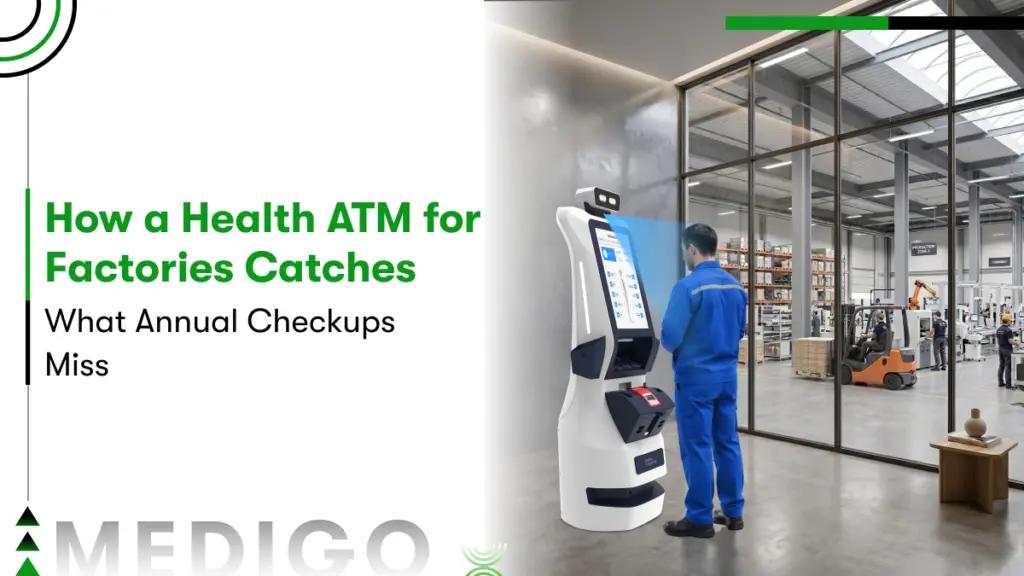
Blog Summary: A Health ATM for Factories catches what an annual checkup misses, the months in between. Three-minute screenings, same-day results, and a flagged reading routed straight to a doctor, all running quietly inside every shift on your own factory floor.
A Health ATM for Factories fills a specific gap in existing occupational health compliance: the time between mandatory exams. Indian factories already run on a fixed medical exam calendar under the Factories Act, 1948, once a year for most workers, twice for anyone in a hazardous process. No mechanism in that calendar tracks a worker’s vitals in the months between exams, when blood pressure, blood sugar, or heart rate can move outside a safe range without generating a single record.
A study of industrial workers in India found that roughly one in ten reported reduced output on a given working day because of an unaddressed health problem, losing close to two hours of productive time each.
A Health ATM for worker health monitoring closes that gap with a kiosk installed directly on the factory floor, operated by one trained operator rather than a certifying surgeon. The screening itself runs on AI in healthcare, reading vitals and flagging abnormal results without a doctor present for every check. A worker completes the screening between shifts and gets a report in about three minutes, the kind of continuous record an annual exam was never built to provide.
What a Health ATM for Industrial Health Programs Actually Does
A health ATM for industrial health programs runs on a guided workflow, not unattended self-service. A worker moves through a fixed sequence of checks under one trained operator: blood pressure, blood glucose, hemoglobin, lipid profile, an ECG, spirometry, and hearing and vision screening.
The sequence completes in about three minutes, and the operator hands the worker a structured digital report instead of a handwritten slip.
A paper slip exists only in the worker’s hand unless someone manually files it. Tracking one worker’s health trend across several screening dates then means locating each of those individual sheets separately.
Medigo saves every report automatically to the worker’s digital record, so an EHS or occupational health team can pull a worker’s past screening records on demand. The screening runs on AI in healthcare, reading vitals and flagging abnormal results without a doctor present for every check.
Factories running steel, textile, chemical, or heavy engineering operations, where hundreds of workers rotate through screening across multiple shifts, rely on Medigo’s Health ATM features like automatic record-saving and instant report delivery to track each worker’s health trend across repeat screenings
If you want to know how a health screening kiosk works in a different setting, read our blog on Health ATM for PHC.
What a Health ATM for Factories Means for Owners, HR, and Compliance
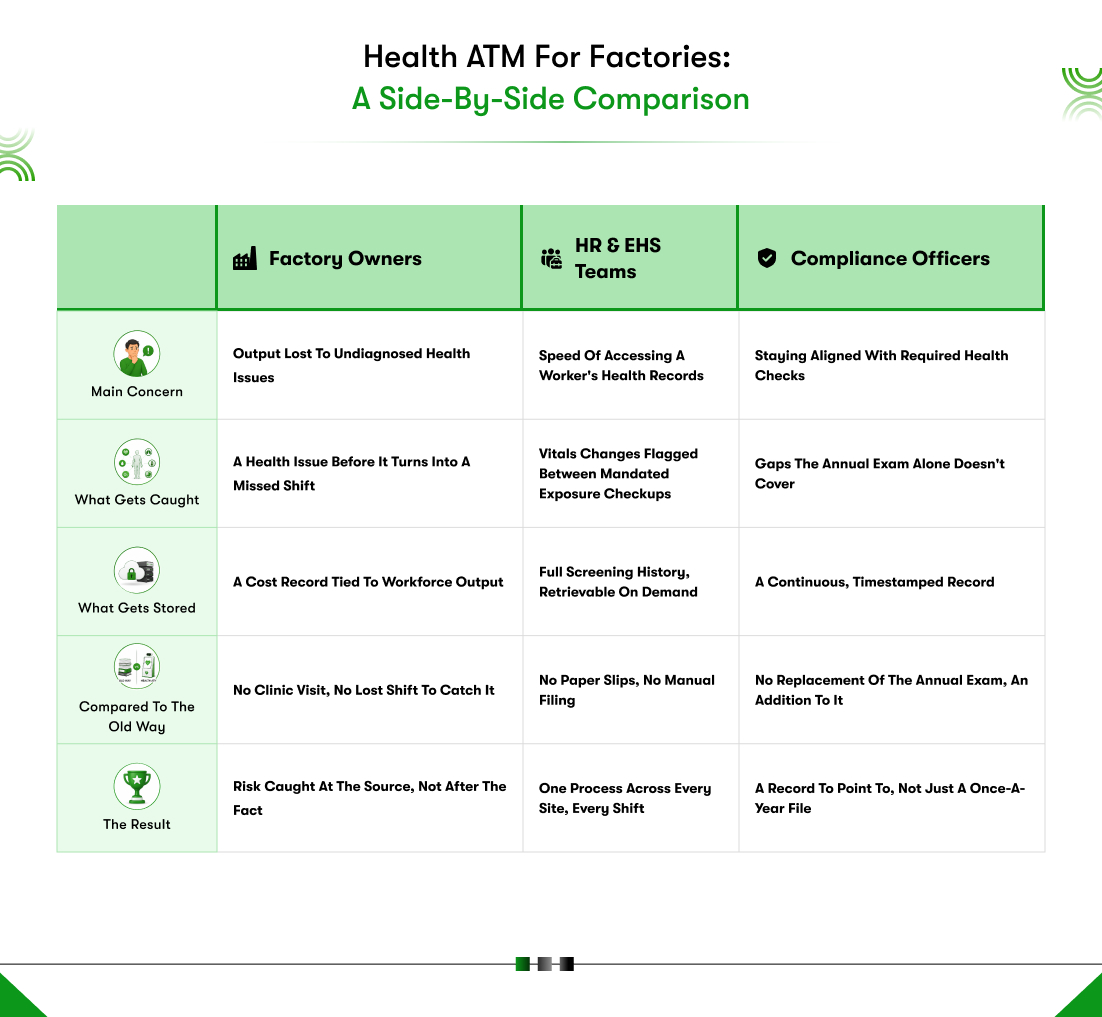
The owner asks what an undiagnosed health issue is costing the line. HR asks how fast a worker’s screening history can be pulled up. The compliance officer asks whether any of this interferes with the certifying surgeon’s exam. One Workplace Healthcare Solutions answers all three, with a different fact for each desk.
Factory Owners
- An undiagnosed health issue costs output long before it surfaces as a missed shift.
- Failing to meet health and welfare obligations under the Factories Act, 1948 can also draw penalties, fines, or factory closure, a legal exposure that sits apart from the productivity loss.
- A Health ATM for Factory Workers gives an owner a way to catch both risks at the source instead of discovering them after the fact.
- A Health ATM for Factory Workers runs on robotics healthcare infrastructure built for shift-based screening, giving an owner a way to catch both risks at the source instead of discovering them after the fact.
- Medigo gives a factory owner a way to catch both risks at the source, running on robotics healthcare infrastructure built specifically for shift-based screening environments.
HR and EHS Teams
- The law already ties exams to specific exposure: food-handling workers get checked for skin conditions, workers in hazardous processes get chest X-rays.
- Medigo’s screening sits between those exposure-specific checkups, flagging vitals changes tied to the same hazard category before the next mandated exam.
- For Industrial Health and Safety Programs running across multiple shifts, that gap coverage adds real value to the existing exam calendar.
Compliance Officers
- The certifying surgeon’s annual exam stays mandatory exactly as written; a Health ATM does not substitute for it.
- Medigo adds a continuous, timestamped record covering the months the exam doesn’t reach.
- That record gives a compliance officer more than a single annual file to point to if the factory’s health diligence ever comes under review.
The three desks don’t sign off on the same benefit. The owner signs off on the cost, HR signs off on the retrieval speed, and the compliance officer signs off on a record that doesn’t conflict with the law. Medigo, built on robotics in healthcare rather than a manual screening process, is what gets all three signatures, not because it solves one problem well, but because it solves three different problems for three different people at once.

Key Benefits of a Health ATM for Factory Workers and Workforce Health
A Health ATM in factories delivers six benefits: screening that doesn’t cost shift time, same-day results, stored health history across visits, continuous availability with no rebooking, screening categories most annual checks skip, and mental health screening in the same session.
Screening that doesn’t cost a shift
A Health ATM screening takes about three minutes and runs right on the shop floor, during a worker’s break. Because the health screening robot operates without a clinic visit, the worker never has to leave the premises, never has to book a slot weeks in advance, and finishes well before the next shift change begins.
Results the worker sees first
The report reaches the worker the same day, printed on-site or sent by WhatsApp or email, the moment the screening ends. A flagged reading gets seen immediately by the person it affects most. A camp slip can take weeks to circulate back through the same channel.
Stored health history
Health ATM for Workforce Health Management means each worker’s results are saved automatically after every screening. An EHS team can open a worker’s full history and compare results across visits, seeing exactly how a reading has changed since the last screening took place.

Continuous availability, no rebooking
A Health ATM stays installed on the factory floor and runs every shift on an ongoing basis, the same continuous model used for a Health ATM for hospitals, just adapted to shift-based factory work. New workers joining a shift or a fresh hiring batch get screened the same week they start, with no health camp date to wait for and no separate event to schedule.
Screening categories that most exams skip
A Health ATM also runs AI-assisted eye and oral health screening within the same three-minute session, covering categories that many one-time health checks leave out entirely. A worker gets a baseline reading on vision and oral health without a separate appointment for either.
Mental health screening included
The same session also includes a mental health screening, a category most workplace health initiatives skip entirely. A Deloitte survey on Indian workplaces found that roughly 80 percent of employees had experienced a mental health issue within the past year, a scale that gives a single screening question real weight.
Each of these six benefits stands on a specific, confirmed capability already running inside Medigo: shift-friendly timing, instant delivery, stored history, continuous deployment, broader screening categories, and a mental health check built into the same session, the same core capability set that powers a Health ATM for airports, just deployed for a factory’s shift pattern instead of passenger flow. None of it asks the factory to launch a new health initiative; the capability already exists, it just needs to be put to use.
How a Health ATM Works in a Factory, Step by Step
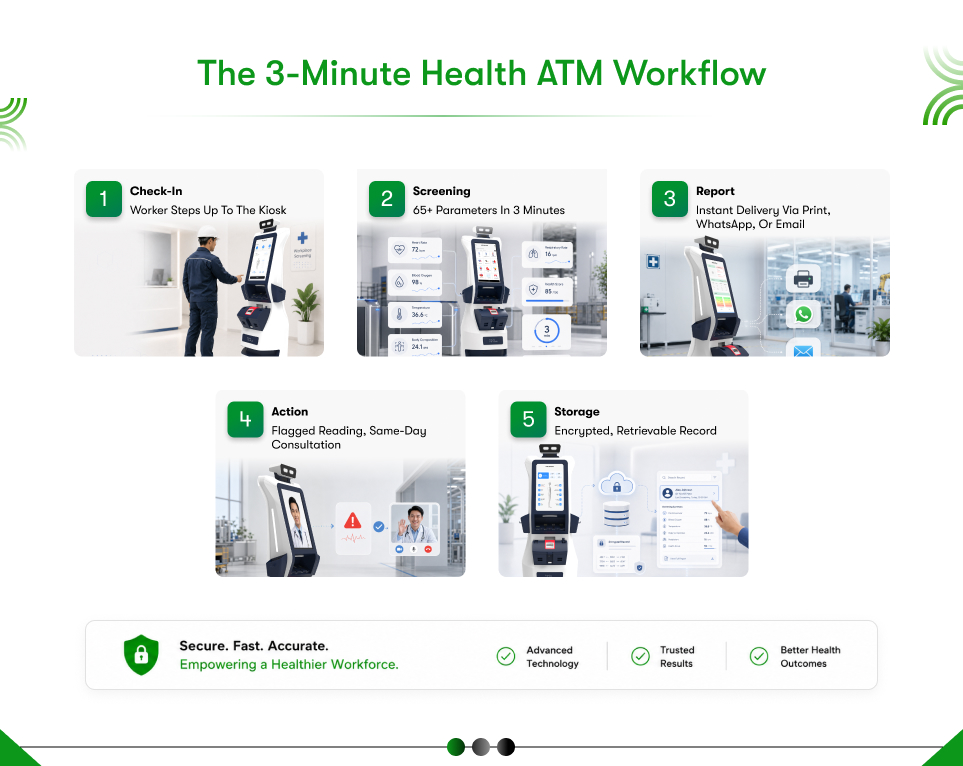
A Health ATM runs through five steps inside one session: check-in, guided screening, report delivery, action on a flagged result, and storage of the record. The entire process takes about three minutes per worker and run directly on the shop floor.

1. Check in on the floor
A worker walks up to the Medigo unit installed directly on the shop floor. There’s no appointment to book in advance and no separate room to walk to. Check-in happens wherever the unit is placed, fitting into a break between shifts rather than requiring time away from the floor.
2. Guided screening
A trained operator, typically an existing EHS or safety team member, guides the worker through a fixed sequence covering 65+ parameters: blood markers like hemoglobin and HbA1c, core diagnostics like a 6-lead ECG and spirometry, vitals like blood pressure and oxygen saturation, plus eye, oral, and mental health screening, the same parameter set deployed in a Health ATM for government healthcare programs, adapted here to a factory’s screening window. The full sequence runs in about three minutes.
3. Report delivery
Once the screening ends, the worker receives the report immediately, printed on-site, sent by WhatsApp, or emailed directly. There’s no waiting period between the screening and the result, and no separate visit is required to collect it later.
4. Action on a flagged result
If a reading comes back outside a safe range, the same session routes the worker into a video consultation. A digital prescription gets arranged the same day, so the worker leaves with a next step already in place.
5. Record storage
Every report saves automatically as an encrypted digital file tied to the worker’s identity. An EHS team can retrieve a worker’s past screenings on request, comparing results across visits without searching through paper records.
Each of these five steps happens inside the same three-minute window, with no step requiring the worker to leave the shop floor, wait for a separate appointment, or return later to collect a result. That’s how Medigo works end to end: a worker enters the process once and exits it with both an answer and a record, the same visit covering detection, delivery, and storage in full.
How Health ATM for Factories Brings a Smarter Approach to Workforce Wellness
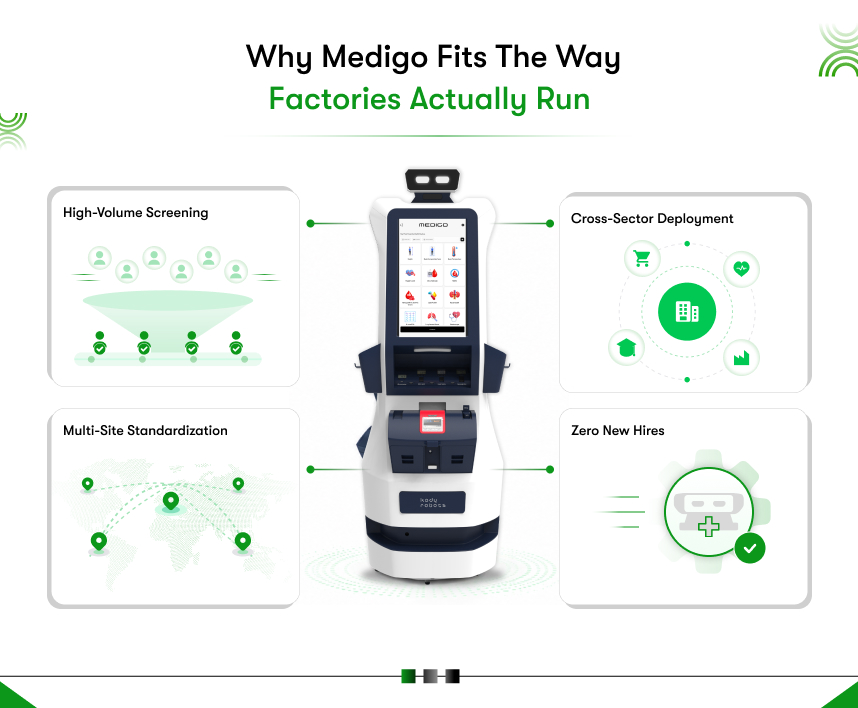
Medigo fits factory operations because it was built for the exact conditions factories operate under: high worker volume, shift-based screening windows, multiple plants, and workforces across sectors with varying exposure risks. The same design logic underpins a Health ATM for high footfall locations, a kiosk built to handle constant throughput rather than scheduled, one-at-a-time visits.

Built for shift volume, not appointment slots
Most healthcare delivery runs on individual appointments, one doctor, one patient, one slot at a time. A factory shift doesn’t work that way: hundreds of workers move through a floor inside a fixed window. Medigo was built specifically for that kind of volume, screening one worker roughly every three minutes without a backlog forming.
One workflow across different sectors
A steel plant, a textile unit, and a logistics warehouse carry different exposure risks. Medigo runs the same screening categories at all three, so a factory doesn’t need a separate health solution built for each sector. One unit fits a chemical plant as readily as a warehouse floor.
Multi-site consistency without rebuilding the setup each time
A company running five factories doesn’t need five different screening setups built independently. Medigo deploys an identical workflow, report format, and operator training at every site. An EHS team overseeing multiple locations manages one consistent process across all of them.
No dependency on hiring medical staff
A factory doesn’t need to hire a doctor at every location to run preventive screening. An existing EHS, safety, or occupational health staff member operates the unit after training, so screening capacity doesn’t depend on medical staff availability at each plant.
Each of these fit points traces back to one factor: Medigo was designed around shift volume, multiple sites, mixed exposure risk, and uneven staff availability, the same kind of constraints a Health ATM for rural communities is built to handle, where access and staffing are just as limited. That design choice is what makes a single unit usable across a 500-worker shift or a five-plant operation without asking the factory to change how it runs.
Conclusion
A factory already tracks every machine’s output to the minute. The same precision is now available for the people running those machines. A Health ATM for Factories takes workforce health out of the once-a-year checkup and puts it inside every shift, three minutes per worker, a result delivered the same day, and a flagged reading routed to a doctor before it ever turns into a missed day of work.
That’s the real value this blog has walked through: continuous screening instead of a single annual snapshot, records that an EHS team can actually retrieve, and a process built for shift volume rather than appointment slots. None of it asks a factory to change how it operates. It runs inside the existing shift pattern, at one site or across many.
Kody Technolab built Medigo specifically for this deployment, operator training, and ongoing support included, so a factory can start screening its workforce without hiring new medical staff or restructuring a single shift. The next step is seeing it on your own floor. Book a Medigo demo with Kody Technolab and find out how it fits your factory’s specific shift pattern, headcount, and sites.
FAQs
How long does it take to install a Health ATM unit at a factory?
Deployment includes the hardware, integrated screening devices, workflow software, and operator training as part of the setup. The exact installation timeline depends on the factory’s site and how many units are being deployed, which is something Kody Technolab confirms during the evaluation process for each specific location.
Who owns and manages the health data collected through Medigo?
Each worker’s screening report is saved as an encrypted digital file tied to that worker’s identity, accessible to authorized EHS or occupational health staff at the factory. The factory’s own team controls access to its workforce’s records rather than the data sitting with a third party.
Does a Health ATM replace the mandatory annual medical exam?
No. A Health ATM adds continuous screening for the months between mandatory exams. The annual exam remains a separate, required process on its own schedule.
Can a Health ATM be customized for a specific industry’s risk profile?
Medigo runs a fixed set of screening categories, including tests like spirometry and audiometry that are relevant to specific exposure types such as dust, fume, or high-noise environments. A factory in a particular sector can confirm with Kody Technolab which screening categories apply most directly to its workforce’s exposure risks.
What happens if a worker’s screening flags a serious health concern?
The same session routes the worker into a video consultation, with a digital prescription arranged the same day. The worker gets the next step immediately rather than waiting for a separate appointment to be scheduled later.
Does a factory need to hire medical staff to run a Health ATM?
No. An existing EHS, safety, or occupational health team member operates the unit after training, so screening capacity doesn’t depend on hiring a doctor or nurse at each location.
How does ongoing support work after a Health ATM is deployed?
Kody Technolab provides operator training and onboarding support as part of deployment. For specifics on maintenance schedules and ongoing technical support after installation, a factory can confirm details directly with Kody Technolab during the evaluation process.