


Blog Summary: A health risk can sit undetected inside a crowd of people for years, simply because nobody thought to check. Medigo, an AI-powered Health ATM from Kody Technolab, places full health screening directly inside these spaces, turning routine waiting time into preventive care nobody had to seek out separately.
Every hospital, airport, and factory already pays for the footfall moving through its doors. Almost none of them use it to catch a single case of the diseases quietly building inside the people who walk through. A Health ATM for high-footfall locations turns that overlooked movement into a screening opportunity without adding a single extra visit to anyone’s day.
Noncommunicable diseases such as heart disease, cancer, chronic respiratory conditions, and diabetes now account for 75% of all non-pandemic deaths worldwide, and the World Health Organization confirms that 73% of these deaths occur in low and middle-income countries. WHO names detection and screening as central to reducing this burden, yet screening has rarely been placed where people naturally spend time waiting.
The fix is not a new appointment system or a separate facility, but screening placed exactly where people already stand.
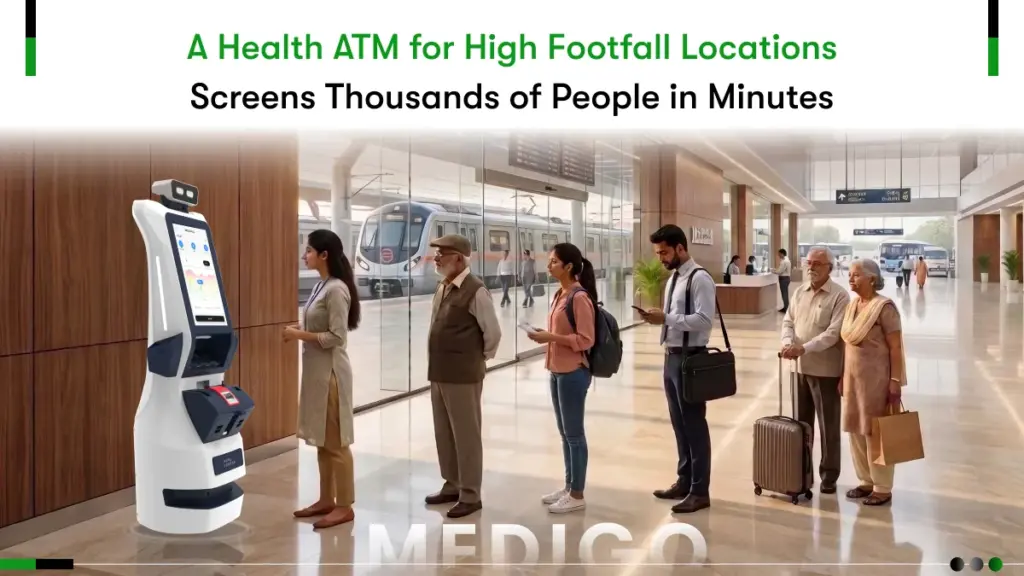
Medigo, built by Kody Technolab, is a Health ATM designed for precisely these waiting spaces, one working example of AI in healthcare deployed outside a hospital’s walls. A person standing on a platform or sitting in a hospital lobby completes a full AI-powered health screening in the same few minutes they would already be spending waiting, with no extra visit and no separate appointment required.
Key Takeaways
- A Health ATM for high footfall locations brings AI-powered health screening directly into hospitals, factories, airports, and rural centers, wherever people already gather.
- Medigo, built by Kody Technolab, screens 65+ health parameters and delivers a full report in approximately 3 minutes.
- Placement matters more than device specification: a location with consistent daily footfall creates more screening impact than a busy but occasional site.
- Beyond health outcomes, structured screening creates a documented record that strengthens liability protection and audit readiness for hospitals, factories, and transit authorities.
- Deployment requires only stable power, internet, and floor space, with Kody Technolab managing installation, integration, and staff training end to end.
What a Health ATM for High Footfall Locations Actually Does
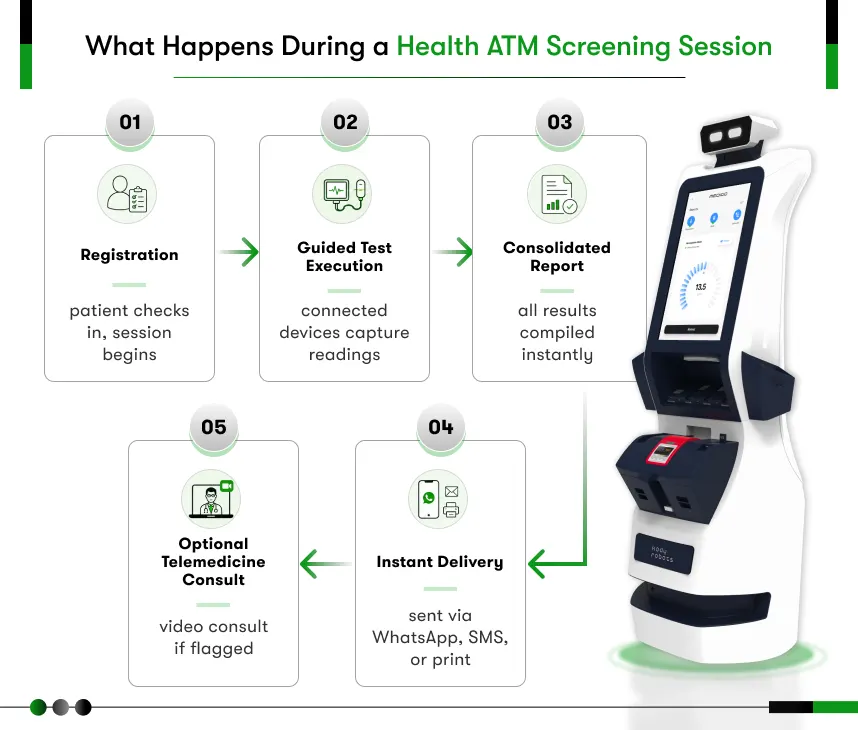
A Health ATM is a single AI-powered unit that replaces an entire diagnostic setup, the lab, the multiple devices, the multiple staff members, and the multi-day wait for results. One machine, one operator, one consolidated report.
Medigo’s Health ATM features go beyond a basic vitals check into real clinical testing. Blood markers such as hemoglobin, lipid profile, kidney function, and blood glucose are captured directly, the same panel a lab would draw blood for.
A 6-lead ECG, lung function test, hearing check, and vision test run through the same guided flow. Blood pressure, temperature, weight, and oxygen levels are recorded automatically through connected devices. AI-assisted oral health and eye screening round out the panel, alongside mental health and autism spectrum assessments, categories most digital health screening solutions skip entirely.
A full session takes approximately 3 minutes, report included. Compare that to the 24 to 72 hour wait a conventional lab requires. The report reaches the patient instantly via WhatsApp, SMS, or email, or prints on-site for anyone without digital access. If a result needs a doctor’s opinion, Medigo’s built-in telemedicine module connects the patient to a physician on video immediately, no second appointment, no second location.
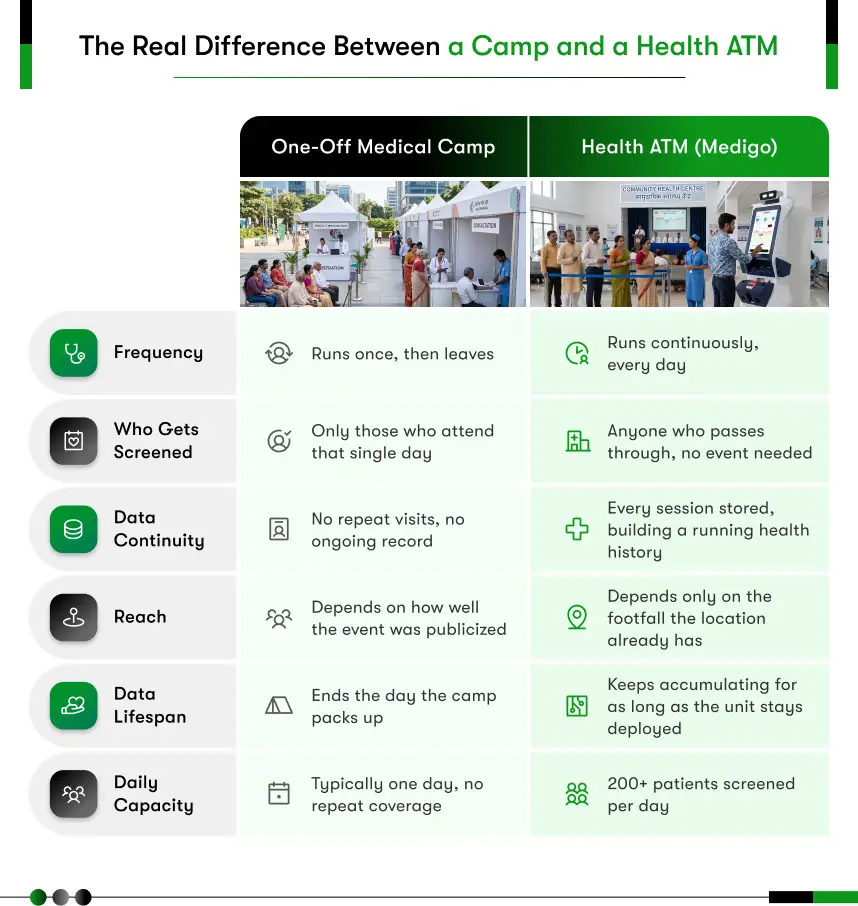
This is what separates a Health ATM in high traffic areas from a one-off medical camp. A camp screens someone once and disappears. Medigo stores every session digitally, so repeat screenings at the same hospital, factory, or health ATM for PHC deployment follow the same test flow and report format, building an actual health history instead of a single disconnected result.
Why Are High Footfall Locations the Right Place for a Health ATM?
One Medigo unit can screen more than 200 people in a single day. That number only matters because of where the unit stands. A Health ATM for high footfall areas works because it sits inside a population that is already present, already stationary for a few minutes, and already large enough to make screening worth running every day rather than once a year.
What Happens When Screening Isn’t Placed Where People Already Are?
Each high-footfall setting fails preventive health in its own specific way. A factory running three shifts loses labor hours to conditions like undiagnosed hypertension or early-stage diabetes long before anyone notices a pattern, because no one on the floor is checking for one. A airport moves thousands of daily commuters who may never visit a doctor voluntarily in a given year, simply because nothing at the station gives them a reason to.
A hospital OPD queue screens for the one complaint a patient walked in with, and stops there, missing every other condition sitting quietly in the same person.
Three different locations, three different blind spots, one shared cause: screening never reached the room they were already standing in.

Where Does a Health ATM for Public Health Access Make the Most Difference?
Government-run health centers, factory floors, and transit hubs concentrate exactly the population early detection is built to protect: working adults with limited time for a separate clinic visit, travelers under physical strain, and patients already inside a healthcare setting who came in for something else entirely.
Placing a robotics healthcare infrastructure for public health access inside these locations turns a passive crowd into an active screening population, without asking anyone to change their day to get checked.
Does Screening Placement Scale With Footfall?
Yes, directly. A location moving 50 people a day gains a health resource. A location moving 2,000 people a day gains health infrastructure, screening data across a population large enough to reveal patterns a single clinic would never see. The unit does not change. What changes is the size of the population it now protects, which is why deployment location, not device specification, is the decision that determines how much impact a Health ATM actually delivers.
For any hospital, factory, or transit authority deciding where a Health ATM for high footfall areas belongs, the answer is not the busiest single day. The right location is the one with the most consistent daily flow, the platform, floor, or waiting hall that people pass through as a routine. That consistency is what separates effective robotics in healthcare from a device that simply sits unused, turning a single screening into a running health record.
How a Health ATM for Preventive Healthcare Works Across Different Verticals
Placement determines who gets reached. Once Medigo, a health screening robot built for exactly this kind of deployment, is running inside a specific type of location, the question becomes what that screening needs to accomplish there. The technology stays identical everywhere it goes. What shifts is which conditions matter most, who reviews the data, and what decision the results are meant to support.
Hospitals and Healthcare Networks
A health ATM for hospitals works best positioned ahead of the OPD queue, not inside it. A patient waiting to see a doctor completes vitals, ECG, and blood markers before the consultation even starts, so the physician opens the appointment already holding data instead of spending the first five minutes gathering it. This does not replace clinical diagnosis. It removes the repetitive intake work that currently eats into consultation time on every single visit.
Factories and Industrial Workforces
On a factory floor, the same screening answers a different question: is this workforce fit to keep running the shift it is on? Hypertension, blood sugar, and lung function all carry direct safety implications on a production line, an undiagnosed cardiac risk factor does not stay a private health matter once it becomes a floor incident. Placed at a shift change point, Medigo turns a mandatory clock-in moment into a recurring fitness check, without adding a single extra minute, most workers would notice.
Railway Stations and Airports
Transit hubs carry a population that almost never volunteers for screening on its own, commuters and travelers moving through on a fixed schedule with no built-in reason to think about their health that day. A health ATM for airports and railway platforms works differently: placed directly in the terminal or on the platform, Medigo does not ask anyone to make time. The screening simply uses time that was already being spent waiting.
Rural and Community Health Centers
In rural deployments, the same unit solves a supply problem rather than a convenience problem. A single Medigo installation gives a village health center diagnostic capacity that would otherwise require a fully staffed lab and a specialist rotation, neither the population size nor the budget can support. A health ATM for government healthcare programs does its most direct public health work exactly here, closing a gap that has nothing to do with awareness and everything to do with access. This is precisely why a Health ATM for high footfall locations belongs in the public health toolkit.
| Vertical | Where It’s Placed | Who Benefits Most |
| Hospitals & Healthcare Networks | Ahead of the OPD queue | Physicians, who start consultations with data already in hand |
| Factories & Industrial Workforces | Shift-change checkpoints | Safety officers, who catch risk before it becomes a floor incident |
| Railway Stations & Airports | Platforms and terminals | Commuters and travelers who would never book a checkup on their own |
| Rural & Community Health Centers | Standalone installation | Villages with no lab, no specialist rotation, and no other diagnostic option |
Medigo, built by Kody Technolab, is what makes running the same unit across all four settings possible without four different systems to manage. One test flow, one report format, one data structure, regardless of whether the unit sits in a hospital corridor or a village panchayat.

What Does a Health ATM Actually Cost a Business to Not Have?
A single undiagnosed cardiac event on a factory floor costs more than the screening that would have caught it, in lost production hours, in the liability review that follows, and in the disruption to every worker who saw it happen. A single missed hypertension case in a transit workforce shows up later as a driver fitness failure during an audit, not as a health record anyone can produce. Preventive healthcare solutions carry a visible, upfront cost. Skipping them costs more later, usually at a worse time and a higher price.
Does Preventive Screening Reduce Liability, or Just Health Risk?
Both, and for a CTO or facility owner, that distinction matters. A documented, repeatable screening program gives an organization something a one-off camp never produces: a paper trail. When an insurer, auditor, or regulator asks whether a workforce’s fitness was monitored, “we ran a camp two years ago” is a different answer than a digital record showing structured screening on a defined schedule. Medigo’s stored reports and screening history exist specifically to answer that question when it gets asked.
What Does Preventive Screening Mean for Workforce and Footfall Productivity?
A factory does not need every worker screened to see a return, it needs the small percentage carrying undiagnosed risk identified before that risk becomes downtime. A hospital does not need every OPD patient to have a hidden condition, it needs the physician’s first five minutes spent on the actual complaint instead of gathering vitals manually. A transit authority that never had visibility into workforce health gains a usable dataset the moment it runs health screening in public places instead of relying on assumption.
Does Preventive Screening Create a Differentiation Advantage?
Yes, and it is one that competitors cannot claim by simply announcing intent. A hospital offering OPD pre-screening looks different to a patient than one that doesn’t. A factory that can show a documented wellness program looks different to an insurer, a certifying body, or a prospective employee than one that cannot. A government health center running structured screening looks different to the district it serves than one relying on annual camps. None of this requires new headcount, new real estate, or a new department. It requires one unit, placed correctly, running continuously.
For an owner or CTO evaluating this as a business decision rather than a wellness initiative, the calculation is straightforward: one machine, one placement decision, and a return that shows up as reduced liability exposure, protected productivity, and a visible point of difference competitors cannot copy overnight.
What Does It Take to Install a Health ATM On-Site?
Deployment does not require construction or a dedicated room. Medigo needs stable power, a working internet connection, and enough floor space for a single kiosk, roughly the footprint of a vending machine. That is the entire physical requirement. There is no lab to build, no separate diagnostic room to carve out of an existing facility, and no specialized medical staff to hire, since one trained operator manages the full session from registration to report.
What Happens Before the Unit Goes Live?
Before installation, a site needs its network configured for secure data transmission, user and administrator accounts set up, and, where relevant, its integration requirements finalized if the deployment connects to an existing Hospital Information System, EMR, or Laboratory Information Management System. None of this falls on the deploying organization to figure out alone. Kody Technolab’s team manages installation, device configuration, software setup, system testing, and staff training directly, so the unit arrives operational rather than requiring in-house technical setup.
What If the Location Has Unreliable Internet?
Rural and low-connectivity deployments hold up in practice, not just on paper, because of Medigo’s offline-capable architecture. Screening data stores locally when connectivity drops and syncs automatically once the connection returns. A village health center with intermittent network access loses nothing, screenings continue, and records catch up the moment signal is restored.
To know how a health ATM works, read our blog on how Medigo runs 65+ health screenings through connected diagnostic devices and delivers a consolidated report within minutes.
How Long Before a Health ATM Is Actually Running?
Once site requirements are confirmed, the Kody Technolab team handles the remaining steps end to end, installation, configuration, testing, and staff training, with the goal of minimal disruption to whatever is already operating at that location. A hospital corridor, a factory floor, or a airport does not need to pause normal operations to accommodate the process.
None of this requires the deploying organization to become an expert in the technology first. A digital health screening solution built for high footfall environments is designed to arrive ready to run, with the technical burden sitting on Kody Technolab, not on the hospital, factory, or transit authority hosting it.

Bring Screening to Where Your People Already Are
The case for a Health ATM rests on more than one argument. A hospital OPD queue gets faster once vitals are captured before the consultation starts. A factory floor catches what an annual camp misses through shift-change screening. A railway platform gets thousands of commuters checked without a single appointment booked. A rural health center gains diagnostic capacity it could never staff on its own.
Covering that population does not mean expanding the facility or hiring a specialized team. One Medigo unit, built by Kody Technolab, placed where footfall already exists and running continuously instead of occasionally, is enough.
For an organization deciding whether this belongs at their site, the strongest argument is the simplest one. The population that needs reaching is not somewhere else, it is already walking through your doors, every day, waiting for something that has not been offered to them yet.
If your hospital, facility, or organization sees where a Health ATM for high footfall locations fits, the next step is a direct conversation with Kody Technolab’s team about what deployment looks like at your specific site.
Frequently Asked Questions
How much does a Health ATM cost to deploy?
Cost depends on configuration: the specific test packages selected, whether telemedicine integration is included, and the scale of deployment across one site or multiple locations. Kody Technolab provides a tailored quote based on the exact use case rather than a fixed price, since a factory running shift-change screening and a government health center running population-scale screening have different requirements.
Does staff need medical training to operate a Health ATM?
No. Medigo is designed to run with one trained operator managing the full session, from registration to report. No specialized medical staff, lab technician, or nursing qualification is required to operate the unit day to day. Kody Technolab handles operator training as part of the installation process.
Can the screening package be customized for a specific site?
Yes. Medigo’s screening catalog is configurable, meaning an organization can select which tests run as part of its standard package. A factory focused on occupational fitness may prioritize a different test combination than a government health center running population-level NCD screening.
What happens if a screening flags a serious condition?
Medigo’s built-in telemedicine module connects the patient to a physician over video immediately, within the same session, for real-time guidance and digital prescription issuance. For conditions requiring further evaluation, the patient can be referred to a qualified healthcare provider using the consolidated report already generated.
How is patient data kept secure?
Access to any screening session requires secure operator login, and all stored reports are encrypted. Data collected on-site transmits securely to a centralized institutional or government dashboard when connected, and stores locally with automatic sync if the connection is temporarily unavailable.
Can a Health ATM connect with our existing hospital or HR systems?
Yes. Medigo is built to integrate with Hospital Information Systems, Electronic Medical Records, Laboratory Information Management Systems, telemedicine platforms, and corporate health management systems through secure APIs, so screening data can feed directly into records an organization already maintains.
Is a Health ATM only useful for one-time screening, or can it track health over time?
Every screening session is stored digitally, so repeat visits build an ongoing record rather than a single disconnected result. Patients can also access their own screening history through login credentials, which supports follow-up tracking rather than a one-time snapshot.