


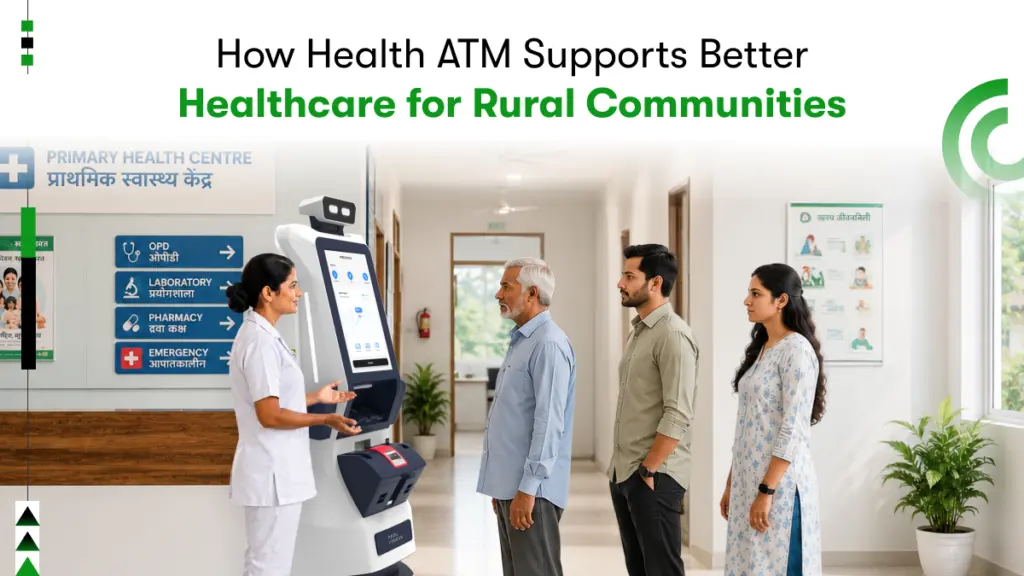
Summary: Discover how a Health ATM for rural communities can bridge critical healthcare gaps by bringing essential screening, instant diagnostics, digital health records, telemedicine support, and multilingual access closer to the people who need it most. The blog explores the real challenges rural populations face, how Medigo Health ATM addresses them, and why it is becoming a practical solution for improving access, early detection, and preventive healthcare in underserved areas.
Introduction
Millions of families in rural India delay a doctor visit simply because the nearest clinic is hours away. What we call a simple routine checkup, for rural families, often means arranging transport, losing a day’s wages, and spending money many households cannot spare.
As a result, minor symptoms are ignored, preventive screenings are missed, and illnesses are often diagnosed only after they become serious. Even for the individuals who make the journey, timely medical care isn’t guaranteed due to the shortage of healthcare resources. According to the State of Healthcare in Rural India 2024 report by Transform Rural India, the doctor-patient ratio in India stands at roughly 1:1,456, and the gap runs deeper in villages and remote blocks.
A Health ATM for rural communities helps bridge this gap by bringing screening, diagnostics, and doctor consultations to a single point closer to home. Medigo makes this possible through an affordable, technology-enabled healthcare solution that improves timely access to quality care for underserved communities.
What Is an AI Health ATM?
An AI Health ATM is a digital healthcare infrastructure built for screening, diagnostics, and remote doctor access, all inside one compact unit. A patient walks up to the machine, follows a guided checkup, and receives readings on vitals and common health parameters within minutes. The Health ATM for Rural Communities works like a self-service health point, similar in concept to a banking ATM, except the output is a health report instead of cash.
Artificial intelligence powers the experience behind the screen. Medigo, a health ATM, guides each checkup step by step, analyzes the readings collected, and offers decision support that flags risks early. A doctor can review the same data during a teleconsultation, so the machine supports diagnosis rather than replacing the doctor’s judgment. The combination of screening, data analysis, and remote access separates a Health ATM from a standard health camp or manual checkup.
Why Rural Communities Need AI Health ATMs?
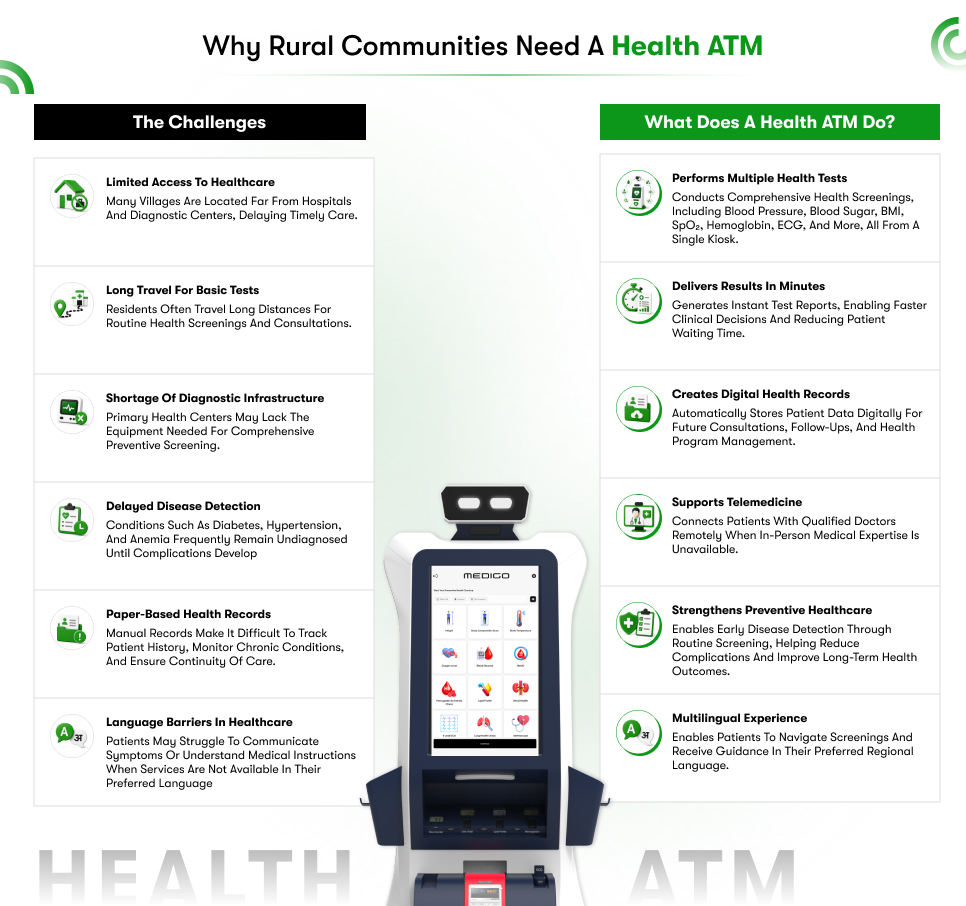
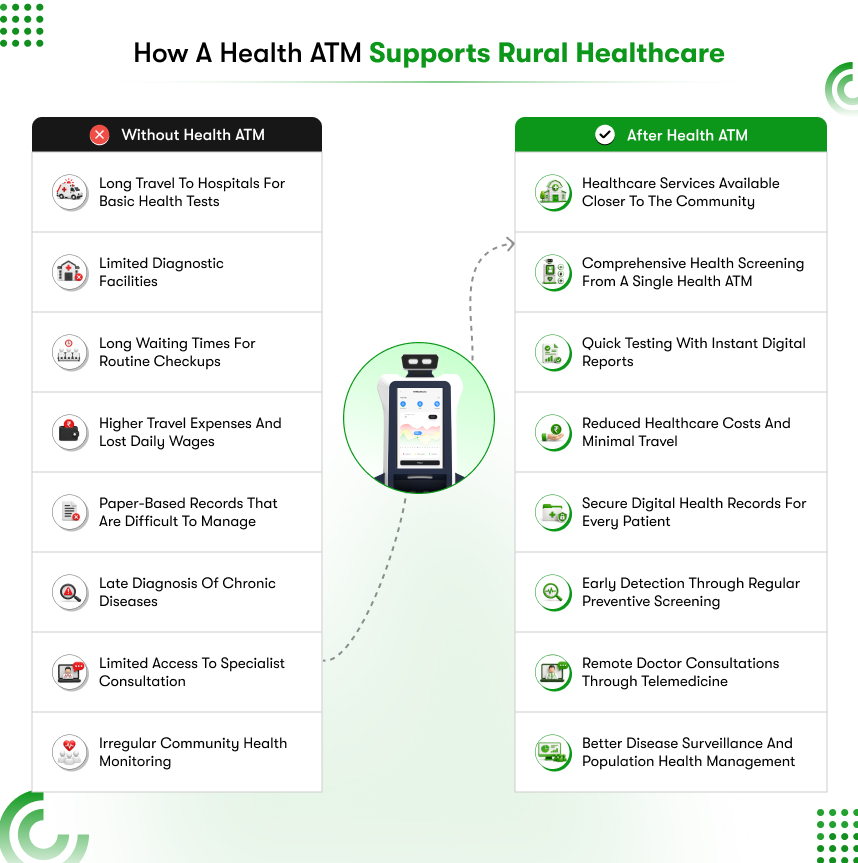
Rural India carries the weight of a healthcare gap that shows up in daily life and leaves a lasting impact when we talk about healthcare. Every missed checkup, every delayed diagnosis, and every long journey to a hospital adds up to real hardship for families who simply have fewer options nearby. A Health ATM for Rural India addresses several of these pain points at once.

Limited Doctors and Specialists
Rural Primary Health Centers often run with a fraction of the staff they need. Specialists like cardiologists, gynecologists, and pediatricians are rarely available on site, so patients either wait weeks for a visiting doctor or skip the consultation altogether. Families in these regions often make peace with going without expert care, simply because expert care rarely reaches them. A Health ATM for Rural Communities fills this gap by connecting patients to a doctor through teleconsultation the same day.
Long Travel Distances to Hospitals
Many villagers travel over 50 to 100 kilometers to reach a hospital with basic diagnostic equipment. The journey costs money, takes a full day, and often means a daily-wage worker loses a full day of income. For an elderly patient or a parent traveling with a sick child, that distance alone can be the reason a checkup gets postponed indefinitely. Bringing a health screening robot closer to the village turns a full-day trip into a short walk.
Language Barriers in Multilingual Regions
Rural communities need AI Health ATMs because language-specific barriers often prevent people from clearly explaining symptoms or understanding medical advice, especially in multilingual regions. A patient who struggles to describe pain in Hindi or English may go undiagnosed simply because the consultation never reached the actual problem. Medical terms rarely translate cleanly across regional dialects, leaving patients with limited healthcare accessibility in rural areas even when a clinic is technically nearby.
Delayed Diagnosis and Treatment
Without nearby screening, minor symptoms often go unchecked until the condition worsens. A cough that could have been caught early turns into a respiratory infection requiring hospitalization. By the time a patient finally reaches a hospital, a manageable issue can turn into an emergency that costs more money and more time to treat.
Higher Risk for Untreated Chronic Conditions
Diabetes, hypertension, and heart disease need regular monitoring, as these health conditions get serious over time when left untreated or undiagnosed. Rural patients with chronic conditions frequently miss follow-ups because reaching a clinic every month is not practical, and inconsistent monitoring raises the risk of complications like stroke, kidney damage, or vision loss over time.
Lower Healthcare Awareness and Inconsistent Monitoring
Health literacy remains low in many rural pockets, and monitoring stays inconsistent without a fixed touchpoint that patients can visit routinely. A Health ATM for Rural Communities gives villages that touchpoint, encouraging routine checkups instead of reactive visits after symptoms turn serious.
How an AI Health ATM for Rural Communities Works?
A Health ATM for Rural Health Screening follows a simple, guided sequence designed for people with no medical background and no prior experience with digital health tools.
- Walk-in and guided checkup: The patient walks up to the kiosk and follows on-screen instructions that guide the entire checkup independently, with no assistance required from clinic staff.
- Vitals and readings: The machine captures vitals such as blood pressure, oxygen saturation, blood glucose, and other basic health readings using built-in sensors.
- Multilingual interaction: AI Health ATMs break the language barrier by offering multilingual interaction, making the checkup process easier for people who are more comfortable in their local language than in Hindi or English.
- AI-assisted interpretation: AI in healthcare helps interpret the readings collected during the checkup and flags any values that fall outside a healthy range for further review.
- Consolidated report: Medigo improves time efficiency by providing a consolidated health report in approximately 3 minutes, helping users get quick, clear results without long waiting periods or repeat visits.
- Teleconsultation: Patients can connect with a doctor through teleconsultation for guidance on the next step, whether that means medication, a follow-up test, or a hospital referral.
- Data storage: Health data gets stored securely for future visits, so follow-up checkups can track progress over time and give doctors a clearer history to work from.
This guided flow means a patient with no digital literacy can complete a full health screening independently, while a doctor still stays involved at the point that actually needs medical judgment. The entire experience is built to feel less like operating a machine and more like a short, supported conversation about personal health.
What are the Key Benefits of a Health ATM for Rural Communities?
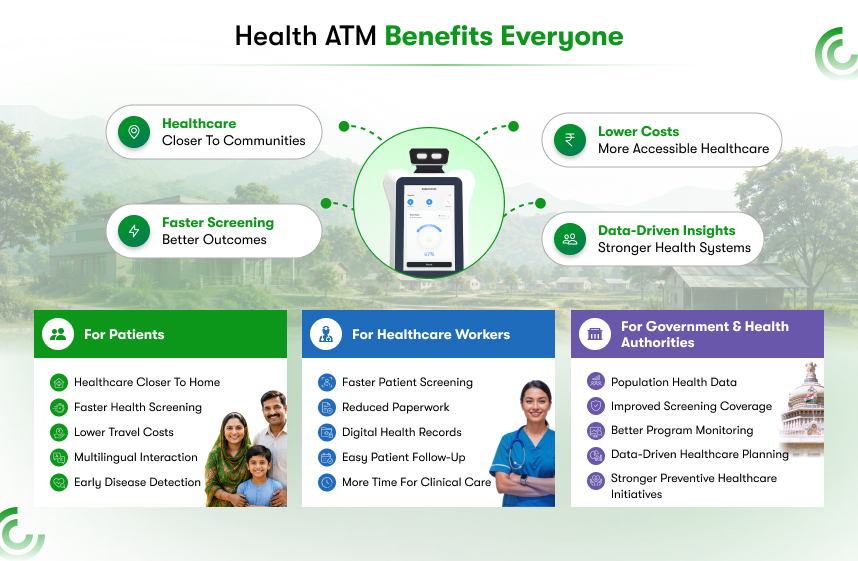
A Health ATM for Rural Communities delivers measurable value where healthcare accessibility in rural areas has historically been weakest. The benefits below show up in patient outcomes and convenience, which compounds over repeated visits.

Faster access to primary care:
Patients get screened and guided within minutes instead of waiting weeks for a visiting doctor to arrive at the local health center.
Early detection of common health issues:
Routine screening catches problems like high blood pressure or elevated blood sugar before they escalate into a medical emergency that needs hospitalization.
Reduced travel costs and waiting time:
Villagers save on transport, lost wages, and the time spent traveling to distant hospitals for a checkup that could happen closer to home.
Better chronic disease monitoring:
Regular, nearby checkups make it easier for patients with diabetes or hypertension to stay on track with treatment and catch warning signs early, rather than discovering complications during a hospital emergency.
Improved reach in villages, PHCs, and remote locations:
A Health ATM for Rural India extends care to Primary Health Centers and pockets that hospitals and specialist doctors rarely reach on a consistent basis.
Consistent records for follow-up care:
Stored health data gives doctors and health workers a running history instead of a single disconnected visit, making repeat consultations more useful.
A repeatable model for screening drives:
A Health ATM for Rural Health Screening gives NGOs and government programs a consistent format to run across multiple villages instead of one-off health camps.
Together, these benefits build a healthcare system for rural areas that responds to patients where they already live, rather than asking families to travel toward care that stays out of reach. Over time, consistent screening also strengthens Healthcare Infrastructure in Rural Areas by giving public health workers a steady stream of health data to plan around, instead of scattered records from occasional health camps. For public health teams evaluating Rural Healthcare Solutions, this steady data stream is often as valuable as the screening itself.

What Makes AI Better Than a Traditional Health Kiosk?
A traditional health kiosk measures basic vitals and stops there, leaving patients to interpret readings on their own without any medical context. An AI-driven Health ATM for Rural Communities goes several steps further, turning raw numbers into something a patient and a doctor can actually act on.
- Smarter symptom guidance: The system asks relevant follow-up questions based on the readings collected, rather than offering a static checklist that treats every patient the same way regardless of history.
- Automated triage: Cases get sorted by urgency automatically, so a patient with concerning readings gets flagged for immediate teleconsultation instead of waiting in a general queue behind lower-priority cases.
- Better data analysis: Patterns across vitals get analyzed together instead of viewed as isolated numbers, giving doctors sharper context on what a patient’s readings actually mean over time.
- Personalized health recommendations: Guidance reflects the specific patient’s readings, age, and history instead of generic advice that applies to everyone equally.
- Scalable deployment across multiple locations: Robotics Healthcare Infrastructure allows the same intelligence to run consistently across hundreds of kiosks, whether the deployment covers a single village or an entire district.
A traditional kiosk asks a patient to carry the readings to a doctor separately. A Health ATM for Rural Communities brings the analysis, the triage, and often the doctor consultation itself into one visit, cutting out the extra steps that used to fall entirely on the patient. This is the gap that most Healthcare Technology for Rural Communities still needs to close.

Where AI Health ATMs Can Be Deployed?
Healthcare Infrastructure in Rural Areas depends on placing screening points where people already gather, rather than asking villagers to travel to a new, unfamiliar location. A Health ATM for Rural Communities fits naturally into several settings:
- Village centers: Central locations where residents already visit for daily errands, making a health checkup part of an existing routine rather than an extra trip.
- Primary health centers: A Health ATM for PHC adds screening capacity without needing additional doctors on staff, supporting the existing team instead of replacing it.
- Panchayat offices: Local governance hubs that villagers trust and visit regularly for other administrative needs, which makes a nearby health checkup feel familiar rather than intimidating.
- Schools and community hubs: Locations that support both student health checks and family screenings during the same visit, extending reach to entire households.
- Industrial rural clusters or CSR healthcare projects: Worksites and CSR-funded health drives that need reliable, repeatable screening across a shifting workforce, often across multiple sites at once.
Each of these locations shares one advantage: people are already there for another reason, so the health checkup becomes a natural addition to daily life rather than a separate errand that competes for their time.
Introducing Medigo, a Health ATM for Rural Communities
Medigo is an AI Health ATM designed to make Healthcare in Rural India more accessible, practical, and consistent for the people who need it most. Rather than replacing the doctors and health workers already serving these communities, Medigo works as an extended arm for the team, handling screening and data collection so healthcare workers can spend more time on care and follow-up instead of paperwork.
What Medigo Offers
In plain terms, Medigo brings guided checkups, screening, diagnostics, and remote doctor support into a single kiosk, so a patient does not need separate facilities for each step. Health ATM Features built into the system include:
- Broad screening coverage: Over 65 health parameters screened in a single visit, covering common vitals and chronic-condition indicators.
- Multilingual interaction: Regional language support so patients can complete the checkup in the language they are most comfortable using.
- Fast, consolidated reporting: A full health report generated in approximately 3 minutes, so patients leave with clear results instead of waiting days for a lab callback.
- Automated triage: Readings that need urgent attention get flagged automatically, so a patient is not left to interpret risk alone.
- Teleconsultation access: A direct line to a doctor built into the same visit, rather than a separate referral process.
- Offline functionality: The kiosk can run a full checkup even without an active internet connection, storing the readings locally and syncing the data automatically once connectivity is restored. This matters most in villages with unreliable power or network coverage, where waiting for a signal should never stand in the way of a checkup.
How the Checkup Flow Comes Together
How Medigo Works follows the same guided sequence described earlier in this blog, from walk-in to teleconsultation to stored records, built specifically for rural deployment conditions like inconsistent connectivity and low digital literacy.
Who Medigo Is Built For?
Medigo is positioned as a practical rural healthcare solution for communities, healthcare providers, NGOs, and public health initiatives working across Healthcare Infrastructure in Rural Areas. The tone stays outcome-driven: fewer missed diagnoses, shorter wait times, and a healthcare system for rural areas that keeps pace with patient needs instead of falling behind them.
Medigo also supports Health ATM for government healthcare programs, giving public health teams a consistent screening layer across large geographies without adding permanent staff at every single location, which matters for programs working within tight budgets and wide coverage areas.
Who Can Benefit from Medigo
Medigo serves a wide range of users across the rural healthcare ecosystem, each with a different reason to rely on it day to day.
- Rural residents: Get screening and doctor access without traveling to a distant hospital for a checkup that could take a few minutes locally, freeing up an entire day for work or family responsibilities.
- Elderly patients: Benefit from simple, guided checkups that do not require navigating complex hospital systems, long queues, or unfamiliar paperwork.
- People managing diabetes, BP, or other chronic conditions: Get consistent monitoring closer to home, making it easier to stick with a treatment plan instead of skipping follow-ups.
- Local clinics and healthcare workers: Gain a screening tool that supports their existing workload rather than adding to it, freeing up time for patients who need direct medical attention and hands-on care.
- NGOs, CSR teams, and public health programs: Deploy a reliable Healthcare Technology for Rural Communities solution across multiple sites with consistent reporting and centralized data that supports program-level planning.
- Airports: Health ATM for airports to enable quick passenger health screening and help in early detection and geo-level infection prevention to reduce spread of contagious diseases.
What are the Challenges and Future Scope of Adapting Health ATMs?
Deploying AI Health ATMs across rural India consists of many challenges, and closing the healthcare accessibility gap in rural areas at scale requires planning around real, on-the-ground constraints.
Current Challenges
- Inconsistent connectivity: Teleconsultation depends on stable internet access that some remote blocks still lack, which can delay the doctor-facing part of a checkup.
- Building trust: Many rural residents are more comfortable with a familiar face than a screen, so community outreach and local health worker involvement matter as much as the technology itself.
- Power and maintenance: Reliable electricity and routine servicing need continuous attention as deployment scales beyond a pilot phase.
Future Scope
- Alignment with government health missions: Health ATM for Rural India adoption is likely to grow alongside government health mission targets and low-cost screening priorities.
- Deeper government integration: Integration with existing government health databases and tighter coordination with ASHA workers and PHC staff represent the next phase of this rollout.
- Growth into adjacent settings: Robotics in Healthcare is still an emerging space in India, and rural deployment is likely to be one of the fastest-growing areas, alongside adjacent use cases like a health ATM for hospitals managing outpatient overflow or a health ATM for airports handling routine traveler screening.
- Standardization across public health programs: As these use cases mature, Rural Healthcare Solutions built around AI screening are likely to become a standard part of public health planning rather than a pilot project.

Conclusion
A Health ATM for Rural Communities can bridge the gap between where patients live and where healthcare has historically been available. Medigo brings this idea into practice as a modern, accessible entry point for screening, diagnostics, and doctor access, built for villages, PHCs, and community hubs rather than city hospitals alone. Rural healthcare is heading toward something simpler and closer: checkups that respond faster and include more people in routine care.
Kody Technolab has spent over a decade solving healthcare access problems for several organizations, including underserved communities, and this experience shapes how carefully Medigo gets deployed on the ground. If your organization is exploring a Health ATM for Rural Communities as part of its healthcare infrastructure, reach out to us, and we will help you plan a deployment suited to your community and your program.