Quick Summary: Computer vision examples sound great in sales demos, but most projects stall when reality hits production floors. This guide breaks down where vision actually cuts costs and where it just adds complexity nobody asked for. You get straight answers on testing vendor accuracy claims, running pilots that reveal problems early, and writing contracts that protect you when systems underperform. By the end, you’ll stop guessing and start evaluating based on what works in messy real environments, not controlled lab setups
Your operations generate thousands of images daily through production cameras, security systems, and document scanners. Manual review cannot keep up with the volume your cameras capture: inspectors check 50 products hourly, while lines output 500 units. The gap allows defects to reach customers and creates expensive recalls that damage margins and reputation. Security teams discover incidents hours after they occur because humans cannot maintain focus on multiple video feeds simultaneously. Document processors spend minutes extracting data from each scanned form, while errors accumulate and payment cycles drag on unnecessarily.
Most computer vision examples remain unanalyzed despite containing insights that prevent quality failures and operational bottlenecks. Computer vision applications address blind spots that spreadsheets cannot measure by processing millions of frames to identify patterns humans miss. Factories reduce scrap rates, hospitals accelerate diagnoses, and warehouses eliminate sorting errors through automated visual analysis. Understanding how computer vision works starts with recognizing the cost of leaving visual data unprocessed. A comprehensive Computer Vision Development guide helps teams evaluate where automation delivers measurable returns versus where manual processes remain more practical for current operational scale.
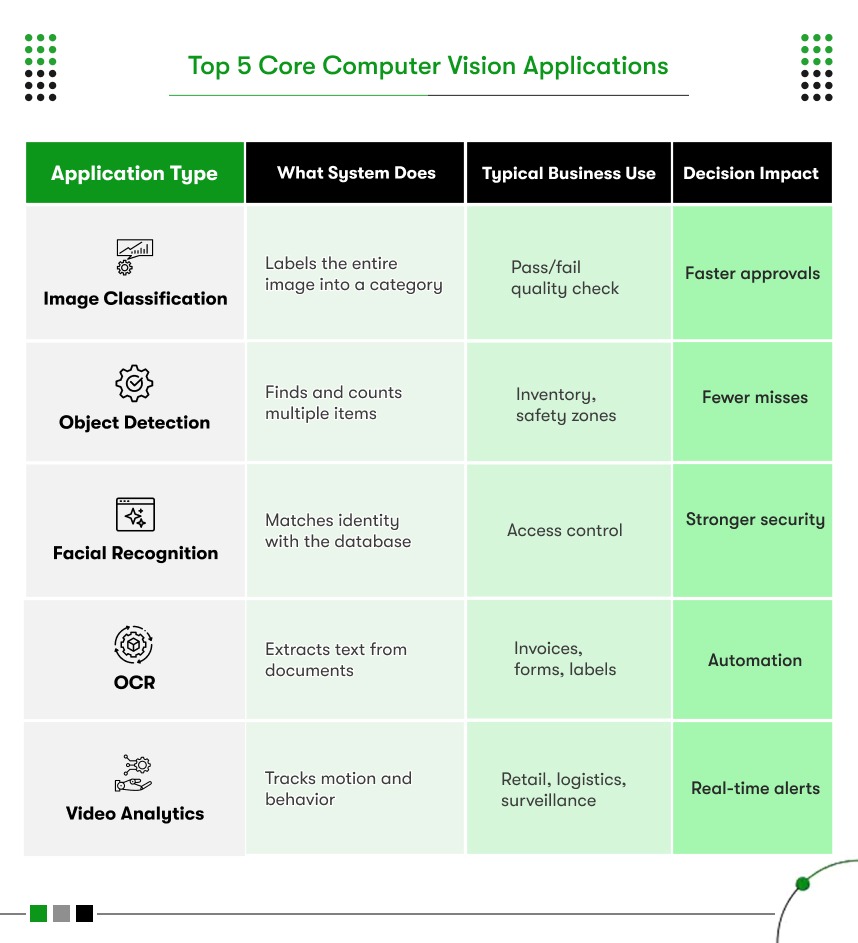
Core Types of Computer Vision Applications
Visual intelligence operates through distinct technical approaches that solve specific business problems across different operational contexts. Understanding which type matches your workflow determines whether automation delivers measurable returns or creates integration complexity without value.
2.1 Image Classification
Image classification assigns visual inputs to predefined categories based on learned patterns in training datasets. A system trained to distinguish between defective and acceptable products automatically categorizes each unit that passes inspection checkpoints. Manufacturing quality control uses classification to separate conforming parts from rejects before packaging occurs. Compliance monitoring uses classification to verify the presence of protective equipment on factory floors without requiring manual supervisor rounds. Agricultural operations classify crop health status from drone imagery to prioritize field intervention schedules. Classification works best when categories remain stable and visual differences between classes appear consistently across imaging conditions.
2.2 Object Detection
Object detection locates and identifies multiple items within a single image or video frame simultaneously. Warehouse systems detect package types, positions, and orientations to guide robotic sorting arms toward correct conveyor destinations. Retail loss prevention detects unscanned items leaving checkout zones to trigger staff alerts before theft occurs. Construction safety monitoring detects workers entering restricted zones without proper clearance, helping prevent accidents. Traffic management detects vehicle types and counts at intersections to optimize signal timing based on actual flow. Detection systems process complex scenes in which multiple objects require simultaneous tracking, and positional accuracy is critical for downstream automation.
2.3 Facial Recognition
Facial recognition matches captured facial features against stored biometric templates to verify individual identity. Access control systems grant building entry only when recognized faces match authorized personnel databases. Time tracking eliminates badge fraud by confirming actual employee presence rather than accepting credential transfers. Patient identification in healthcare helps prevent medication errors by matching faces to treatment records before procedures begin. Banking fraud prevention flags account access attempts when facial biometrics fail to match registered account holders. Recognition accuracy depends on lighting consistency, camera positioning, and database quality maintenance across enrollment and verification scenarios.
2.4 Optical Character Recognition
Optical character recognition extracts text from images and scanned documents to enable searchability and automated data entry. Invoice processing extracts vendor names, amounts, and dates from scanned bills to populate accounting systems without manual data entry. Shipping label recognition routes packages based on extracted destination codes, without requiring a barcode. License plate recognition automates parking access and toll collection without stopping vehicles for manual verification. Medical record digitization converts handwritten notes into searchable electronic health records, improving care coordination. A Computer Vision Software Development Company implements OCR when document volume exceeds manual processing capacity, and text standardization enables downstream workflow automation.
2.5 Video Analytics
Video analytics processes continuous footage to detect motion patterns, behavioral anomalies, and temporal trends across surveillance environments. Retail analytics tracks customer paths through stores to identify high-traffic zones and optimize product placement strategies. Manufacturing monitors equipment operation cycles to predict maintenance needs before breakdowns halt production lines. Security systems detect loitering, crowd formation, or unusual movement patterns to proactively alert response teams. Logistics facilities analyze loading dock activity to optimize scheduling and reduce truck wait times. Video analytics generates longitudinal insights that single-frame analysis cannot capture because patterns emerge only over time.
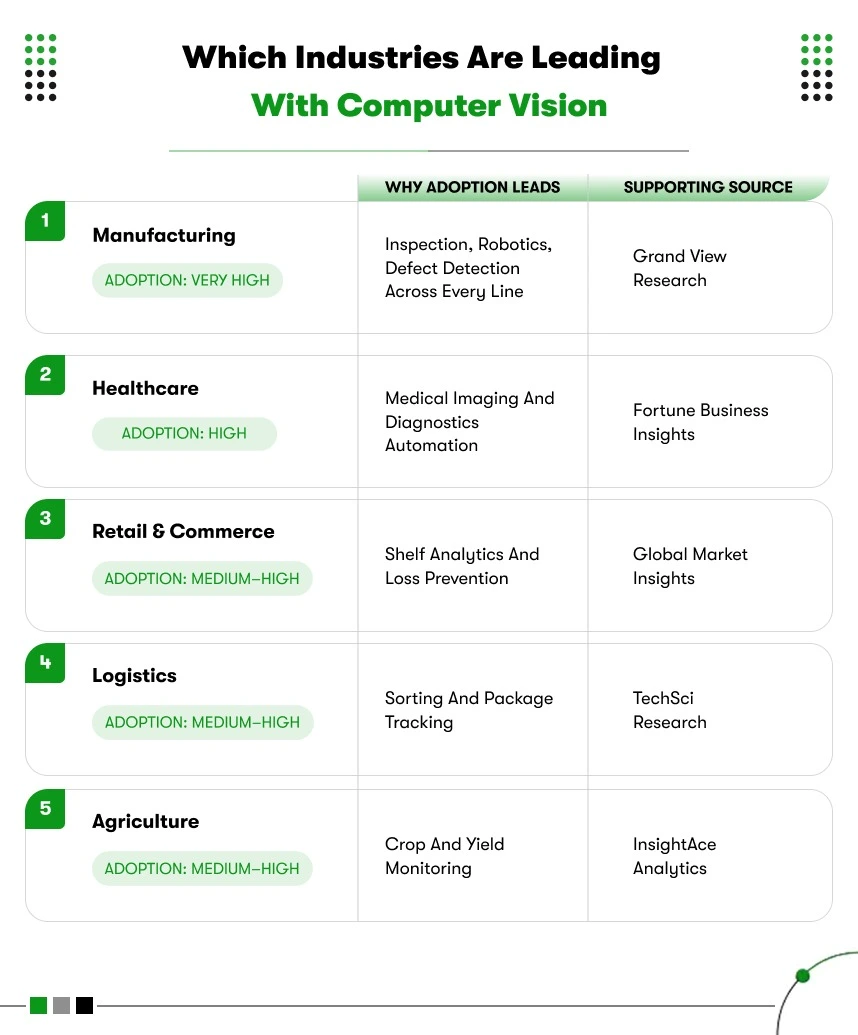
Computer Vision Applications by Industry
Visual intelligence solves different operational problems depending on sector-specific workflows and quality requirements. Industries adopt computer vision where manual inspection creates bottlenecks or where visual accuracy directly affects safety and compliance outcomes.
3.1 Manufacturing
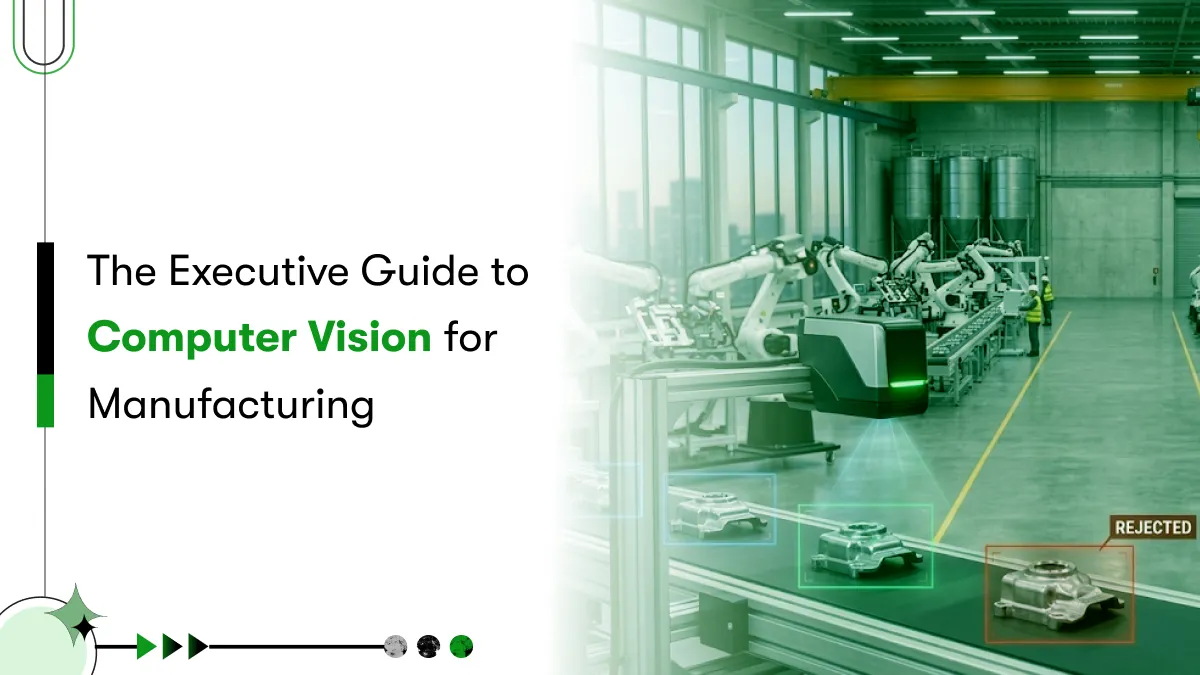
Production lines generate constant visual data through cameras positioned at every assembly stage and quality checkpoint. Automated defect detection identifies surface scratches, dimensional variations, and assembly errors faster than human inspectors can process. A single vision system inspects hundreds of components per minute while maintaining consistent quality standards across shifts. Worker safety monitoring detects missing protective equipment or unsafe proximity to machinery before accidents occur. Equipment condition analysis tracks wear patterns on moving parts to schedule maintenance before breakdowns halt production. Manufacturers often Hire Computer Vision Developers when scrap rates exceed acceptable thresholds or when production speeds outpace manual inspection capacity.
3.2 Healthcare
Medical imaging generates terabytes of visual data daily across radiology departments, pathology labs, and diagnostic centers worldwide. Computer vision analyzes X-rays, MRIs, and CT scans to flag anomalies that require immediate radiologist attention. Pathology systems examine tissue samples to detect cancerous cells, with consistent results that reduce diagnostic variability among specialists. Patient monitoring tracks movement patterns and fall risks in hospital rooms without requiring constant nursing presence. Workflow optimization analyzes operating room activity to identify bottlenecks that extend procedure times and reduce daily case volumes. Healthcare facilities need computer vision consulting when diagnostic backlogs delay treatment decisions or when imaging volume exceeds radiologist availability.
3.3 Retail
Store operations depend on visual information about inventory placement, customer behavior, and loss prevention across hundreds of locations. Shelf availability monitoring detects out-of-stock conditions in real time, triggering restocking before sales opportunities are missed. Customer behavior analysis tracks paths through aisles to understand product discovery patterns and optimize promotional placements. Footfall analysis measures traffic density across store zones to align staffing levels with actual customer presence. Theft prevention detects unusual behavior at self-checkout stations or identifies unscanned items that leave the payment zones. Retail chains apply Computer Vision Use Cases when inventory accuracy affects revenue or when staffing decisions require objective traffic data.
3.4 Logistics and Warehousing
Distribution centers process thousands of packages hourly through sorting systems that rely on accurate identification and routing. Package inspection detects damage before shipment reaches customers to prevent returns and maintain service quality standards. Barcode and label recognition automates sorting without manual scanning when labels face cameras at any orientation. Load optimization analyzes truck bed fill patterns to maximize space utilization and reduce transportation costs. Dock door monitoring tracks loading times to identify bottlenecks that delay departures and affect delivery schedules. Warehouses adopt computer vision application examples when package volume exceeds manual processing speed or when sorting accuracy directly impacts customer satisfaction metrics.
3.5 Agriculture
Farm operations cover vast acreages where manual inspection becomes physically impossible across entire growing seasons. Crop health detection identifies disease or pest damage from aerial imagery before visible symptoms spread across fields. Yield monitoring predicts harvest volumes by analyzing fruit development stages to optimize labor scheduling and buyer commitments. Field analysis detects irrigation issues or nutrient deficiencies through vegetation index measurements across soil zones. Livestock monitoring tracks animal movement and feeding patterns to identify health problems before productivity declines. Agricultural businesses explore the applications of computer vision when field sizes make manual scouting impractical or when early problem detection prevents total crop losses.
Real-World Computer Vision Examples
Where do businesses use computer vision today?
Businesses apply computer vision for quality inspection, safety monitoring, fraud prevention, and operational optimization. Applications span factories, hospitals, warehouses, retail stores, and farms where visual accuracy directly affects cost, speed, and reliability.
Visual intelligence deployment varies significantly across operational contexts because each industry faces unique inspection requirements and accuracy thresholds. Manufacturing plants install vision systems at every quality checkpoint to catch defects before units reach packaging stages. Hospitals route urgent cases faster when algorithms flag critical findings in medical images within seconds of capture. Retailers optimize shelf layouts based on actual customer movement data rather than assumptions about shopping behavior patterns.
Logistics centers reduce misrouted packages when vision systems verify addresses and barcodes without human scanning delays. Agricultural operations protect crop yields by detecting disease early enough for targeted intervention instead of field-wide treatment. Financial institutions prevent fraudulent transactions when facial recognition confirms account holder identity before processing high-value transfers.
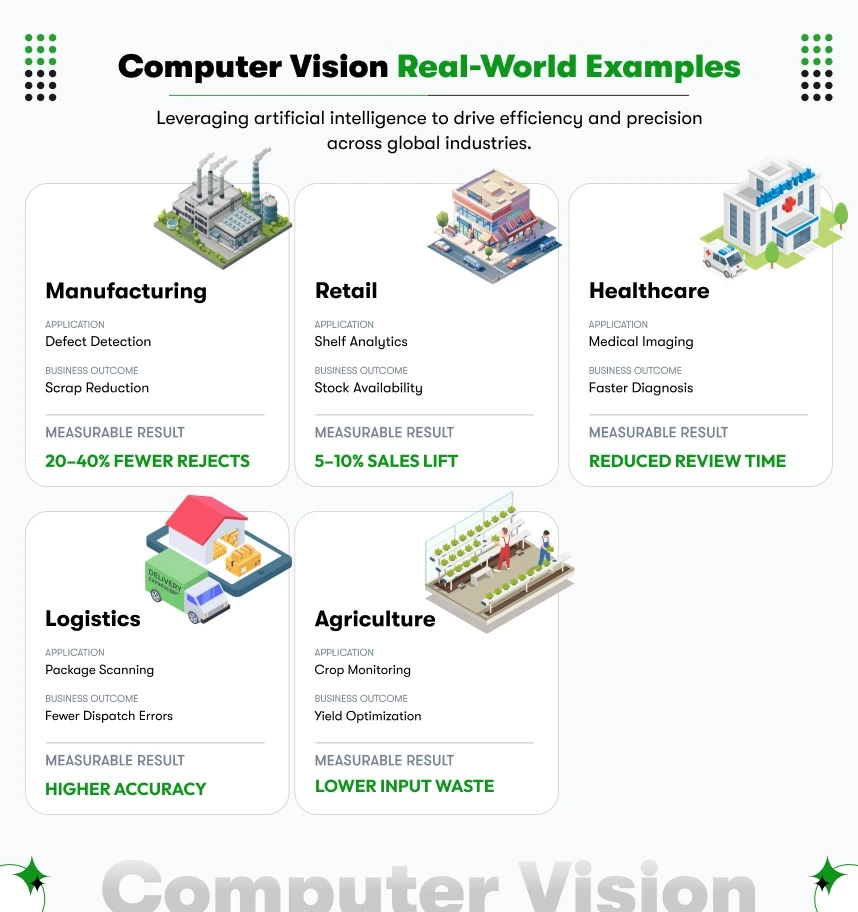
Examples of computer vision applications demonstrate value through measurable operational improvements rather than theoretical capabilities:
| Industry | Application | Business Outcome |
| Manufacturing | Defect detection on assembly lines | Scrap reduction by 40% through early fault identification |
| Retail | Shelf availability monitoring | Sales increase of 12% by eliminating out-of-stock situations |
| Healthcare | Medical image analysis for diagnostics | Diagnosis time reduced from 48 hours to 6 hours |
| Logistics | Package scanning and routing accuracy | Sorting errors decreased by 35% through automated verification |
| Agriculture | Crop disease detection from drone imagery | Yield protection of 25% through early treatment intervention |
| Banking | Facial recognition for transaction approval | Fraud prevention saves $2M annually per branch network |
| Construction | Safety compliance monitoring on sites | Workplace incidents reduced 60% through real-time alerts |
| Automotive | Quality inspection of painted surfaces | Rework costs cut by 30% through defect detection before assembly |
Implementation success depends on matching computer vision examples in real life to specific business problems rather than adopting technology for visibility. A Computer Vision Software Development Cost analysis reveals whether expected improvements justify development investment and ongoing maintenance expenses. Vision systems deliver returns when visual inspection currently limits throughput or when manual review creates unacceptable error rates.
Factories achieve payback within months when automated inspection prevents recalls that cost millions in warranty claims. Hospitals justify investment when faster diagnosis enables treatment decisions that improve patient outcomes and reduce bed occupancy. Warehouses calculate returns based on labor hours saved and accuracy improvements that reduce customer service complaints.
Business Benefits of Computer Vision
Visual automation delivers operational advantages that manual inspection cannot match, regardless of team size or training investment. Organizations implement vision systems when visual data volume exceeds human processing capacity or when consistency requirements demand elimination of subjective judgment.
Reduced Manual Inspection Effort
Vision systems process thousands of images hourly without requiring breaks or shift rotations like human inspection teams need. A single camera installation replaces multiple inspectors while maintaining coverage across all production hours, including nights and weekends. Manufacturing facilities redirect quality control staff to exception handling and root cause analysis instead of repetitive visual checks. Labor costs decrease because fewer personnel deliver higher inspection coverage when automation handles routine verification tasks continuously.
Faster and More Accurate Decisions
Algorithms analyze images in milliseconds and flag issues immediately instead of waiting for scheduled inspection rounds to detect problems. Real-time feedback enables production adjustments before hundreds of defective units are manufactured during the delay between manual checks. Electronics assembly lines stop within seconds when vision detects component placement errors rather than discovering problems during final testing. Decision speed improves from hours to seconds because visual analysis happens in-line without removing samples for laboratory evaluation.
Improved Operational Consistency
Vision models apply identical criteria to every inspection regardless of time, location, or environmental conditions affecting human judgment. The same defect definition gets enforced at facilities across different regions without interpretation variations between inspection teams. Pharmaceutical operations maintain regulatory compliance because automated systems document identical quality standards application across every batch produced. Consistency extends across years because algorithms do not drift in judgment like human inspectors who gradually adjust personal thresholds.

Lower Compliance and Safety Risks
Automated monitoring detects safety violations and compliance failures in real time before accidents occur or auditors identify problems. Construction sites prevent injuries when vision systems alert supervisors immediately about missing protective equipment or unsafe work positioning. Food processing maintains health standards because contamination detection happens during production rather than through post-shipment recalls. Regulatory documentation improves because every inspection generates timestamped records proving continuous compliance monitoring versus periodic manual audits.
Scalable Automation Across Locations
Adding inspection capacity requires camera installation and model deployment rather than recruiting and training additional quality control personnel. Business expansion no longer depends on proportional workforce growth because vision infrastructure scales through hardware addition and software replication. Retail chains deploy shelf monitoring to hundreds of stores simultaneously, using a centralized model management instead of hiring local inspection staff. Understanding Computer Vision for Industries helps businesses plan scalable deployments that maintain consistent performance across geographic expansion and volume increases.
Challenges in Computer Vision Adoption
Visual automation delivers significant benefits, but implementation faces technical and operational obstacles that delay deployment or limit accuracy. Understanding common challenges helps businesses prepare realistic timelines and budget appropriate resources for successful vision system launches.
| Challenge | Solution | Business Impact |
| Inconsistent image quality across lighting conditions and camera angles | Install controlled lighting systems and standardize camera positioning with calibration protocols | Reduces false positives by 45% and ensures reliable detection across all shifts |
| Limited labeled data availability for training accurate models | Partner with domain experts to label initial datasets and implement active learning for continuous improvement | Accelerates model training from 6 months to 8 weeks while improving accuracy |
| Integration with existing systems like ERP and MES platforms | Use API-based architecture and middleware that connects vision outputs to legacy databases | Eliminates manual data transfer and enables real-time decision workflows |
| Accuracy expectations versus actual model performance in production | Set realistic benchmarks through pilot testing and establish human-in-loop validation for edge cases | Prevents deployment failures and builds stakeholder confidence through measurable results |
| Operational change management and workforce resistance | Involve operators early in design and demonstrate how automation reduces tedious tasks | Increases adoption rates by 60% and reduces implementation timeline friction |
| Edge case handling when rare defects lack training examples | Implement anomaly detection alongside classification and maintain expert review queues | Catches novel defects that pure classification misses while continuously improving models |
| Computing infrastructure costs for real-time processing | Deploy edge processing for latency-sensitive applications and cloud processing for batch analysis | Reduces infrastructure spend by 40% while meeting performance requirements |
| Model drift over time as products or processes change | Establish monitoring dashboards that track prediction confidence and trigger retraining workflows | Maintains accuracy above 95% despite process variations that would degrade unmonitored systems |
Businesses exploring examples of computer vision applications often underestimate the data preparation effort required before model training begins. Clean labeled datasets rarely exist because visual inspection historically relied on human judgment without systematic documentation. Creating training sets requires subject matter experts to review thousands of images and label defects consistently.
Integration complexity increases when vision systems must trigger actions in manufacturing execution systems or warehouse management platforms. Legacy systems lack modern APIs and require custom middleware development to accept vision outputs and route decisions. A Computer Vision Software Development Company addresses integration challenges through experience with common enterprise platforms and protocols.
Accuracy calibration demands iterative testing because initial models trained on limited data perform differently under actual production conditions. Pilot deployments reveal lighting variations, product positioning inconsistencies, and defect types missing from training sets. Successful implementations plan for model refinement cycles rather than expecting immediate production-ready performance.
When Computer Vision Makes Sense for a Business
Investment decisions require evaluating whether visual automation addresses actual operational constraints or simply adds technology without measurable returns. Vision systems justify costs when visual inspection currently limits throughput, creates quality risks, or consumes resources that could deliver higher value elsewhere.
Apply Computer Vision When
Visual inspection drives operational decisions
Production quality, safety compliance, or inventory accuracy depend on evaluating images that humans currently review manually. Manufacturing lines pause for quality checks while warehouses employ staff who verify package contents through visual confirmation. Hospitals delay treatment decisions, waiting for radiologists to analyze medical images during off-hours. Visual bottlenecks create downstream delays that affect customer commitments and revenue recognition timelines.
Error costs affect margins or safety.
Defects reaching customers trigger recalls, warranty claims, or liability exposure that exceeds prevention costs significantly. Pharmaceutical companies face regulatory penalties when visual inspection misses contamination before distribution occurs. Construction firms pay injury compensation when safety violations go undetected until accidents happen. Financial impact of errors justifies automation investment when prevention costs less than failure consequences.
Processes operate at scale.
Volume exceeds what manual inspection can process without creating bottlenecks or accepting reduced sampling rates. Distribution centers handle thousands of packages hourly while retail chains monitor hundreds of store locations simultaneously. Agricultural operations cover acreages where physical inspection becomes impossible within decision windows for intervention. Scale makes human review impractical, regardless of the budget available for hiring additional personnel.
Avoid Computer Vision When
Visual data lacks business impact.
Images exist, but do not influence operational decisions or financial outcomes worth optimizing through automation investment. Surveillance footage sits archived without anyone reviewing it for actionable insights or compliance documentation. Product photos get captured for record-keeping without affecting quality decisions or customer experience improvements. Data collection without utilization indicates vision systems would automate processes that do not currently drive value.
Data volume stays limited.
Inspection workload remains manageable through existing manual processes without creating delays or quality compromises. Small batch manufacturers inspect dozens of units daily, where human review maintains adequate throughput and accuracy. Specialty operations handle unique products where model training costs exceed manual inspection expenses across annual volumes. Limited scale makes automation overhead unjustifiable when human expertise handles current demand efficiently.
ROI metrics remain undefined
Organizations cannot articulate specific improvements vision systems should deliver or measurement methods proving deployment success. Vague goals like “improving quality” lack baseline metrics and target thresholds that determine whether implementation succeeded. Successful deployments require defining expected scrap reduction percentages, inspection time decreases, or error rate improvements before development begins. Understanding Computer Vision Applications and Examples across similar operations helps establish realistic performance benchmarks and return calculations.
How to Start with Computer Vision Projects
Successful deployments follow structured approaches that validate business value before committing resources to enterprise-wide rollouts.
Identify high-impact visual workflows.
Map current operations to find where visual inspection creates bottlenecks, quality risks, or resource consumption disproportionate to value. Manufacturing teams identify quality checkpoints that delay throughput during manual inspection, while warehouse operations examine sorting processes that create customer complaints. Priority workflows show measurable pain, such as scrap rates exceeding targets or inspection costs rising faster than volumes.
Define success and accuracy metrics early.
Establish quantifiable targets to determine whether the vision system’s performance justifies deployment costs and operational changes. Defect detection projects specify acceptable false-positive rates to avoid production halts and false-negative rates to prevent defective units from reaching customers. Metrics defined during planning prevent scope disputes when stakeholders disagree about whether results meet expectations.
Run a controlled pilot project.
Deploy vision systems in limited production environments where failure risks remain contained while success patterns become measurable. Select single production lines or individual warehouse zones that represent broader operational conditions without exposing the entire network. The pilot scope includes sufficient data volume for meaningful testing but limits investment before validation.
Validate outcomes with business teams.
Engage operational staff who execute current manual processes to evaluate whether automation delivers the promised improvements without creating new problems. Production supervisors confirm defect-detection accuracy, while warehouse managers verify sorting-speed improvements that introduce no misrouting errors. Finance teams calculate actual cost savings against initial projections while validation catches integration gaps.
Scale only after measurable results
Expand vision systems to additional locations only when pilot deployments demonstrate repeatable performance and positive returns. Replication requires documenting installation procedures and integration specifications to enable consistent deployments. Organizations ready to scale often need to hire Computer Vision Developers with deployment experience who understand how pilot success translates to enterprise implementations.
Computer Vision Applications are Your Business Alibi
Computer vision replaces manual review with consistency, ensuring visual inspection drives operational decisions that affect quality, safety, or throughput. Factories reduce scrap, hospitals accelerate diagnoses, and warehouses eliminate sorting errors through automated analysis that processes thousands of images without fatigue.
Industry adoption continues accelerating because visual automation delivers measurable returns through faster decisions and lower compliance risks. Success depends on data quality and clear objectives rather than technology sophistication alone. Organizations that define specific accuracy targets and test pilot deployments avoid costly failures when production environments reveal untested assumptions.
Strategic implementation delivers measurable operational value when businesses match vision capabilities to actual workflow constraints. Planning rigor and partner capability decide performance outcomes more than technology selection alone.
Kody Technolab Limited supports organizations by developing custom computer vision software grounded in operational reality. The team guides problem definition, architecture design, validation planning, and system integration for production environments. Organizations seeking predictable outcomes and scalable growth can engage Kody Technolab Limited as a long-term development partner.

FAQ
What are common computer vision examples businesses use daily?
Businesses use computer vision examples for defect detection on production lines, package sorting in warehouses, shelf monitoring in retail stores, and medical image analysis in hospitals. Manufacturing plants inspect thousands of products hourly, while distribution centers automatically verify shipping labels. These Computer Vision Applications eliminate manual scanning bottlenecks and maintain consistent quality standards across shifts, without human fatigue affecting accuracy or throughput.
How accurate are Computer Vision Applications compared to human inspectors?
Vision systems maintain consistent accuracy above 95% across millions of inspections, while human accuracy fluctuates between 80% and 90%, depending on fatigue and shift duration. Automated systems apply the same criteria to every inspection, whereas human judgment varies with experience and attention. Computer vision examples in pharmaceutical quality control demonstrate detection rates exceeding manual inspection by 15-20% for micro-defects that human eyes miss under time pressure.
Can Computer Vision Applications work with existing cameras and infrastructure?
Existing surveillance cameras rarely meet specifications for quality inspection, as their resolution, frame rate, and positioning are optimized for security monitoring rather than defect detection. Most deployments require industrial cameras with controlled lighting and precise mounting to achieve accuracy targets. However, some computer vision examples in warehouse operations have successfully upgraded existing camera networks with better lenses and lighting rather than replacing the entire infrastructure.
How long does implementing computer vision examples take from planning to production?
Pilot deployments typically require three to six months, including workflow analysis, data collection, model training, integration testing, and operator training. Enterprise rollouts across multiple facilities extend timelines to 12-18 months, depending on customization requirements and infrastructure readiness. What are the applications of computer vision that deploy fastest, including barcode reading and package sorting, because training data requirements stay minimal compared to complex defect detection scenarios?
What computer vision examples in real life show the fastest return on investment?
Quality inspection prevents recalls, safety monitoring reduces workplace injuries, and delivers the fastest returns because error costs exceed the cost of automation within months. Pharmaceutical defect detection and construction safety compliance can achieve payback periods of under one year through risk reduction alone. Computer Vision Use Cases in food packaging inspection typically recover investment within 8-12 months by eliminating customer returns and avoiding regulatory penalties.
Do Computer Vision Applications require continuous internet connectivity to function?
Edge deployments process images locally, without an internet connection, when latency requirements demand real-time decisions on production lines or in safety monitoring. Cloud-based systems require connectivity for centralized model management and cross-facility analytics, but edge processing handles time-sensitive operations offline. Most computer vision application examples use hybrid architectures in which critical inspection occurs at the edge, while performance monitoring and model updates occur through scheduled cloud synchronization.








 Contact Information