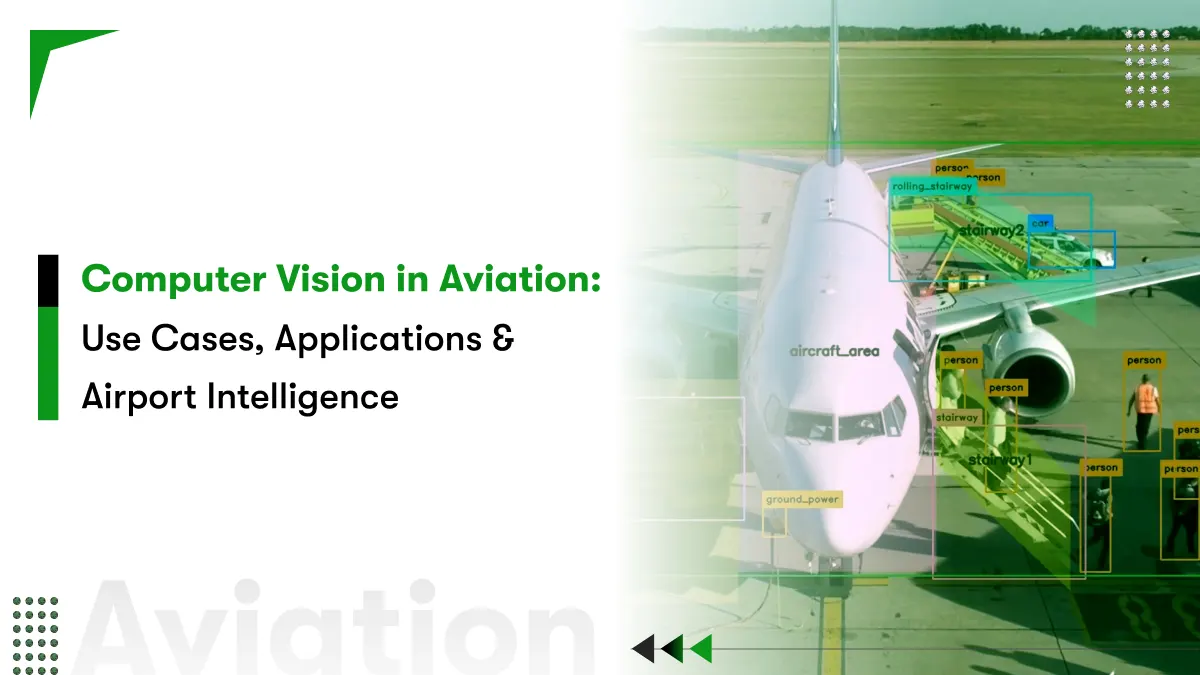
Quick Summary: Your airport loses money from runway closures, mishandled bags, and operational inefficiencies. But that ends here as this guide reveals how computer vision in aviation eliminates these pain points through automated FOD detection, real-time baggage tracking, and predictive analytics. Discover 10 proven use cases delivering 15-40% efficiency gains, implementation roadmaps with ROI data, and how to avoid costly deployment mistakes that generic vendors create.
Aviation is one of the safest industries in the world. However, human error still accounts for over 70% of all aviation accidents, according to the FAA’s 2024 Safety Report (faa.gov). With global air traffic projected to double by 2040, the margin for manual oversight is shrinking fast. Computer vision is closing the safety gap in aviation. These AI-powered visual intelligence enhances aircraft inspection, airport operations, security screening, and beyond. This guide covers every major use case, application, and everything you need to know to implement it.
How Computer Vision is Used in Aviation
Computer vision uses AI-powered image and video analysis to automate visual tasks across aviation. Engineers deploy this technology to inspect aircraft for structural defects. Operators monitor airport runways for hazards in real time. Airport staff manage passenger flow through terminals efficiently, and security teams detect threats instantly as passengers move through checkpoints.
Traditional surveillance and inspection in aviation relied on fixed cameras, manual checklists, and human observers. Manual inspections reveal critical limitations, such as Inspector fatigue reduces accuracy, and detection rates vary between inspectors. Inspectors simply cannot check every surface of a wide-body aircraft during a quick turnaround. AI computer vision in aviation changes this fundamentally.
Modern computer vision systems process image and video feeds through deep learning models trained on aviation-specific datasets. AI models identify anomalies, classify objects, track movement, and generate alerts faster and more consistently than human teams. Organizations deploy these systems in two ways: real-time deployment allows the system to respond instantly to live camera feeds. Scheduled deployment enables technicians to analyze high-resolution imagery captured during maintenance windows in batches. For a full technical breakdown of the underlying mechanisms, see how computer vision works.
Best Use Cases of Computer Vision in Aviation
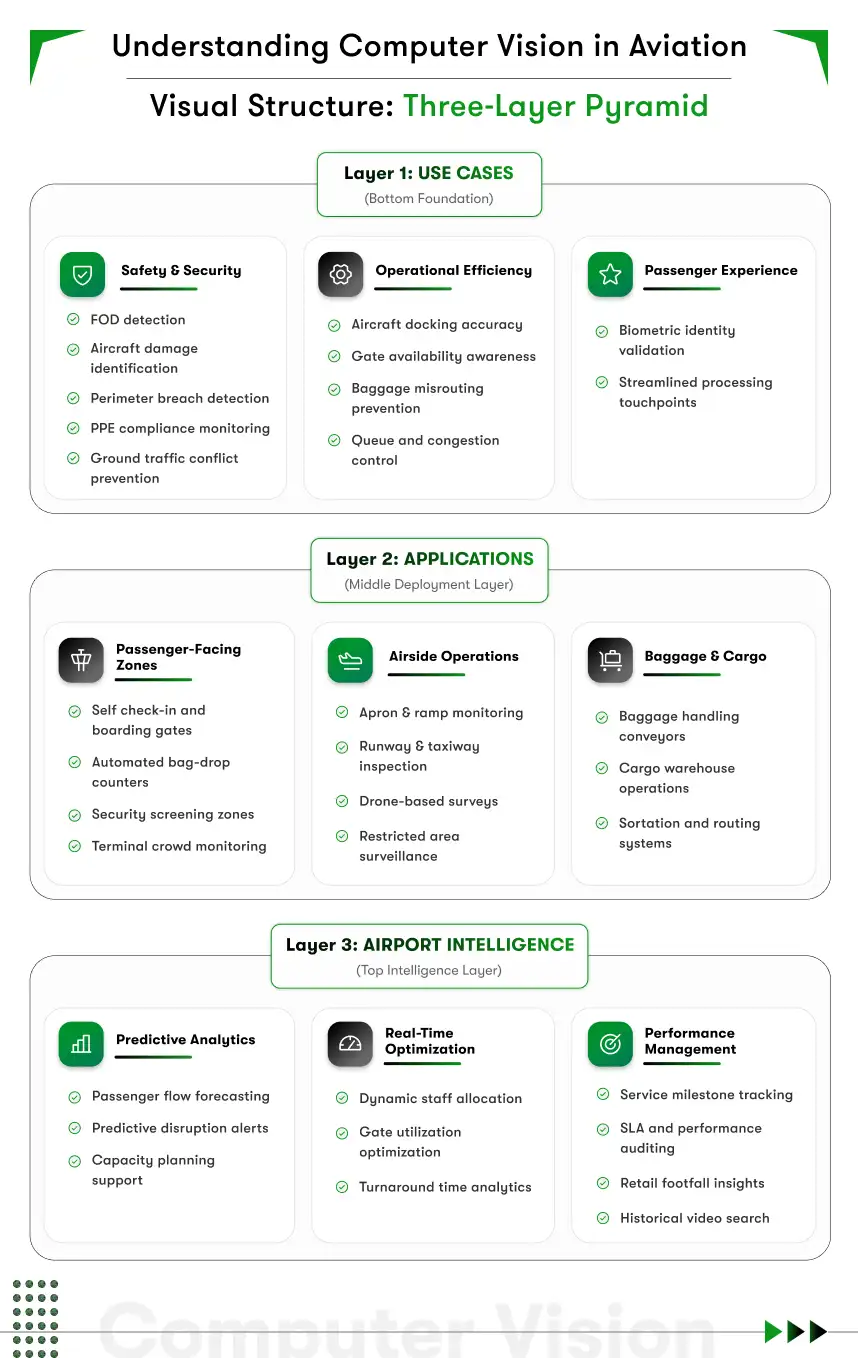
Before evaluating any technology investment, the first question to answer is: what specific operational problems does it solve? In aviation, computer vision addresses six high-value problem areas where manual processes are slow, inconsistent, or costly to remain viable.
Aircraft Structural Inspection
Wide-body aircraft present massive inspection challenges. Each aircraft has over 500,000 fasteners and thousands of square metres of surface area to inspect. Inspectors working under time pressure miss an estimated 20 to 30% of minor defects during quick turnaround schedules. These undetected defects later become major structural problems.
Computer vision eliminates the gap; the system scans fuselage surfaces, wing structures, engine cowlings, and landing gear with sub-millimetre precision. It detects hairline cracks, corrosion patches, and paint delamination that human inspectors miss entirely.
Runway and Taxiway FOD Detection
Foreign Object Debris on active runways is one of the most underreported and costly hazards in aviation. A single bolt or tyre fragment on a runway can cause catastrophic engine ingestion or tyre blowout. The use case for computer vision here is clear: continuous, automated visual monitoring of runway surfaces that flags debris within seconds of it appearing, regardless of time of day, weather conditions, or traffic volume. Manual FOD patrols happen once or twice per shift. AI vision monitors every second.
Baggage Handling and Misrouting Prevention
Baggage mishandling is a passenger experience failure and a direct operational cost. The use case for computer vision is at every transfer point in the baggage journey. Be it automated tag reading, routing verification, damage detection, or real-time flagging of bags that deviate from their intended path. The goal is catching misrouted bags before they board the wrong aircraft, not after passengers land at the wrong destinations.
Passenger Flow and Queue Management
Terminal congestion at security, passport control, and boarding gates creates delays that cascade across an entire operation. The use case for computer vision is real-time visibility of queue lengths and passenger density across every terminal zone, enabling operations teams to reallocate staff dynamically before a queue becomes a delay. At boarding gates, biometric vision systems eliminate the manual document check entirely, processing each passenger in under two seconds.
Ramp and Ground Vehicle Safety
The airport apron is one of the most hazardous working environments in any industry. Ground service vehicles, fuel trucks, pushback tractors, and aircraft all operate in close proximity under time pressure. The use case for computer vision on the ramp is continuous position tracking of every vehicle and aircraft, with proximity alerts generated automatically when safe separation distances are breached. This removes the reliance on ground crew vigilance alone as the primary safety mechanism.
Air Cargo and Security Screening
Security screening at both passenger and cargo checkpoints depends heavily on human analysts reviewing X-ray imagery under sustained concentration. Fatigue and cognitive load degrade detection performance over a shift. The use case for AI computer vision in aviation security is augmenting or replacing human X-ray analysis with models trained on threat object libraries, delivering consistent detection accuracy at the start of a shift and at hour eight equally. For air cargo, vision systems verify manifest compliance, identify undeclared items, and flag packaging anomalies at scale.
Top 5 Applications of Computer Vision in Aviation
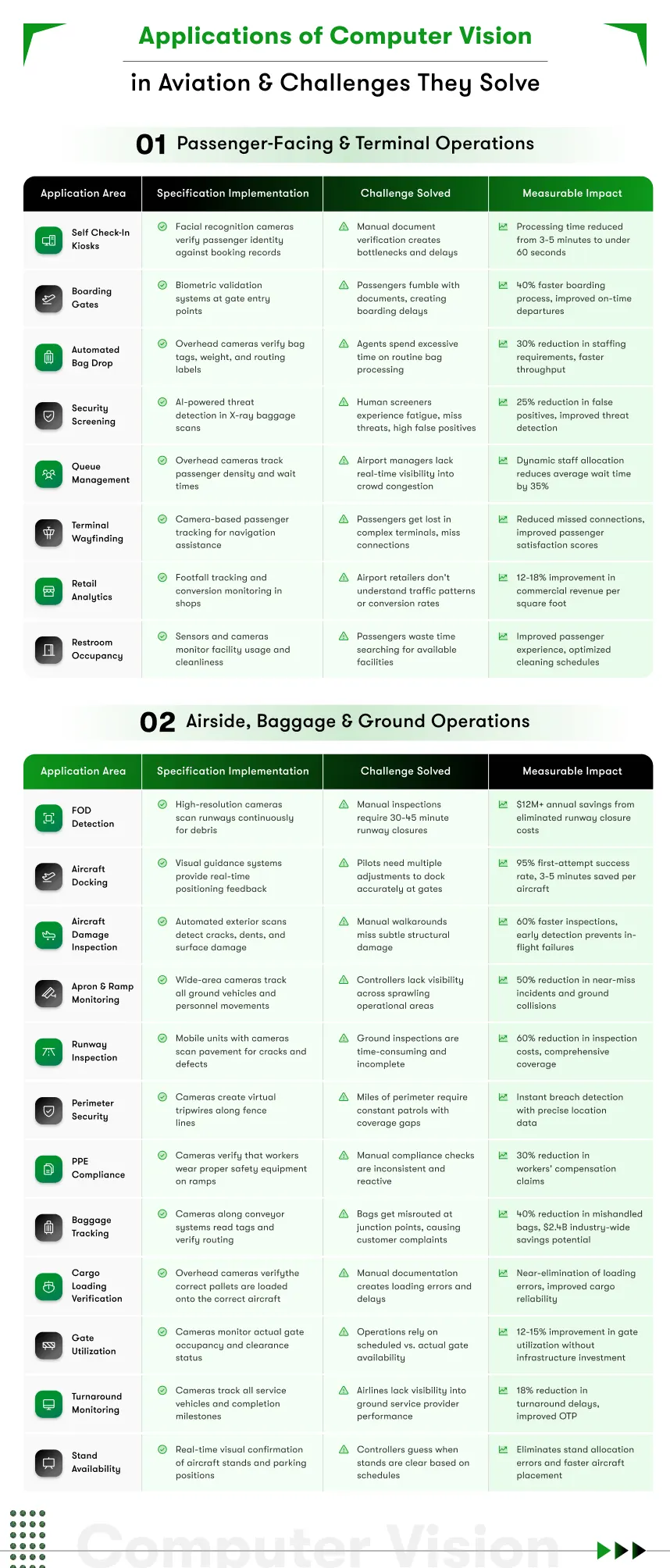
Use cases define the problem. Applications define how computer vision technology is actually deployed to solve it. Here is what each deployment looks like in practice across the aviation industry.
Drone-Based Inspection Systems for MRO
Autonomous inspection drones equipped with high-resolution cameras and AI vision processing fly pre-programmed paths around parked aircraft, capturing thousands of images per inspection pass. The AI model analyses each image in real time, classifying defect type, size, and location. Engineers receive a prioritised defect report with annotated images within minutes of the drone completing its pass, rather than working through a manual checklist over several hours. Lufthansa Technik, Air France Industries KLM Engineering and Maintenance, and Singapore Airlines Engineering Company have all deployed drone inspection as a core part of their MRO workflow.
Fixed Runway Camera Arrays for FOD Detection
High-resolution cameras mounted at intervals along runway edges feed continuous video streams into an AI vision platform trained to distinguish debris from runway surface features, wildlife, and moving aircraft. When foreign object debris is detected, the system generates an automatic alert to the air traffic control tower and ground operations, including the precise location of the object. The entire detection-to-alert cycle takes under ten seconds. Airports including Tokyo Narita, Amsterdam Schiphol, and Dallas Fort Worth operate fixed FOD detection systems as part of their standard runway safety infrastructure.
Biometric Gates and E-Boarding Systems
Facial recognition computer vision systems at check-in kiosks, security lanes, lounge entrances, and boarding gates create a single biometric token that carries a passenger through every touchpoint without repeated document presentation. The application uses a one-to-one match at each gate, comparing the live facial scan against the passenger’s pre-enrolled image from their travel document. Processing time is under two seconds per passenger. British Airways, Delta, and Emirates operate biometric boarding across multiple hub airports, with passenger opt-in rates consistently above 85%.
Apron Monitoring Platforms for Ground Safety
A network of cameras covering the full apron area feeds into a central AI vision platform that tracks every vehicle and aircraft in real time, maintains a live spatial map of the ramp, and generates alerts when defined safety parameters are breached. The application goes beyond simple proximity detection: the system learns normal movement patterns for each aircraft stand and flags deviations from expected behaviour, such as a fuel truck approaching from the wrong direction or a pushback tractor moving without a wing walker in position.
AI-Powered X-Ray Vision for Cargo and Security
Computer vision models trained on thousands of threat and contraband object images are integrated directly into existing X-ray screening equipment, overlaying AI-generated highlights on the screener’s display when a potential threat item is detected. The application does not replace the human screener but directs their attention with consistent accuracy, reducing both missed detections and unnecessary secondary screening. For air cargo, standalone AI vision platforms analyse X-ray imagery of freight consignments against manifest data, flagging discrepancies and undeclared items automatically.
For a comprehensive reference on how these applications are built and deployed, see computer vision applications and examples.
Airport Intelligence: Where It All Comes Together
Individual computer vision applications solve individual problems. Airport intelligence is what happens when those applications are connected into a single, unified operational picture. Rather than a security camera recording footage for retrospective review, or a FOD system alerting in isolation, airport intelligence means every vision system feeds into a central operations platform that gives airport leadership real-time awareness of their entire estate simultaneously.
AI vision for airport operations in this context covers gates, terminals, runways, taxiways, baggage halls, and the apron in a single integrated view. When a queue builds at security, the operations centre sees it. If a ground vehicle enters a restricted zone, the alert is immediate. When an aircraft lands with a visible surface anomaly flagged by the runway camera system, the MRO team is notified before the aircraft reaches the stand. This is the operational reality that the world’s most advanced airports are building toward.
Changi Airport, Singapore
Changi has deployed AI vision across its five terminals to monitor passenger flow, automate check-in and boarding, and manage baggage end-to-end without manual intervention. Their vision platform processes over 100,000 passenger journeys daily with an automated touchpoint rate exceeding 90%. The airport’s operations centre receives a continuous AI-generated picture of the terminal state, enabling proactive resource deployment rather than reactive firefighting.
Heathrow Airport, London
Heathrow uses computer vision in airports for real-time aircraft stand monitoring, automated gate assignment, and ground vehicle tracking across its two terminals. Their AI vision layer reduced average aircraft turnaround time by 8 minutes per movement, translating into measurable on-time performance improvement across 480,000 annual flights. The system integrates directly with their Airport Operations Database, giving every stakeholder from airline operations to ground handlers a shared, accurate picture of stand status.
Dubai International Airport
Dubai International has integrated biometric computer vision across all passenger touchpoints, creating a seamless single-token journey from check-in through boarding. The system processes over 90 million passengers annually and has cut average passenger processing time by 40%. Beyond the passenger journey, Dubai’s operations platform integrates ramp monitoring, baggage tracking, and gate management into a single airport intelligence layer that gives their operations centre genuine real-time control.
To see how vision intelligence is reshaping operations across other high-stakes industries, explore computer vision for industries.
Benefits of Computer Vision in Aviation
The benefits of computer vision in aviation go well beyond automation. They touch every metric that matters to airline and airport operators: safety performance, operational efficiency, cost control, and regulatory standing.
Safety: Removing the Human Error Variable
AI vision systems do not experience fatigue, distraction, or inconsistency. An inspector on hour twelve of a night shift and an AI vision system at the same hour perform identically. In an industry where a missed hairline crack can have catastrophic consequences, this consistency is the single most compelling argument for adoption.
Efficiency: Faster Turnarounds and Fewer Delays
Visual inspection tasks that take a human team two to three hours can be completed by an AI drone and vision system in under 30 minutes. At a hub airport where gate utilisation is measured in minutes, this improvement directly translates to on-time departure performance and higher aircraft utilisation rates.
Cost Reduction: Predictive Over Reactive
Unscheduled maintenance events cost airlines an average of $150,000 per aircraft per day in downtime, according to Oliver Wyman’s 2024 MRO survey. Computer vision shifts maintenance from a reactive posture to a predictive one, identifying issues during scheduled turnarounds before they become AOG (Aircraft on Ground) events.
Passenger Experience: Faster and Frictionless
Biometric processing at boarding gates, AI-managed queue systems in terminals, and automated baggage tracking all directly improve the passenger journey. Shorter queues, faster boarding, and fewer mishandled bags translate into higher satisfaction scores and stronger loyalty metrics for both airlines and airports.
Compliance: Meeting FAA and EASA Requirements
Every AI vision inspection generates a timestamped, geo-tagged digital record. This audit trail meets FAA and EASA documentation requirements automatically, eliminating the manual record-keeping burden and providing regulators with a richer evidence base than paper-based inspection logs.
To see how these benefits compare across other regulated industries, explore computer vision for industries.
Your Implementation Options: How to Get Started
Once your use case and regulatory path are defined, the next decision is how to build and deploy. There are three practical routes, each suited to a different organisational context.
Work with a Computer Vision Software Development Company
A computer vision software development company takes ownership of the full build: model development, hardware integration, regulatory documentation support, and post-deployment maintenance. This is the right route for organisations that lack in-house AI capability but need a production-ready, certification-aware system delivered on a defined timeline.
What to look for in an aviation-focused partner:
- Prior deployments in MRO, airport operations, or aerospace environments
- Familiarity with FAA, EASA, and ICAO documentation standards
- A clear model retraining and support commitment post go-live
Before engaging a partner, understanding computer vision software development cost is critical for accurate budget planning. Costs in aviation are typically higher than other industries due to certification requirements, specialist training data, and edge hardware.
Hire Computer Vision Developers
If computer vision is a long-term strategic capability for your airline or airport, building an internal team makes sense. You hire computer vision developers to own the models, retrain them as aircraft fleets evolve, and extend the system to new use cases over time. The key advantage is institutional knowledge: developers embedded in your operation understand your specific aircraft types, inspection standards, and operational constraints in a way an external vendor never fully can.
Core roles you will need:
- Computer vision engineers specialising in inspection and anomaly detection
- MLOps engineers to manage model deployment and retraining pipelines
- Aviation domain experts for data annotation and model validation
- Systems integration engineers for MRO and airport operations connectivity
Engage a Computer Vision Consulting Firm
Computer vision consulting is the right starting point when you know the operational problem but are not yet clear on the technical solution, the vendor landscape, or how to present the business case to your board. A consulting engagement defines the architecture, maps the regulatory pathway, evaluates build versus buy options objectively, and produces the investment case with the numbers your finance team will accept.
Consulting is most valuable when:
- You have multiple competing use cases and need a prioritised roadmap
- Your internal team lacks the expertise to evaluate AI vision vendors fairly
- You need independent validation of a vendor’s accuracy claims before committing to the budget
How to Choose the Right Computer Vision Platform for Aviation
Selecting a computer vision platform for aviation is a different exercise from most industries. General-purpose industrial vision platforms may perform well on standard inspection tasks but lack the safety certification support, edge deployment maturity, and aviation-specific model libraries that critical deployments require.
Build vs. Buy for Aviation
Choose an existing platform when:
- Your use case is well-defined and matches a platform’s existing aviation modules
- You need rapid deployment and cannot wait for a full custom build
- The platform has existing integrations with your MRO or airport management software
Build a custom solution when:
- Your aircraft fleet or airport environment has characteristics no existing platform is trained for
- Your regulatory obligations require full transparency into model architecture and training data
- You are building a long-term competitive capability in AI-driven safety operations
Key Evaluation Criteria for Aviation Platforms
- Safety certification pathway: Can the vendor support FAA/EASA approval documentation?
- Edge deployment maturity: proven performance in low-connectivity, high-criticality environments
- Detection accuracy on aviation-specific defect and object types, not generic benchmarks
- Integration APIs for MRO platforms (SAP PM, AMOS, Trax) and airport systems (AODB, FIDS)
- Vendor track record with airlines, MROs, or airport operators of comparable scale
For a broader reference on what strong computer vision development looks like end to end, the computer vision development guide is a useful starting point.
Is Computer Vision Worth the Investment for Aviation?
The short answer is yes, and the data from live deployments makes a compelling case. The real question for most aviation organisations is not whether the ROI exists but how to quantify it convincingly enough to secure budget approval.
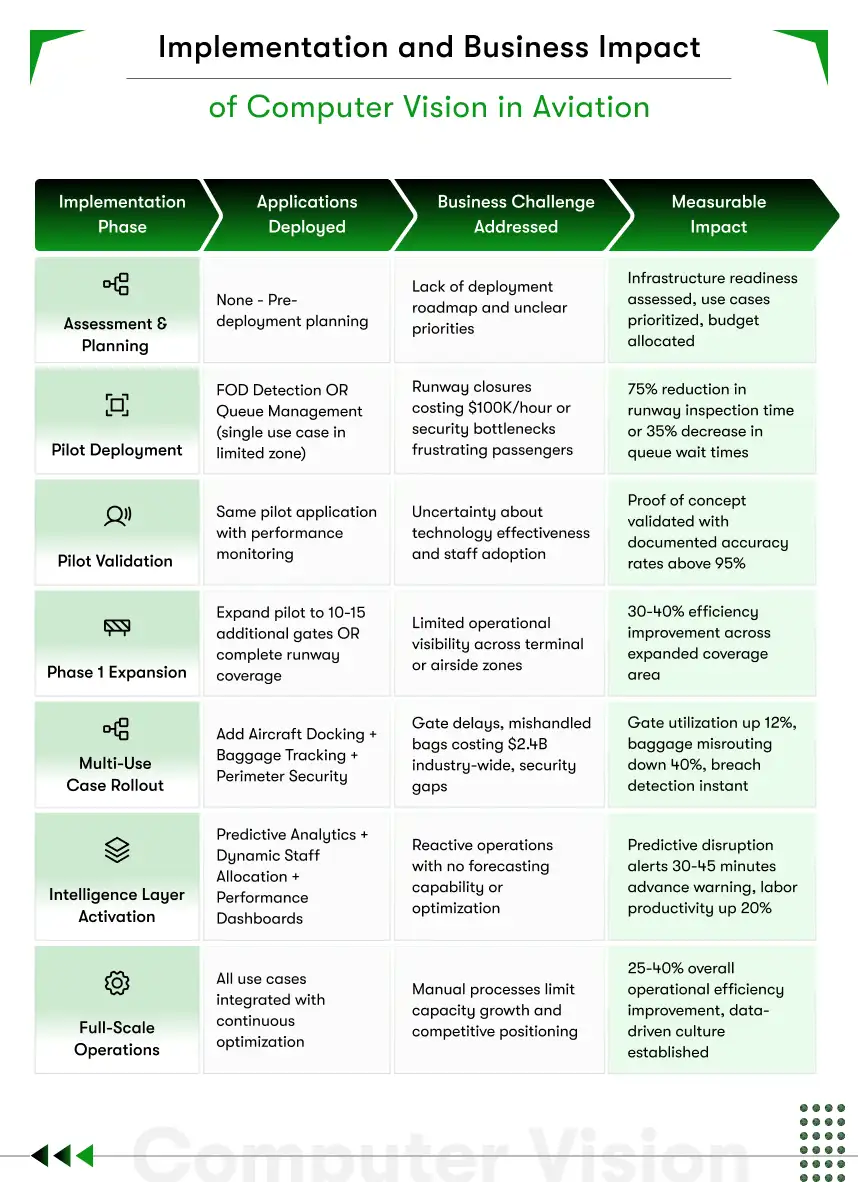
What the Numbers Say
- Inspection time: AI-powered aircraft inspection reduces turnaround inspection time by 30 to 50%, with some narrow-body operators completing full external scans in under 20 minutes (Lufthansa Technik, 2024)
- Defect catch rate: AI vision systems detect surface defects with 95%+ accuracy versus an industry average of 70 to 80% for manual inspection (Oliver Wyman MRO Survey, 2024)
- AOG cost avoidance: Catching a structural issue during a scheduled check rather than an unscheduled event avoids an average of $150,000 per day in AOG costs
- Passenger processing: Biometric vision at boarding gates reduces processing time by up to 60%, directly improving on-time departure rates
- FOD damage reduction: Continuous runway vision monitoring has reduced FOD-related incidents by 70% at airports where it has been deployed at scale (ACI World, 2024)
Conclusion
The field of computer vision in aviation is evolving at a very high rate and assisting the airports and airlines to increase their ROI by enhancing the efficiency of their operations. The technology ensures less expenditure on manual checking of products, avoidance of delays, and allocation of resources is made better across operations. The initial adopters have reported 15-40% efficiency improvements in specific applications in the first year.
The vision systems provide quantifiable pay-offs in terms of shorter turnaround times, lower mishandled baggage rates, and better use of the gates. The benefits related to safety and the increase in the passenger experience through the improvement of the experience lead to growth in money and loyalty.
If you are ready to bring AI vision intelligence into your aviation operation, Kody Technolab is the partner to do it with. Whether you need a dedicated computer vision software development company to build your system, experienced developers to join your team, or a consulting engagement to define your roadmap, we help aviation organisations move from use case to live deployment with precision.

Frequently Asked Questions
What is computer vision used for in aviation?
Computer vision in aviation is used for aircraft structural inspection, runway FOD detection, baggage tracking, passenger flow management, biometric identity verification, ramp safety monitoring, and pilot vision assistance systems. It automates visual tasks that were previously performed manually, delivering higher accuracy and faster turnaround across the full aviation operation.
How does AI computer vision improve airport safety?
AI computer vision in aviation improves safety by removing human error and fatigue from critical visual inspection and monitoring tasks. Runway systems detect foreign object debris within seconds. Ramp monitoring systems identify unsafe vehicle movements before incidents occur. Inspection systems catch structural defects that manual checks miss. Every alert is logged automatically, creating a continuous, auditable safety record.
What are the main benefits of computer vision in aviation?
The primary benefits of computer vision in aviation are improved safety through consistent, fatigue-free inspection; faster aircraft turnarounds through automated visual checks; significant cost savings from predictive maintenance and reduced AOG events; better passenger experience through faster biometric processing; and stronger regulatory compliance through automated digital record-keeping.
How much does a computer vision system cost for aviation?
Computer vision software development cost in aviation varies significantly based on use case complexity, regulatory requirements, hardware, and integration scope. A focused FOD detection deployment for a single runway typically ranges from $200,000 to $500,000. A full MRO inspection system with multi-aircraft coverage and regulatory documentation support can exceed $1 million. A scoped pilot on a single aircraft type or terminal zone is the most practical starting point for validating ROI before full commitment.
Which airports are currently using AI vision systems?
Changi Airport in Singapore, Heathrow in London, Dubai International, Amsterdam Schiphol, and Seoul Incheon are among the most advanced airports currently operating AI vision systems at scale. Applications range from biometric passenger processing and baggage automation to ramp monitoring and runway surveillance. The technology is also deployed at hundreds of regional airports through platforms integrated into standard airport management systems.







 Contact Information