Quick Summary: Computer vision in retail changes how store performance gets measured, managed, and improved. Retail leaders exploring inventory accuracy, checkout efficiency, loss control, and execution consistency need clarity before investment decisions. This guide explains real use cases, implementation challenges, partner selection, and execution strategy, helping decision-makers move forward with confidence and control.
Cameras in modern retail spaces now perform far beyond security surveillance. Computer vision in retail has become a vital tool for operational efficiency, tracking inventory in real time, streamlining the checkout process, and offering deep insights into shopper behavior. Unlike legacy systems, computer vision technology delivers accurate, actionable data that drives decision-making.
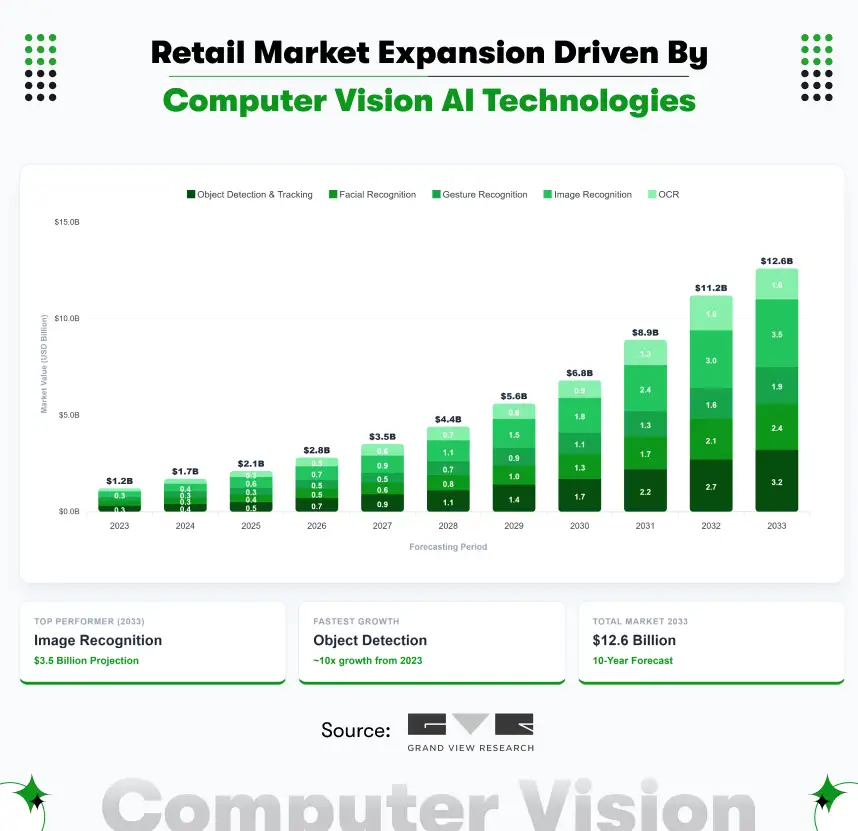
With the global market of computer vision in retail accelerating from $1.66 billion in 2024 toward $12.56 billion by 2033 at a 25.4% CAGR, this technology has shifted from experimental pilot programs to essential infrastructure for competitive enterprise operations. Source: grandviewresearch
Once viewed as an experimental solution, computer vision in retail is now seen as essential infrastructure for competitive enterprises. For CEOs and CTOs managing multi-location operations across the United States, United Kingdom, and United Arab Emirates, implementing intelligent vision systems addresses critical P&L challenges.
The focus today is on how quickly companies can scale automated inventory systems, create seamless checkout experiences, and use predictive analytics to capture market share. In high-value retail environments, operational efficiency is key to profitability, and computer vision is the driving force behind this transformation.
If you plan to implement computer vision in retail but feel unsure where to begin, read our comprehensive Computer Vision Development Guide to gain clarity, structure, and a practical roadmap for confident execution.
What is Computer Vision in Retail?
Computer vision in retail is a powerful technology that enables businesses to automatically analyze and interpret visual data from their store environments. This AI-driven solution processes images and video feeds from cameras or sensors to gather valuable insights, improving retail optimization and operational efficiency.
In the context of retail AI computer vision technology, this technology allows for real-time inventory tracking, shelf scanning for stock levels, and customer behavior analysis.
For example, computer vision in retail can identify misplaced items, ensure that shelves are well-stocked, and track foot traffic patterns, helping businesses make data-driven decisions to enhance store layouts and product placements.
Beyond inventory management, computer vision helps retailers reduce checkout friction through AI vision in retail, enabling features like automated checkout and contactless shopping. It also plays a critical role in loss prevention, detecting potential theft by analyzing visual data.
As computer vision becomes an integral part of retail operations, it offers retailers the tools to enhance operational efficiency, improve customer experience, and increase profitability.
Key Benefits of Computer Vision in Retail and How It Drives Profitability, Efficiency, and Customer Experience
Computer vision in retail is not just a technological advancement; it’s a strategic asset that enhances operational efficiency and profitability. Retailers across the globe are adopting AI-powered vision systems to solve key operational challenges, from managing inventory to improving customer satisfaction.
This technology provides real-time insights, drives automated solutions, and ultimately leads to better decision-making and a stronger bottom line.
Real-Time Inventory Tracking and Improved Stock Management
Managing inventory has always been a challenge in retail, but computer vision changes the game by providing real-time tracking that ensures stock levels are always up to date. This AI-powered system automates inventory monitoring and provides instant updates on stock availability.
- Accurate Stock Levels: Computer vision enables real-time tracking, eliminating stockouts and overstocking by ensuring accurate inventory levels.
- Optimized Replenishment: The system automatically triggers inventory replenishment orders when stock runs low, ensuring products are always available.
- Reduced Labor Costs: Automated systems reduce the need for manual inventory checks, leading to cost savings on labor and improved resource allocation.
In summary, real-time inventory tracking powered by computer vision ensures accurate stock management, reducing costs and improving sales opportunities by keeping shelves stocked with the right products.
Enhancing Customer Experience with Data-Driven Insights
Computer vision provides retailers with direct visibility into customer movement and product interaction inside stores. Visual data shows where shoppers pause, browse, and exit, offering a practical view into how retailers use people analytics for physical store decisions.
Retail teams apply such insight to refine layouts, improve product placement, and guide merchandising decisions.
- Customer movement data highlights high-traffic zones and weak engagement areas. Retail teams adjust layouts to improve visibility and conversion.
- Visual interaction data supports promotions based on real shelf behavior instead of assumptions.
- Operational teams respond faster during peak hours and campaign periods using continuous visual feedback.
Customer behavior insights from computer vision support layout design, merchandising strategy, and in-store experience planning with operational clarity.
Streamlined Checkout Process and Reduced Wait Times
A seamless checkout experience is crucial for customer satisfaction. Computer vision enables contactless checkout, allowing customers to simply pick up items and walk out without waiting in long lines. This AI technology automates the checkout process, ensuring faster and smoother transactions.
- Faster Checkout: AI-powered systems automate the checkout process, reducing wait times and improving flow using queue and dwell-time analytics in retail.
- Higher Satisfaction: Reduced friction at checkout leads to higher satisfaction, encouraging repeat visits.
- Lower Labor Needs: Automated checkout systems reduce the reliance on cashiers, allowing employees to focus on customer service.
The automated checkout system powered by computer vision reduces wait times and improves customer satisfaction, enhancing the overall shopping experience and optimizing labor resources.
Loss Prevention and Theft Detection
Loss prevention is a constant concern for retailers. Computer vision provides a solution by monitoring store activity in real-time and identifying suspicious behavior, thus reducing shrinkage and protecting revenue.
- Real-Time Monitoring: AI-powered surveillance continuously monitors the store for any suspicious activities, providing instant alerts for potential theft.
- Improved Accuracy: Unlike traditional security methods, computer vision detects suspicious actions with greater precision, reducing the chances of missed incidents.
- Cost Savings: Preventing theft directly impacts profit margins, making computer vision an essential tool for retailers looking to safeguard revenue.
Computer vision enhances loss prevention by providing real-time surveillance and detecting theft accurately, helping retailers protect their profits and reduce shrinkage.
Optimizing Operational Efficiency and Reducing Labor Costs
Operational efficiency is crucial for staying competitive in the retail industry. Computer vision helps automate routine tasks like inventory tracking, product placement, and customer monitoring, supported by retail heatmap analytics that reveal how space and staff effort get used across the store. Such visibility leads to improved resource allocation and measurable cost savings.
- Task Automation: AI systems automate repetitive tasks, freeing up employees to focus on higher-value activities that improve customer service.
- Optimized Workflow: Computer vision provides insights, including signals from retail heatmap analytics, that help prioritize tasks and allocate effort where impact remains highest.
- Cost Efficiency: Reducing manual labor and optimizing workflows allows businesses to save on operational costs and increase productivity.
By streamlining operations and automating routine tasks, computer vision helps retailers reduce labor costs, increase efficiency, and achieve better profitability.
Computer vision in retail delivers direct operational value across inventory accuracy, checkout speed, loss prevention, and in-store decision quality.
Retail leadership teams gain tighter cost control, stronger on-shelf availability, and consistent customer experiences across multi-location operations.
Organizations that approach computer vision in retail with clear commercial objectives place daily operations on a foundation built for predictable margins and scalable growth.
How Computer Vision in Retail Improves Daily Store Operations at Scale
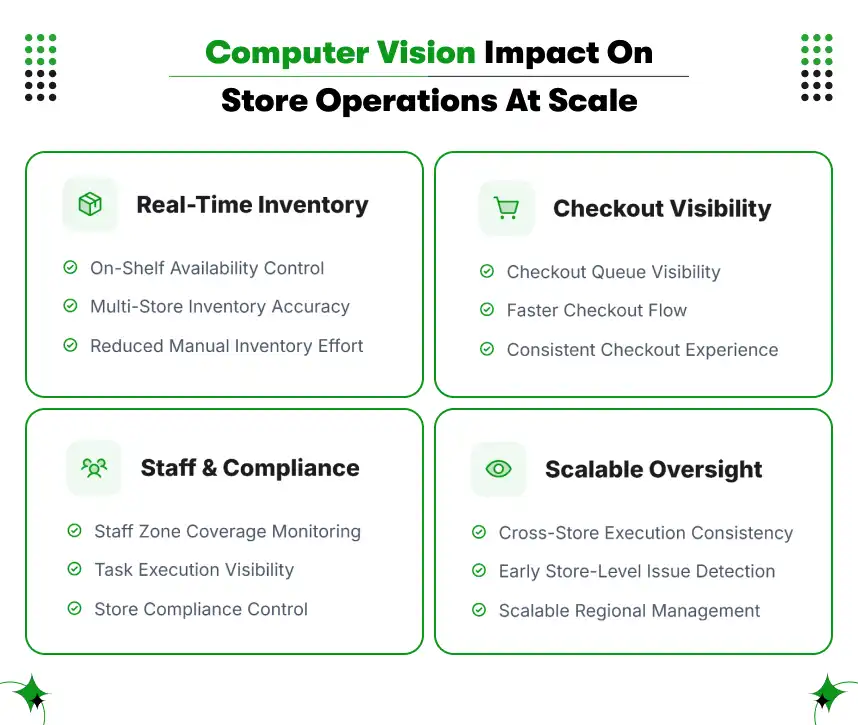
Retail operations depend on accurate visibility across inventory, checkout flow, staff activity, and store compliance. Computer vision in retail improves daily store operations through continuous visual awareness inside physical locations.
Retail leadership teams gain operational clarity across single stores and large networks without manual audits or delayed reports. Vision intelligence for retail supports faster decisions, tighter cost control, and consistent execution across locations.
Inventory execution across shelves and stock rooms
Inventory errors disrupt sales, create excess labor effort, and damage customer trust. Computer vision retail optimization enables constant shelf and stock room monitoring through visual data captured across store zones, forming the foundation of retail computer vision intelligence used for day-to-day inventory decisions. Retail teams receive accurate inventory signals without manual scanning or periodic stock checks.
- On-shelf availability control
Visual systems detect empty shelves, misplaced products, and incorrect facings during store hours. Store teams respond faster to availability gaps using retail computer vision intelligence rather than delayed audits.
- Stock accuracy across locations
Retail AI computer vision technology maintains consistent inventory visibility across multiple stores. Central teams identify patterns without relying on store-level reporting.
- Reduced manual inventory tasks
Automated visual tracking replaces repetitive stock checks. Store staff focus on customer-facing work instead of routine counting.
Inventory execution supported through computer vision improves stock accuracy, reduces labor pressure, and protects revenue across daily retail operations.
Checkout flow and queue management
Checkout congestion slows store throughput and frustrates customers. AI vision in retail improves checkout flow through visual monitoring of queues, counters, and customer movement near payment zones. Retail teams gain real-time awareness of bottlenecks during peak hours.
- Queue length visibility
Visual systems identify queue buildup early. Store managers adjust counter staffing before delays escalate.
- Faster transaction flow
Checkout operations move smoother when staff allocation matches real-time demand.
- Consistent checkout experience
Store operations maintain predictable service levels across locations and time periods.
Checkout flow managed through computer vision reduces wait time pressure and supports higher store throughput during busy operating windows.
Staff activity and floor compliance
Store performance relies on consistent execution across staff roles and floor standards. Computer vision in retail enables objective visibility into staff presence, task completion, and floor coverage without intrusive supervision, supported by retail space utilization analytics that show how different store areas get used throughout the day.
- Zone coverage monitoring
Visual data confirms staff availability across store sections during operational hours, aligned with insights from retail space utilization analytics.
- Task execution visibility
Retail teams track shelf replenishment, cleaning cycles, and display maintenance through visual confirmation.
- Operational discipline
Store standards remain consistent without constant manual supervision.
Staff activity visibility supported through computer vision strengthens accountability and maintains store readiness across shifts and locations.
Multi-store operational consistency
Retail scale fails when store execution varies across locations. Computer vision retail optimization gives leadership teams direct visibility into store conditions across networks without manual audits.
- Consistent execution visibility
Visual intelligence for retail tracks shelf availability, checkout readiness, and floor activity using the same standards across stores.
- Early detection of store-level issues
Visual signals highlight repeated shelf gaps, idle checkout counters, and missed floor tasks at specific locations. Regional teams act before revenue loss or customer complaints increase.
- Scalable regional oversight
Area managers review multiple stores through visual dashboards instead of physical visits, supporting scale without extra supervision.
Operational consistency improves when leadership teams rely on visual execution data instead of subjective store reporting.
Computer vision in retail strengthens daily operations through accurate inventory execution, controlled checkout flow, disciplined staff activity, and consistent multi-store performance.
Retail organizations that understand how computer vision can be used in retail gain predictable operations and stronger margin control. Decision-makers exploring how to use computer vision in retail position store networks for scalable execution and long-term operational confidence.
Use Cases of Computer Vision in Retail That Deliver Measurable Operational Impact
Retail decision-makers evaluate technology through practical application, not theory. Computer vision in retail proves value when deployed against daily operational problems inside stores. Real-world use cases show how visual intelligence converts raw camera data into operational control across inventory accuracy, checkout flow, loss prevention, and store execution. Each use case below reflects scenarios retail leaders actively evaluate while planning scalable deployments.
Shelf availability and inventory accuracy
Shelf gaps directly affect revenue and customer trust. Computer vision retail optimization monitors shelf conditions continuously across store aisles using visual recognition models trained on product placement and facings.
- Out of stock detection during store hours
Visual systems identify empty shelf positions and misplaced products while customers shop, allowing faster staff response.
- Planogram compliance visibility
Retail AI computer vision technology verifies product placement against approved layouts without manual checks.
- Inventory accuracy across locations
Central teams view shelf status across multiple stores without relying on store-submitted reports.
Inventory visibility through computer vision supports revenue protection, faster replenishment cycles, and consistent shelf execution.
Customer movement and in-store behavior analysis
Understanding physical shopper behavior remains difficult without objective observation. AI vision in retail captures anonymized movement patterns across entry points, aisles, and product zones.
- Footfall pattern visibility
Visual data shows peak traffic zones and underperforming store areas.
- Product interaction tracking
Retail teams identify products that attract attention without conversion.
- Layout improvement decisions
Store planners adjust aisle design and product placement based on observed behavior rather than assumptions.
Behavior insights from computer vision support smarter merchandising decisions and better store layout planning.
Checkout flow and queue management
Checkout delays create lost sales and poor customer experience. Computer vision in retail improves checkout flow through real-time visibility into queue buildup and counter readiness.
- Queue length monitoring
Visual systems track customer buildup near checkout counters during peak hours.
- Staff allocation support
Store managers adjust counter staffing based on live demand signals.
- Predictable service levels
Checkout operations maintain consistency across time slots and locations.
Checkout visibility through computer vision improves store throughput and reduces customer frustration during high-traffic periods.
Loss prevention and shrinkage control
Shrinkage results from limited visibility into in-store product movement and customer behavior. Computer vision in retail improves loss prevention through structured analysis of product handling and exit activity. Retail teams review incidents with a clear visual context instead of scanning long video recordings.
- Product handling pattern detection
Visual systems identify abnormal sequences such as concealment gestures, repeated shelf interaction, and extended dwell time near exits.
- Checkout mismatch visibility
Product movement near exits is matched against completed transactions. Unpaid item movement triggers review workflows.
- Faster incident review
Each event includes location, timing, and visual evidence, reducing investigation effort.
- Lower operational friction
Focused alerts reduce unnecessary staff intervention and manual surveillance effort.
Loss prevention supported through computer vision protects margins through faster detection and clearer incident context.
Staff activity and floor execution monitoring
Retail performance breaks when staff presence, task timing, and floor readiness drift during operating hours. Computer vision in retail creates objective visibility into staff movement, zone coverage, and task execution without relying on supervisor observation or self-reported updates.
- Zone presence validation
Visual systems confirm staff availability in priority zones during peak hours, shift changes, and promotional periods, reducing unattended sales areas.
- Task timing visibility
Shelf replenishment, display setup, and floor maintenance receive time-based visual confirmation, highlighting delays and missed execution windows.
- Execution variance detection
Store-level execution patterns surface gaps between expected and actual staff activity, allowing regional teams to intervene with precision.
Staff execution monitoring through computer vision improves floor readiness, reduces operational drift, and supports consistent performance across shifts and locations.
Real-world use cases show how computer vision in retail converts cameras into operational intelligence. Retail organizations exploring how computer vision can be used in retail gain control over inventory accuracy, checkout flow, loss prevention, and store execution.
Decision-makers evaluating how to use computer vision in retail move closer to predictable operations, controlled costs, and scalable growth when use cases align with daily store realities.
Real World Use Cases of Computer Vision in Retail That Prove Business Value
Retail leaders trust technology only after observing proven results inside live store environments. Computer vision in retail demonstrates value through deployments that solve inventory accuracy, checkout friction, and margin protection challenges at scale. The following real-world use cases reflect how large retailers apply vision intelligence to daily operations with measurable operational control.
Walmart and Target inventory accuracy and stock management
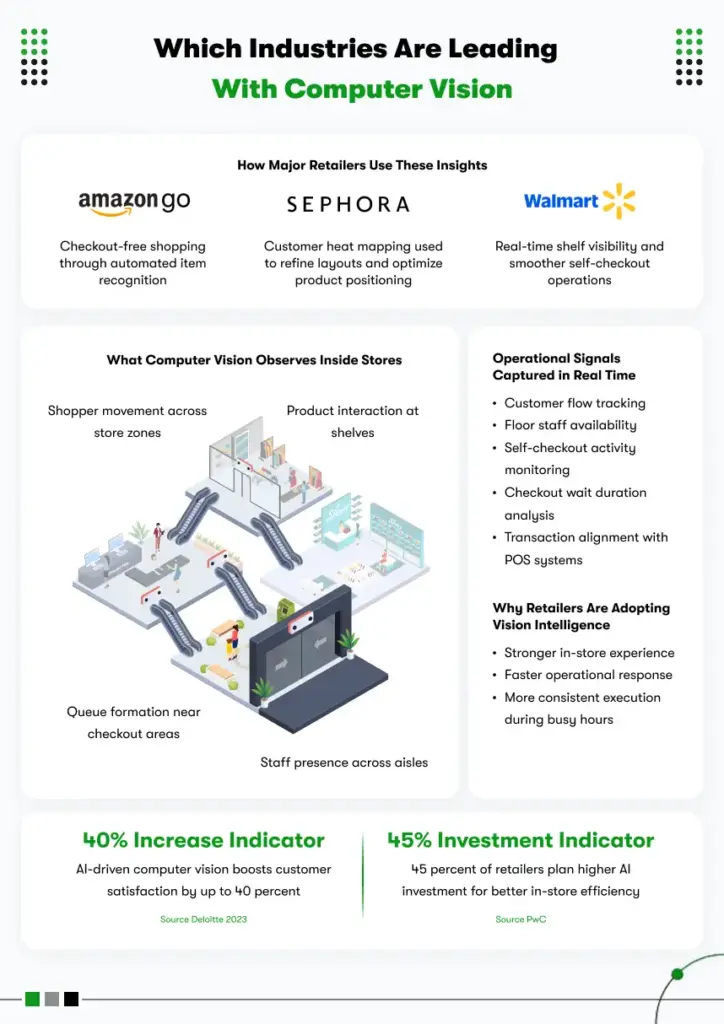
Large-format retailers struggle with inventory accuracy across thousands of SKUs and locations. Walmart and Target apply computer vision retail optimization to maintain shelf availability and reduce reliance on manual stock checks.
- Continuous shelf monitoring
Vision systems scan aisles during store hours to identify empty facings, misplaced items, and incorrect product positioning.
- Centralized inventory visibility
Retail AI computer vision technology delivers consistent shelf status signals across locations, supporting faster replenishment decisions.
- Reduced manual audits
Store teams spend less time counting inventory and more time addressing availability gaps that affect sales.
Inventory execution supported through computer vision protects revenue, improves shelf accuracy, and scales across large retail networks.
Amazon Go frictionless checkout execution
Checkout queues create friction that reduces store throughput and customer satisfaction. Amazon Go applies AI vision in retail to remove traditional checkout entirely through automated product recognition and transaction processing.
- Product recognition during shopping
Vision systems track item selection and return events as customers move through the store.
- Automatic transaction completion
Purchases process without checkout counters, payment queues, or cashier intervention.
- Consistent checkout experience
Store throughput remains predictable during peak periods without staffing adjustments.
Frictionless checkout through computer vision proves how visual intelligence reshapes transaction flow inside physical retail environments.
Retail deployments demonstrate how computer vision delivers control at scale when applied to defined operational problems. Inventory accuracy at Walmart and Target improves through continuous shelf visibility, while Amazon Go removes checkout queues through automated product recognition.
Loss prevention across large retail chains gains speed and precision through behavior-level monitoring, giving decision-makers confidence through proven store-level execution.
Why Computer Vision in Retail Solves Problems Retail Leaders Actually Face
Retail leaders face resistance, cost pressure, and operational risk during computer vision implementation, including early concerns around Computer Vision Software Development Cost as projects move from pilot to production. Most failures occur because teams underestimate real store challenges during rollout. Computer vision in retail succeeds only when deployment plans address operational friction that appears across inventory accuracy, checkout flow, loss prevention, staff execution, and multi-store consistency.
Challenge 1: Inaccurate inventory visibility during store hours
Retail inventory systems often show availability while shelves remain empty. Manual audits detect gaps after sales loss already occurs. Store teams lack live visibility into shelf conditions during selling hours.
How computer vision addresses inventory visibility
Computer vision retail optimization monitors shelves continuously during store operations. Visual signals highlight empty facings, misplaced products, and delayed replenishment. Store teams respond during active selling hours. Central teams view execution status across locations without relying on end-of-day reports.
Inventory accuracy improves when shelf conditions guide decisions during store operations.
Challenge 2: Checkout congestion during peak traffic
Checkout congestion limits store throughput and damages customer experience. Staffing plans rely on forecasts instead of real-time demand, creating queues during peak periods.
How computer vision addresses checkout congestion
AI vision in retail tracks queue buildup and counter readiness during operating hours. Store managers receive live visibility into congestion patterns. Staffing adjustments follow real demand instead of static schedules.
Checkout performance stabilizes when operational decisions follow live store activity.
Challenge 3: Shrinkage detected after the financial impact
Shrinkage appears in reports after loss accumulates. Manual video review consumes time without preventing repeated theft patterns. Loss prevention teams lack timely operational signals.
How computer vision addresses shrinkage detection
Retail AI computer vision technology observes product handling, shelf interaction, and exit movement during store hours. Visual signals surface high-risk behavior early. Loss prevention teams focus effort on verified events instead of continuous surveillance.
Shrinkage control improves when risk signals appear before financial loss compounds.
Challenge 4: Inconsistent staff execution across shifts
Store performance drops when staff coverage and task timing vary across shifts. Supervisory oversight struggles to scale across large teams and extended hours.
How computer vision addresses staff execution gaps
Vision intelligence for retail provides objective visibility into zone coverage and task completion. Store leaders identify execution gaps early without intrusive monitoring. Corrective action follows observed patterns rather than assumptions.
Execution consistency improves when leadership relies on observed store activity.
Challenge 5: Operational inconsistency across multi-store networks
Retail scale introduces uneven execution across locations. Regional teams depend on store reports and periodic audits that miss daily operational drift.
How computer vision addresses multi-store inconsistency
Computer vision in retail delivers standardized operational visibility across store networks. Leadership teams compare shelf readiness, checkout flow, and floor activity using uniform criteria across locations. Intervention occurs with precision instead of broad corrective measures.
Multi-store consistency improves when operational visibility scales across locations.
Implementing computer vision in retail requires confronting real operational challenges, not theoretical limitations. Inventory visibility, checkout congestion, shrinkage timing, staff execution, and multi-store inconsistency define the core barriers during rollout.
Retail organizations that address each challenge with clear operational solutions reduce risk, control costs, and unlock scalable store performance.
Choosing the Right Computer Vision Partner for Retail Operations at Scale
Partner selection defines the success or failure of computer vision in retail long before deployment begins. Retail leadership teams make irreversible decisions during partner evaluation that affect cost exposure, execution reliability, internal adoption, and long-term control.
A structured decision framework helps senior leaders evaluate partners based on operational ownership rather than surface capability.
Retail experience versus pure computer vision capability
Retail environments introduce constant variation through foot traffic patterns, staffing constraints, lighting inconsistencies, and continuous on-floor activity. Vendors without direct retail exposure often design computer vision systems that perform well during controlled evaluations but struggle during live store operations where conditions change hour by hour.
Retail businesses should evaluate whether a partner understands store operations beyond technical delivery and model performance.
- Evidence of deployments inside active retail stores
A credible partner can point to live retail deployments where solutions operated during business hours, handled customer movement, and adapted to store-specific conditions without constant intervention.
- Ability to discuss shelf replenishment timing, checkout congestion, and staff constraints
Strong partners speak clearly about how inventory replenishment cycles, peak-hour checkout pressure, and limited staff availability affect system behavior and operational outcomes.
- Comfort explaining failures that occur during peak hours and recovery actions
Partners with real retail experience openly explain where systems break under load and how recovery processes restore accuracy and operational confidence.
Partners with retail execution experience reduce deployment risk and improve reliability during live store conditions.
Customization depth across store formats and layouts
Retail networks operate across multiple formats, layouts, and product densities. Differences between compact stores, large-format stores, and mixed-use locations create performance gaps for rigid computer vision solutions.
Partner evaluation should focus on adaptation capability rather than generic coverage claims.
- Model tuning for varied store layouts and shelf structures
Effective partners adjust vision models to account for aisle width, shelf height, product density, and camera placement differences without requiring full system redesign. - Flexibility across supermarkets, hypermarkets, and compact formats
Customization capability allows solutions to function consistently across different retail formats while preserving accuracy and operational relevance.
- Structured process for adjustments during assortment and layout changes
Retail assortments change frequently. Reliable partners maintain clear processes for updating models as products rotate, promotions launch, or layouts shift.
Customization protects system performance while allowing retail teams to maintain existing workflows.
Integration into daily retail operations
Computer vision creates operational value only when insight connects directly to daily retail decision-making. Separate dashboards and isolated tools increase friction, reduce usage, and slow response time.
Retail businesses should assess how partners connect vision output to operational paths already in use.
- Integration with inventory systems, transaction data, and reporting tools
Vision insights gain relevance when connected to inventory records, sales data, and operational reporting systems used across stores and headquarters.
- Alert delivery inside platforms already used by store and regional teams
Partners should deliver insights through existing tools rather than introducing additional interfaces that increase training effort.
- Reduced reporting effort for store staff
Well-integrated solutions decrease manual reporting and free staff time for customer-facing work.
Integration quality determines adoption and long-term operational usage.
Readiness for multi-store scale
Pilot success often hides scale risk. Expansion across regions introduces variation in store conditions, staffing models, and operating environments that expose weak deployment planning.
Retail businesses must evaluate partner readiness beyond pilot environments.
- Experience managing multi-store rollouts
Partners with scaling experience understand how performance shifts as store count increases and can maintain consistency across locations.
- Governance approach for consistent performance across locations
Clear governance ensures model behavior, alert logic, and operational thresholds remain aligned across the network.
- Expansion strategy that avoids repeated redesign
Scalable solutions grow through structured rollout plans rather than repeated customization at each new location.
Scale discipline protects investment as store networks expand.
Long-term accountability after deployment
Retail operations change continuously through promotions, seasonality, assortment updates, and layout revisions. Static computer vision systems lose accuracy without ongoing attention.
Partner selection should account for responsibility beyond initial deployment.
- Commitment to continuous performance monitoring
Reliable partners track system behavior over time and identify performance drift before operational impact appears.
- Process for ongoing refinement as store conditions change
Clear refinement processes allow solutions to evolve alongside retail operations without disruption.
- Alignment with retail planning and review cycles
Partners aligned with retail planning timelines support operational reviews, seasonal changes, and long-term improvement.
Accountability sustains operational value and protects long-term confidence.
Choosing the right computer vision partner requires disciplined evaluation across retail understanding, customization depth, integration strength, scale readiness, and long-term accountability, especially when businesses plan to hire computer vision developers for long-term execution and system ownership. Retail businesses that follow a structured decision approach reduce operational risk and gain confidence before deployment begins.
A Practical Path to Confident Computer Vision Adoption in Retail
Computer vision in retail succeeds when strategy, execution, and partner choice align with real store operations. Inventory accuracy, checkout flow, loss control, and staff execution define daily retail performance. Each decision taken during planning and implementation shapes long-term cost control and customer experience.
Retail organizations that treat computer vision as an operational system gain clarity across stores and confidence across teams. Clear goals, realistic rollout planning, and disciplined partner evaluation reduce risk and protect investment value.
Decision-makers who approach computer vision with operational ownership avoid stalled pilots and fragmented deployments. Strong outcomes follow structured execution and measurable accountability.
Kody Technolab Limited supports retail organizations through every stage of computer vision adoption as a trusted Computer Vision Software Development Company. Kody Technolab designs custom AI automation software aligned with store realities, system integration needs, and multi-location scale.
Retail teams receive tailored solutions, clear execution ownership, and long-term support. Businesses seeking reliable computer vision in retail can work with Kody Technolab to move from strategy to production with confidence and control.
FAQs
What business problems does computer vision in retail solve first
Computer vision in retail delivers the fastest impact on inventory accuracy, checkout flow, shrinkage visibility, and store execution consistency. Retail leaders usually prioritize shelf availability and checkout congestion because revenue leakage becomes visible within weeks. Loss prevention and staff execution follow once operational signals stabilize.
How long does computer vision implementation take in live retail stores
Timelines depend on store format complexity, camera readiness, and system integration depth. A focused pilot typically requires several weeks to stabilize outputs under live conditions. Network-wide rollout depends on rollout discipline rather than model complexity. Rushed deployments increase rework and internal resistance.
Does computer vision in retail require replacing existing camera systems
Most deployments reuse existing camera infrastructure when placement and coverage meet operational needs. Additional cameras may be required for shelf-level accuracy or checkout visibility. A strong partner evaluates store conditions first and recommends upgrades only where operational gaps exist.
How accurate is computer vision under real store conditions
Accuracy depends on model training using store-specific data, lighting variation handling, and layout awareness. Systems trained only on generic datasets struggle during peak hours. Reliable deployments focus on operational reliability rather than headline accuracy metrics.
How does computer vision integrate with POS and inventory systems
Computer vision gains operational value through direct connection with inventory records, transaction data, and reporting tools. Integration allows visual signals to trigger replenishment actions, staffing adjustments, or loss review workflows. Disconnected dashboards rarely achieve adoption.
What internal teams need involvement during computer vision deployment
Successful deployments involve retail operations, IT, store management, and loss prevention teams from the start. Clear ownership prevents confusion during rollout. Projects stall when ownership remains limited to innovation or technology groups alone.
How does Kody Technolab support computer vision adoption in retail
Kody Technolab Limited designs custom AI automation software aligned with real store operations. Kody Technolab supports strategy, implementation, integration, and long-term optimization. Retail organizations receive tailored solutions, execution accountability, and scalable deployment support across locations.







 Contact Information