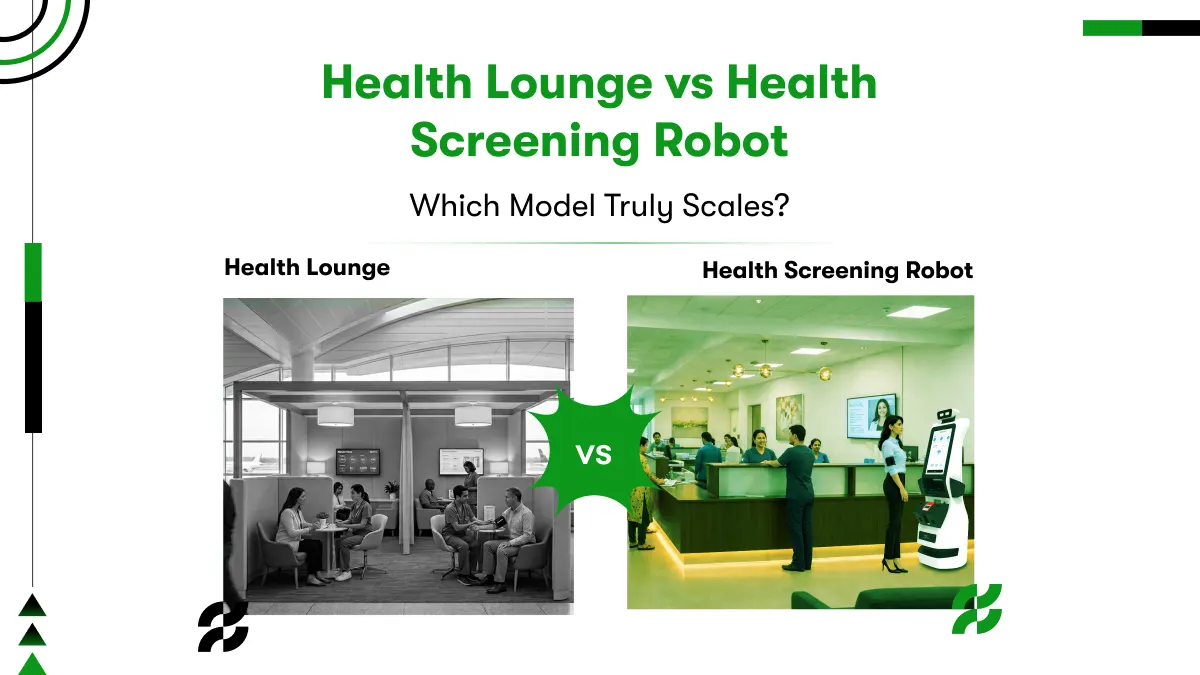
Quick Summary: Most organizations invest in employee health, yet struggle to deliver it consistently across every location. This blog on Health Lounge vs Health Screening Robot reveals why traditional models fall short at scale and how automated health screening solves it. Discover how businesses can expand access, cut costs, and gain real-time health insights, enabling smarter decisions, healthier teams, and a scalable preventive care strategy that grows with the organization.
The global preventive healthcare market is projected to reach USD 585.6 billion by 2030, growing at 11.8% annually. Yet most organizations still rely on a model that requires dedicated rooms, scheduled appointments, and trained staff on standby. When you are evaluating Health Lounge vs. Health Screening Robot as your preventive healthcare strategy, you are really asking one question: Can this model grow with my organization, or will it hold it back?
A health lounge operates as a fixed, staff-assisted screening setup. A health screening robot is an automated, self-operating unit designed for rapid, location-independent assessments. The comparison of health lounge vs robotic health screening is not just about infrastructure, but about scalability, efficiency, and accessibility. Understanding the difference between health lounge and health screening robot helps decision-makers choose between a fixed, resource-heavy model and a flexible, deployable system that supports modern preventive care needs.
What is a Health Lounge and How Does It Work for Health Screening?
A health lounge is a dedicated, physical wellness space within a facility where individuals access health checks, vitals monitoring, and basic diagnostics. It requires a fixed room, installed equipment, and typically a trained health professional to operate it.
Health lounges work well as a centralized wellness destination within a single site. An employee books a slot, walks in, gets checked, and leaves with a report. The experience is structured, human-guided, and familiar.
For organizations with a single large campus and a strong HR-led wellness culture, the health lounge delivers a controlled and comfortable screening environment. Staff can offer contextual guidance, answer questions in real time, and handle sensitive results with care.
However, the model is built on a set of fixed assumptions: one location, consistent footfall, available staff, and a budget that can sustain dedicated space and personnel year-round. Health lounge assumptions hold reasonably well in large, single-site organizations. They begin to break down the moment an organization tries to replicate that experience across multiple locations or geographies.
What is a Health Screening Robot and How Does Robotic Health Screening Work?
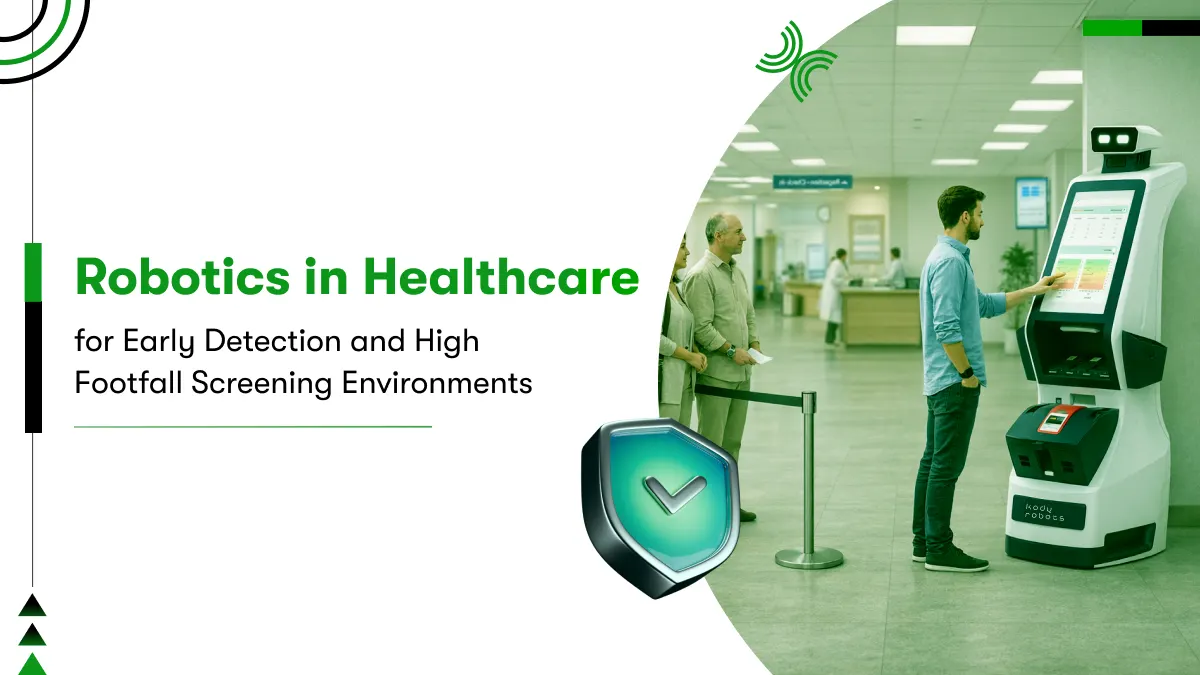
A health screening robot is an AI-powered unit that conducts comprehensive health assessments without requiring a dedicated room, a fixed location, or a trained operator on duty. The user interacts directly with the robot through a guided AI interface, completes the screening, and receives a full health report within minutes.
The robotic health screening process is end-to-end. A user approaches the unit, selects their preferred language, and follows an AI-guided protocol that walks them through each diagnostic step. The robot measures vitals, runs metabolic and hematology checks, assesses cardiac and lung function, and screens for conditions ranging from diabetes and hypertension to infectious diseases. Once the session is complete, the report is delivered instantly via WhatsApp, SMS, email, or on-site thermal print.
The defining characteristic of a health screening robot is its independence from fixed infrastructure. It does not need a clinic, a consultation room, or a nurse on standby. It operates in corporate lobbies, hospital waiting rooms, railway stations, pharmacies, and rural health centers with equal effectiveness. That independence is what makes it a fundamentally different category of preventive healthcare infrastructure.
Health Lounge vs Robotic Health Screening: Where the Gap Starts to Show
When you compare Health Lounge vs. robotic health screening side by side, the differences are not just operational. They reflect two fundamentally different philosophies about how preventive healthcare infrastructure should work.
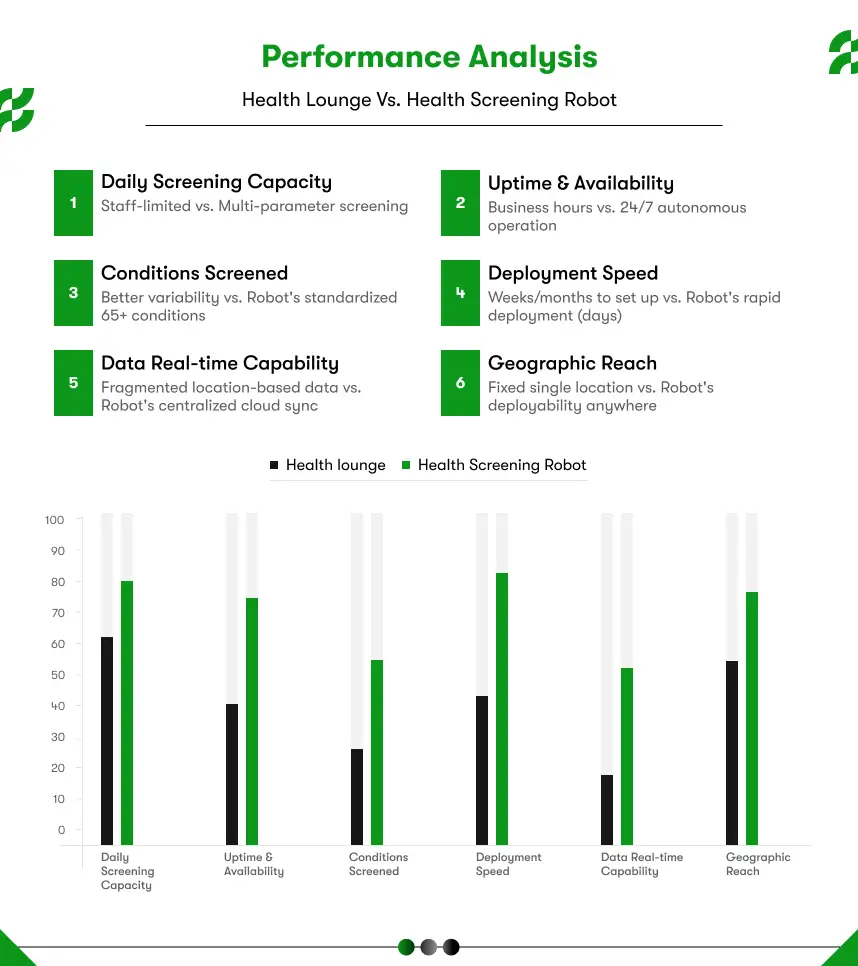
| Factor | Health Lounge | Health Screening Robot |
| Deployment Speed | Weeks to months (fit-out, staffing, equipment procurement) | Days (plug-and-operate unit, no construction required) |
| Cost to Scale | Full cost replicates per new location (space, staff, equipment) | Marginal cost per additional unit, no fixed infrastructure needed |
| Location Flexibility | Fixed to one location permanently | Deployable anywhere: offices, campuses, airports, clinics, villages |
| Operator Dependency | Requires trained staff on duty | Requires only 1 operator |
| Daily Screening Volume | Limited by staff availability and appointment slots | Unlimited screenings per day per unit, no scheduling required |
| Data Capture | Manual, fragmented, often paper-based | Real-time, centralized, cloud-synced across all units |
| Multi-Site Rollout | Expensive and slow, each site is a new project | Scalable fleet model, all units managed from one dashboard |
| Conditions Screened | Depends on staff expertise and equipment available | Multiple screenable conditions per session, standardized and AI-interpreted |
| Report Delivery | Manual, delayed, printed, or emailed later | Instant via WhatsApp, SMS, email, or on-site thermal print |
| Telemedicine Access | Requires a separate referral process | Built-in real-time video consultation with a physician |
The table above is not designed to discredit the health lounge. It is designed to show decision makers where the model starts to create friction at scale. Every cell in the health lounge column represents a constraint that compounds as your organization grows. Every cell in the health screening robot column represents a design decision made specifically to remove that constraint.
Impact on the Business
For any organization managing a workforce across multiple sites, the health lounge creates an invisible inequality. Employees at the headquarters get access to preventive screening, while those at branch offices or remote facilities get nothing. That gap shows up in absenteeism data, insurance claims, and productivity metrics. A business that cannot screen its workforce uniformly cannot make informed decisions about workforce health, and that blind spot has a direct cost.
Impact on the Healthcare Industry
At the healthcare system level, the health lounge model keeps preventive care confined to facilities that already have resources. It does not reach the communities, transit nodes, or underserved populations where the early detection gap is most acute. Health screening robots change that equation by turning any high-footfall location into a functional screening point. For healthcare providers and public health systems, this shift from fixed-facility care to deployable infrastructure is the foundation of genuinely scalable preventive healthcare.
Difference Between a Health Lounge Vs Robotic Health Screening at the Infrastructure Level
The difference between a health lounge and a health screening robot is not just operational. At the infrastructure level, they represent two different investment philosophies with very different long-term outcomes.
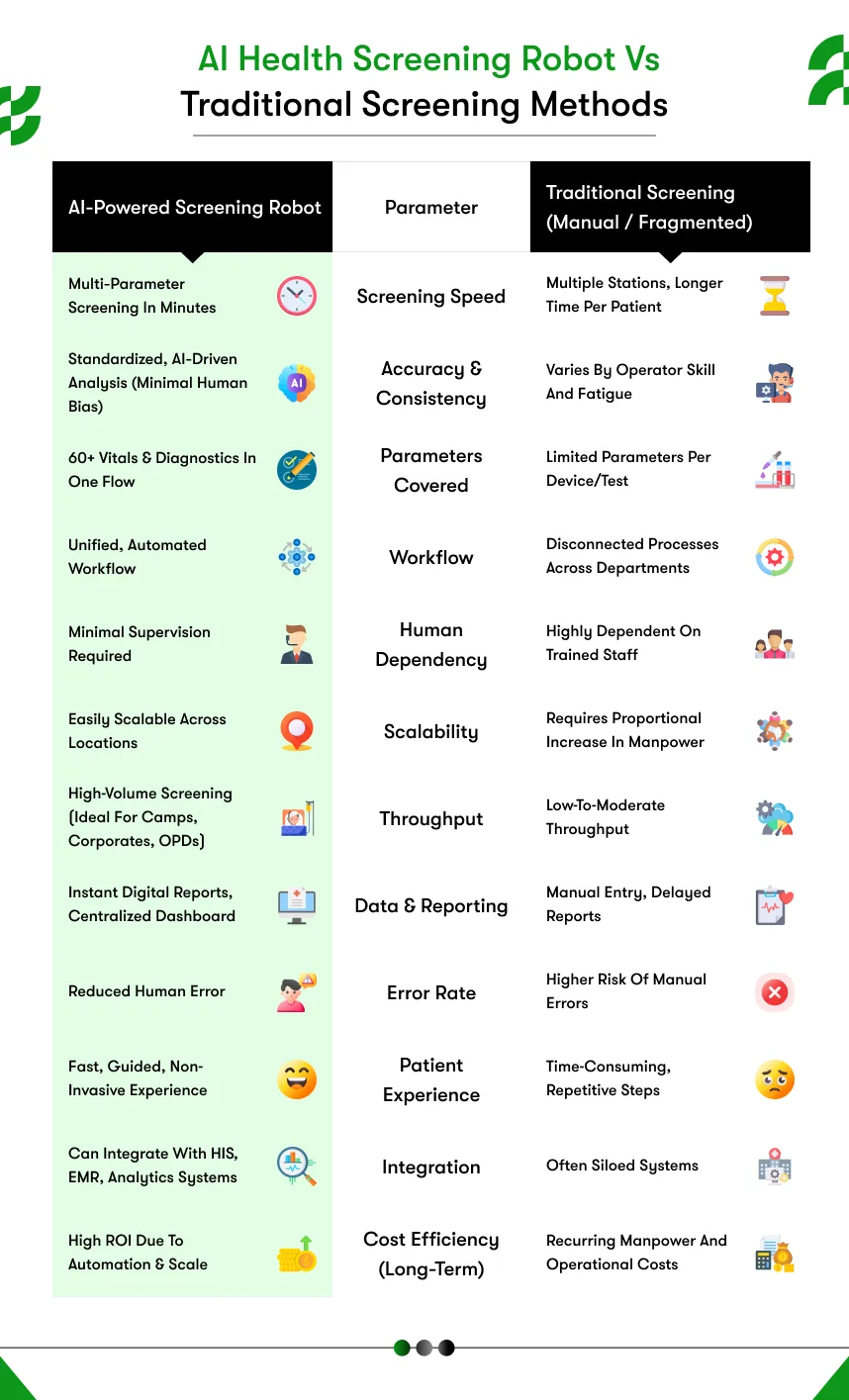
| Dimension | Health Lounge | Health Screening Robot |
| Asset Type | Fixed, room-bound, non-relocatable | Deployable, relocatable, reusable across sites |
| Return on Investment | Capped by single-location footfall | Compounds with every additional deployment |
| Cost Model | Capex-heavy, replicates fully per new site | Marginal unit cost per new location |
| Data Output | Siloed, location-specific, fragmented | Centralized, real-time, standardized across all units |
| Scalability | Linear cost increases with each new site | Non-linear, fleet scales without proportional cost |
A health lounge is a fixed asset. It depreciates in value, occupies space that carries a permanent cost, and delivers a return that is capped by the number of people who can physically access that one location. Every additional site requires the same investment from scratch. The model does not compound; it replicates cost.
A health screening robot is a deployable infrastructure. It can be relocated, redeployed, and scaled as an organization’s needs evolve. A unit placed at a headquarters today can move to a new facility tomorrow, serve a temporary deployment next month, and return to a permanent location the month after. The asset earns a return wherever it operates, not just where it was originally placed.
At the data layer, the difference is even sharper. Health lounges generate siloed, location-specific data that rarely feeds into a unified organizational health picture. Robotic healthcare infrastructure generates real-time, centralized, standardized data across every deployment simultaneously. For C-suite decision makers evaluating preventive care investment, the data advantage alone justifies the shift.
What Business Impact Does a Health Screening Robot Actually Deliver?
A health screening robot delivers measurable business impact across three dimensions: workforce productivity, operational cost, and organizational intelligence. The benefits are not theoretical; they are structural.
Problem
A mid-size enterprise with 2,000 employees across five locations runs a health lounge at its headquarters. Four other sites have no screening infrastructure. Less than 12% of the total workforce accesses preventive screening annually. Undetected conditions drive absenteeism, insurance claims, and late-stage medical interventions that cost significantly more to address.
Insight
Research from the RAND Corporation confirms that well-designed wellness programs reduce healthcare costs by addressing chronic disease risks early. The World Bank estimates that every USD 1 invested in preventive health yields USD 4 to 9 in long-term treatment cost savings. The financial case for early detection is not marginal; it is compounding.
Business Action
The organization deploys a fleet of health screening robots across all five locations. Each unit operates accurately and screens multiple individuals and employees per day, and delivers instant reports without adding headcount. Leadership gains a real-time health dashboard across the entire workforce for the first time.
Result
Screening coverage rises from 12% to over 80% of the workforce within the first quarter. Early detection flags a statistically significant cluster of hypertension and pre-diabetic conditions across two sites. Targeted interventions follow, reducing downstream medical claims and cutting absenteeism measurably within six months.
This is what a transition from reactive to preventive healthcare infrastructure looks like in practice. The health screening robot does not just replace a health lounge; it changes the entire scope of what preventive care can achieve inside an organization.

Why Automated Health Screening Scales Where a Health Lounge Cannot
Automated health screening scales because they separate the delivery of healthcare from the cost of fixed infrastructure. A health lounge ties every new location to a proportional increase in cost: new space, new equipment, new staff. A health screening robot adds a new location by adding a unit.
The scalability advantage operates across four dimensions:
- Capital Efficiency
A health lounge requires a substantial upfront investment in fit-out, equipment, and staffing before a single screening takes place. A health screening robot is operational from day one, with no construction, no recruitment, and no dependency on local medical staffing availability. - Geographic Reach
Preventive healthcare infrastructure built around robotic healthcare kiosks can reach locations where a health lounge is simply not viable. A remote manufacturing facility, a rural community health center, a high-traffic transit node: none of these can support a dedicated staffed wellness room, but all of them can support a deployable unit. - Data Continuity
When an organization operates multiple health lounges, data is fragmented across locations, teams, and reporting systems. A fleet of health screening robots feeds every result into a single centralized dashboard in real time. Leadership sees the health picture across the entire organization, not just the sites that happened to invest in a lounge. - Resilience
A health lounge depends on staff availability. When a nurse is absent, screening stops. A health screening robot operates around the clock, independently of shift patterns, public holidays, or staff turnover.
This is the structural difference between a wellness amenity and a preventive healthcare infrastructure. Robotics in healthcare is not about replacing human care; it is about extending the reach of early detection to every person, at every location, without requiring a clinic to follow them.
Which Preventive Healthcare Infrastructure Model is Right for Your Organization?
A health screening robot vs. health lounge is not a binary choice for every organization in every context. The right model depends on what you are building, how many locations you manage, and what you need your preventive healthcare infrastructure to do in five years, not just today.
Choose a Health Lounge If:
- Your organization operates from a single large site with consistent, high employee footfall.
- You have a mature HR wellness culture, and employees value a human-guided screening experience.
- You need an on-site counseling and follow-up facility for complex or sensitive results.
- Screening volume is low enough that appointment-based access does not create bottlenecks.
Choose a Health Screening Robot If:
- Your organization operates across multiple locations and needs uniform screening access at every site.
- You want real-time health data across your entire workforce, not just the employees at headquarters.
- You are expanding geographically and cannot afford to replicate full lounge infrastructure at every new site.
- You manage a large, dispersed, or shift-based workforce where appointment scheduling is not practical.
- You are a government, hospital network, insurer, or public health agency that needs deployable screening infrastructure at scale.
For governments, hospital networks, insurance providers, and public health agencies, the calculus is even clearer. The preventive healthcare infrastructure gap these organizations face cannot be closed with fixed wellness rooms. It requires deployable, scalable, data-generating infrastructure that reaches every community, every campus, and every transit point, and does so at a cost per screening that makes universal access financially viable.
The question is not whether to invest in preventive healthcare. The question is whether your investment model will still be working for you in five years, or whether it will have hit a ceiling long before then.
Meet Medigo: The Health Screening Robot Built for Organizations That Need to Scale
Medigo is Kody Technolab’s AI-powered health screening robot, purpose-built to close the gap between where preventive healthcare exists today and where it needs to be. It is not a kiosk with a blood pressure cuff. It is a complete, intelligent health screening infrastructure in a single deployable unit.
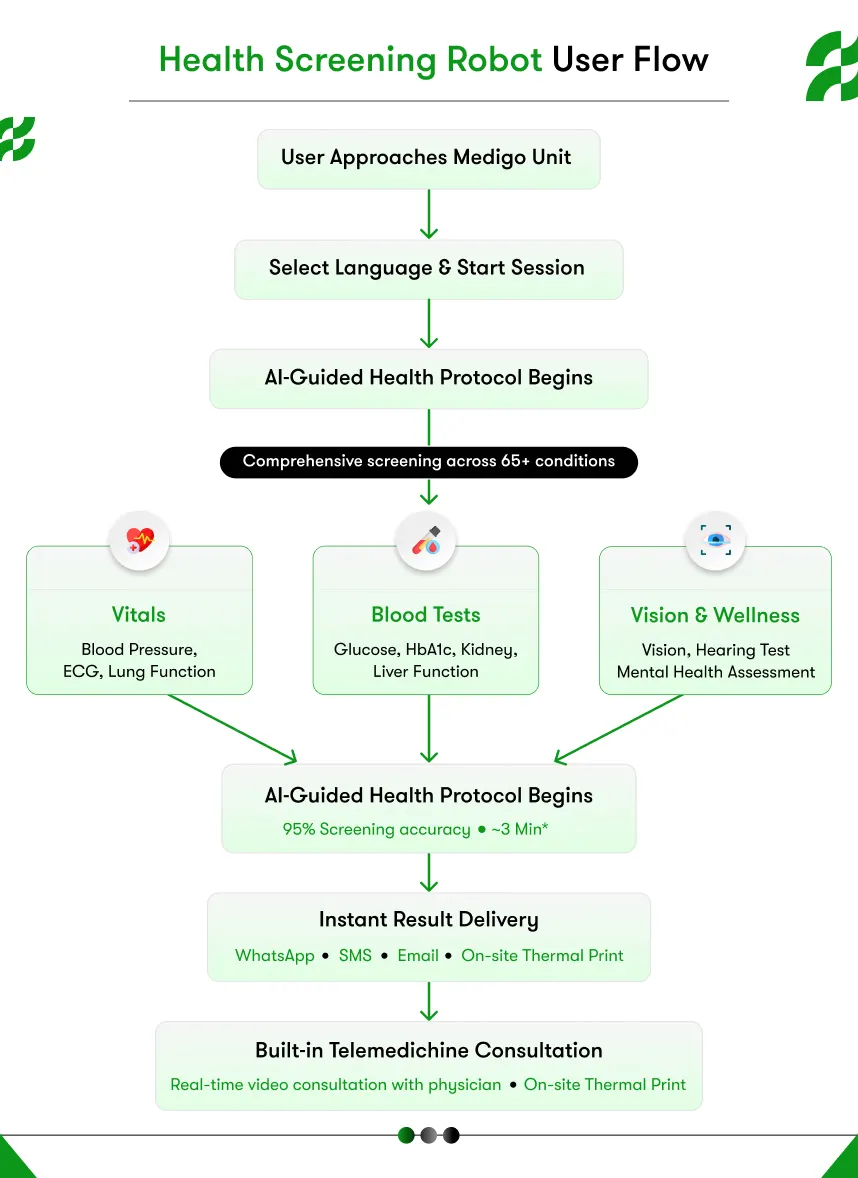
Medigo screens over 65 distinct medical conditions, covering metabolic and hematology markers, infectious diseases, cardiac and lung function, vision, hearing, and mental health assessments. It generates a comprehensive health report in approximately 3 minutes, with 95% screening accuracy. Its multilingual conversational AI guides users in their native language, making it accessible across diverse workforces and geographies.
The screening categories Medigo covers include:
- Metabolic and Hematology: Diabetes (Blood Glucose, HbA1c), BMI and Body Composition, Liver Function, Kidney Function, Cholesterol Panel
- Infectious Disease: HIV Screening, Malaria RDT, TB Symptom Screening, Fever Surveillance, Pregnancy Test
- Systems and Vitals: Blood Pressure and ECG, Lung Efficiency, Vision Test, Hearing Test, Dental Check-up, Mental Health Assessments, including ASD
Every result is delivered instantly via WhatsApp, SMS, email, or thermal print. An integrated telemedicine module connects the user to a physician for real-time consultation and digital prescription within the same session. All screening data flows to a centralized, encrypted cloud dashboard that organizations and governments can access in real time.
Medigo operates offline in areas with intermittent connectivity, syncing all data automatically when the connection resumes. This makes it as viable in a rural health center as it is in a premium corporate campus.
Medigo was showcased at the NXT Conclave 2026, held at Bharat Mandapam in New Delhi, one of India’s most significant global technology summits attended by heads of state, Members of Parliament from 30 countries, and academic leaders from Harvard, MIT, Oxford, and Stanford. Its presence at that stage, alongside the world’s most influential voices in technology and public health, reflects the scale of the problem it is built to solve.
Conclusion
The health lounge had its place. It still does, in the right context. But as a scalable model for preventive healthcare infrastructure, it has a ceiling, and most organizations are already close to it. A health screening robot removes that ceiling. It deploys faster, scales further, costs less per screening, and generates the kind of real-time organizational health intelligence that a fixed wellness room never could.
At Kody Technolab, we built Medigo to be that infrastructure. If your organization is ready to move from a wellness amenity to a system that genuinely scales, we are ready to show you exactly how.
Frequently Asked Questions
What is the difference between a health lounge and a health screening robot?
A health lounge is a fixed, staffed wellness space within a facility that requires a dedicated room, equipment, and a trained operator. A health screening robot is a deployable unit that conducts comprehensive health screenings without a fixed location or medical staff. The robot operates accurately, delivers instant reports, and can be deployed across multiple sites without replicating infrastructure costs. This clearly defines the difference between a health lounge and health screening robot and helps organizations evaluate health lounge vs robotic health screening infrastructure in practical terms.
Can a health screening robot replace a health lounge completely?
In most multi-site and enterprise contexts, yes. A health screening robot covers a broader range of conditions, delivers results faster, operates without staff, and scales across locations at a fraction of the cost. This makes health screening robot vs health lounge a critical consideration for organizations aiming to scale preventive care. For single-site organizations that value human-guided post-screening counseling, a hybrid model, with a robot for screening and a counselor for follow-up, often delivers the best outcome when comparing health lounge vs robotic health screening models.
How accurate is automated health screening compared to traditional screening?
Medigo, Kody Technolab’s AI-powered health screening robot, delivers 95% screening accuracy across 65+ conditions. Its AI models are trained on large-scale validated clinical datasets and interpreted by a clinical-grade AI layer. This accuracy is sufficient for preventive screening and early detection purposes, with the built-in telemedicine module enabling immediate physician consultation for any result requiring clinical judgment, making the robotic health screening system vs health lounge a strong alternative in modern healthcare delivery.
How does scalability differ between a health lounge and a health screening robot?
A health lounge is limited by space, staffing, and setup requirements, making expansion slower and cost-intensive. In contrast, a health screening robot can be deployed quickly across multiple locations without additional infrastructure. This makes the health lounge vs health screening robot an important factor for organizations planning large-scale preventive care programs.
How many conditions can a health screening robot screen for in one session?
Medigo screens 65+ distinct medical conditions. The screening includes metabolic and hematology markers, infectious diseases, cardiac and lung function, vision, hearing, dental, and mental health assessments. Every result is consolidated into a single comprehensive health report, delivered instantly via the patient’s preferred channel. This capability highlights why health screening robots vs health lounges are increasingly relevant for organizations seeking high-throughput screening and supports the broader shift toward automated health screening vs health lounge solutions.






 Contact Information