Quick Summary: Healthcare Industry faces growing screening demand with limited capacity and delayed diagnosis. Robotics in Healthcare enables you to scale screening, standardize diagnostics, and process higher patient volumes without increasing staff load. Healthcare Solutions such as Medigo help you detect risks earlier, improve workflow efficiency, and build a structured preventive healthcare infrastructure across your operations.
“The real gap in healthcare is not treatment quality. It is missed opportunities for early detection.”
Your hospital sees patients arriving after diabetes, hypertension, or cardiac conditions have already progressed. You know early screening could have identified these risks sooner, yet your setup cannot keep pace with the volume requiring routine health checks. Robotics in healthcare is already closing that gap across hospital chains, corporate campuses, defence networks, and transport hubs where high-footfall screening is critical .
You face this constraint daily. Demand grows, while staff capacity and diagnostic infrastructure remain limited.
That move from treatment to prevention is where healthcare robotics creates real value. You can run automated assessments, guide diagnostics, and capture structured data in a way that standardizes screening without increasing operational load.
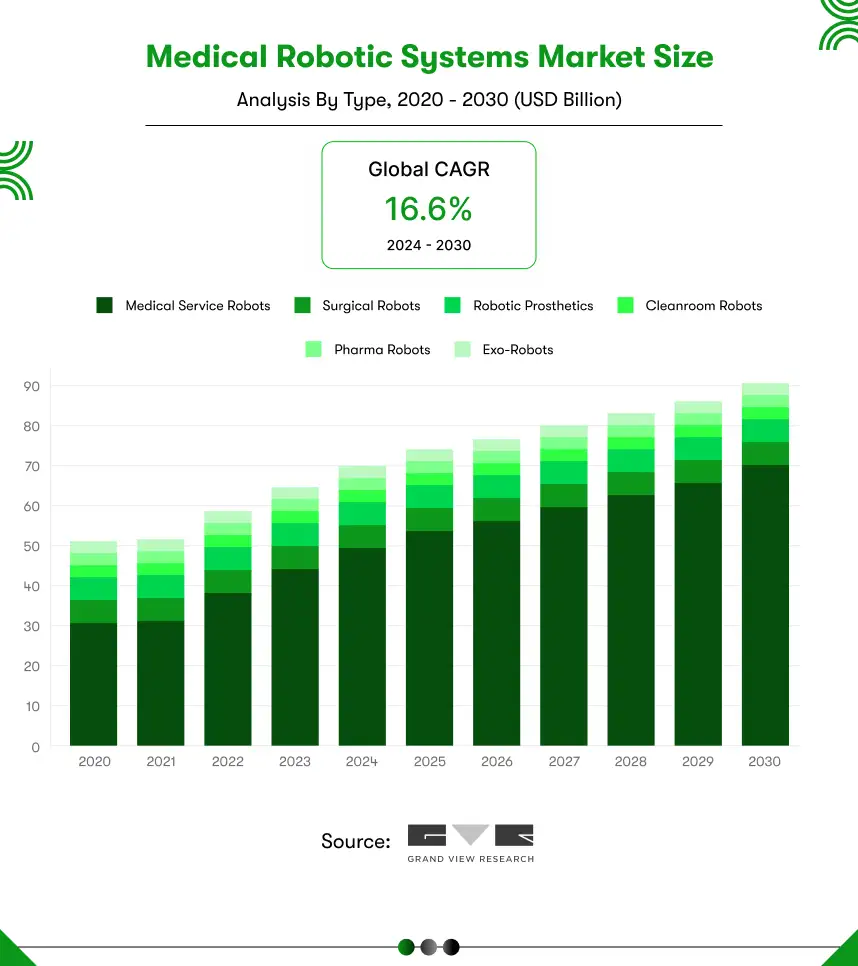
According to grand view research, Healthcare systems invested USD 25.56 billion in medical robotic systems in 2023, with projections reaching USD 76.45 billion by 2030.
The question for you is simple: where can robotics create the fastest impact in your operations?
What Is Robotics in Healthcare?
Robotics in Healthcare refers to the use of intelligent robotic systems that support medical screening, diagnostics, treatment procedures, and hospital operations through automation, sensors, and artificial intelligence. Modern healthcare robotics allows hospitals and health systems to conduct structured clinical tasks with greater speed, precision, and operational consistency.
Healthcare institutions begin evaluating robotic technology when patient demand grows faster than traditional diagnostic workflows can handle. Manual screening, repetitive diagnostic checks, and operational tasks place continuous pressure on doctors, nurses, and technicians.
Robotic systems help address those constraints by automating structured health assessments, guiding diagnostic procedures, and capturing patient data in organized digital formats that support consistent clinical protocols.
Many hospitals now explore AI and robotics in healthcare because robotic systems help expand preventive screening programs and maintain diagnostic accuracy across high-volume environments.
Healthcare leaders exploring robotics in healthcare industry solutions increasingly focus on robotic screening systems, including the health screening robot, to expand diagnostic capacity, maintain consistent clinical protocols, and support medical teams serving large patient populations.
What Are the Key Applications of Robotics in Healthcare Across Modern Medical Workflows
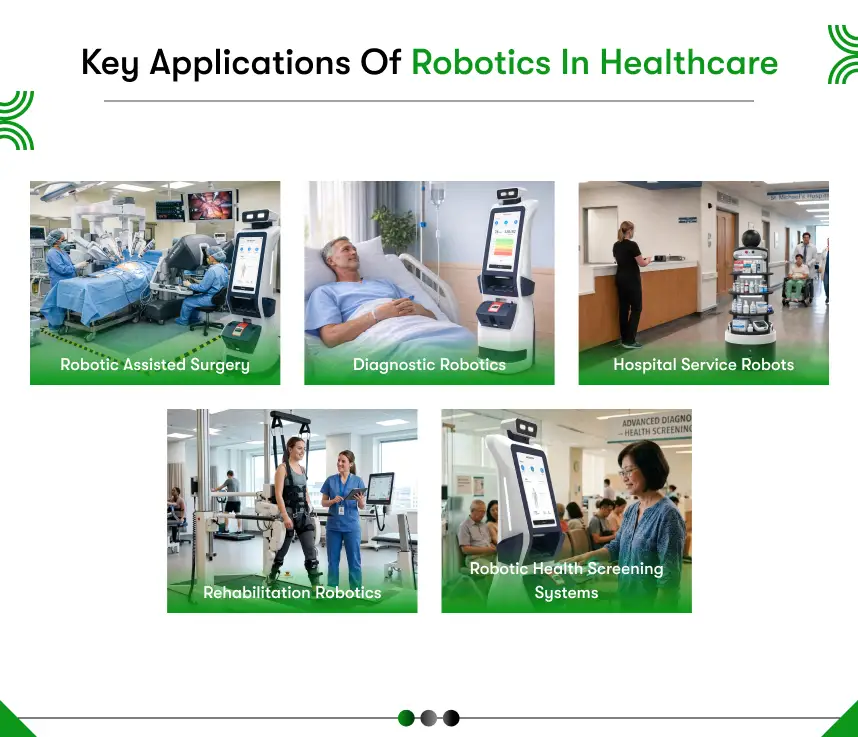
Hospitals now use robotics in healthcare across several medical workflows where precision and consistency matter most. Healthcare leaders adopt robotic systems when medical teams must manage complex procedures, large diagnostic volumes, operational logistics, rehabilitation therapy, and preventive screening programs. Each application addresses a specific operational gap that traditional workflows struggle to solve.
Robotic Assisted Surgery
Robotic surgical systems support surgeons during delicate procedures that demand high precision. A surgeon controls robotic instruments through a console, while robotic arms replicate the movements with greater stability and control.
- Surgeons perform complex procedures with higher precision and improved control over surgical instruments.
- Robotic systems provide magnified 3D visualization that improves surgical accuracy during delicate operations.
- Smaller incisions reduce trauma to surrounding tissues during minimally invasive procedures.
- Patients experience lower blood loss compared with traditional surgical techniques.
- Hospitals often see faster recovery and shorter hospital stays after robotic-assisted surgeries.
Diagnostic Robotics
Diagnostic robotics supports clinical laboratories and diagnostic departments that process large testing volumes every day. Many hospitals deploy robotic systems for healthcare diagnostics to automate repetitive laboratory workflows and maintain consistent testing standards across thousands of samples.
- Robotic systems process diagnostic samples with consistent accuracy while reducing manual laboratory errors.
- Laboratories handle higher testing volumes without increasing staff workload.
- Automated workflows reduce diagnostic turnaround time for patients and physicians.
- Structured digital data capture improves clinical decision-making during diagnosis.
- Healthcare providers maintain standardized diagnostic protocols across large laboratory environments.
Hospital Service Robots
Hospital service robots support operational logistics that normally consume valuable staff time. These robots transport laboratory samples, deliver medication, and move medical equipment between hospital departments.
- Medical staff spend less time on routine logistics and more time on patient care.
- Automated transport improves coordination between hospital departments.
- Hospitals maintain smoother operational workflows across large facilities.
- Staff fatigue reduces when robots handle repetitive transport tasks.
- Hospital administrators improve operational efficiency through automated logistics systems.
Rehabilitation Robotics
Rehabilitation robotics helps patients recover from injuries, neurological disorders, and mobility limitations. Robotic therapy systems guide therapeutic movements and monitor patient progress during physiotherapy sessions.
- Patients receive consistent rehabilitation exercises guided by robotic therapy systems.
- Physiotherapists monitor recovery progress through measurable data tracking.
- Robotic systems help patients perform controlled therapeutic movements safely.
- Rehabilitation programs maintain consistent therapy intensity across treatment sessions.
- Patients often regain mobility faster with structured robotic rehabilitation support.
Robotic Health Screening Systems
It allow healthcare providers to conduct preventive health assessments across large populations, forming a key part of a broader robotic healthcare infrastructure. These systems integrate diagnostic devices, guided testing workflows, and digital health reporting into a single screening process.
- Healthcare institutions expand preventive screening capacity without increasing staff workload.
- Robotic screening platforms conduct multiple diagnostic tests during a single patient session.
- Structured digital reports allow healthcare providers to maintain organized patient records.
- Early detection of chronic diseases becomes easier through systematic screening programs.
- Healthcare systems deploy screening infrastructure across high-footfall environments such as hospitals, corporate campuses, and community health programs.
Robotic health screening platforms are becoming significant as healthcare systems focus on preventive care and early detection. Solutions such as Medigo, designed for multi-parameter health screening and rapid digital reporting, demonstrate how robotics can support scalable preventive healthcare programs across hospitals, corporate health facilities, and community screening networks.

What Benefits Does Robotics in Healthcare Deliver for Hospitals and Healthcare Systems
Hospitals exploring robotics in healthcare often begin with a practical question: what is the use of robots in healthcare when medical teams already manage complex clinical workflows? The answer becomes clear inside modern hospitals where healthcare robotics improves diagnostic accuracy, streamlines operations, and expands preventive care programs without increasing pressure on clinical staff.
Higher Clinical Accuracy
Medical procedures and diagnostic testing demand consistent precision. Robotic technology in healthcare helps hospitals maintain standardized clinical workflows during surgeries, laboratory testing, and diagnostic evaluations.
- Robotic systems assist surgeons in performing delicate procedures with greater precision and stability.
- Diagnostic laboratories reduce manual testing errors through automated robotic workflows.
- Structured data capture allows healthcare providers to make more accurate clinical decisions.
- Hospitals maintain consistent diagnostic and treatment protocols across departments.
- Patients receive more reliable treatment outcomes because robotic systems minimize procedural variation.
Greater Operational Efficiency
Hospitals handle thousands of operational tasks every day. Healthcare robotics helps healthcare institutions streamline workflows and reduce the burden of repetitive activities on medical teams.
- Robots automate logistical tasks such as medication delivery, equipment movement, and sample transport.
- Healthcare teams spend more time on patient care rather than operational duties.
- Hospital departments coordinate more efficiently through automated systems.
- Medical facilities manage higher patient volumes without expanding clinical staff.
- Healthcare administrators improve operational productivity across hospital environments.
Automation of Medical Workflows
Automation is one of the major reasons healthcare leaders explore robotics in the healthcare industry. Robotic systems can perform repetitive tasks continuously while maintaining consistent performance.
- Automated systems perform routine tasks without operational fatigue.
- Hospitals maintain standardized workflows across diagnostic and operational departments.
- Automation reduces delays during patient screening and diagnostic procedures.
- Healthcare institutions manage large-scale healthcare operations more effectively.
- Medical teams focus on complex clinical decisions while robotic systems handle repetitive tasks.
Expansion of Preventive Healthcare
Preventive healthcare programs require infrastructure that can screen large populations efficiently. Robotic health screening systems support robotics in preventive healthcare by enabling structured health assessments across hospitals, corporate health programs, and community screening initiatives.
- Healthcare providers expand screening coverage across large populations.
- Early detection programs identify chronic health risks sooner.
- Structured digital health records support long-term patient monitoring.
- Healthcare systems detect diseases earlier through systematic screening.
- Preventive health programs become scalable across high-footfall healthcare environments.
Structured Digital Health Records and Data Integration
Modern healthcare depends on reliable digital data. AI and robotics in healthcare helps healthcare providers capture structured patient information during screening and diagnostics.
- Robotic systems generate organized digital health reports for every screening session.
- Healthcare providers maintain consistent patient records across multiple facilities.
- Digital reports allow doctors to review screening data quickly during consultation.
- Population health programs gain access to aggregated screening insights.
- Healthcare leaders use screening data to improve preventive health strategies.
Healthcare leaders increasingly explore AI and robotics in healthcare, including robotic health ATM. These technologies improve precision, strengthen diagnostics, and enable preventive healthcare programs that reach far more patients than traditional systems allow.
What Challenges Should You Evaluate Before Adopting Robotics in Healthcare
Hospitals planning to expand screening or diagnostic capacity often reach a point where existing systems stop scaling. Patient volumes increase, staff bandwidth remains limited, and manual workflows begin to slow down operations. At that stage, many leaders explore robotics in healthcare, but adoption requires careful evaluation before implementation
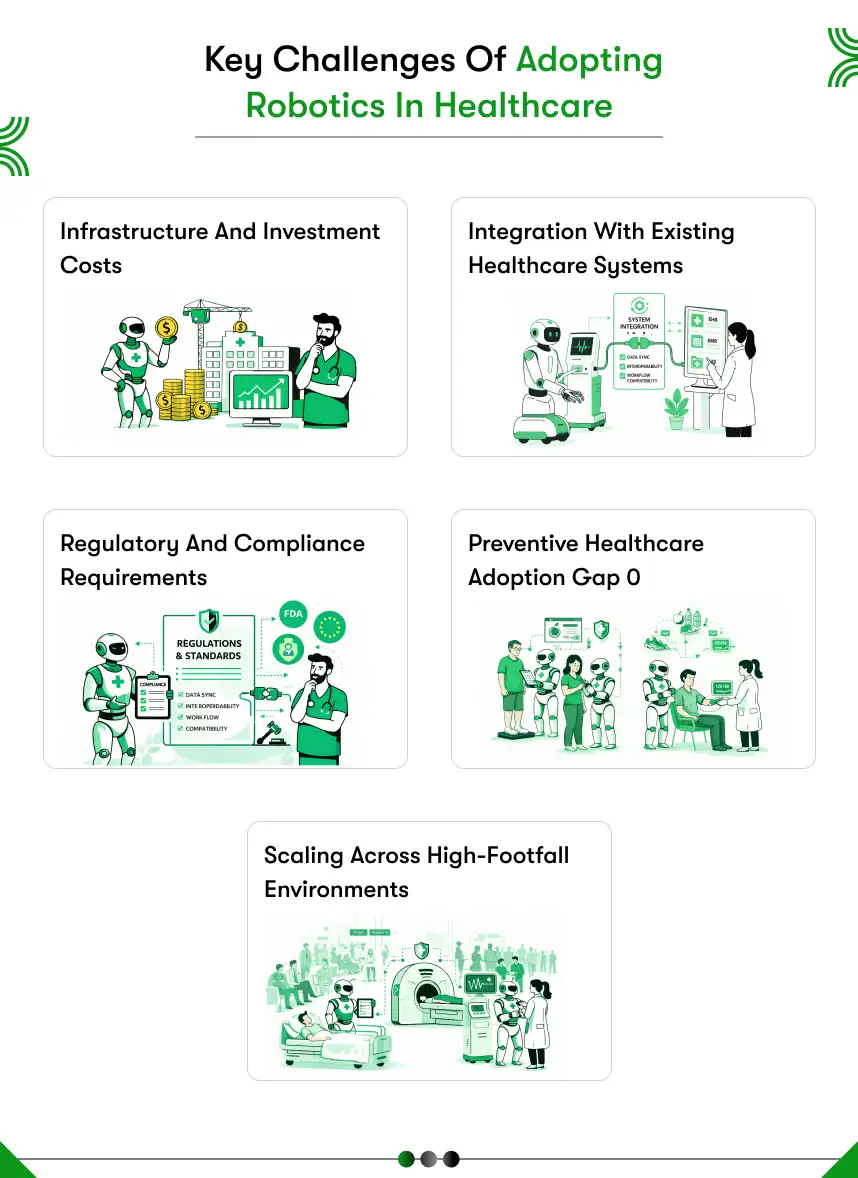
Where will it fit into existing workflows, how will teams use it, and what changes will it demand across operations?
Infrastructure and Investment Costs
Healthcare robotics systems require specialized hardware, software platforms, and clinical infrastructure. Hospitals evaluating robotic technology in healthcare must consider both initial investment and long-term operational planning.
- Advanced robotic systems require significant upfront investment in equipment and infrastructure.
- Hospitals may need facility upgrades to support robotic surgical or diagnostic platforms.
- Maintenance and technical support increase long-term operational costs.
- Healthcare institutions must allocate budgets for staff training and system management.
- Smaller healthcare facilities may face financial constraints when adopting robotics.
Integration with Existing Healthcare Systems
Hospitals operate through interconnected digital platforms such as electronic health records, diagnostic systems, and hospital management software. Integrating robotic systems for healthcare diagnostics into these environments requires careful system coordination.
- Robotic platforms must integrate smoothly with existing hospital information systems.
- Healthcare providers must ensure compatibility with electronic health record platforms.
- Diagnostic robotics systems must synchronize with laboratory and imaging workflows.
- Data exchange between robotic systems and hospital databases must remain secure.
- Hospitals may require technical expertise to manage system integration across departments.
Regulatory and Compliance Requirements
Healthcare technologies operate under strict regulatory frameworks. Hospitals adopting AI and robotics in healthcare must ensure compliance with medical device regulations, data protection standards, and clinical safety protocols.
- Healthcare providers must obtain regulatory approvals before deploying robotic systems.
- Hospitals must comply with national medical device certification standards.
- Patient data collected by robotic platforms must follow strict privacy regulations.
- Clinical teams must follow standardized protocols when operating robotic technologies.
- Healthcare institutions must maintain ongoing compliance monitoring for robotic systems.
Scaling Across High-Footfall Environments
Many healthcare providers aim to expand screening beyond hospitals into corporate parks, PHCs, and public health programs. Scaling robotics in the healthcare industry across such environments introduces operational challenges.
- Screening programs must maintain consistency across multiple locations and operators.
- High-footfall environments require systems that can handle continuous usage without performance drop.
- Managing large volumes of patient data requires secure and structured digital systems.
- Deployment across distributed locations demands centralized monitoring and reporting capabilities.
- Ensuring user-friendly workflows is critical when operating in non-clinical environments.
Preventive Healthcare Adoption Gap
Preventive healthcare programs often struggle due to low participation and fragmented screening processes. While robotics in preventive healthcare addresses these gaps, adoption still requires behavioral and operational alignment.
- Many populations do not participate in routine health screening programs.
- Healthcare providers need structured workflows to ensure consistent screening execution.
- Data from screening programs must convert into actionable clinical insights.
- Institutions must align screening initiatives with broader healthcare programs and policies.
- Decision makers must evaluate long-term ROI from preventive screening investments.
Hospitals that evaluate these factors early can implement AI and robotics in healthcare more effectively and move toward scalable screening and diagnostic infrastructure without operational friction.
If you want to understand the difference between a Health Lounge and a health screening robot, read our blog on Health Lounge vs Health Screening Robot.

Future of Robotics in Healthcare for Scalable Screening and Clinical Workflows
Hospitals expanding screening and diagnostic capacity often solve one problem first and uncover another. Testing becomes faster, reports are generated quickly, but decision-making and follow-up still move through disconnected systems. As operations scale, that gap becomes more visible.
Healthcare leaders exploring robotics in healthcare are now focusing on how systems can move beyond isolated tasks and support continuous, connected care across screening, diagnostics, and clinical action.
Where will data go after screening, how will teams act on it faster, and how will systems scale across multiple locations?
Connected Healthcare Systems
Hospitals operate through multiple systems that often work independently. The next phase of robotic technology in healthcare focuses on connecting screening, diagnostics, and clinical workflows into one continuous system.
- Screening data must integrate directly with hospital workflows to reduce delays in decision-making.
- Healthcare providers need unified systems that connect testing, reporting, and clinical action.
- Disconnected systems create delays between diagnosis and treatment planning.
- Centralized data visibility becomes critical for multi-department coordination.
- Hospitals require infrastructure that supports real-time data flow across operations.
AI-Driven Clinical Decision Support
As screening volumes increase, healthcare teams require support in identifying high-risk cases quickly. AI and robotics in healthcare plays a key role in turning structured data into actionable insights.
- Hospitals need systems that prioritize patients based on screening results and risk indicators.
- Clinical teams require faster access to structured insights instead of raw reports.
- Data-driven decision support reduces dependency on manual interpretation.
- Early risk identification improves intervention timelines.
- Healthcare providers move toward more proactive clinical planning.
Expansion Beyond Hospital Infrastructure
Healthcare providers are extending services beyond traditional hospital settings. The future of robotics in the healthcare industry includes deployment across distributed environments.
- Screening programs expand into corporate parks, public health programs, and transport hubs.
- Healthcare providers require systems that operate consistently across multiple locations.
- High-footfall environments demand reliable and continuous system performance.
- Multi-location deployments require centralized monitoring and reporting systems.
- Healthcare institutions need scalable infrastructure that supports distributed screening.
Preventive Health Automation
Preventive care requires continuous monitoring rather than one-time screening. The future direction of robotics in preventive healthcare focuses on building structured, repeatable screening systems.
- Healthcare providers move toward continuous screening instead of episodic checkups.
- Preventive programs require systems that track patient health over time.
- Structured digital records support long-term monitoring and follow-up.
- Early detection depends on consistent and repeatable screening workflows.
- Healthcare systems require scalable models for population-level screening.
Hospitals that align systems, data, and workflows early move faster toward scalable AI-driven healthcare models. Early alignment builds a preventive healthcare infrastructure where screening, diagnosis, and clinical decisions operate as a connected system.
How to Implement Robotics in Healthcare in Your Facility
Hospitals planning to expand screening or diagnostics often reach a stage where existing workflows cannot handle higher patient volume. Manual processes slow down operations, and adding staff does not always solve the problem. At that point, leaders begin evaluating how to introduce robotics in healthcare into real environments.
Implementation depends on how well the system fits into your existing setup and how quickly teams can start using it without disruption.
What to focus on
- Define the use case. clearly, whether screening, diagnostics, or operational support, before selecting any system.
- Evaluate how the robotic system will integrate with existing hospital workflows and reporting formats.
- Ensure the setup supports structured data capture for consistent clinical use.
- Train staff on guided workflows so adoption remains simple across operators.
- Start with controlled deployment, then expand across departments or locations.
Healthcare providers that follow a structured approach move faster from pilot to full-scale deployment.
Medigo Health Screening Robot by Kody Technolab
Hospitals and healthcare providers often face a common limitation. Screening demand increases, but diagnostic infrastructure, staff capacity, and time do not scale at the same pace. Expanding screening programs across multiple locations becomes difficult without adding significant operational load.
Medigo, developed by Kody Technolab Limited, addresses this gap with a structured approach to preventive screening. It is an AI-powered health screening robot designed to conduct rapid, multi-parameter assessments and generate digital health reports within minutes.
What makes Medigo different
- Medigo can assess more than 65+ health parameters and generate a structured report in approximately 3 minutes.
- The system integrates multiple diagnostic modules including blood tests, vitals monitoring, ECG, and respiratory screening into one workflow.
- An AI-guided interface ensures guided screening without requiring complex operator intervention.
- Reports are generated digitally and can be shared instantly or printed on-site for clinical use.
- Telemedicine integration allows patients to connect with doctors when further evaluation is required.
Medigo is designed for deployment across hospitals, diagnostic centers, corporate health programs, and public health environments where large-scale screening is required.
Healthcare providers using such systems can expand preventive screening capacity, standardize diagnostics, and improve early detection without increasing operational pressure on medical teams.

Conclusion
You already see delays in screening, gaps in diagnostic workflows, and limits in how many patients your current setup can handle in a day. These constraints directly affect how early conditions are detected and how effectively your team manages patient load.
Robotics in healthcare allows you to increase screening capacity, standardize diagnostics, and handle higher volumes without adding operational pressure on your staff.
What matters now is how quickly you move from identifying these gaps to fixing them.
Kody Technolab Limited helps you deploy Medigo, a health screening robot built for rapid, multi-parameter screening across hospitals, corporate health programs, and public health environments.
If your current workflow limits screening speed or consistency, you need to identify exactly where delays occur and implement infrastructure that removes those bottlenecks.









 Contact Information