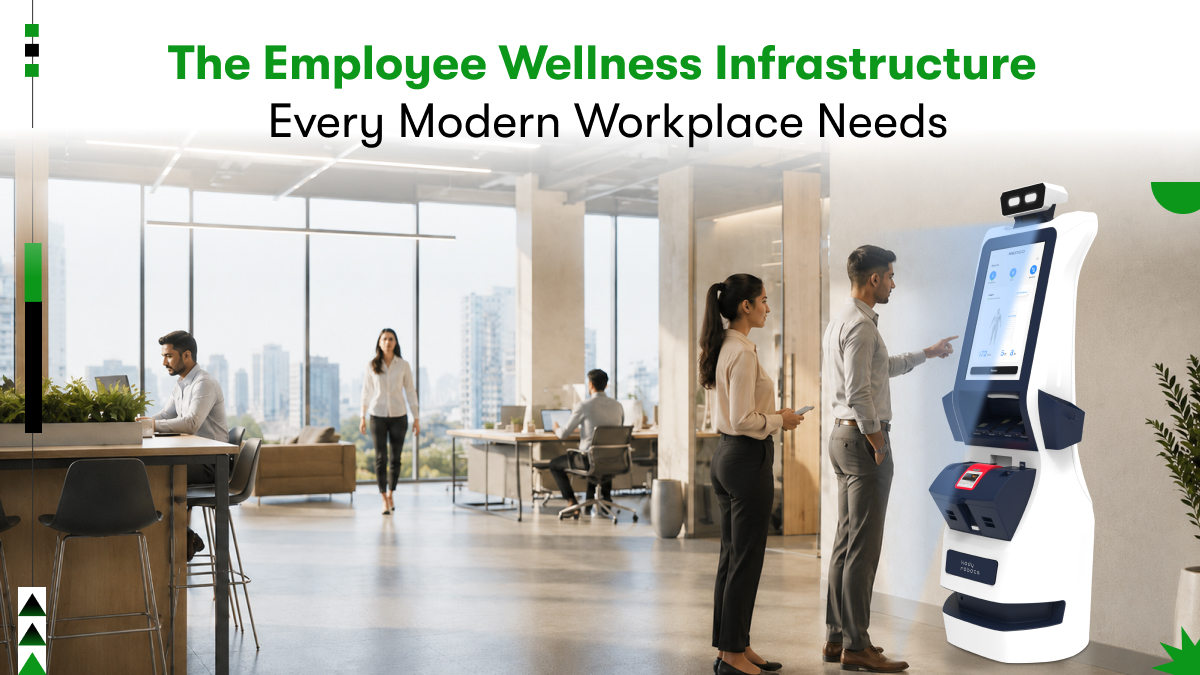
Employee wellness programs are evolving, yet many organizations still struggle with low participation, limited health visibility, and rising healthcare costs. Traditional health camps provide only periodic insights, leaving critical health risks undetected between screenings. A health ATM for corporate offices offers a smarter approach by bringing preventive healthcare directly into the workplace.
With AI-powered diagnostics, instant digital reports, and automated health screening in offices, employees can monitor their health in minutes without disrupting their workday. This guide explores how a health ATM machine for offices helps organizations improve employee wellbeing, increase engagement, and build a data-driven wellness strategy.
What Is a Health ATM for Corporate Offices?
A health ATM for corporate offices is a self-service, AI-enabled health screening kiosk installed within the workplace that allows employees to complete multi-parameter health assessments without scheduling a doctor visit or lab appointment.
It measures vitals, runs diagnostic tests, and generates a digital health report, typically in under five minutes. Employees walk in, follow guided on-screen prompts, and leave with instant results.
No technician required, no appointment needed, and no half-day health camp is required.
Think of it as preventive healthcare embedded directly into your office environment, available every working day, not once a year.
The Real Cost of Ignoring Workforce Health
Before examining the solution, it is worth understanding the scale of the problem.
Poor employee health is not just a personal issue. It is a business problem with measurable financial consequences.
- Chronic conditions like hypertension and diabetes often go undetected for years.
- Employees managing undiagnosed health issues show lower productivity and concentration.
- Preventable illness drives absenteeism, quiet quitting, and long-term attrition.
- High medical claims raise group insurance premiums and shrink your benefits budget.
- Organizations with poor health visibility cannot intervene before a health event becomes a crisis.
The World Health Organization estimates that every dollar invested in employee health returns two to four dollars through reduced absenteeism and improved performance.
The challenge is not awareness. Most HR leaders understand this. The challenge is finding an approach that employees will actually use consistently, not occasionally.
There is another layer that is often missed. The business impact of poor workforce health is not limited to individual sick days. It shows up in team dynamics, project timelines, client relationships, and management bandwidth. A manager dealing with a sudden cardiac event, a key employee managing undiagnosed diabetes, these are not isolated incidents. They are signals that preventive care is not reaching the workforce early enough.
The business case for preventive healthcare automation is not idealistic. It is financially grounded and operationally urgent.
Why Traditional Employee Wellness Programs Fall Short
Annual health camps are still the most common corporate wellness initiative. They are also the most predictable failure.
Here is the typical pattern:
- HR schedules a health camp once or twice a year.
- A vendor sets up testing counters in a conference room.
- Employees are encouraged, but not required, to participate.
- Many skip it because they are in meetings or simply do not prioritize it.
- Results are collected in paper files or fragmented spreadsheets.
- Nothing changes until the next camp, twelve months later.
This model has three structural gaps that prevent it from working.
Gap 1: Infrequency. A single annual checkup cannot catch conditions that develop month to month.
Gap 2: Inconvenience. Employees who are busy, anxious, or forgetful will opt out. Participation rates for traditional health camps are often 30–50%, even in organizations that actively promote them.
Gap 3: No actionable data. Paper reports and disconnected spreadsheets give HR no ability to track health trends, measure improvement, or justify wellness spending to leadership.
The result is a wellness program that consumes budget, generates activity reports, but changes nothing.
What Employees Actually Expect from Workplace Health Programs
Employee expectations have shifted, and health and well-being benefits now rank among the top three factors employees consider when evaluating an employer, alongside compensation and growth opportunities.
But what employees actually want is different from what most wellness programs offer.
They do not want a health camp that disrupts their schedule once a year. They want access to health information when it is relevant to them, during a stressful quarter, after a change in lifestyle, or simply out of curiosity about a number that has been bothering them.
This expectation gap is exactly what a health ATM machine for offices closes. Employees engage more with a tool they can access on their terms. And when engagement increases, the data organizations collect becomes far more representative and far more useful.
Why Preventive Healthcare Needs Automation in the Workplace
Think about how employees interact with other essential office services. They grab coffee without a meeting. They print documents without calling IT and book meeting rooms from their phone.
Preventive healthcare should work the same way: available on demand, without scheduling, without disruption.
When health screening requires coordination, travel, or a dedicated time slot, most employees will deprioritize it. When it takes five minutes at a kiosk in the lobby, behavior changes naturally.
Automated health screening in offices removes the dependency on annual events and replaces them with always-on access. Employees can check their blood pressure before a high-stress week, monitor blood glucose after a health scare, or complete a full screening during a lunch break.
More importantly, automation creates something manual camps can never have: longitudinal data. Health trends tracked over months and quarters are far more valuable than a single data point once a year. For HR leaders and occupational health teams, that continuity changes what is possible in workplace health monitoring.
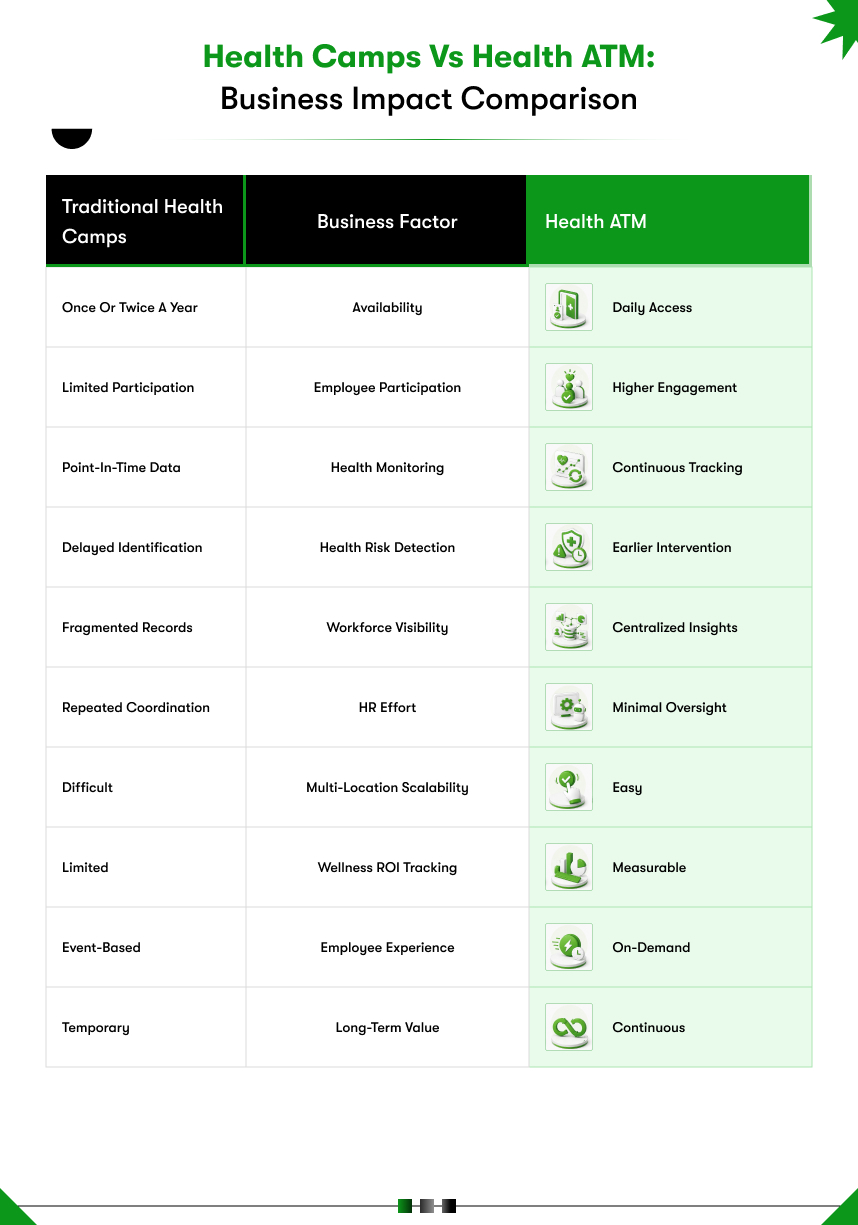
Traditional Health Camps vs. Health ATM for Corporate Offices
| Factor | Traditional Health Camp | Health ATM for Corporate Offices |
| Accessibility | Once or twice a year | Every working day |
| Employee convenience | Fixed schedule, disrupts work | Self-service, on their own time |
| Time required | Half a day or more | 3–5 minutes |
| Participation rate | Often 30–50% | Higher with frictionless, on-demand access |
| Scalability | Difficult across multiple locations | Deployable across offices at scale |
| Data availability | Paper or fragmented records | Centralized, real-time digital reports |
| Follow-up capability | None until next camp | Ongoing monitoring and early intervention |
| Cost over time | High recurring cost per event | Lower per-screening cost at scale |
| Deployment effort | Heavy coordination every time | One-time setup, ongoing value |
| Health trend visibility | None | Longitudinal data across teams and sites |
A health camp is an event. A health ATM machine for offices is an infrastructure. That distinction shapes everything from participation rates to ROI measurement.
How an AI Health ATM for Workplaces Works
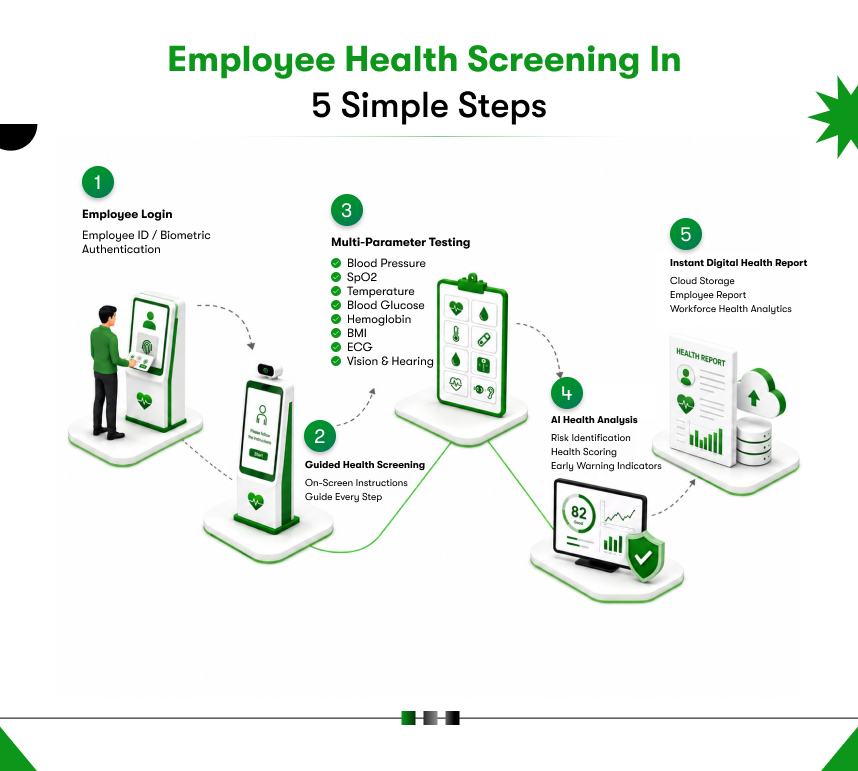
A good AI health ATM for workplaces follows a simple, guided workflow. Employees need no prior medical knowledge or technical training.
Step 1: Registration
The employee logs in using an employee ID or biometric identifier. Their personal profile loads securely.
Step 2: Guided Screening
The machine prompts each test in sequence with on-screen instructions. No technician or support staff is needed.
Step 3: Multi-Parameter Testing
Tests run within a single, integrated session. Depending on the configuration, these include:
- Blood pressure, SpO2, and temperature monitoring
- Blood glucose, hemoglobin, and HbA1c testing
- BMI and physical measurements
- ECG (cardiac rhythm screening)
- Vision and hearing assessments
- AI-assisted analysis for early-risk identification
Step 4: Instant Digital Report
A consolidated health report is generated in approximately three minutes. Employees see their results immediately. Data is securely stored in the cloud.
Step 5: AI-Driven Health Insights
The system flags abnormal values and recommends follow-up actions where clinically relevant, giving employees context, not just numbers.
This is what automated health checkups look like when the design prioritizes the employee experience. It is a perfect Robotics Healthcare Infrastructure that can deliver value to your organization.
Introducing Medigo: Health ATM Built for Scalable Corporate Wellness
You understand the problem, and you understand the model as well. Now, let us look at a system built specifically around these principles.
Medigo is a Health ATM solution developed by Kody Technolab Limited. It was originally designed to make preventive healthcare more accessible worldwide, wherever it is needed. Such as health ATM for PHCs and corporate wellness, where challenges like high demand, limited staff, disconnected data, and a need for scalable, guided diagnostics exist.
That foundation makes Medigo particularly well-suited for corporate environments. It was built for high-volume, multi-location deployment, not for a single clinic room.
Medigo Screening Capabilities
Medigo consolidates a comprehensive range of diagnostics into one guided session through advanced health ATM features:
Blood & Diagnostic Tests
- Hemoglobin (Hb), Lipid Profile, Random Plasma Glucose, HbA1c
- Renal Function (Creatinine, Urea, Uric Acid)
Vitals Monitoring
- Blood Pressure, Body Temperature, SpO2 (Oxygen Saturation)
Cardiac & Respiratory Screening
- ECG (6 Lead), Spirometry (Pulmonary Function), Digital Stethoscope (optional)
Vision & Hearing
- Visual Acuity, Color Blindness, Audiometry, AI-Assisted Fundus Screening
Physical Measurements
- Height, Weight, BMI
AI-Assisted Preventive Modules
- Oral Health Screening, Mental Health Assessment Tools, ASD Screening Support
Most corporate health checkup programs require employees to rotate between counters and specialists. Medigo consolidates all of this into a single three-to-five-minute session consistently, every time.
AI-Enabled Risk Detection
Medigo does not just record numbers; it is a successful application of AI in healthcare that analyzes data to identify early risk patterns, elevated cardiac risk, pre-diabetic markers, and anemia indicators before they escalate into serious conditions.
For HR wellness teams, this means knowing which segments of the workforce may need clinical attention before a serious health event disrupts productivity.
Cloud-Based Health Records and Workforce Visibility
Every employee’s health report is stored digitally and accessed securely. HR wellness managers can review anonymized aggregate data by department, location, or cohort to understand workforce health trends over time.
This gives organizations something traditional health camps have never provided: a real-time picture of workforce health that evolves throughout the year.
Compact and Modular Hardware
Medigo is designed for actual workplace environments. A single kiosk fits in a reception area, wellness room, or open office corner. No dedicated clinic space. No on-site medical staff.
Multi-Location Scalability
Organizations with offices across multiple cities can deploy Medigo across sites with consistent screening protocols. Centralized dashboards give leadership a unified view of health engagement and outcomes, regardless of geography.
Read more to learn how Medigo works in detail to understand the application better in your corporate offices.
Medigo’s Deployment Model for Corporate Offices
Deployment complexity is a common concern. Medigo addresses this with a structured five-step process designed to minimize disruption.
- Site Assessment – Space, power, and connectivity evaluation.
- Installation & Configuration – Physical setup and system configuration.
- Digital Integration – Connection to existing HR or health management platforms.
- Staff Orientation – Brief training for HR or admin teams overseeing the kiosk.
- Ongoing Support – Continuous technical monitoring and performance updates.
The setup is straightforward. The ongoing maintenance burden on HR teams is minimal.
How to Choose a Health ATM for Employee Wellness Programs
Not every health ATM for employee wellness programs is built the same way. Here is a practical checklist for evaluating options.
1. Screening Depth
Does the system cover clinically relevant diagnostics, not just basic vitals? Look for blood glucose, hemoglobin, ECG, and lipid testing at a minimum.
2. AI-Powered Analysis
Data collection without analysis is incomplete. The system should interpret values, flag risks, and provide context, not just print numbers.
3. Digital Reporting
Reports should be instant, employee-facing, and accessible to HR teams in aggregate for trend analysis.
4. Self-Service Design
If employees need assistance every time, adoption will be low. The workflow must be completely guided and intuitive.
5. Multi-Location Support
Confirm the system supports uniform protocols and centralized data visibility across multiple offices.
6. Data Security
Employee health data requires strict security standards and compliance with applicable data privacy regulations. Verify the vendor’s approach before committing.
7. Scalability
Can the system grow with your headcount? Look for flexible hardware configurations and modular software options.
8. Vendor Support
Post-deployment reliability matters. Downtime means employees lose access. Evaluate the vendor’s support model, response times, and track record carefully.
Business Outcomes That Corporate Leaders Measure
Deploying a health ATM machine for employee health checks is not purely a welfare initiative. It delivers outcomes that matter to the entire leadership team.
Higher Participation Rates
When screening takes five minutes and requires no scheduling, more employees participate consistently, not just during a designated health week.
Earlier Health Intervention
Catching hypertension, elevated blood glucose, or cardiac risk markers early gives employees time to take corrective action before a condition worsens. Early intervention reduces emergency healthcare events across the workforce.
Reduced Absenteeism
Employees who actively manage their health take fewer unplanned sick days. Organizations that invest in preventive employee care consistently report measurable reductions in absenteeism over time.
Lower Long-Term Healthcare Costs
Prevention is less expensive than treatment. Organizations that detect and address health risks early report fewer high-cost insurance claims over time.
Stronger Employer Branding
Today’s workforce, particularly younger employees, actively evaluates employer investment in wellbeing. A visible, functional health infrastructure communicates that commitment every single day.
Measurable Wellness ROI
For CHROs and CEOs who want wellness spending tied to outcomes, Medigo provides the data to make that case. Participation rates, health trend improvements, and intervention flags are all trackable.
Why Organizations Are Turning to Medigo Health ATM
Corporate wellness is being prioritized, and HR leaders are moving away from event-based health programs that generate activity reports but not health outcomes.
The shift is driven by a clear insight: sustainable workplace health monitoring requires ongoing access, not occasional events.
Medigo Health ATM addresses the challenge directly. It combines diagnostic breadth, AI-driven analysis, cloud-based data management, and the benefits of Robotics in Healthcare into one system built for real workplace environments.
For organizations managing large or distributed workforces, Medigo provides something that traditional approaches cannot: consistency. Every employee at every location completes the same structured screening, generating comparable, centralized health data.
For HR leaders who have struggled to demonstrate wellness program ROI to senior leadership, Medigo provides evidence-based participation data, health trend metrics, and early intervention records that connect wellness spending to measurable business outcomes.
Final Thoughts
Employee wellness is not a checkbox or an annual obligation. It is a strategic investment with measurable returns on productivity, retention, healthcare costs, and employer brand.
The organizations building wellness programs that actually work are not running better health camps. They are embedding preventive healthcare into the daily rhythm of office life, accessible, automated, and consistent.
A health ATM for corporate offices is one of the most practical ways to do that. It removes friction, increases participation, generates real health data, and scales across your entire workforce without proportionally increasing HR workload.
If you are ready to move beyond traditional wellness programs and build something that delivers measurable results, Medigo Health ATM is worth exploring.
Speak with the Medigo team to understand how the solution can be configured for your workforce size, office locations, and wellness goals. There is no obligation, just a practical conversation about what preventive healthcare automation could look like in your organization.






 Contact Information