
In 2023, global fraud losses exceeded $485 billion. Most of that damage was taken up by banks, fintechs, and crypto platforms, and manual KYC reviews slowed onboarding. Human reviewers overlooked document forgery that was subtle. Computer Vision to KYC Automation directly solves each of these failures.
Jumio has created one of the most reliable and trusted AI-powered identity verification systems that uses scale to operate and is currently in operation today. Financial institutions, digital banks, and crypto exchanges use Jumio to verify users accurately and in compliance.
This guide breaks down exactly how Jumio implements computer vision inside a complete KYC workflow. You will learn the checkpoint procedures involved in building a similar system, how much it costs to build a similar system, and how to find the right development team. You may either be a fintech startup or a compliance-intensive business, but either way, you should read through before making any decisions about automated KYC using computer vision.
How does computer vision work in KYC automation?
Computer vision processes images and video frames to extract identity data, detect document fraud, and verify biometric matches. KYC systems use computer vision to automate manual review tasks with speed and measurable precision across thousands of simultaneous checks.
Computer vision is a branch of artificial intelligence. AI models trained on large visual datasets learn to identify patterns inside images. For KYC, that training data includes ID documents from over 200 countries. Models learn what a valid passport looks like. Models learn how security holograms appear under different lighting conditions. It learns how facial geometry maps onto two-dimensional document photos.
KYC processes three core requirements:
- Identity capture: Collect the user’s government-issued ID document.
- Document verification: Confirm the document is genuine, not forged.
- Biometric matching: Match the user’s face to the photo on the document.
Manual compliance agents handle each step slowly. One agent checks one document at a time. A computer vision system handles thousands of documents simultaneously. Accuracy rates in AI-driven KYC systems regularly reach 99% or higher under production conditions.
Automating KYC using computer vision also cuts operational costs significantly. Banks reduce compliance team sizes. Onboarding timelines shrink from days to seconds. Customers complete identity verification without mailing documents or visiting a branch.
How does computer vision improve KYC solutions in fintech?
Computer vision gives fintech companies the ability to verify identities at scale without manual bottlenecks. AI-driven KYC solutions detect fraud faster, process more users simultaneously, and keep institutions compliant with global regulations.
Digital banking grew fast after 2020. Customers expect to open accounts in minutes. Regulators expect institutions to verify every identity thoroughly. These two demands conflict directly. KYC Solutions with AI bring both demands into alignment.
Jumio operates at the center of this space. The Jumio platform uses artificial intelligence, machine learning, and computer vision to verify IDs from over 200 countries. A user submits a photo of a passport. Jumio’s system reads the document, checks authenticity, matches the user’s face, and returns a decision, and the entire process takes under sixty seconds.
For fintech businesses, the business case is concrete:
| Benefit | Operational Impact |
| Fraud reduction | Detects forged IDs and synthetic identities |
| Speed | Verifies users in under 60 seconds |
| Compliance | Meets AML, GDPR, and local KYC regulations |
| Cost savings | Reduces manual review workload and headcount |
| Global reach | Supports 200+ countries and 3,500+ document types |
Computer vision in fintech allows companies to scale user acquisition without adding compliance headcount proportionally. Automated KYC using computer vision also produces full audit trails that regulators accept without dispute.
How Computer Vision in Jumio Works: Step-by-Step Process
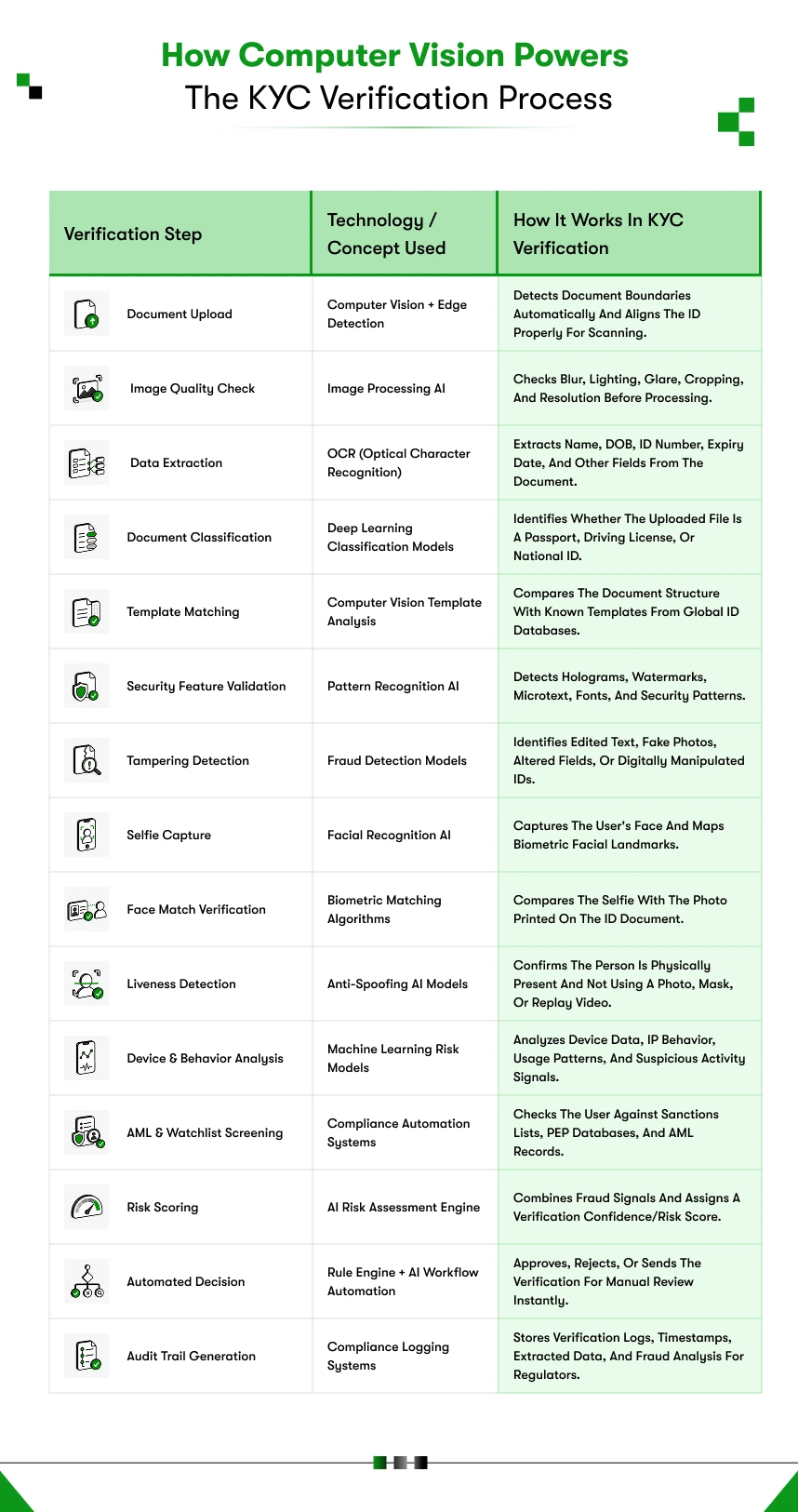
Jumio uses computer vision across five stages: document capture, visual authenticity verification, biometric face matching, fraud and AML screening, and real-time decision. Each stage uses AI models trained on millions of global identity documents across every major document type.
Step 1: ID Document Capture and OCR
A user opens a Jumio-integrated app or web portal, and the user photographs a government-issued ID card, passport, or driver’s license. Jumio’s computer vision models detect the document edges automatically. The system aligns the captured image for optimal clarity and readability.
Optical Character Recognition (OCR) then extracts text fields from the document. Jumio’s AI reads names, dates of birth, document numbers, and expiry dates. OCR models auto-populate all data fields without manual typing. The system immediately flags blurry, cropped, or low-resolution images and prompts the user to retake the photo.
Step 2: Visual Authenticity Check
Jumio’s models analyze the document image for physical security features. Holograms, watermarks, microprinting, and UV-reactive patterns all carry distinct visual signatures. Trained models recognize these signatures across thousands of document templates from different countries and issuing authorities.
A counterfeit ID lacks these precise visual characteristics. The computer vision system identifies anomalies at a pixel level. Jumio cross-references the captured document against a global document template library containing over 3,500 ID types. Any mismatch between the captured document and the expected template triggers a fraud flag.
Step 3: Biometric Face Matching and Liveness Detection
The user captures a selfie through the app camera. Jumio’s facial recognition model maps the user’s facial geometry and key biometric landmarks. The model compares the selfie against the photo printed on the submitted ID document.
Liveness detection runs simultaneously with face matching. The system confirms the user is a real, physically present person at the moment of verification. Liveness checks prevent spoofing attacks that use printed photos, masks, or pre-recorded video replays. Jumio’s biometric engine holds NIST certification for facial recognition accuracy standards.
Step 4: Fraud Detection and AML Screening
Machine learning models flag anomalies that the visual checks alone may miss. Behavioral signals, device metadata, and document characteristics all feed into a fraud risk score. Jumio’s AI identifies patterns associated with synthetic identities, organized fraud rings, and known document manipulation techniques.
AML screening runs alongside the KYC verification process. Jumio’s system checks user data against global watchlists, sanctions lists, and Politically Exposed Person (PEP) databases. Financial institutions meet AML compliance requirements automatically without separate manual screening workflows.
Step 5: Real-Time Decision and Audit Trail
Jumio returns a verification decision within seconds. Approximately 90% of verifications are completed without any human intervention. The system routes flagged or uncertain edge cases to human reviewers for manual assessment. Institutions receive a complete audit trail with every decision. The trail includes extracted data fields, document authenticity scores, facial match confidence scores, fraud risk scores, and verification timestamps.

How much does it cost to build a computer vision KYC system?
Building a custom computer vision KYC system costs between $100,000 and $350,000 for core development. API-based KYC solutions cost between $0.10 and $1.50 per verification check, depending on the provider and contracted volume.
The cost of implementing computer vision for KYC depends heavily on the approach a business selects.
Option 1: Custom Development
A custom-built system gives full model ownership and data control. Development costs range between $100,000 and $350,000. The final figure depends on:
- Number of document types and countries the system must support
- Required verification throughput (checks per second)
- Biometric capabilities: face match only, or face match plus liveness plus voice
- Regulatory markets requiring specific certifications
- Infrastructure choices: cloud, on-premise, or hybrid deployment
Option 2: Third-Party API Integration
Businesses integrate a pre-built KYC API into their existing product. Providers charge per verification. Typical market pricing:
| API Tier | Price per Check |
| Basic OCR and document reading | $0.10 – $0.30 |
| Full KYC with biometric matching | $0.50 – $1.50 |
| Enterprise volume pricing | Custom contract |
Option 3: Build a Jumio-Scale Platform
Businesses aiming to build a proprietary, production-grade platform comparable to Jumio invest considerably more. Platform-grade solutions require large proprietary training datasets, regulatory certifications across multiple markets, and continuous model retraining pipelines. Total investment for a production-ready platform typically starts at $500,000 and scales from there.
Kody Technolab helps businesses identify the approach that fits their budget, use case, and compliance obligations before committing to development.
What steps are required to build a KYC automation system like Jumio?
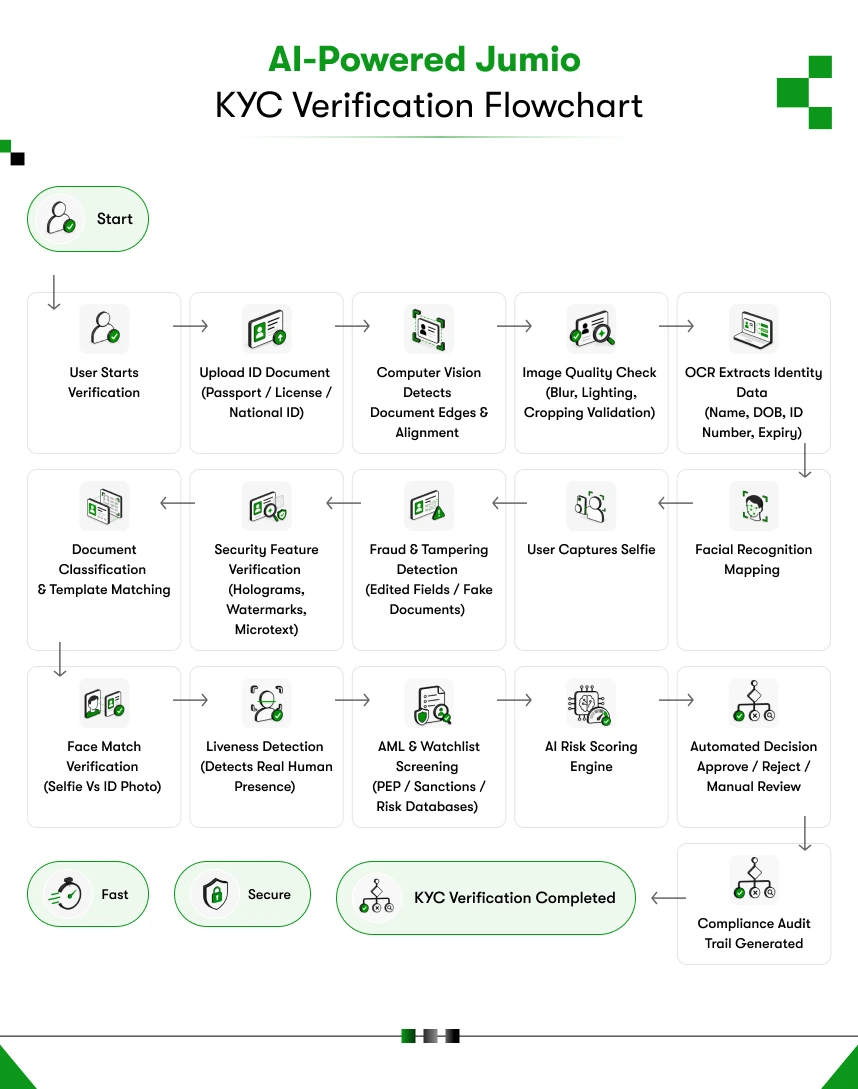
Building a Jumio-like KYC system requires four phases: training data collection, model development, biometric and ML integration, and structured testing before deployment. Each phase demands specialized AI and computer vision engineering expertise.
Step-by-Step Development Process
Step 1: Data Collection and Document Templates
The foundation of any KYC computer vision system is training data. Development teams collect verified ID document images from every target region. A robust dataset must include:
- Passports, national ID cards, and driver’s licenses
- Documents from every geographic market the system will serve
- Fraud and forgery samples for negative model training
The quality and diversity of training data directly determines how accurately models perform under real-world conditions.
Step 2: Model Training Using Classical CV and Deep Learning
Development teams train multiple model types for different tasks within the pipeline.
Classical computer vision handles structured, rule-based tasks: edge detection, document alignment, and OCR preprocessing. Deep learning models handle complex classification tasks: hologram recognition, tampering detection, and facial geometry mapping.
Model training requires:
- Convolutional Neural Networks (CNNs) for image classification and feature extraction
- Transformer-based models for document understanding and multi-field extraction
- Generative Adversarial Networks (GANs) for fraud simulation during model testing
Step 3: Biometric and Machine Learning Integration
The face matching module requires a separate biometric pipeline from document reading. Liveness detection adds another independent model layer. Machine learning fraud scoring models integrate with the main verification flow through API connectors. External AML screening databases connect through secure, compliant API channels.
Step 4: Testing and Deployment
QA engineering teams test the complete system against thousands of verified and fraudulent document samples. Teams measure False Acceptance Rates (FAR) and False Rejection Rates (FRR) across all supported document types. Regulatory compliance testing follows internal QA validation. The system deploys on cloud infrastructure with financial-grade security protocols covering data encryption, access controls, and retention policies.
Hire Computer Vision Developers or a Development Company
Building a KYC automation system requires a cross-functional team with specific technical skills:
- Computer vision engineers: CNN architecture, OCR pipeline development, image preprocessing
- Machine learning engineers: Fraud detection models, AML screening integration
- Biometric specialists: Face matching algorithms, liveness detection development
- Security engineers: Data encryption, compliance architecture, penetration testing
- QA and compliance experts: Regulatory testing frameworks and audit trail design
Businesses have three paths to build this capability:
- Build an in-house team: Highest control, highest recruiting cost and timeline.
- Hire freelance specialists: Flexible for smaller scopes, challenging to coordinate across disciplines.
- Partner with a computer vision development company: Fastest time-to-market, built-in expertise across every required discipline.
Partnering with a specialized development company shortens build timelines significantly. Kody Technolab brings end-to-end expertise across AI automation, computer vision model development, and fintech compliance architecture. The Kody team guides businesses from initial system design through model training, deployment, and regulatory readiness.
What are the key benefits of computer vision for KYC automation?
Computer vision reduces KYC processing time from days to seconds, cuts fraud losses, lowers compliance costs, and enables global user onboarding without proportionally growing manual review teams.
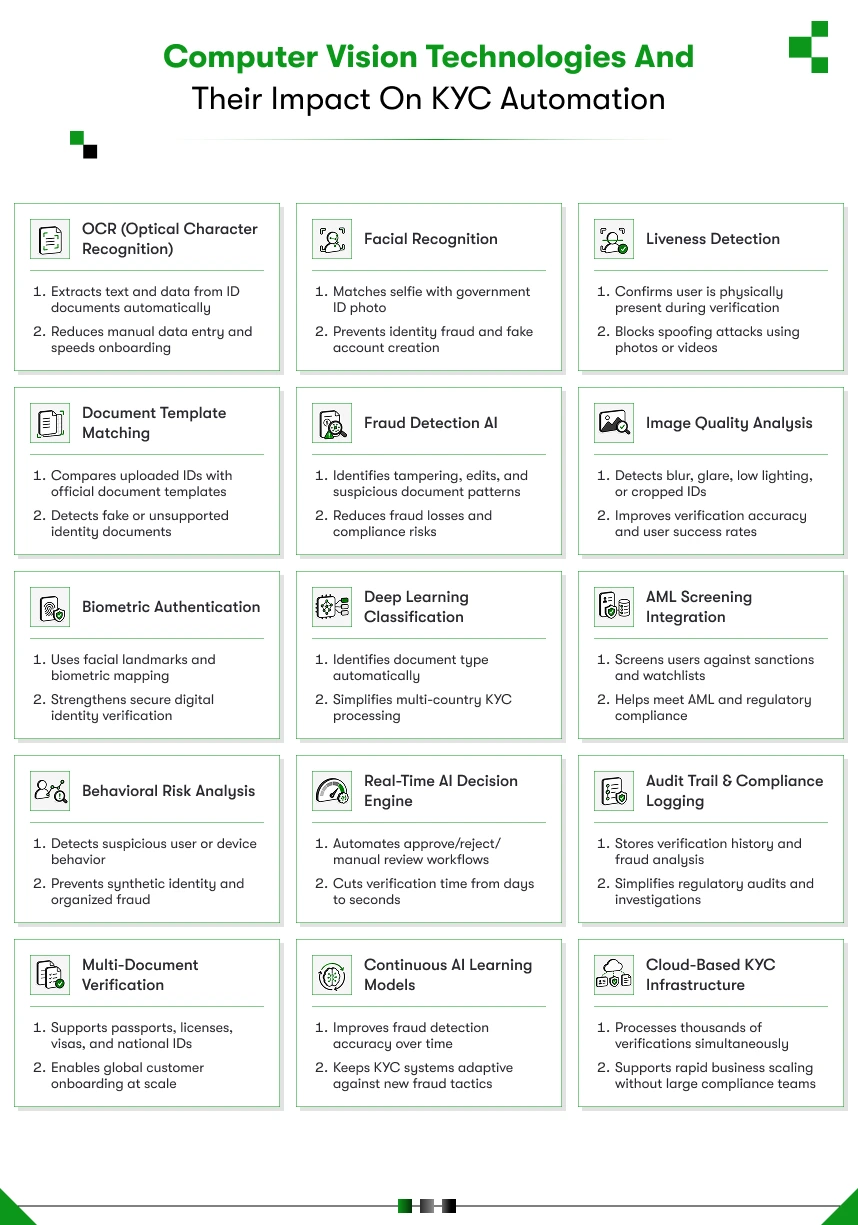
Jumio’s published results demonstrate what automated KYC using computer vision delivers at production scale:
- Jumio processes over one million identity verifications daily
- Jumio automates approximately 90% of all verification decisions
- Jumio supports ID documents from over 200 countries and territories
- Jumio’s document template library covers 3,500+ document types globally
The road ahead points toward deeper AI integration across every layer of identity verification. Jumio partnered with LatticeFlow AI to strengthen robustness testing and bias detection across computer vision models. Future KYC systems will analyze behavioral patterns, device signals, and continuous authentication cues rather than relying solely on point-in-time document checks. Fraud detection will shift from single-event verification to continuous risk monitoring throughout the customer lifecycle.
Businesses that build computer vision KYC capabilities now gain a meaningful competitive advantage. Compliance technology built on strong AI foundations adapts faster to regulatory changes without full system rebuilds.
Conclusion
KYC automation powered by computer vision is a proven, operating reality. Jumio demonstrates what the technology delivers daily: document capture, authenticity checks, biometric matching, fraud detection, and real-time decisions at one million verifications per day.
Businesses ready to build similar capability face clear strategic choices. Use a third-party API for speed to market. Build a custom system for full model ownership. Partner with a specialized development team to balance speed, control, and technical depth.
Kody Technolab supports businesses across every stage of that journey. From system architecture and model training through deployment and compliance certification, Kody brings deep expertise in computer vision for KYC automation. Connect with the Kody team today. Get a clear development roadmap built around your business requirements, compliance obligations, and growth targets.

Frequently Asked Questions
1. What is computer vision in KYC?
Computer vision in KYC refers to AI systems that analyze identity document images and video to extract data, detect forgeries, and match biometric features. KYC systems use computer vision to replace slow, error-prone manual document reviews with fast, accurate, and scalable automated verification.
2. How does Jumio use AI for KYC automation?
Jumio uses artificial intelligence, machine learning, and computer vision across five stages: document capture and OCR, visual authenticity checks, biometric face matching with liveness detection, fraud scoring and AML screening, and automated real-time decision delivery. Jumio automates approximately 90% of all verification decisions without human intervention.
3. How much does it cost to build a KYC system like Jumio?
Custom development for a KYC computer vision system typically costs between $100,000 and $350,000 for a functional system. Building a production-grade, Jumio-comparable platform with regulatory certifications and global document coverage typically starts at $500,000. API integrations cost between $0.10 and $1.50 per verification check.
4. How accurate is computer vision for KYC verification?
Well-trained computer vision KYC systems achieve accuracy rates of 99% or higher under production conditions. Accuracy depends on training data quality, the range of document types supported, and the sophistication of the fraud detection models deployed.
5. What is liveness detection in KYC?
Liveness detection confirms that the person submitting a selfie during KYC verification is physically present at that moment. Computer vision models detect signs of life including natural facial movement and depth. Liveness detection prevents attackers from using printed photos, masks, or video recordings to bypass biometric matching checks.
6. How long does it take to build a computer vision KYC system?
A basic KYC system with document reading and face matching takes four to six months to build with a full development team. A production-ready system with fraud detection, AML integration, and multi-country document support typically requires nine to fourteen months. Timelines depend on team size, data availability, and regulatory testing requirements.
7. What regulations does an automated KYC system need to meet?
Automated KYC systems must meet regulations, including AML (Anti-Money Laundering) directives, GDPR for data handling in European markets, and country-specific KYC regulations from financial regulators. Systems must produce full audit trails, handle data retention policies correctly, and pass regulatory penetration testing before production deployment.
8. How do I hire the right computer vision developers for a KYC project?
Look for development partners with demonstrated experience in AI model training, biometric systems, and fintech compliance architecture. Evaluate prior work in identity verification or document processing. Assess team depth across computer vision engineering, machine learning, security, and QA. Kody Technolab specializes in building custom AI automation systems for fintech and compliance-driven industries.











 Contact Information