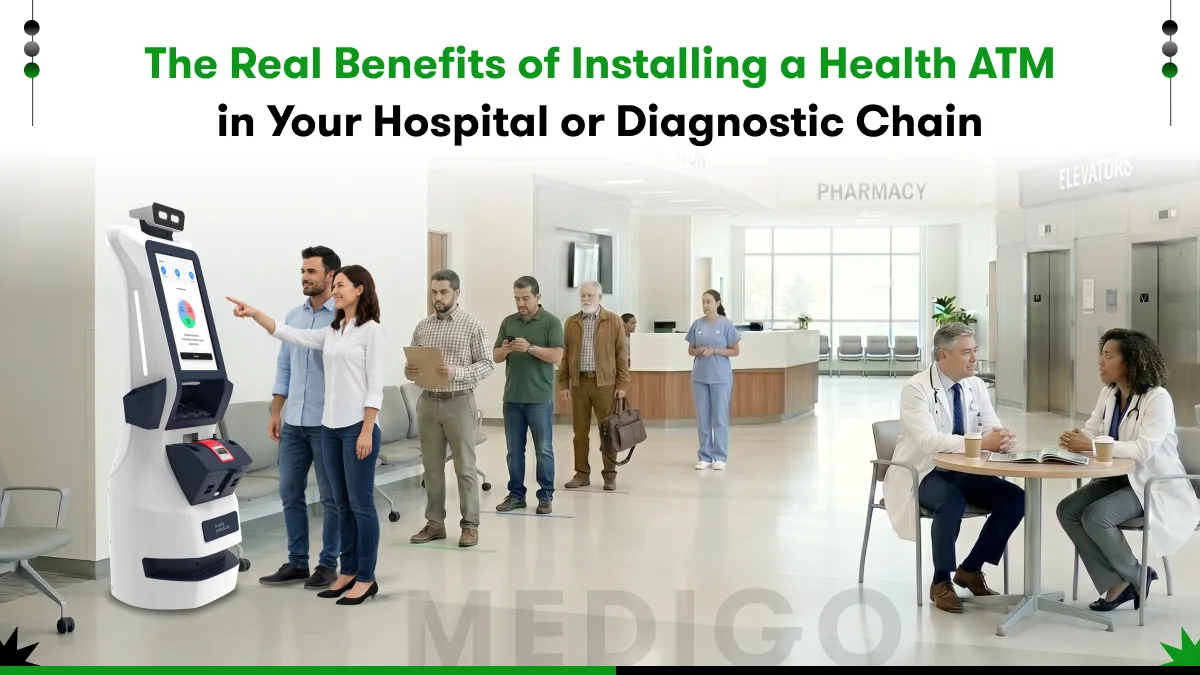
Blog Summary: A health ATM machine gives hospitals and diagnostic chains the ability to screen more patients, reduce staff dependency, deliver instant results, and expand into new markets without rebuilding their entire operation. Every benefit covered in this blog is already being delivered inside facilities running Medigo today, with the same teams, the same spaces, and the same budgets they already had.
Screening a patient should not require three staff members, four devices, and a two-day wait for a report that arrives with no explanation attached. The issue is not a lack of awareness. Healthcare providers have known about these inefficiencies for years. The challenge has been finding a practical way to solve them at scale.
The organizations adopting Health ATMs are not doing so because they have extra resources to spare. They are doing it because they understand the cost of the current process. When you look at the time, effort, and operational expense involved in every screening, the inefficiencies add up quickly.
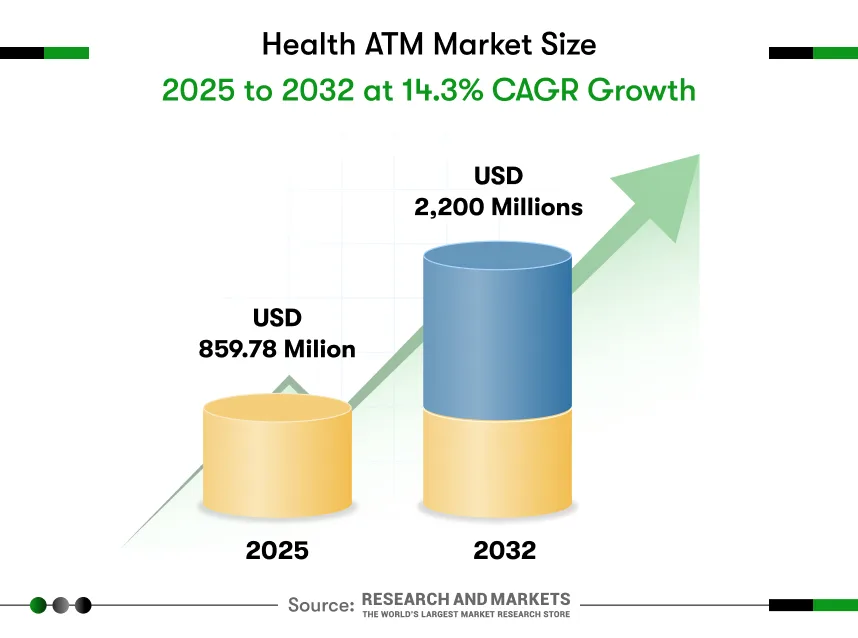
This growth is easy to understand when you look at what hospitals are dealing with every day. Research and Markets reports that the Health ATM market increased from USD 756.25 million in 2024 to USD 859.78 million in 2025 and could reach USD 2.20 billion by 2032. The installation of these systems is increasingly adopted, as conventional means of handling screenings are no longer sustainable with the number of patients continuing to increase.
Here is what that looks like in practice.
Key Takeaways:
- A health ATM machine removes the manual pre-consultation workflow that costs your doctors five to seven minutes of clinical time per patient, every single day.
- Patients who receive their health report before leaving your facility follow up, accept referrals, and return for treatment far more often than patients waiting 48 hours for results they cannot interpret.
- Diagnostic chains can enter Tier-2 and Tier-3 markets with one unit, no full lab required, running the same protocols and producing the same report quality as their flagship location.
- Early screening costs a fraction of late-stage treatment. Every condition caught through consistent screening is a patient your facility manages affordably rather than expensively.
- A health ATM machine fits into your existing patient flow without restructuring your operations, your team, or your budget.
What Is a Health ATM Machine and How Does It Work?
A Health ATM is a health screening kiosk that lets people complete a basic medical checkup on their own. Instead of moving between different counters, devices, or staff members, the patient uses a single machine that guides them through the entire process.
The experience is similar to using a bank ATM. You walk up to the machine, follow the instructions on the screen, complete the required steps, and get the information you need. In this case, instead of a banking transaction, the machine performs a health screening.
Patients can choose their preferred language, follow simple on-screen guidance, complete a series of diagnostic tests, and receive a health report within minutes. The role of AI in healthcare is what makes this possible. The system collects readings from connected medical devices, interprets them through trained clinical models, organizes the results, and generates a single report that can be shared digitally or printed on the spot.
For hospitals, diagnostic centers, and PHCs, it offers a faster way to screen patients without depending on multiple staff members or separate testing stations.
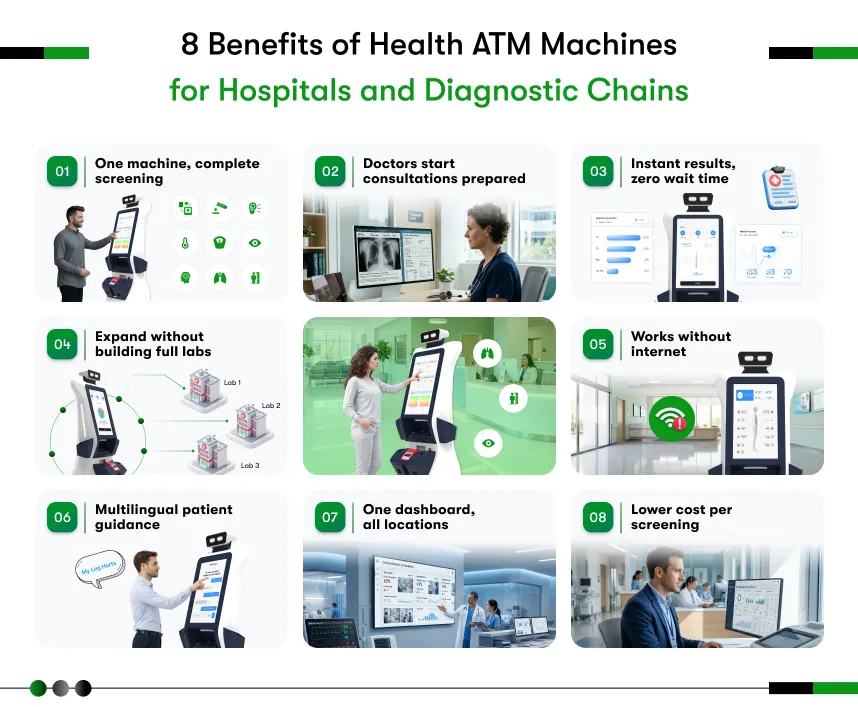
Benefits of Health ATM Machines for Hospitals and Diagnostic Centers
Most hospitals and diagnostic centers face a similar challenge: patient numbers keep growing, but staffing and infrastructure do not grow at the same pace. As a result, teams are expected to handle more work with the same resources.
The health ATM features built into a single unit address exactly that gap. It helps hospitals and diagnostic centers screen more patients, reduce pressure on staff, and improve day-to-day operations without needing to constantly expand their workforce.
Benefit 1: One Machine Handles the Work of Multiple Screening Stations
In most hospitals, collecting patient vitals is still a manual process. Staff move between different devices, record readings separately, and pass the information to the doctor. By the time the consultation starts, the doctor often spends valuable time reviewing and organizing data that could have been available from the start.
A health ATM for hospitals brings all of those steps together in one place. Patient readings are captured, organized, and turned into a single report before the consultation begins. The same holds true for a health ATM for PHC settings, where staff shortages make manual data collection an even bigger burden on the facility.
Instead of spending time gathering information, doctors can start with a complete picture of the patient’s health. Staff spend less time managing devices and paperwork, and more time helping patients.
For hospitals with busy OPDs, even small time savings across hundreds of patients can make a noticeable difference in daily operations.
Benefit 2: Doctors Spend More Time on Care, Less Time Gathering Information
In many OPDs, doctors spend the first few minutes of a consultation gathering information. They review paper records, check readings, ask routine questions, and try to piece together a patient’s health status before they can focus on the actual medical discussion.
With a health ATM machine for hospitals zain the waiting area, that information is already available. Built on robotics healthcare infrastructure, the unit captures key health indicators such as blood pressure, SpO2, ECG, blood glucose, weight, and other readings and organizes them into a complete digital report before the patient even enters the consultation room.
This allows doctors to spend less time collecting information and more time understanding the patient’s condition, discussing concerns, and deciding on the next steps. For busy OPDs, that can make every consultation more productive from the very beginning.
Benefit 3: Patients Walk Out With Their Results, Not a Two-Day Wait
The follow-through gap is where early detections go to waste. A patient completes their tests, waits two days for results, receives a message with numbers that carry no context, and never follows up because nothing about that experience compelled them to act.
A health ATM kiosk for hospitals and diagnostic centers delivers results before the patient leaves the building. Every reading comes with a plain language explanation, flagged abnormalities, and clear next steps the patient can act on immediately. A patient who receives their complete health picture while still inside your facility is significantly more likely to book a follow-up, accept a referral, or purchase a treatment package than one waiting 48 hours for a number they cannot interpret.
Benefit 4: Diagnostic Chains Can Enter Tier-2 and Tier-3 Markets Without Building a Full Lab
The unit economics of expanding into smaller cities have always been the barrier for diagnostic chains. A full branch requires real estate, pathology equipment across multiple categories, licensed staff who are difficult to recruit in smaller markets, and compliance overhead that pushes the break-even point further than most expansion budgets can justify.
A health ATM for hospitals and diagnostic chains changes what a branch needs to look like. A small footprint space, one unit, and a standardized screening protocol that delivers the same report quality as your flagship location. The advancement of robotics in healthcare is what allows a single compact unit to run the kind of multi-condition screening that previously required an entire diagnostic setup.
Every branch runs identical workflows, produces identical report formats, and feeds into the same centralized dashboard regardless of city size or staff experience level. The expansion conversation stops being about whether the numbers work and starts being about which city you want to enter first.
Benefit 5: Keeps Working Even When the Internet Does Not
Many digital health systems struggle in rural areas because they rely on a stable internet connection. When connectivity drops, reports may not generate, data can become difficult to access, and staff often stop relying on the system altogether.
A health screening kiosk for hospitals and labs is designed with these conditions in mind. Screening data is stored locally and automatically syncs with the cloud once the connection is restored. Patients can continue their screenings, reports can still be generated, and records remain secure even during network interruptions.
For PHCs and rural hospitals that deal with unreliable connectivity, this means the system continues to work when it is needed, not just when the internet is available.
Benefit 6: Patients Can Complete Screenings in Their Preferred Language
Clear instructions are essential for accurate health screenings. When patients struggle to understand what they are being asked to do, the chances of incomplete or incorrect screenings increase.
An AI health ATM for hospitals patients through the entire process in their preferred language, using simple instructions for every step. The system explains each test, adapts the screening flow based on patient responses, and provides results in a format that is easy to understand.
Because the process is self-guided, there is no need for a trained operator to stand by the machine. This is especially valuable for diagnostic centers serving different regions and PHCs supporting communities where patients may speak different languages. It helps create a more consistent screening experience for everyone, regardless of location or language.
Benefit 7: One Dashboard for Every Location
Managing health data across multiple facilities can be challenging. Reports often come from different systems, data is recorded in different formats, and by the time everything is compiled, the information may already be outdated.
A health ATM machine for hospitals automatically sends screening data to a centralized dashboard as each session is completed. This gives management teams a real-time view of activity across all locations from a single platform.
Instead of waiting for reports, you can quickly see screening volumes, identify health trends, track performance across branches, and monitor patient outcomes as the data comes in. For hospitals, diagnostic chains, and franchise networks, it makes reporting simpler and decision-making much faster.
Benefit 8: Lower Screening Costs and Better Use of Resources
Traditional screening involves multiple staff members, separate devices, paperwork, and time spent compiling reports. While each step may seem small on its own, the cost adds up quickly when hundreds of patients are screened every day.
A health ATM kiosk for hospitals and diagnostic centers brings these activities into a single process. With one system handling the screening workflow, the cost per patient can be much lower than a traditional setup that relies on multiple devices and staff members.
There is also a bigger long-term benefit. According to ICMR 2025, around 65% of cancers in India are diagnosed at Stage III or IV. When health conditions are detected late, treatment becomes more complex, resource-intensive, and expensive. Early screening increases the chances of identifying health issues before they develop into serious complications.
That is why a Health ATM should not be viewed as just another expense. It helps hospitals and diagnostic centers use their existing resources more effectively while making preventive screening easier to deliver at scale.
For hospitals managing large numbers of patients with chronic conditions, early screening is not just about improving health outcomes. It can also reduce the number of costly emergency admissions while increasing opportunities for preventive care services. Over time, even a modest reduction in late-stage complications can have a noticeable impact on both patient care and the hospital’s financial performance.
If you want to understand how Medigo works in detail, read our dedicated blog covering everything from the screening process to real facility deployment.
Who Benefits Most From a Health ATM?
A health ATM machine for hospitals is not a single-use solution built for one type of facility. The same infrastructure that fixes the OPD bottleneck in a 500-bed hospital also solves the expansion problem for a diagnostic chain, the staffing shortage at a PHC, the annual health camp chaos at a school, and the compliance headache inside a corporate wellness program. The problem each of them faces is different on the surface. Underneath, it is the same gap between the demand for screening and the infrastructure available to deliver it.
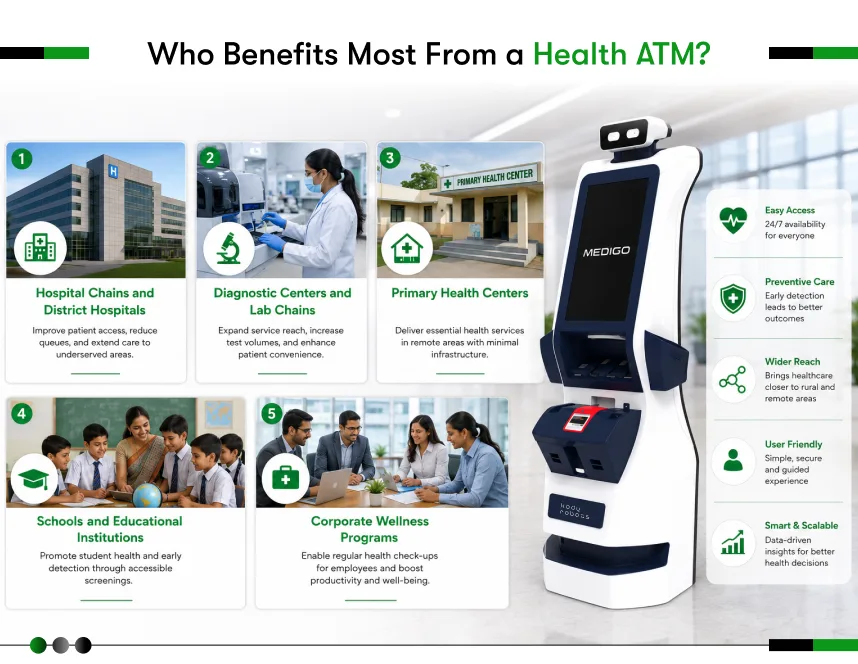
Hospital Chains and District Hospitals
Health ATMs can be placed in OPD waiting areas to handle pre-screening before patients meet a doctor. This reduces manual vitals collection, gives doctors a consistent starting point for consultations, and helps identify high-risk patients earlier.
Diagnostic Centers and Lab Chains
For diagnostic networks looking to expand into smaller cities, a Health ATM can provide screening services without the cost of setting up a full laboratory. It also helps maintain consistent screening and reporting standards across locations.
Primary Health Centers (PHCs)
PHCs in rural and semi-urban areas can use Health ATMs to conduct screenings for more than 65 conditions, even in locations with limited staff or unreliable internet connectivity. Patients can complete screenings in their preferred language without needing assistance.
Schools and Educational Institutions
Schools can use Health ATMs for routine student health screenings, including vision, hearing, BMI, hemoglobin, and mental wellness assessments. Reports can be shared directly with parents, helping identify potential health concerns early.
Corporate Wellness Programs
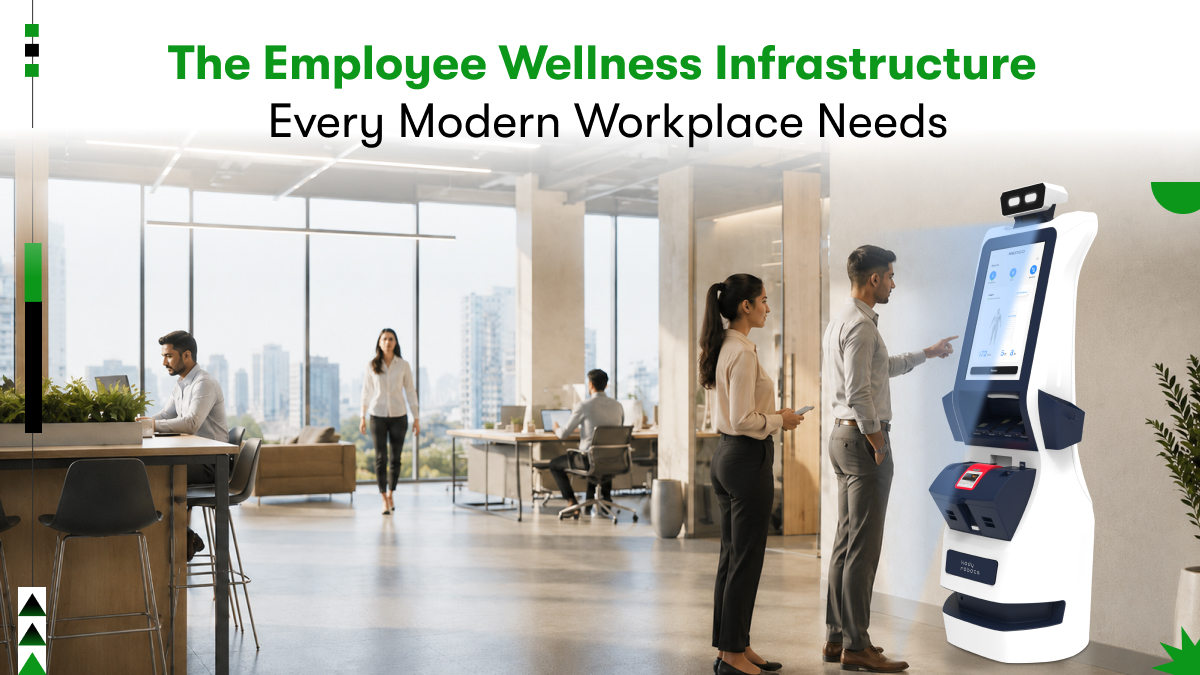
Organizations can use Health ATMs to conduct employee health screenings on-site throughout the year instead of organizing periodic health camps. The system maintains digital health records and provides standardized reports that support workplace health and compliance requirements.
Every facility on that list is dealing with a version of the same problem: more demand than the current infrastructure can handle cleanly. A health ATM for hospitals and diagnostic chains does not ask you to hire more people, build more space, or redesign how your facility operates. It fits into what you already have and immediately starts handling the volume your current process was never built for.
The next section covers exactly how Medigo delivers all of this in practice.
What Is Medigo and How Does It Help Healthcare Facilities?
All the benefits discussed so far- faster screenings, fewer staff dependencies, quicker reports, multilingual support, centralized data, and offline functionality- come down to one thing: having a system that can handle the entire screening process without creating more work for your team.
That is where Medigo comes in.
Developed by Kody Technolab Limited, Medigo is an AI-powered health screening system designed for hospitals, diagnostic centers, PHCs, schools, and corporate facilities. Unlike a basic kiosk or a single-test device, Medigo operates as a fully autonomous health-screening robot that integrates multiple diagnostic devices into a single guided workflow without any operator involvement.
Instead of relying on multiple devices, separate workflows, and manual coordination, Medigo brings everything together into a single screening experience.
Patients are guided through the process step by step, screenings are completed in minutes, and reports are generated automatically without requiring a dedicated operator.
How Medigo Helps
One system instead of multiple screening stations
Medigo combines readings from different diagnostic devices into a single workflow and generates one consolidated report. Staff spend less time coordinating tests and more time assisting patients.
Doctors get information before the consultation starts
Patients arrive with a complete digital report that includes key health indicators such as blood pressure, blood glucose, ECG readings, SpO2, weight, and more. Doctors can focus on assessment and treatment instead of collecting basic information.
Reports are available within minutes
After the screening is completed, patients can receive their reports through WhatsApp, email, or a printed copy. The results are organized in a way that is easy to review and understand.
Supports expansion without a full lab setup
Diagnostic centers can offer comprehensive screening services without investing in a complete laboratory at every location. The same screening process and reporting standards can be maintained across all branches.
Works even when internet connectivity is unreliable
Medigo stores data locally and syncs it when the connection becomes available again. Screenings continue without interruption, making it suitable for PHCs and facilities in areas with unstable internet access.
Guides patients in their preferred language
The system walks patients through each step in their chosen language, helping them complete screenings comfortably without needing constant assistance.
Provides a centralized view across locations
Screening data from different sites is available through a single dashboard, making it easier to monitor activity, track trends, and manage operations across multiple facilities.
Helps reduce screening costs
By simplifying the workflow and reducing dependence on multiple devices and manual processes, Medigo can lower the overall cost of delivering screenings at scale.
The biggest advantage is that Medigo fits into existing workflows. Hospitals and healthcare providers do not need to redesign their operations. The system works alongside current processes while helping teams screen more patients, access better data, and maintain consistency across locations.
Conclusion
At some point, every hospital has to ask a simple question: how much time, effort, and money is being spent just to get a patient screened?
The benefits of a health ATM machine are not theoretical. Faster consultations, instant reports, consistent screening across every location, offline capability, multilingual guidance, and real-time data are all operational realities that hospitals and diagnostic chains are experiencing right now.
What makes health ATM machines worth serious consideration is not any single benefit in isolation. It is the fact that one machine delivers all of them simultaneously, inside the facility you already run, with the team you already have.
If even half of what this blog covers applies to a challenge your facility is currently dealing with, a demo costs you thirty minutes. What you learn in those thirty minutes will tell you everything you need to know about whether a health ATM machine belongs in your facility.
Book a Free Medigo Demo Today
See a health ATM machine in action before committing to anything. Kody Technolab’s team will walk you through exactly how Medigo fits into your facility, your patient flow, and your operational setup in a single thirty-minute session.
Facilities that have seen the demo have walked away with a clear answer, one way or the other. That clarity alone is worth the thirty minutes.
FAQs
1. What is a health ATM machine and how does it work in a hospital setting?
A health ATM machine works exactly like a bank ATM, but instead of cash, your patient walks away with a complete health report. Your patient walks up, picks their language, follows simple on-screen instructions, completes their diagnostic tests, and gets their results before they leave your facility. No operator needed, no manual data entry, no waiting.
For your OPD specifically, it sits in the waiting area and sends a complete health report to the consultation room before the patient even sits down in front of your doctor.
2. How much does it cost to install a health ATM machine in a hospital or diagnostic center?
Pricing is structured around your facility’s specific setup, so there is no single number that fits every hospital or diagnostic chain. Kody Technolab offers a 90-day managed pilot with full installation included, so you can see real numbers from your own patient population before making any long-term commitment.
Reach out to sales@kodytechnolab.com and the team will walk you through what makes sense for your facility.
3. Can a health ATM machine work without a doctor or trained medical staff operating it?
Completely. Your patients follow the AI guidance on screen in their own language from start to finish without anyone standing next to the machine.
And if a reading comes back critical and needs immediate medical attention, the built-in telemedicine module connects your patient to a physician right there through the machine without them having to go anywhere else.
4. What medical tests and screenings can a health ATM machine perform?
More than you might expect from a single machine. Medigo covers 65-plus conditions in one ten-minute session, including blood glucose, HbA1c, hemoglobin, lipid profile, kidney function, 6-lead ECG, spirometry, hearing, vision, blood pressure, BMI, SpO2, oral health, and mental health screenings covering depression, anxiety, and ASD, all in one consolidated report.
5. How accurate are the results from a health ATM machine compared to a traditional diagnostic lab?
Medigo runs at 95% screening accuracy across AI models trained on validated clinical datasets. The machine identifies which of your patients need clinical follow-up before their condition progresses. It works alongside your diagnostic lab, not instead of it, catching the patients who need to be there before symptoms force the visit.
6. Can a health ATM machine work in areas with poor or no internet connectivity?
Your screenings will not stop because the internet did. Medigo stores all data locally on the unit and syncs automatically to the cloud the moment connectivity comes back. Reports still generate, patients still get their results, and your records stay intact. For PHCs and rural hospitals where this has historically been the reason good technology never lasted in the field, this changes that entirely.
7. How does a health ATM machine help diagnostic chains expand into Tier-2 and Tier-3 cities?
One unit, small footprint, no full lab required. Every location in your network runs the same screening protocol and produces the same report format, whether it is your flagship branch or a new location in a smaller city. The expansion economics that never quite worked with a full branch model start working with a health ATM machine because the capital requirement is a fraction of what a traditional setup costs.
8. What is the return on investment for a hospital that installs a health ATM machine?
Your ROI shows up in three places. Your doctors recover the minutes lost to manual vitals collection across every single consultation. And your facility converts more follow-ups because patients receive their results before they leave rather than waiting 48 hours.
And according to ICMR 2025, 65% of cancers are detected at Stage III or IV, meaning every condition caught early through consistent screening is a patient who does not return requiring treatment that costs significantly more than the screening ever would have.







 Contact Information