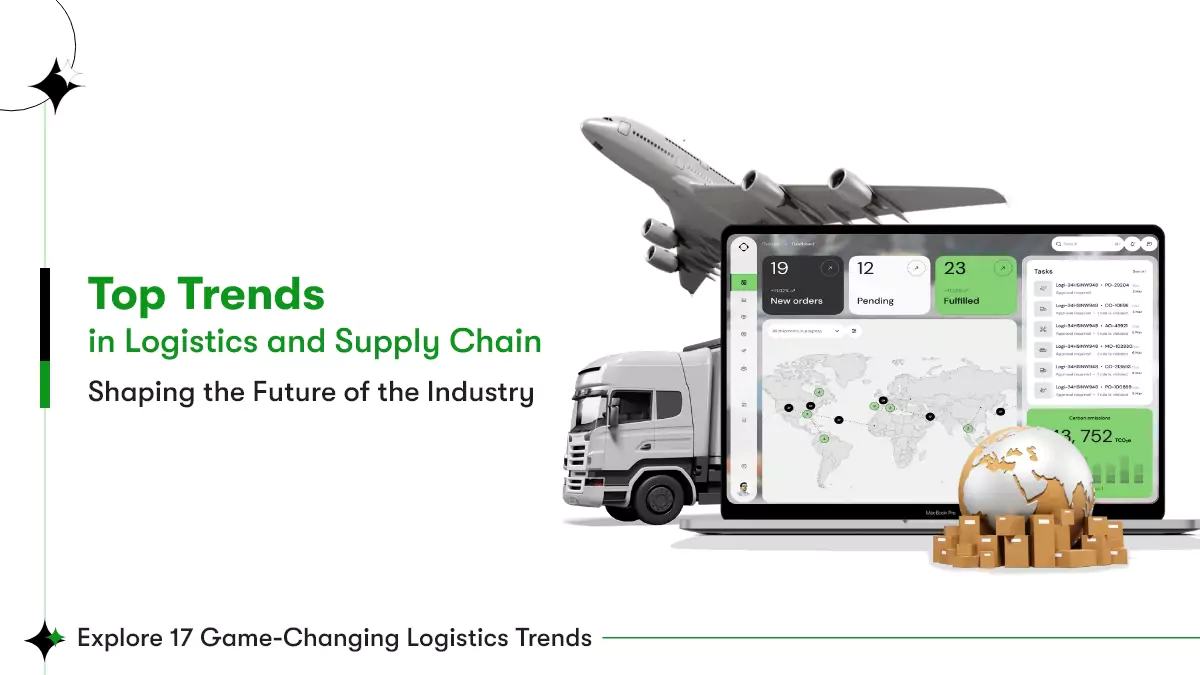
Summary: The trends in logistics and supply chain are changing faster than most businesses realize. New technologies are shifting customer expectations and demands, leading to stockouts or surpluses, and these global disruptions are forcing companies to rethink how to allocate goods and optimize warehouse operations. It is good to follow the trends, but at the same time, you should also observe which trend is more efficient for your business problems and then implement it. The question is, how would you know what the trends are and how they’ll bring efficiency in your business? The answer lies in this blog, where we explore 18 key trends in logistics and supply chain that are genuinely shaping the industry. This blog will help you see what really matters for your business, and what can give you an edge in a world that’s constantly evolving.
We couldn’t agree more with the words that mention, “Great companies know logistics and supply chain is the key differentiator to separate from the competition.” The rising demand and emerging trends are reshaping the future of logistics. The constantly evolving logistics and supply chain trends are tech-driven, focusing on increasing productivity and reducing business expenses. New trends emerge in supply chain management and logistics every year, and this year’s list is notably different due to the pandemic’s significant impact. With a shift towards eCommerce and online shopping, the industry faces a pressing need to develop innovative, instant solutions. Thus, the logistics and supply chain management trends for 2024-25 promise to be particularly intriguing. Shall we begin?
An Era of Revolution Begins
Logistics and supply chains are the backbone of any business: the more agile and flexible the process, the greater the future growth opportunities. By adapting to these trends, you can enhance your business’s reliability, resilience, speed, and sustainability. Technological advancements allow you to focus on core business offerings while innovations handle the rest. These trends will consistently keep your customers ahead.
However, current trends in logistics, especially the push towards digital transformation, are increasing operational flexibility. Embracing digital transformation enables businesses to handle unforeseen events more effectively and enhances overall efficiency.
Let’s look at how exactly the transformation will be implemented and which trends will strengthen modern-day businesses.
Top Trends in Logistics and Supply Chain
As the logistics world grows, you must stay aware of trends in logistics and supply chain that can help your business and its operations remain efficient. With these trends, such as AI in manufacturing and predictive analytics, businesses are staying agile and adaptive to expand and perform better in the industry.
1. Blockchain:
Blockchain is everywhere today; you name an industry, and this vibrant technology will have a stunning impact. If we talk about this segment, logistics, and supply chain, it was a hustle to manage and process the data.
This can be overcome by implementing blockchain technology. The success story of Koopman Logistics is the proof of concept. The company executed Bitcoin blockchain technology and became the first company to deliver automotive vehicles without paperwork.
2. eCommerce logistics:
We all participated extensively in bringing this trend to light. One of the most prominent trends in logistics and supply chains today is eCommerce logistics. The online shopping craze has driven exponential growth in the eCommerce industry. It is expected that eCommerce logistics will cross $524 billion by 2025. Another poll conducted by Peerless Research Group indicates that nearly 10% of participants expect the eCommerce channel to grow by 60% or more.
3. Digital training solutions:
Again, the rise in demand for eCommerce solutions is one thing, but hiring officials who can fulfill the purpose is another. This challenge has given rise to new trends in logistics and supply chain, particularly around workforce readiness. The onboarding and development of the hired professionals are also tasks that accompany growth.
To address this issue, businesses now resort to digital training solutions that will do the job for them. Besides, the digital solutions will handle the hiring, recruiting, and onboarding of professionals.
Amazon, the biggest eCommerce giant, adopted this trend when it hired nearly 175,000 temporary employees during the COVID-19 pandemic and has since hired almost 2800 workers every day (since July 2020).
4. Gamification:
One thing that definitely stimulates the human mind is gamification. Among the emerging trends in logistics and supply chain workforce management, gamification is gaining attention. The growing need to deliver the product on time may force the team to work extended hours. And if this continues for days, they are likely to lose their motivation and productivity.
To boost their morale, you can include gamification activities, such as real-time feedback and a digital challenge, to help them interact with the team and improve their skills.
You can also introduce a Reward system. For example, you might give a virtual badge or a performance bonus to the employee who performs extravagantly.
As a result, even workers can have real-time access to their performance and learn to manage their workload. Additionally, the repetitive and tedious tasks can be made fun & engaging, which will boost their creativity.
We have curated the 11 best logistics management software features for you!
5. Warehouse automation:
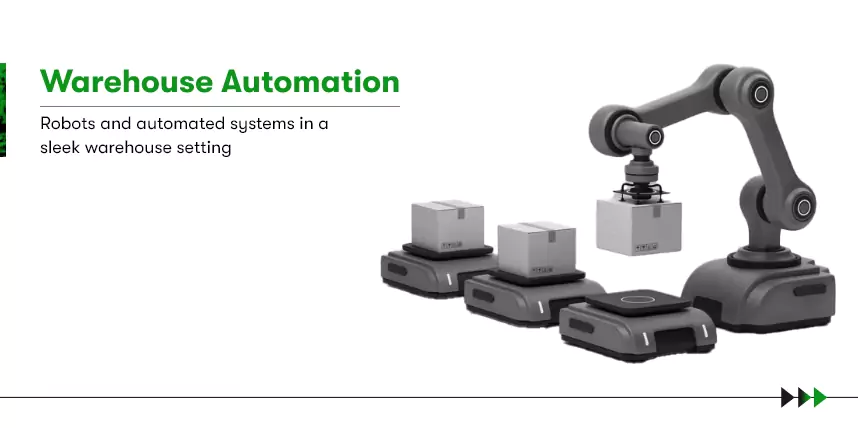
One of the important segments in logistics and supply chain strategies is warehouse management. Well, the old-school manual methods of managing the warehouse are extremely time-consuming and costly. And also most likely will be replaced by automated methods in a short time.
Robotic arms, automated guided vehicles, automated storage, and retrieval are a few things that will follow in the year 2023 and beyond. Well, we wouldn’t stop citing Amazon again as an example here. Amazon made an upfront investment in warehouse automation and is expected to save $18 billion in warehouse operating costs.
Also Read: Detailed Guide on Optimizing Warehouse Processes
6. Internet of Things:

Well, as the adoption of IoT is increasing like wildfire across industries, why not here? A McKinsey report states that warehouse automation will grow by 3-5% by 2025.
IoT will help organizations maintain data accuracy and keep devices in sync. The embedded software will literally help businesses in taking the data transformation journey to ANOTHER level.
7. Artificial intelligence:
Another trend in supply chain management is the advent of Artificial Intelligence and Machine Learning. You will see numerous applications functioning without human input yet delivering accurate results. Automation streamlines repetitive, labor-intensive tasks. At the same time, AI attempts to emulate human intelligence and learn from past data to simplify more complex, challenging tasks.
Know more about AI in Logistics being an industry catalyst!
8. Increased supply chain visibility:
One thing that probably earlier supply chain management approaches were lacking is the ability to forecast the catastrophe. However, supply chain visibility will help businesses optimize their operations by forecasting the revenue/expenditure scenario and thereby boosting strong decision-making.
Supply chain visibility will help organizations deep-dive into operations such as procurement, manufacturing, transportation, and delivery. Since the data will be made available in real-time, businesses have a chance to manage the inventory effectively.
Read Also: How Digital Supply Chain Technologies are Bringing a Revolution in Supply Chain Management?
9. Lean logistics:
Change is the only constant; yes, we all know this. But do you see how this philosophy applies to supply chain management, too? Organizations will soon start implementing Lean Logistics to empower workers by talking to them. The open platform will give each team member a chance to speak up about how to increase efficiency and reduce time waste. This will raise awareness of the importance of productivity and costs within the organization and encourage teams to optimize processes further.
10. Predictive analytics in supply chain:
Planning has always been key in logistics, but predictive analytics in supply chain is turning that into a science. With real-time data and AI, companies can now spot trends before they fully form.
That includes sudden spikes in demand, potential delivery delays, or low stock at a warehouse.
This is where AI for supply chain comes in handy; it gives supply chain teams more control. Instead of reacting to problems, they can prepare for them.
For example, Walmart uses predictive systems to restock stores based on what customers are likely to buy in each location, rather than relying only on past sales. This leads to fewer stockouts, smoother operations, and better customer satisfaction.
11. SaaS in the supply chain:
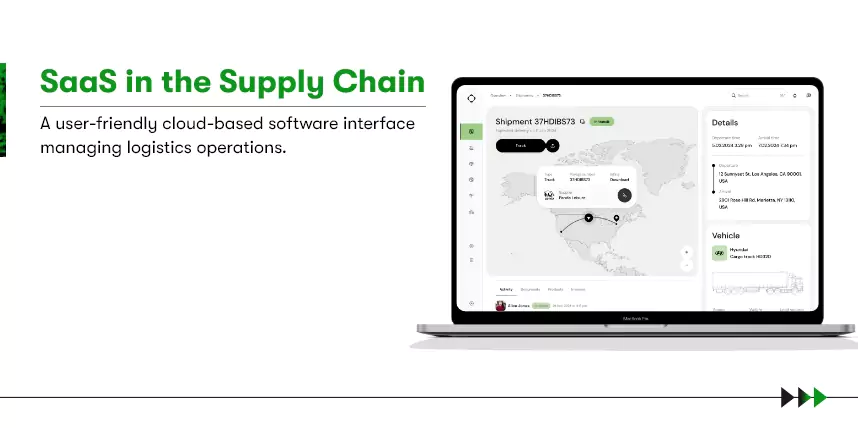
If you have considered implementing cloud computing in the supply chain model, the Software-as-a-Service model is a natural fit. The SaaS model provides the organization with security and safety, and they pay only when they use the service.
Companies can free themselves from additional costs, such as system maintenance, constant updates, and infrastructure costs. Companies can opt for SaaS cloud-based transportation management software and have a competitive advantage.
Supply chain-as-a-service is another new concept gaining traction in the industry.

12. Cloud-based Solutions:
To stay competitive in the market, accuracy, agility, and accessible solutions are key for any organization. That’s where Software-as-a-Service (SaaS) models become particularly useful for your supply chain management. Despite being reliable and secure, SaaS is also highly efficient and convenient.
Since it stores all of your organization’s data in the cloud, you or your team can easily access the required information at any time, from anywhere. If you have a multinational and digital supply chain, the efficiency achieved by SaaS solutions will support your organization as you progress into a fast-paced future.
Companies can reduce costs by adopting SaaS cloud-based solutions. For those interested in building tailored solutions, refer to our AI App Development Guide to integrate intelligent features efficiently.
13. Reverse Logistics:
Reverse Logistics has become a significant trend for retailers of all kinds. In fact, Allied Market Research stated that the global reverse logistics market– valued at $635.6 billion in 2020– is projected to grow by $958.3 billion in 2028, at a CAGR of 5.6%.
The trend is to make your supply chain more sustainable using returns, repairs, reselling, replacements, and recycling. Apple gives us the best example of reverse logistics. You know, when consumers go back to an Apple store to buy the latest model, they can get discounts on a new purchase if they return their old models. Apple collects these old products and brings them back to its factories. .
14. Circular Supply Chain Model:
The circular supply chain model is a new trend in supply chain management. In this model, instead of the traditional linear model in which materials are used and then disposed of, materials are reused and recycled in a closed loop. This helps eliminate waste and reduce environmental impact.
The circular supply chain model is becoming more popular as businesses become more aware of the environmental impact of their supply chains. Additionally, this model can save businesses money by reducing waste and maximizing resource use.
If you’re interested in implementing the circular supply chain model in your business, there are a couple of things you need to keep in mind. First, you need to have a clear understanding of your supply chain and the materials you use. And then you need to find suppliers willing to recycle materials.
15. Omnichannel Supply Chain:
Increasingly, platforms have made it essential for businesses to offer an actual omnichannel buying experience to serve customers where they engage most. For example, by providing customers with the option to shop online or in-store, the omnichannel model increases demand on logistics and supply chains, stimulating individual customer orders and replenishing stock at retail outlets.
16. Increase Focus on Sustainability in the supply chain:
Consumers now understand the impact of greenhouse gas emissions and how they threaten the entire global atmosphere. Besides, it is a growing concern amongst consumers, and they wish the logistics industry were more transparent about it.
This is why the logistics and supply chain industry is adopting a green behavior approach toward management. The organizations are now moving in a greener direction, keeping environmental sustainability in focus. For example, packaging is becoming more eco-friendly, products are made with sustainable components, and lighting is used to reduce electricity demand are some of the points logistics companies have started addressing.
Read Also: Mastering Logistics Management
Bonus Trend to follow:
17. Augmented Reality
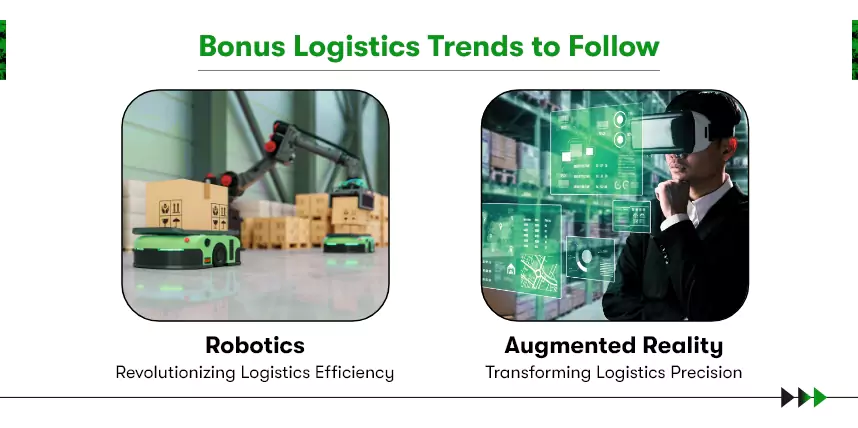
Augmented Reality (AR) is one of the exciting trends in logistics that helps workers see digital information overlaid in the real world. Imagine wearing special glasses that show you exactly where to place items in a warehouse. This makes tasks quicker and reduces mistakes.
18. Robotics
Last but not least, Robotics is another key trend in logistics. Robots help with tasks like moving items, packing boxes, and even delivering goods. These robots work faster and more accurately than humans, reducing errors and saving time. For example, in a warehouse, robots can transport heavy items, freeing up human workers to focus on more complex tasks. This makes the whole logistics process smoother and more efficient.
Implementing these trends in logistics and supply chain in your business will help you stay efficient, productive, and perform better in the market. However, you should pick trends that are valuable to your business and address genuine problems. If these trends are analyzed and implemented correctly, your success is guaranteed.
Ready to follow the trend?
We hope that this curated list helps you in moving forward and excelling in your logistics and supply chain management profession. Sometimes it might become challenging to follow the trend and implement it in the right direction. However, you may always seek help from an expert.
For businesses looking to develop advanced features and stay ahead in the industry, hiring PHP developers can be a game-changer. These professionals can help integrate cutting-edge technologies into your TMS, ensuring seamless and efficient operations.
The outcomes of the trend implementation mentioned above are going to define the future of the logistics industry. Well, this is just the beginning.
Ready to follow the trends in logistics and supply chain?
We hope that this curated list helps you in moving forward and excelling in your logistics and supply chain management profession. Sometimes it might become challenging to follow the trend and implement it in the right direction. However, you may always seek help from an expert.
The outcomes of the trend implementation mentioned above are going to define the future of the logistics industry. Well, this is just the beginning.

FAQ
What are the top trends shaping logistics in 2025?
AI, blockchain, warehouse automation, IoT, and predictive analytics are the top trends in logistics and supply chain, driving efficiency and visibility across operations.
How does AI impact supply chain management?
AI is one of the top trends in logistics and supply chain. AI automates tasks, predicts demand, and optimizes routes, reducing costs while minimizing inventory and delivery errors.
Why is sustainability crucial in modern logistics?
Consumers demand eco-friendly practices and trends such as reverse logistics and circular models that reduce waste and emissions, boosting brand loyalty and trust.
What role does blockchain play in supply chains?
Blockchain is a promising trend in logistics and supply chain, enabling transparent, tamper-proof tracking of goods, eliminating paperwork, and speeding up transactions.
How can businesses implement warehouse automation?
Businesses can adopt robotic arms, AGVs, and IoT systems to accelerate picking and storage, potentially saving billions, as Amazon has done by implementing these trends in logistics and supply chain.
What are predictive analytics in logistics?
It uses AI to forecast disruptions and demand spikes, enabling proactive restocking and smoother operations, exemplified by Walmart’s systems.
Should small businesses follow these trends?
Yes, these trends in logistics and supply chains apply to all business types. It offers quick wins in agility and cost savings without massive upfront investments.










 Contact Information