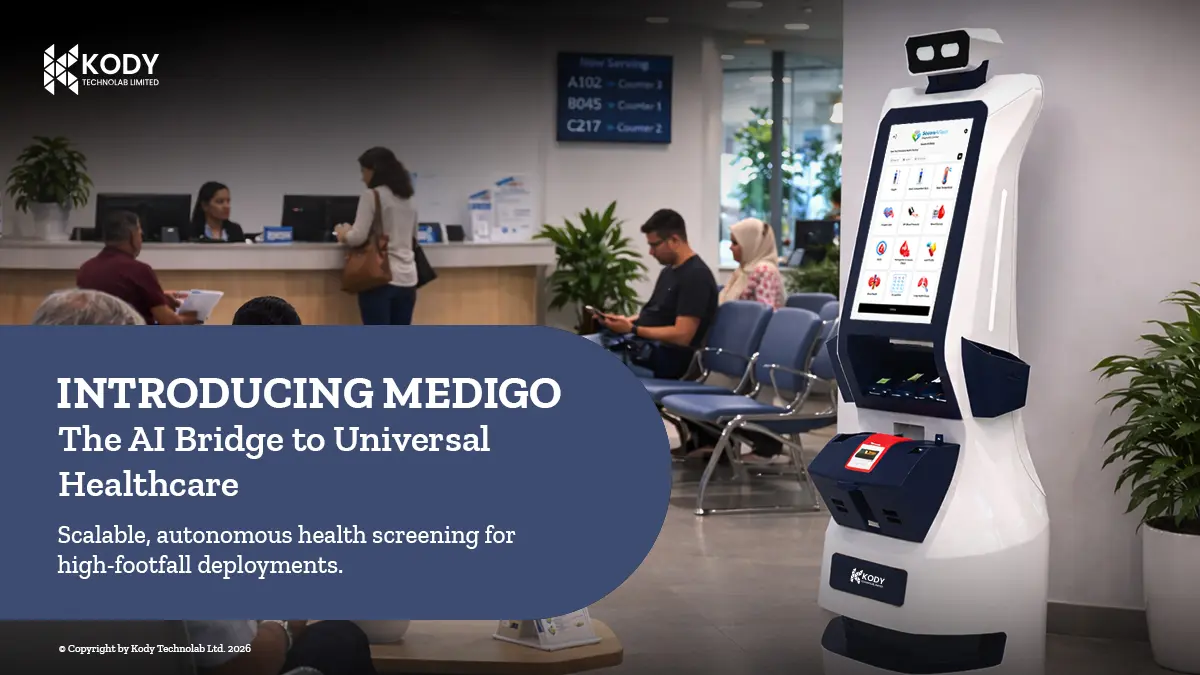
Quick Summary: Airports handled record passenger traffic in 2024 due to the massive virus outbreak. Yet most terminals still have no proactive health screening infrastructure in place. This blog breaks down why airport and transit authorities can no longer afford the healthcare gap. The guide explains what a health ATM machine for airports actually does operationally, and how Medigo delivers clinical-grade screening.
When COVID-19 first spread across the world, airports and railway stations were among the fastest transmission corridors. The global health community watched helplessly as thousands of infected travelers crossed borders undetected. Within just 11 weeks of the first reported outbreak, the virus had been confirmed across 114 countries.
There were no systems at terminals to flag elevated temperatures at scale & screen respiratory health in real time. There was also no infrastructure in place to catch what was coming before it landed in a new country.
A health ATM for airports, if deployed at scale, could have created an early detection layer that reactive systems couldn’t provide. Today, that technology exists, and airport and transit operators no longer have a reason to leave that gap open.
Health ATMs for airports are prioritizing preventive healthcare in high-footfall public environments. Airport and transit operators who are adopting early will lead the future industry. You’ll elevate the passenger experience, workforce compliance, and public health accountability going forward.
Why Airports and Transport Hubs Are Vulnerable Health Environments?
Airport and transit authorities are responsible for the health and safety of everyone on their premises. This includes travelers from dozens of countries, staff in physically demanding roles, and crews operating safety-critical machinery. Airports are among the most health-sensitive environments in the world, yet they remain the least equipped for preventive health screening.
Three specific realities make transport hubs a uniquely high-risk health environment and reason itself to why you should be equipped with a health ATM for airports:
- High-volume, high-diversity passenger flow means people carrying undetected health conditions, or people whose conditions worsen under travel stress, pass through your facility every hour. Blood pressure spikes during travel are well-documented. Unmanaged cardiac conditions do not announce themselves in advance.
- Workforce health compliance is a legal and operational requirement, but most airports and transit authorities still fulfill the requirement through periodic third-party camps that are inconsistent, hard to audit, and produce paper records that are difficult to track over time.
- The post-COVID reality has made health surveillance at transit nodes a genuine public health concern. An environment where thousands of people from different geographies interact daily is exactly where early detection of respiratory illness, fever clusters, or infectious disease symptoms matters most, and where real-time data could enable a containment response instead of a reactive one.
A health ATM kiosk for airports does not just serve passengers who want a quick checkup during a layover. A well-deployed health screening infrastructure serves your facility’s safety mandate, your workforce compliance obligations, and your public health responsibilities simultaneously, from a single unit that requires no medical staff to operate.
What Is a Health ATM Machine and Why Does the Airport Context Change Everything
A health ATM machine is a self-service, AI-powered health screening unit that enables individuals to complete a comprehensive health assessment without visiting a clinic, booking an appointment, or waiting for a doctor. A user walks up, follows a guided on-screen flow, completes a series of diagnostic tests, and receives a full health report, typically in three minutes or less.
In a pharmacy or community health center, the value of a health ATM machine is primarily about access, bringing screening to communities that lack nearby clinics. In an airport or transport hub, the value proposition is fundamentally different, and significantly stronger, for three reasons:

Dwell time converts into health action.
A passenger waiting at a gate for 40 minutes has idle time and no compelling way to use it. A 3-minute health screening fits cleanly into that window without disrupting the travel experience.
The regulatory environment creates institutional demand.
Aviation authorities, railway safety boards, and transport regulators increasingly mandate health monitoring for operational crew and staff. A health ATM machine for transport hubs converts a compliance obligation into a scalable, auditable system rather than an episodic, manually managed process.
The population density creates public health value at scale.
Every screening completed in a transport hub is a data point. Across thousands of daily screenings, a health ATM machine for airports generates the kind of population-level health intelligence that facility managers and public health authorities can actually act on.
The Three Problems Airport and Transit Operators Need Solved Right Now
Before evaluating any health screening kiosk for airports, it helps to be precise about what problem an airport or transit authority is actually trying to solve. Based on the operational reality of transport hubs, three problems consistently come up.
Problem 1: Workforce Health Compliance Without a Dedicated Medical Team
Ground crew, baggage handlers, depot drivers, metro operators, and cabin crew all operate under occupational health frameworks that require periodic health monitoring. Managing that monitoring today typically means coordinating with external diagnostic labs, scheduling camps that disrupt operations, waiting 24 to 72 hours for results, and then maintaining paper or fragmented digital records.
A health ATM machine for transport hubs replaces the entire process with a permanent, on-site screening station that generates digital records instantly, syncs to a centralized dashboard, and gives health managers audit-ready reports without the coordination overhead.
Problem 2: Passenger Health Incidents and the Liability Gap
A medical emergency inside a terminal is a brand event and a liability event as well as a human one. Airports and transit authorities have first-aid resources, but first-aid is reactive. An AI health kiosk for airports creates a proactive layer, giving passengers the ability to identify a health flag before it becomes a crisis, and giving the facility a documented, responsible health infrastructure that goes beyond emergency response.

Problem 3: Zero Health Data Visibility Across the Facility
Transit authorities manage traffic data, security data, infrastructure data, and passenger flow data with sophisticated real-time systems. Health data is almost entirely absent from that picture. A health screening kiosk for airports feeds a centralized, real-time health data dashboard that gives facility health managers visibility they have never had before, including unusual symptom clustering, chronic disease prevalence among staff, and early indicators of infectious illness.
This is the kind of data that allows an authority to act in days rather than weeks, and to demonstrate proactive public health governance rather than reactive incident management. You can explore how Robotics Healthcare Infrastructure is enabling this kind of data-led health governance at scale.
How Health ATM Machines Work in Airports: The Medigo Screening Workflow
Understanding how health ATM machines for airports works requires walking through what actually happens from the moment a user approaches the unit to the moment health data reaches a facility manager’s dashboard.
Medigo, AI-powered health screening robot, is built specifically for high-footfall deployments like airports, transit depots, and railway stations. Here is the complete workflow:

Step 1: Multilingual Guided Onboarding
Medigo’s AI interface greets the user in their preferred language and guides them through the screening process step by step. No medical staff involvement is required at any point. The multilingual capability means international passengers can complete a full screening without language being a barrier, which matters enormously in international terminals handling passengers from across Asia, the Middle East, and beyond.
Step 2: Adaptive Screening Across 65+ Health Parameters
Medigo’s adaptive protocol engine does not run the same test sequence on every user. The AI adjusts the screening flow based on the user’s responses, age, gender, and the readings captured in real time, prioritizing the most relevant tests for that individual. Across a full screening, Medigo covers:
- Metabolic and blood markers: Blood glucose, HbA1c, hemoglobin, lipid profile, renal function panel
- Cardiac and respiratory: 6-lead ECG, blood pressure, SpO2, spirometry for lung function
- Sensory and physical: Vision acuity, colorblindness screening, hearing audiometry, height, weight, body temperature
- AI-based screenings: AI-assisted eye checkup and oral health screening
- Mental health assessments: Depression and anxiety screening, autism spectrum disorder assessment
The full suite covers more than 65 health parameters, which is a capability you will not find in a standard vitals kiosk. You can see the complete Health ATM Features breakdown to understand the full scope of what Medigo screens.
Step 3: Clinical-Grade AI Interpretation
After completing the tests, Medigo’s AI models, trained on large-scale validated clinical datasets, analyze the results and generate a health report with 95% screening accuracy. The post-result analysis is written in plain language, not in clinical abbreviations. The report highlights values that need attention and recommends specific next steps, so a passenger or staff member is not left staring at a number they do not understand.
Step 4: Instant Report Delivery
The health report is delivered immediately through whichever channel the user prefers: WhatsApp, SMS, email, or a thermal printed report for users without digital access. For airport and transit operators, the real-time data simultaneously syncs to a centralized management dashboard, giving health managers live visibility across all active Medigo units in the facility.
Step 5: Telemedicine Escalation for Flagged Results
When a screening result flags a value that needs clinical attention, Medigo does not leave the user without a next step. The integrated telemedicine module connects the user directly to a physician via video consultation, enabling real-time guidance and digital prescription issuance, all within the same session, without the user needing to find a clinic or wait for an appointment.
This is what separates a health ATM kiosk for airports from a basic vitals monitor. You can see the complete How Medigo Works walkthrough to understand the end-to-end experience.
The Two Audiences Inside One Deployment: Passengers and Staff
One of the most operationally compelling aspects of deploying a health ATM machine in an airport or transit hub is that a single unit serves two completely different audiences with two completely different institutional value drivers.
For Passengers: A Premium Experience Touchpoint
International airports are increasingly differentiating on passenger experience, and health is becoming part of that conversation. A health screening kiosk in a lounge, an international arrivals hall, or a business lounge is a tangible, valued service.
Medigo supports multilingual screening for global travelers. A user from Japan, Saudi Arabia, or Germany can complete a full screening independently. This creates a frictionless and accessible experience. Premium passengers notice and remember such thoughtful service.
For elderly passengers, solo travelers, and long-haul travelers, it is especially valuable. A clinical-grade health checkup at the terminal adds safety and reassurance. Medigo is available without an appointment.
For Airport and Transit Staff: Compliance Meets Continuity
Ground crew, metro operators, train drivers, and aviation maintenance staff are legally required to maintain fitness-for-duty standards. Medigo replaces manually managed health camps with a permanent, always-on screening station. The health ATM generates digital health records automatically & stores test data for every staff member. Health compliance managers receive an audit-ready data trail without any additional administrative overhead.
The occupational health case alone justifies deployment at a depot or transit hub. The passenger experience value is the additional return on the same investment. Learn more about how Robotics in Healthcare is reshaping workforce health management across high-footfall institutions.
Why a Basic Health Kiosk Is Not Enough: The AI Difference
A standard health kiosk measures three to five vitals and produces a printout. Medigo is an AI health kiosk for airports that operates at a fundamentally different level of clinical capability, and the difference is not just about the number of parameters screened.
The AI intelligence layer in Medigo does three things that no standard health kiosk can replicate:

The adaptive protocol engine personalizes every screening session.
Rather than running the same test sequence for every user, Medigo’s AI adjusts the protocol in real time based on the user’s inputs, demographics, and early readings. A 58-year-old male with elevated blood pressure gets a different screening priority sequence than a 24-year-old female with no declared conditions. The clinical relevance of the results is significantly higher as a result.
The clinical interpretation layer explains results in human terms.
A number on a screen means nothing to a passenger who is not medically trained. Medigo’s post-result analysis converts raw screening data into plain-language insights with clear recommended actions, so the person walking away understands what their results mean and what to do about them.
The centralized anomaly detection layer gives facility operators intelligence they cannot get anywhere else.
Across thousands of daily screenings, Medigo’s data architecture identifies unusual clusters of respiratory symptoms, fever cases, and cardiac risk markers. This turns a screening kiosk into an early warning system. It also gives airport and transit authorities public health visibility that existing infrastructure does not provide.
Explore how AI in healthcare is enabling this kind of population-level intelligence across healthcare infrastructure globally.
What Airport and Transit Operators Should Evaluate Before Deploying a Health ATM Machine
Not every health screening solution is built for the operational reality of a transport hub. Before committing to any health ATM machine for airports, the following evaluation criteria are worth applying directly to every solution you assess.
Does the unit operate without dedicated medical staff?
A solution that requires a nurse or technician on-site at all times creates a staffing dependency that defeats the purpose of scalable health infrastructure. Medigo is fully autonomous.
Can the unit handle high-footfall volume without creating queues?
A 3-minute screening flow means Medigo can process a meaningful volume of screenings per hour without creating a bottleneck. Understanding throughput capacity is essential for terminal and depot planning.
Does the report output meet your health compliance and audit requirements?
The digital records, test history, and centralized dashboard that Medigo generates are designed specifically for institutional accountability, not just individual use.
Is the data centralized and accessible to facility health managers in real time?
An isolated kiosk that generates reports for individual users but provides no aggregate data to the facility operator delivers only half the value. Medigo’s centralized cloud infrastructure gives health managers live visibility across every unit deployed in the facility.
Is there a telemedicine escalation pathway built in, or does a flagged result lead nowhere?
A health screening that identifies a problem and then leaves the user without a next step is a liability, not a service. Medigo’s integrated telemedicine module ensures that every flagged result connects the user to a physician in the same session.
Can the unit interact with users in multiple languages without staff assistance?
In an international airport handling passengers from across Asia, the Middle East, Europe, and beyond, a health kiosk that operates only in English is not a universal service. Medigo’s multilingual conversational AI handles this autonomously.
You can explore the full Health ATM for the PHC use case to see how Medigo’s deployment model scales across different institutional environments.
Health ATM For Airports Are Future Investment & a Present Accountability Gap
Airport and transit authorities waiting for health screening infrastructure to become mainstream are already behind the operational and regulatory curve. Over the past three years, expectations around passenger health monitoring, workforce fitness compliance, and public health surveillance have evolved significantly. The infrastructure needed to support passenger health monitoring, workforce fitness compliance, and public health surveillance now exists.
A health ATM machine for airports is a compliance infrastructure. A passenger experiences investment, a workforce health management system, and a public health surveillance tool, deployed as a single unit. The health ATM machine requires an operator, generates real-time data, and starts delivering value from day one.
Why Medigo Is Built for the Demands of Airport and Transit Environments
Medigo is built specifically for high-footfall, operationally complex environments where thousands of people move through a single facility every day, where no dedicated medical team is available on the floor, and where health data needs to reach a facility manager’s dashboard in real time, not in a lab report three days later.
Kody Technolab has spent a decade building the AI capability, hardware integration depth, and enterprise software architecture that a deployment of this complexity requires. The result is a health screening infrastructure that an airport or transit authority can deploy with confidence, manage without a clinical team, and report on with complete audit integrity.
If you are evaluating health screening infrastructure for your terminal, depot, or transit facility, a Medigo demo gives your operations and health compliance teams a working answer to every question they will ask.

Frequently Asked Questions – Health ATM for Airports
1. What is a Medigo, a health ATM machine, and how does it work in an airport?
Medigo is a health ATM machine, a self-service, AI-powered screening unit for travelers and staff. Medigo covers 65+ health parameters without on-site medical staff. Users follow a multilingual guided flow & receive a report in 3 minutes*, making it an ideal health ATM for airports.
2. Can a health ATM kiosk for airports screen both passengers and airport staff?
Yes, a health ATM for airports serves both passengers and staff. Passengers receive quick checkups during transit, while staff receive periodic screenings, with digital records maintained for compliance.
3. How accurate are the results from a health ATM machine for transport hubs?
Medigo delivers 95% screening accuracy using AI models trained on large-scale validated clinical datasets. Every result includes a plain-language post-result analysis so users clearly understand what their readings mean and what to do next.
4. Does deploying a health screening kiosk for airports require dedicated medical staff?
No, Medigo operates fully autonomously through an AI-guided interface without any medical staff on-site. When a result flags a concern, the built-in telemedicine module connects the user directly to a physician through video consultation.
5. What health conditions can an AI health kiosk for airports detect?
Medigo screens 65+ health parameters. The health parameters include metabolic health, cardiac function, respiratory health, blood markers, vision, hearing, and mental health indicators.