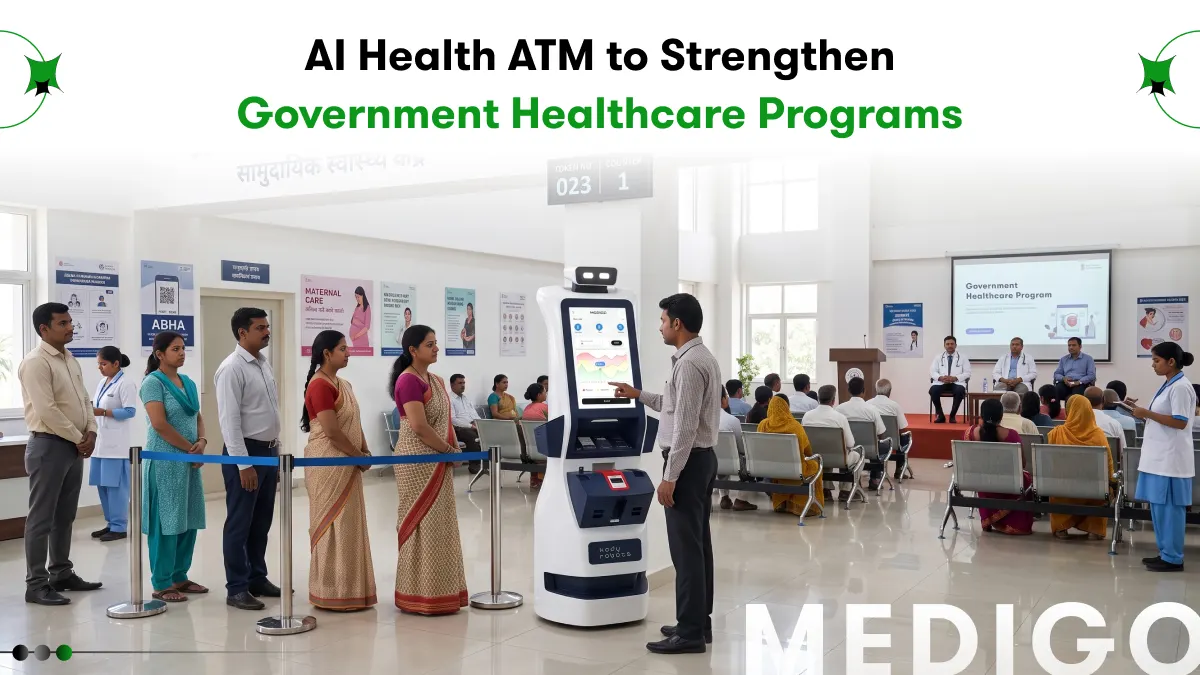
Every day, a government health worker opens a rural PHC with limited staff, aging equipment, and a waiting room full of patients whose conditions could have been detected months earlier. Preventive care exists on paper, but what about in practical environments? In practice, the system is still running to catch up with disease that has already taken hold.
The consequences are measurable, as the stats say over 1.28 billion people worldwide live with hypertension, yet a significant proportion of cases go undetected. Government programs set ambitious targets for preventive screening, NCD management, and community health outreach. However, without the right infrastructure at the point of care, those targets stay aspirational.
A health ATM for government healthcare programs changes the equation for the government and the citizens. Medigo works as an extended arm of the healthcare workforce, delivering multi-parameter preventive screening in minutes while reducing language barriers, travel, and the burden of routine screening.
What Is Medigo, the AI Health ATM Built for Public Health?
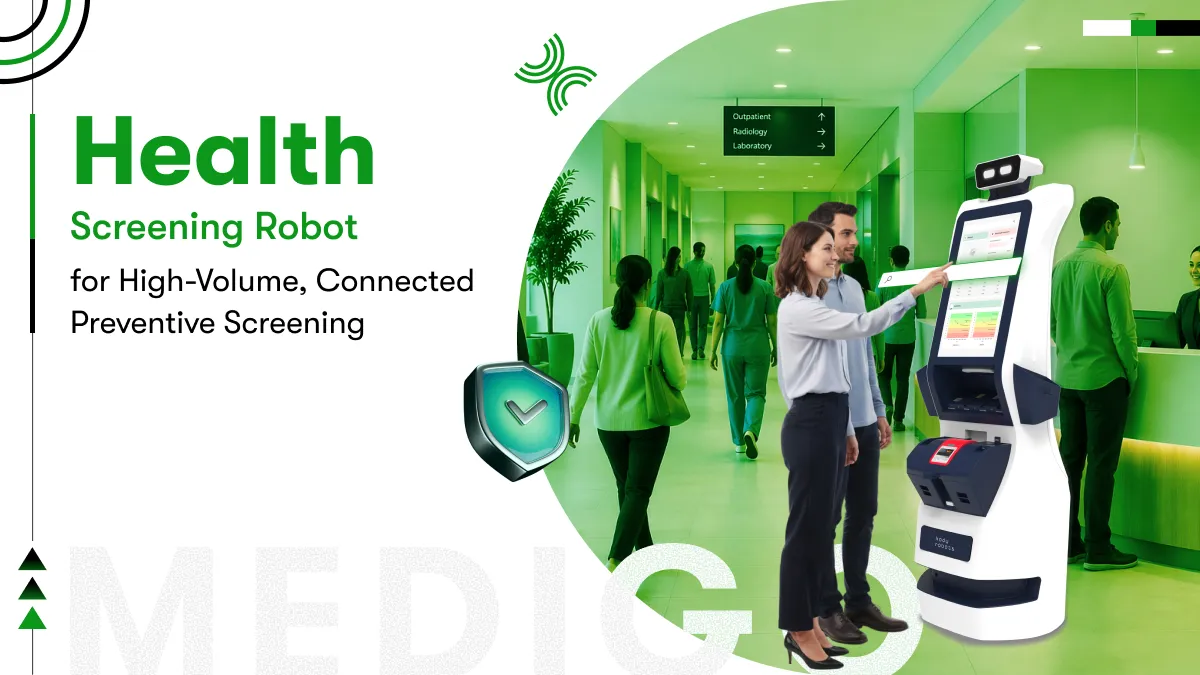
Medigo is an AI health ATM that delivers structured, multi-parameter preventive screening without depending on specialist medical staff. It connects multiple diagnostic devices into a single AI-guided workflow and generates a consolidated digital health report in approximately 3 minutes, with up to 95% screening accuracy.
A single Medigo session covers:
- Vitals measurement: blood pressure, temperature, SpO2, heart rate.
- Blood marker testing: glucose, HbA1c, cholesterol, hemoglobin, lipid profile, renal panel.
- Cardiovascular monitoring: 6-lead ECG.
- Respiratory function: spirometry.
- Sensory assessments: audiometry, visual acuity.
- AI-assisted screenings: eye health, oral health, mental health, ASD.
Across 65+ health parameters, Medigo captures what typically requires multiple devices, multiple appointments, and multiple staff members. It delivers everything in one guided session. Reports are shareable via WhatsApp or email, or printable on-site, making them accessible regardless of whether the patient has reliable digital access.
A multilingual conversational interface guides every patient in their preferred language. For government programs serving diverse communities across rural and semi-urban India, this is what makes health screening robot technology genuinely inclusive rather than just technically capable.
To learn more about what the platform covers, visit Health ATM Features.
The Medigo range includes four variants: Medigo Static for fixed facility deployments, Medigo Kids for pediatric programs, Medigo Women for gender-specific preventive care, and Medigo Mobile, a moving unit engineered for last-mile outreach across rural routes and high-footfall public spaces.
Why Government Healthcare Programs Need a Health ATM in India
India’s public healthcare system faces a set of challenges that are structural, not incidental. Addressing them requires solutions that scale without proportionally increasing cost or staffing. This is precisely where a health ATM in India becomes operationally relevant.
The nine persistent challenges below are real. Medigo addresses each one, directly or as part of a broader program structure.
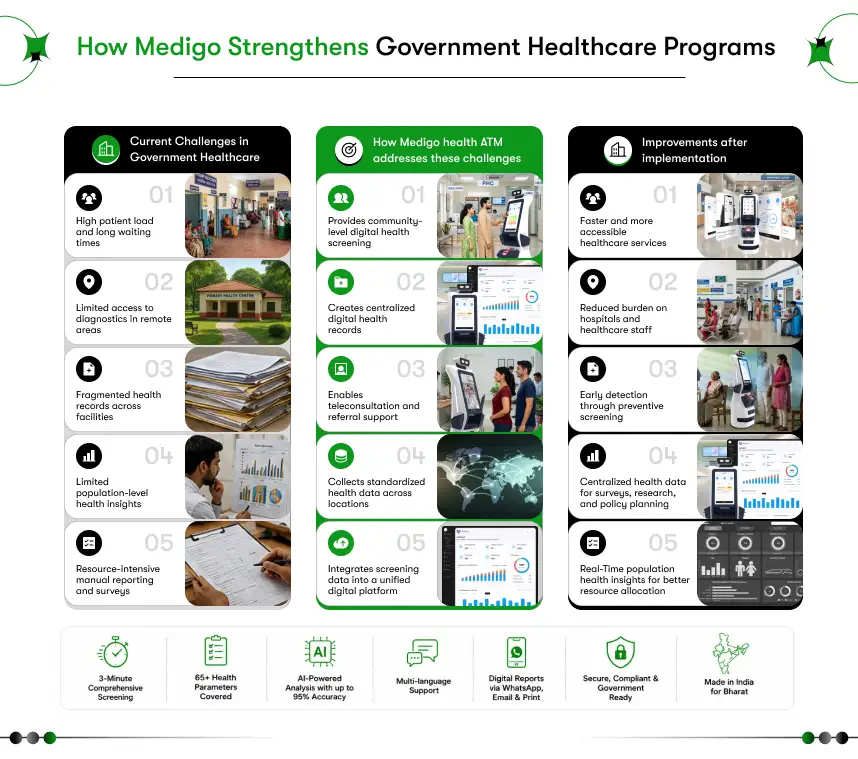
1. Preventive Care While Addressing Existing Reactive Care
The system responds to disease more than it prevents it. Government PHCs see patients who present late, when intervention is more complex and costly. Preventive screening rarely happens systematically because the infrastructure for it does not exist at the point closest to the patient.
Medigo enables routine, structured screening at PHCs, workplaces, panchayats, schools, and community spaces, before symptoms appear. It detects hypertension, diabetes, obesity, anemia, and cardiovascular risk early, giving health programs a real shot at reducing the burden of advanced disease. Health workers shift from reacting to conditions to identifying risk proactively.
2. Health Camps That Happen Once a Year
Annual health camps create one-time visibility into population health without creating continuity. Patients screened in March have no structured way to be re-screened in September, and their results rarely feed into a follow-up program.
Medigo converts the episodic health camp into an always-available screening station. Citizens can be screened throughout the year. Digital health records make repeat screening meaningful, so staff can see how parameters have shifted over time and flag deteriorating trends before they become emergencies.
3. Poor Continuity of Care
Even when a patient is screened and given a referral, follow-through is unpredictable. Paper records get lost, and the patient does not remember their readings. The next healthcare worker they meet has no access to prior history.
Medigo automatically stores structured health records and makes them searchable for authorized users. The system compares results over time, flags parameters that are trending in the wrong direction, and enables teleconsultation or referral generation within the same session. While ensuring patients take medication or complete treatment remains beyond the system’s scope, it removes a significant barrier: the absence of reliable, continuous health data.
4. Uneven Access to Diagnostic Infrastructure
A citizen in an urban area visits a diagnostic lab, gets a blood panel done, and has results on their phone the same evening. A citizen 60 kilometers from the nearest district hospital may wait months for the same information or never get it.
Medigo brings public health screening solutions directly to underserved communities where laboratories and physicians are limited. So, the public health screening solutions have a measurable impact in districts where diagnostic infrastructure is absent. When integrated with teleconsultation, a specialist in the city reviews a patient’s ECG and blood markers without the patient needing to travel.
5. Healthcare Workforce Shortage
When government PHCs are chronically understaffed, asking the same team to handle clinical care and run structured screening programs creates unsustainable workloads. Adding staff is an extremely slow process. The answer is better tools for the people already there.
Healthcare automation for government through Medigo allows a single operator with basic training to run consistent, multi-parameter screening sessions. Nurses and community health workers screen more patients without increasing headcount.
Doctors engage with structured outputs rather than coordinating devices. Medigo does not replace clinical judgment as it frees the clinical workforce to exercise it. This is what it means to use Medigo as an extended arm for the healthcare workforce.
6. Limited Diagnostic Capacity at Primary Level
Most PHCs cannot run an ECG, a blood glucose test, a spirometry assessment, and a vision screening on the same day, for the same patient, in the same room. Each requires different equipment, different calibration, and often different staff.
Medigo integrates all of these into one point-of-care system through robotics and healthcare infrastructure. Blood markers, vitals, ECG, lung function, eye screening, and audiometry operate within a single guided workflow. Complex imaging or specialist diagnostics still require referral, but the base layer of preventive assessment no longer does.
7. Fragmented Health Records
Paper registers at one PHC cannot be read at another. District health officers compile reports from facilities that use different formats. Program monitoring becomes an exercise in reconciling incompatible data sets rather than analyzing trends.
Medigo creates a structured digital health record for every screening session. Where supported, it integrates into broader digital healthcare infrastructure and national health ecosystems. Consistent report formats mean data from multiple facilities can be aggregated and reviewed at the district or state level, making program monitoring a function of visibility rather than manual effort.
8. Financial Burden of Late-Stage Disease
Healthcare costs escalate sharply when conditions like diabetes, hypertension, or cardiac disease progress undetected. Families absorb hospitalization costs that preventive detection could have reduced significantly. The Health ATM does not replace health insurance or eliminate hospitalization costs. Earlier detection shifts the intervention point, and earlier intervention is almost always less expensive.
For government programs that measure outcomes in population health improvements, reducing the rate at which preventable conditions reach advanced stages is a meaningful economic argument for investing in preventive healthcare technology. Across India, this type of preventive healthcare technology is increasingly recognized as essential public health infrastructure.
9. Administrative Overload on Health Workers
Government healthcare workers spend significant time on documentation, registration, and report preparation. This is not clinical work. It is administrative overhead that grows with patient volume and shrinks the time available for actual care.
Medigo automates registration, data capture, report generation, and digital documentation in a single workflow. This kind of healthcare automation for government health workers produces structured, standardized reports ready for review, referral, or program-level submission. Medigo is AI in healthcare applied not to diagnosis, but to the operational layer that makes diagnosis possible at scale. Administrative automation is a foundational part of any functioning digital healthcare infrastructure.
How Medigo Works as a Health ATM for Government Healthcare Programs
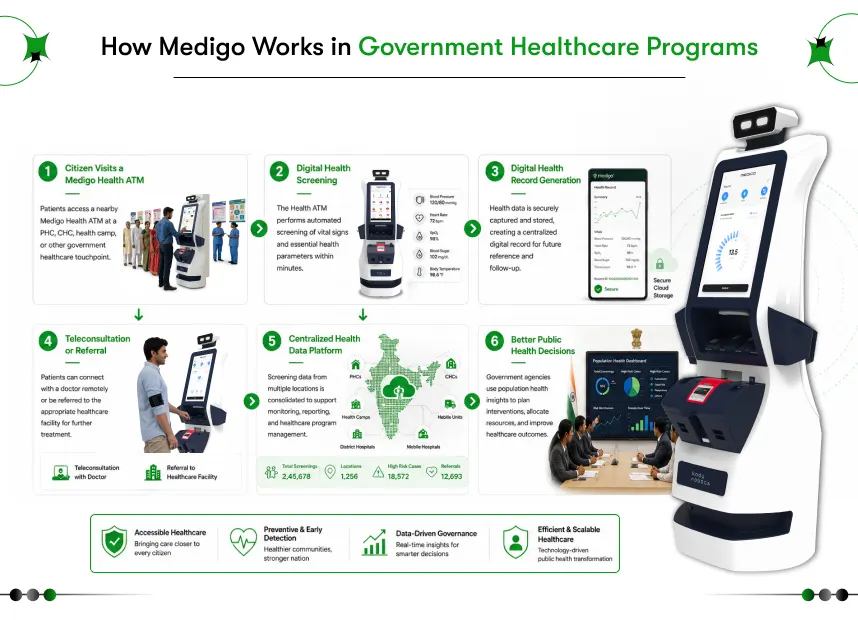
Understanding the impact of Medigo starts with understanding how it functions as a health screening robot within a real public health workflow.
A patient arrives at a PHC or community health camp. An operator logs them into Medigo’s guided interface. The system walks the patient and operator through each screening module: vitals, blood markers, ECG, spirometry, vision, hearing, and AI-assisted assessments in a structured sequence. No device switching, no manual data entry between tests, no risk of results being recorded on different forms.
Within approximately 3 minutes, Medigo compiles every result into a consolidated digital health report. The system’s AI layer processes the data against validated clinical reference ranges and surfaces parameters that warrant clinical attention. The report is shared with the patient via WhatsApp or email, or printed on-site.
If the session flags readings that require physician review, the operator initiates a teleconsultation from the same unit. The physician reviews structured data, consults with the patient via video, and issues a digital prescription, all within the same visit. Nothing falls through the gap between screening and referral.
Across sessions and locations, Medigo maintains searchable records that administrators can access for follow-up, repeat screening comparison, and district-level program monitoring.
This end-to-end workflow is what makes a health ATM for government healthcare programs more than a diagnostic device. It is a structured public health delivery system.
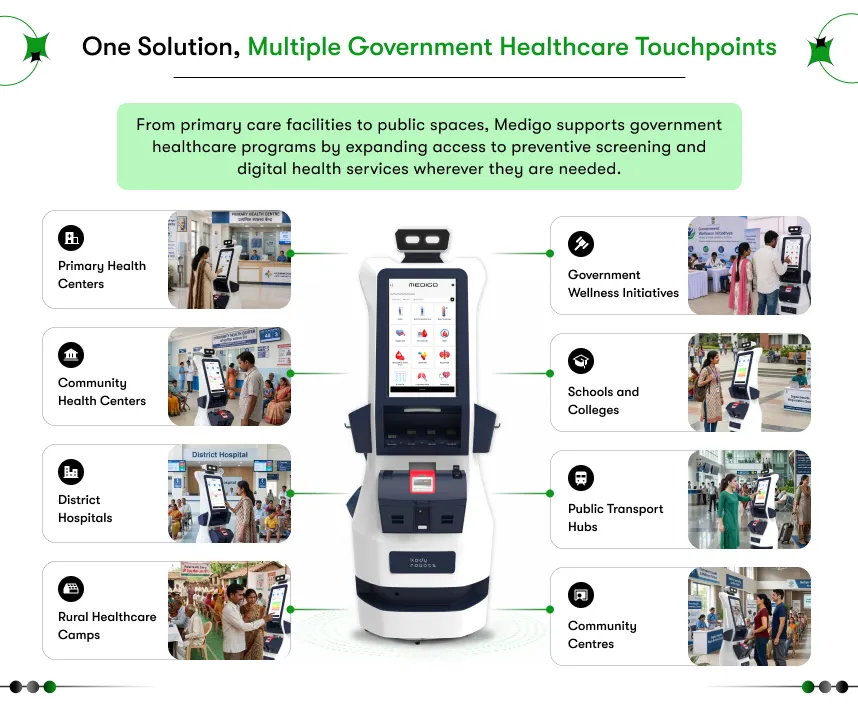
Where Medigo Deploys: Use Cases Across the Public Health System
A health ATM for government healthcare programs needs to work across the full range of settings where government healthcare is actually delivered or needed. Medigo is built exactly for the answer to government settings.
Primary Health Centers (PHCs)
PHCs are the first point of formal contact between citizens and the government health system. Medigo enables structured multi-parameter screening at Health ATM for PHC settings without requiring additional diagnostic staff. It captures readings aligned with NPCDCS and other national NCD monitoring requirements, and generates digital records for individual follow-up and district-level program tracking.
Community Health Centers (CHCs)
CHCs handle larger populations and higher daily volumes. Medigo’s approximately 3-minute screening cycle allows CHCs to run high-volume drives during national health campaigns without disrupting ongoing clinical operations or pulling staff away from existing duties.
Rural Health Camps and Outreach Programs
Medigo Mobile brings structured screening to outreach camps where laboratory infrastructure does not exist. Reports are generated on-site, patients leave with actionable information, and records are stored digitally for program continuity after the camp ends.
Government NCD and Wellness Programs
National NCD management programs require consistent, comparable data across districts and states. Medigo’s standardized workflow and digital output formats support the cross-location aggregation that program monitoring depends on.
Public Transport Hubs and Community Access Points
Railway stations, bus terminals, and transit hubs see populations with limited contact with formal healthcare infrastructure. Deploying Medigo at high-footfall public spaces turns routine transit into an opportunity for preventive screening access.
Government Schools and Pediatric Programs
Medigo Kids supports structured health screening in schools under government education and child health programs. Regular, structured checks enable early identification of nutritional, developmental, and metabolic health concerns at the age when intervention yields the highest long-term benefit.
Benefits of a Health ATM for Government Healthcare Programs Across Every Level
When a health ATM for government healthcare programs is deployed at scale, the impact is not confined to a single facility or program. It compounds across every level of the healthcare system.
For government health departments:
- Standardized screening protocols across all facilities improve data comparability and support audit-ready reporting.
- Aggregated digital dashboards give district and state health officers real-time visibility into program outcomes.
- Higher screening throughput per session reduces per-patient cost over the deployment lifecycle.
- Structured referral data makes follow-up care outcomes measurable at the population level.
- Programs scale across PHCs and CHCs without proportional increases in staffing or diagnostic infrastructure.
For health workers and clinical staff:
- Medigo handles device coordination, data capture, and report generation, freeing clinical staff for interpretation and patient engagement.
- Structured, standardized report outputs provide a reliable basis for clinical decision-making across sessions.
- Teleconsultation integration gives staff access to specialist guidance in environments where specialists are not physically present.
- Standardized workflows reduce the operational complexity of running multi-device screening sessions.
Patients and communities:
- Multi-parameter screening is accessible without long travel, extended wait times, or multiple visits.
- Reports in the patient’s preferred language make health information understandable and actionable.
- Digital delivery via WhatsApp or email ensures results reach patients after they leave the facility.
- Earlier detection creates access to intervention before conditions escalate into serious, costly illness.
- Multilingual guidance removes language as a barrier to participation in preventive programs.
- Communities in underserved areas access Robotics Healthcare Infrastructure previously available only in urban centers.
Challenges to Plan For When Deploying a Health ATM for Government Healthcare Programs
Deploying a health ATM for government healthcare programs at scale is achievable, but it requires deliberate planning across five operational dimensions.
Connectivity and infrastructure: Medigo generates digital reports and transmits data to health dashboards, which requires internet connectivity at deployment locations. For rural and low-connectivity environments, deployment plans should address offline operation and periodic data sync protocols.
Operator training and workflow integration: The guided screening workflow is designed for operators with basic training. Successful deployment depends on structured onboarding that helps both operators and clinical staff integrate Medigo into existing facility routines. Adoption improves significantly with hands-on orientation support.
Maintenance and uptime: Units deployed in high-footfall government environments require scheduled preventive maintenance and responsive hardware support. Service response commitments from the technology provider are essential to sustained operational continuity.
Data privacy and regulatory compliance: Health data generated through government programs is subject to applicable data protection regulations. Deployment frameworks must confirm alignment with digital health data standards before program roll-out.
Local language coverage: Medigo supports multilingual interaction, but local implementation should verify that the specific languages and regional dialects used in the served population are included in the configured interface.
Future Scope: Where Health ATM Technology Heads Next
The role of a health ATM for government healthcare programs will expand as digital health ecosystems in India mature. Here is where the trajectory is heading:
- ABDM integration: As the Ayushman Bharat Digital Mission builds its interoperability layer, Medigo-generated health data will feed directly into national dashboards, longitudinal population health programs, and integrated NCD surveillance systems.
- District-level scale-up: Early pilot deployments across PHC networks will establish measurable outcomes in screening coverage, data quality, and program efficiency, creating the evidence base for broader rollout.
- Population-specific programs: The Medigo range’s variants covering pediatric, women’s health, and mobile outreach position the platform to serve the full spectrum of government health programs, not just a single use case.
- Infrastructure, not pilot: Robotics in Healthcare for public programs is moving from proof-of-concept to deployable, effective infrastructure, and Medigo is built for that shift.
The question for government health programs is how quickly the government can deploy these health ATMs where it is needed.
Conclusion
India’s government healthcare programs carry an obligation that grows larger every year. The populations that need preventive care the most are also the populations that current infrastructure reaches last.
A health ATM for government healthcare programs works as a force multiplier for the workforce already in the field. Medigo delivers 65+ parameter screening in approximately 3 minutes, builds structured digital records for every patient, converts episodic camps into continuous care access, and connects flagged patients to teleconsultation without leaving the facility, without a language barrier.
A health ATM like Medigo makes the health worker capable of reaching further, documenting better, and intervening earlier. A health ATM for government healthcare programs is where policy intent meets ground-level delivery. For health departments ready to close that gap, Kody Technolab Ltd. Medigo is where that effort becomes operational and strengthens your healthcare programs.
FAQ
Q1. Does Medigo replace the doctor or health worker at the PHC?
No, Medigo handles the screening workflow so the health worker can focus on what needs clinical judgment. The professional stays in charge, and Medigo just does the groundwork faster.
Q2. Can Medigo work in areas with poor internet connectivity?
Deployment planning accounts for low-connectivity environments through offline operation modes and periodic data sync. It is designed for real-world government settings, not ideal ones.
Q3. How long does one screening session actually take?
A complete multi-parameter screening session takes approximately 3 minutes. For high-footfall PHCs and health camps, that cycle time makes a significant difference in how many people get screened in a single day.
Q4. What if the patient does not speak Hindi or English?
Medigo’s multilingual interface guides patients in their preferred language. They do not need to rely on someone translating for them to understand their own health results.
Q5. Is the screening data secure and compliant with government health data standards?
Yes, Medigo generates structured digital records aligned with applicable data protection standards. Health departments can access anonymized data for program monitoring without compromising individual patient privacy.







 Contact Information