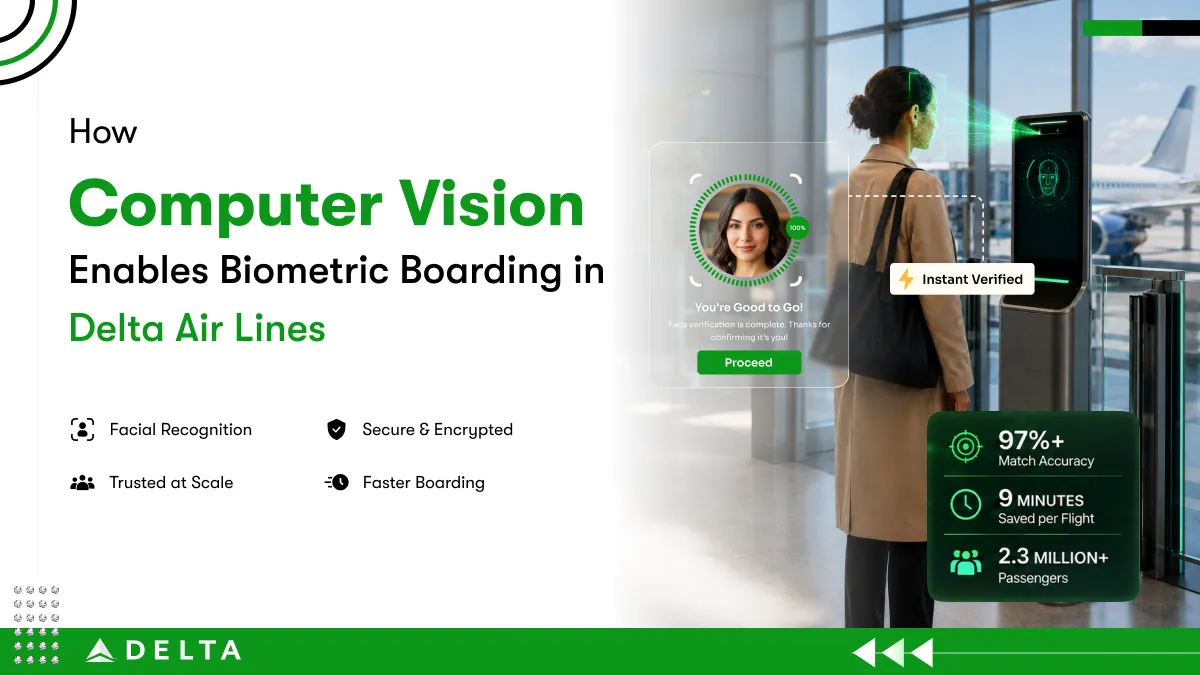
Boarding a flight used to mean fumbling through your bag for a boarding pass and a government ID. Computer vision in Delta Air Lines changed that completely. Today, a passenger walks up to a boarding gate, looks into a camera, and steps onto the plane within seconds. No paper, no scanning, no manual checks.
Delta Air Lines built this system over nearly a decade, starting with a 2016 pilot test and expanding it to millions of passengers across major U.S. airports. The technology behind it is a real-time facial recognition pipeline powered by computer vision and AI.
This blog breaks down how Delta built this system, what technology powers it, and what industries beyond aviation can learn from it.
What Is Biometric Boarding and Why Does Delta Air Lines Need It?
Biometric boarding uses facial recognition to verify passenger identity at the gate. Instead of scanning a boarding pass, passengers look into a camera. Airlines like Delta Air Lines use this to speed up boarding, reduce manual errors, and meet federal identity verification requirements.
Traditional boarding creates friction at every step. A gate agent checks the boarding pass, compares the photo ID, and manually clears each passenger one by one. During peak hours, this process slows down entire flights and frustrates passengers who are already tired from the travel day.
The problems with manual boarding verification are consistent across every major airport:
- Gate agents make human errors during high-pressure boarding windows.
- Long queues build up quickly when each passenger requires a manual document check.
- Security gaps appear when ID verification depends entirely on individual staff performance.
- International travel regulations require airlines to verify each passenger’s identity before departure, adding another layer of manual effort.
- Passengers increasingly expect a touchless, seamless experience at every airport touchpoint.
Smart airport solutions like biometric boarding address all of these problems at once. The system automates identity verification, removes the manual bottleneck, and meets regulatory requirements without adding staff or time to the process.
Internal Read: How Computer Vision Works gives you a solid foundation before we go deeper into Delta’s implementation.
How Did Delta Air Lines Start Using Computer Vision for Biometric Boarding?
Delta Air Lines started testing computer vision for biometric boarding in 2016 with two international routes from Atlanta. Over the next several years, Delta partnered with the U.S. Customs and Border Protection (CBP) and TSA to expand the system across eight major U.S. airports.
Delta did not build this system in one step. The airline tested, refined, and expanded the technology gradually over nearly a decade. Here is how that journey unfolded:
| Year | Milestone |
| 2016 | Tested facial recognition boarding on flights from Atlanta to Tokyo and Mexico City |
| 2018 | Launched the first fully biometric terminal in the U.S. at Hartsfield-Jackson Atlanta (ATL) |
| 2019 | Expanded facial recognition to eight new airports including JFK, LAX, BOS, DTW, SLC, MSP, PDX |
| 2021 | Launched the first domestic digital identity test for a full curb-to-gate biometric experience |
| 2025 | Extended biometric boarding to all 40 international gates at Atlanta Hartsfield-Jackson |
Delta built this system through a three-way partnership with CBP, TSA, and Hartsfield-Jackson Airport. This partnership gave Delta access to government-verified photo databases for facial matching. It also ensured that the system met federal security and identity verification standards from the start.
By 2025, Delta held a 76% international passenger market share at Atlanta. The biometric system now serves millions of passengers every year across Delta’s entire international network.
Internal Read: Explore more about Computer Vision in Aviation to understand how the broader industry is adopting this technology.
How Does Computer Vision Work in Delta Air Lines Biometric Boarding?
Delta Air Lines uses a six-step computer vision pipeline for biometric boarding. The system captures a passenger’s live facial image at the gate, encrypts it, sends it to CBP, performs a 1:1 facial match against a pre-built photo gallery, and authorizes boarding within seconds.
This is where the real engineering work happens. Each step in the pipeline plays a specific role in making the system fast, accurate, and secure.
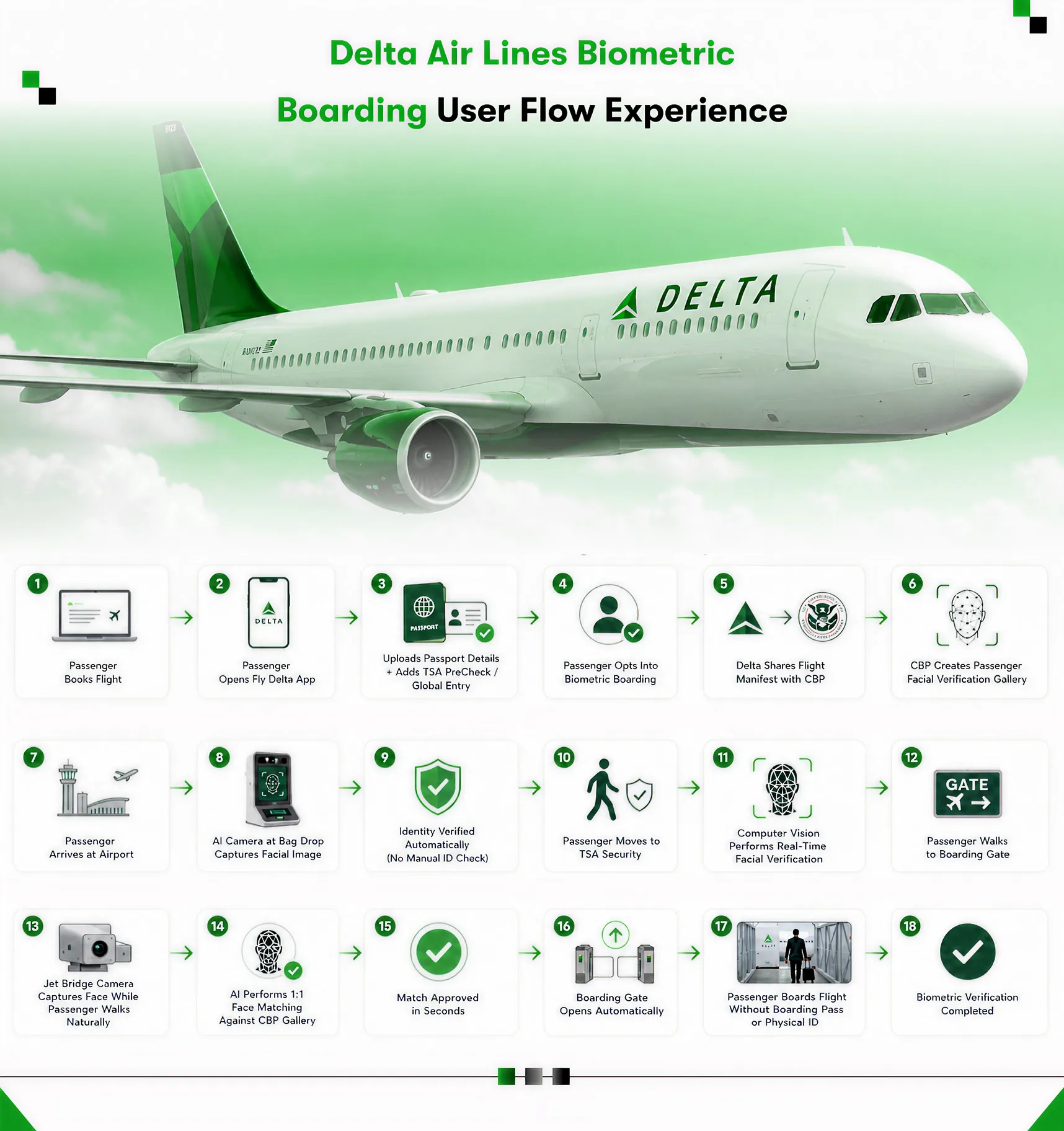
Step 1: Passenger Enrollment Before the Flight
Passengers begin the process by storing their passport details in the Fly Delta app. They also add their TSA PreCheck or Global Entry Known Traveler Number to their SkyMiles profile.
At check-in, passengers opt into the facial recognition program through the app. This step is completely voluntary. Passengers who choose not to participate continue through the standard boarding process without any change.
Step 2: Pre-Flight Photo Gallery Creation by CBP
Once Delta shares the flight manifest with CBP, CBP begins building individual photo galleries for each passenger on that flight. CBP pulls facial images from passports, visas, and biometric records collected during previous international trips.
This gallery contains only the photos associated with passengers on that specific flight. CBP does not search a global database of billions of records. Instead, the system creates a small, focused gallery for each person, which is what makes the matching fast and accurate.
Step 3: Facial Image Capture at Airport Touchpoints
At the airport, cameras capture a live facial image at three key checkpoints:
- Bag drop counter for the initial identity check
- Security checkpoint for TSA verification
- Boarding gate for the final boarding authorization
The camera captures the image in a fraction of a second. Passengers do not need to stop, pose, or press a button. The system works as the passenger naturally approaches the camera.
Step 4: Encryption and Secure Transmission
After the camera captures the image, the system encrypts it immediately. The system also strips the image of any biographic data, such as the passenger’s name or passport number, before transmission.
Delta sends this encrypted, de-identified image to CBP’s facial biometric matching service through a secure channel. No raw personal data travels through unsecured networks at any point in this process.
Step 5: Real-Time 1:1 Facial Matching
CBP compares the live facial image against the passenger’s individual photo gallery. The computer vision model extracts key facial features from both images and converts those features into numerical representations called embeddings.
The system then calculates the similarity score between the live image embeddings and the gallery embeddings. If the score crosses the match threshold, the system confirms the passenger’s identity.
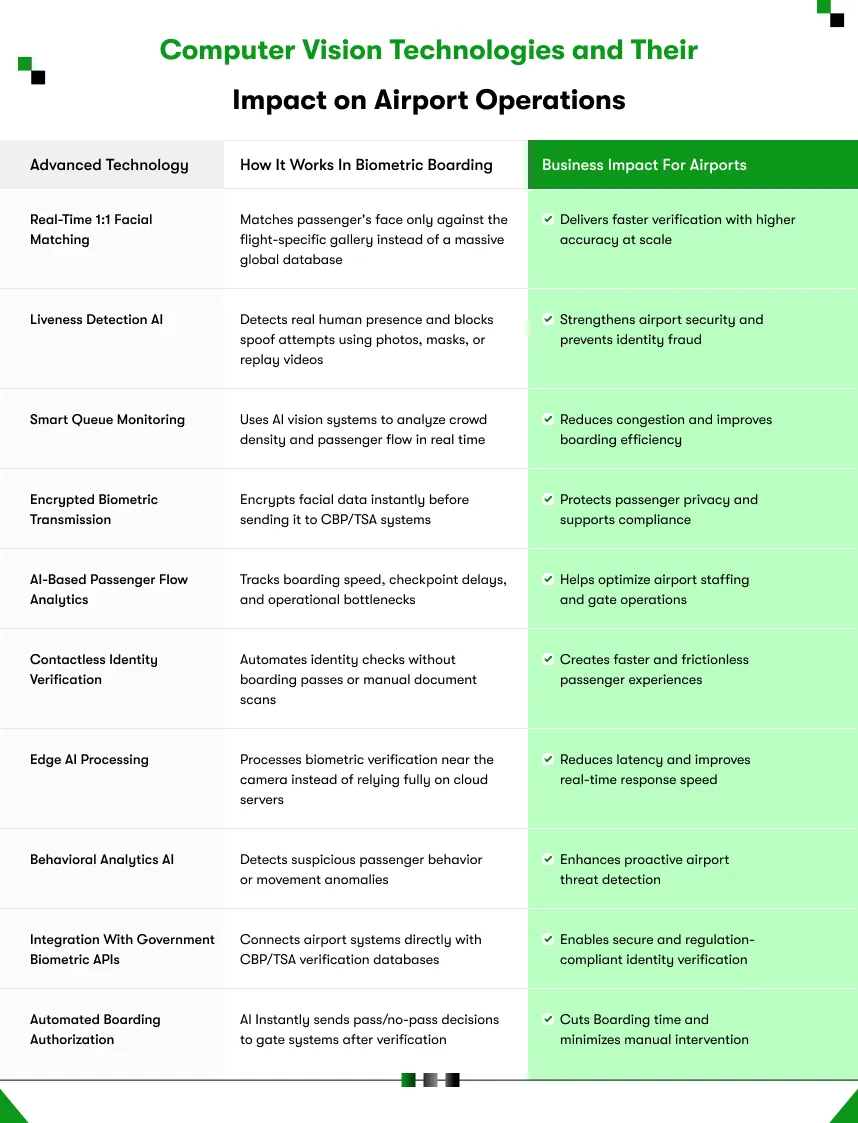
This 1:1 matching approach is the key technical decision that makes the system work at speed. Searching through a billion records would take too long. Matching against a gallery of a few photos takes seconds.
Step 6: Boarding Authorization
CBP sends a pass or no-pass signal back to Delta’s gate system after the match. If the system confirms a match, the gate opens and the passenger boards without any paper document.
If the system does not find a match, a staff member steps in to verify the passenger’s passport manually. CBP also records the departure as part of its biometric exit tracking program, which helps the agency monitor who leaves the country.
Internal Read: See the full Step-by-Step Computer Vision Development Process to understand how these systems get built from the ground up.
What Technology Powers the Delta Air Lines Biometric Boarding System?
Delta Air Lines uses facial detection, deep learning-based feature extraction, and 1:1 similarity matching to power its biometric boarding system. The system integrates with CBP’s government database through encrypted, real-time data transmission and connects with the airport’s gate management infrastructure.
Hardware Layer
The physical infrastructure supports the entire pipeline:
- High-resolution cameras at boarding gates, bag drop counters, and security checkpoints
- Self-service kiosk cameras for biometric bag drop at select airports
- Jetway-mounted cameras for the final scan before the passenger steps onto the aircraft
Computer Vision Techniques
| Technique | Function |
| Face Detection | Locates and isolates the face within the camera frame |
| Face Alignment | Normalizes the facial image for consistent comparison |
| Feature Extraction | Converts facial geometry into numerical vectors called embeddings |
| Similarity Matching | Compares live embeddings against the pre-built gallery embeddings |
| Threshold Decision | Determines if the similarity score meets the required match criteria |
Data Security Layer
Delta encrypts every facial image before the system sends it anywhere. The system removes all biographic information from the image before transmission to CBP. Delta does not store or retain any biometric data after the verification process ends.
This privacy-first design is not an afterthought. Delta built it directly into the architecture so that the system meets privacy regulations without requiring additional data handling policies.
Integration Layer
Delta’s system connects with CBP’s biometric matching API for identity verification. It also integrates with TSA’s identity database and the airport’s gate management software. These integrations allow the system to issue a boarding authorization in real time without any manual input from gate staff.
What Results Has Delta Air Lines Achieved with Computer Vision Biometric Boarding?
Delta Air Lines achieved a 97% facial match accuracy, saved nine minutes per widebody aircraft boarding, and recorded a passenger opt-out rate of less than 2%. These numbers confirm that computer vision biometric boarding delivers real operational value at scale.
The data tells the complete story:
| Metric | Result |
| Facial match accuracy (CBP reported) | 97%+ |
| Time saved per widebody aircraft boarding | 9 minutes |
| Time saved per passenger vs. traditional boarding | 2 seconds |
| Passenger opt-out rate | Less than 2% |
| Passengers with no issues using the system | 93% |
| Passengers who prefer biometric over traditional boarding | 72% |
| Passengers boarded biometrically at ATL (Jan to Apr 2025) | 2.3 million |
These numbers answer the most common question businesses ask before investing in computer vision: does it actually work at scale?
A 97% match accuracy with a near-zero false denial rate means the system performs reliably under real-world conditions, not just in a controlled test environment. A 72% passenger preference rate means the market already accepts this technology. And 2.3 million passengers in four months at a single airport shows that the system scales without breaking.
The 9-minute saving per widebody flight is the operational headline. Multiply that across hundreds of daily flights and the business case for biometric boarding becomes very clear.
What Can Other Industries Learn from Delta Air Lines Biometric Boarding?
Other industries can replicate the same computer vision pipeline that Delta Air Lines uses for biometric boarding. The technology applies directly to any environment that manages identity verification, access control, or high-volume people flow, including healthcare, hospitality, manufacturing, and transportation.
Delta’s implementation proves three things that every industry can use:
- Computer vision can replace manual identity checks reliably and at scale.
- A privacy-first architecture removes the biggest regulatory barrier to biometric adoption.
- Passengers and customers accept biometric verification when the experience is fast and seamless.
Here is how the same technology maps to other industries:
| Industry | Application |
| Railways and Metro | Ticketless entry through facial recognition at turnstiles and gates |
| Hospitals | Patient check-in, staff access control, and secure area management |
| Hotels | Contactless check-in and room access for registered guests |
| Stadiums and Events | Fast-track entry for members and VIP crowd flow management |
| Manufacturing | Worker authentication and restricted access area control |
| Banking | Secure branch access and identity verification at service counters |
The core technical requirements are the same across every one of these use cases. You need a camera at the checkpoint, a verified identity database, and a trained computer vision model that performs 1:1 or 1:N matching in real time.
Delta’s model also shows that businesses do not need to store biometric data to make the system work. Delta processes and verifies each image in real time and discards it immediately. This design eliminates the biggest privacy concern that holds most organizations back.
Internal Read: Understand the Cost of Implementing Computer Vision before you plan your project scope.
How Can Kody Technolab Help You Build a Biometric System Like Delta Air Lines?
Kody Technolab builds AI-powered computer vision systems for identity verification, access control, and automation across industries. The team designs and deploys scalable biometric solutions that match each client’s operational workflow, compliance requirements, and technical infrastructure.
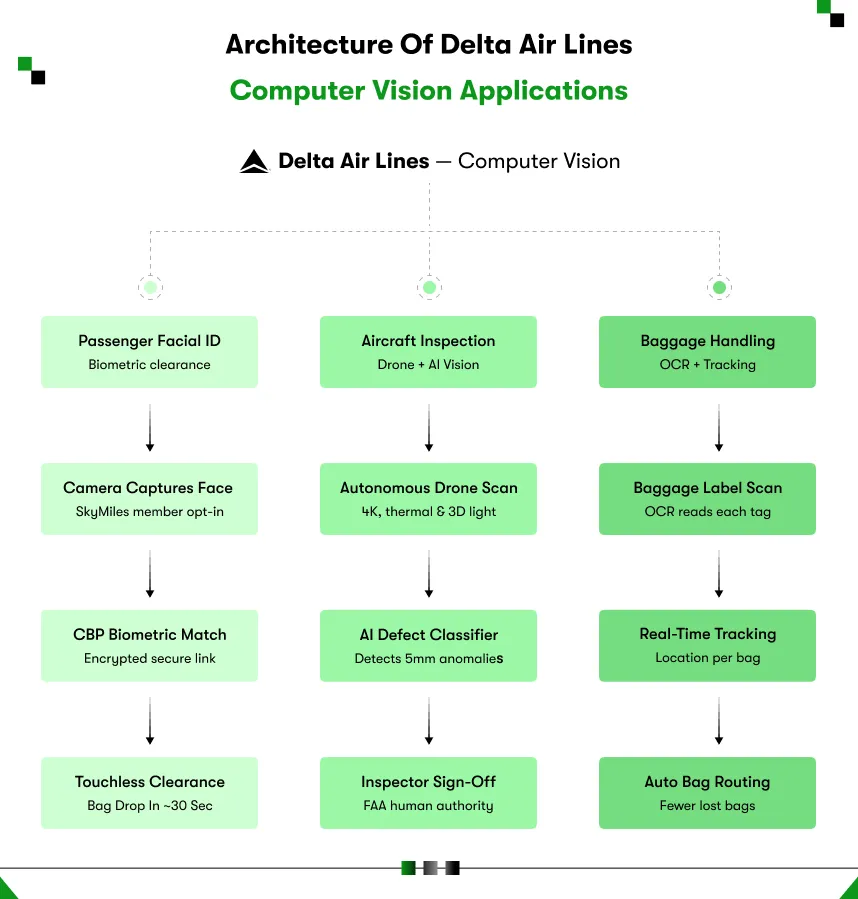
Delta did not build its biometric boarding system alone. Delta relied on technology partners, government databases, and years of iterative testing to get the system right. Your business does not need years to get started, but you do need a development team with the right expertise.
Kody Technolab Ltd is a deep tech company that builds AI-powered robots, computer vision solutions, and scalable automation platforms for businesses across industries. The team at Kody Technolab specializes in building systems that solve the exact problems Delta addressed: real-time identity verification, encrypted data transmission, and seamless integration with existing infrastructure.
What Kody Technolab delivers:
- Custom computer vision model development for facial recognition and biometric verification
- End-to-end system integration with existing databases, access control software, and management tools
- Secure data transmission architecture that meets privacy regulations and compliance standards
- Scalable platforms that grow as your operation grows
- Dedicated computer vision developers with deep expertise in AI and machine learning
Whether you operate in aviation, healthcare, logistics, or hospitality, Kody Technolab can design a computer vision system that fits your specific workflow and scales with your business.
Internal Read: Learn more about Computer Vision Development Company services and explore how to Hire Computer Vision Developers who specialize in biometric systems.
Conclusion
Delta Air Lines did not just automate a process when it built its biometric boarding system. Delta redesigned the entire passenger experience around speed, security, and convenience.
Computer vision in Delta Air Lines made this possible by replacing slow, manual ID checks with real-time facial matching that works at a 97% accuracy rate. The results are clear: nine minutes saved per flight, 2.3 million passengers processed in four months at a single airport, and 72% of passengers who prefer this method over traditional boarding.
The technology is proven. The data is public. The applications stretch well beyond aviation.
If your business manages people, access points, or identity verification at scale, computer vision can solve the same problems. Kody Technolab builds the AI and computer vision systems that power transformations like this across industries.
Ready to explore what a biometric system could do for your operations? Talk to Our Experts or Explore Our Computer Vision Development Services

Frequently Asked Questions
How does computer vision work in Delta Air Lines’ biometric boarding?
Delta Air Lines uses computer vision to capture a live facial image at the boarding gate. The system encrypts the image, sends it to CBP, and matches it against a pre-built passenger photo gallery in real time. The entire process takes seconds and requires no boarding pass or physical ID.
Key steps in the process:
- Passenger opts in through the Fly Delta app before the flight
- CBP builds an individual photo gallery for each passenger from passport and visa records
- The camera captures a live image at the gate
- System encrypts and sends the image to CBP for 1:1 matching
- CBP returns a pass or no-pass signal to Delta’s gate system
Is Delta Air Lines’ biometric boarding safe for passenger privacy?
Yes. Delta Air Lines does not store or retain any biometric data after the verification process ends. The system encrypts and de-identifies each image before transmission. Participation is also completely voluntary, so passengers can opt out at any time without disruption.
How accurate is Delta Air Lines’ facial recognition boarding?
CBP reports a facial match accuracy of over 97% for Delta’s biometric boarding system. If the system does not find a match, a staff member manually verifies the passenger’s passport. Virtually no passengers face boarding denial from a no-match result.
Which airports currently use Delta Air Lines’ biometric boarding?
Delta Air Lines operates biometric boarding at the following airports:
- Atlanta Hartsfield-Jackson (ATL)
- Detroit Metropolitan Airport (DTW)
- New York JFK (JFK)
- Los Angeles International (LAX)
- Boston Logan (BOS)
- Minneapolis-Saint Paul (MSP)
- Salt Lake City (SLC)
- Portland International (PDX)
Can businesses outside aviation implement a similar biometric system?
Yes. The same computer vision pipeline that powers Delta’s biometric boarding applies to hospitals, hotels, stadiums, railways, and manufacturing facilities. The core requirements are a camera at the checkpoint, an identity database, and a trained computer vision model. A privacy-first architecture also removes the biggest regulatory barrier to adoption.
How much time does biometric boarding save compared to traditional boarding?
Biometric boarding saves approximately two seconds per passenger compared to traditional boarding. For a widebody aircraft, this adds up to nine minutes saved per boarding session. Across hundreds of daily flights, the operational savings become significant.









 Contact Information